Nansen Crypto: Smart Money and AI Onchain Trading
Nansen spent years as the dashboard serious traders paid up to $999 a month to use. The whole pitch was visibility: watch what the smart wallets are doing before the crowd catches on. Then the company tore that model up. The Nansen crypto product most people meet in 2026 is no longer just a place to look at charts. It is an app that shows you the signal and then offers to place the trade for you, in the same conversation.
That is a big swing for an analytics company, and it deserves a clear-eyed look. This guide explains what Nansen actually does, how its Smart Money labels work, what the pivot to AI onchain trading really means, what it costs now, and where it falls short. I will be honest about the limits too, because the marketing will not be.
What Nansen Is and How It Works Onchain
Strip away the branding and Nansen's real product is not charts. It is names. Public blockchains record every transaction against an address, but an address is just a string of characters. Nansen's job is to put a human-readable label on it, so that "0x3f…" becomes "Binance hot wallet" or "a fund that bought early." The company says it now has more than 500 million labeled addresses, and that labeling is the foundation everything else sits on.
Nansen was founded in 2019 in Singapore by Alex Svanevik, Lars Bakke Krogvig, and Evgeny Medvedev. Svanevik, a data scientist by background, still runs it as CEO. The platform reads onchain data across dozens of chains, more than 30 through its API, and turns it into something a normal person can scan: who holds a token, where money is flowing, which wallets just woke up after a year asleep.
The labels themselves come from a mix of sources. Some are obvious from how an address behaves on-chain, such as a contract that only ever processes swaps. Others are pieced together from public tags, exchange deposit patterns, and Nansen's own research team. The accuracy of that work is the entire moat. A wrong label does not just mislead one chart; it poisons every Smart Money signal built on top of it.
The reason this matters is simple. Onchain analytics only becomes useful when the raw data is tagged. A spreadsheet of anonymous addresses tells you nothing. A feed that says "three funds you respect just bought this token" tells you something. Whether that something is worth acting on is a separate question, and we will get to it.
How Smart Money and Wallet Labels Work
Smart Money is the feature Nansen is famous for, and it sounds more magical than it is. It is a filter sitting on top of the labels. Nansen tags a curated set of wallets it considers worth watching, then lets you see what that cohort is doing in aggregate. The edge and the catch both live in how those labels are drawn.
What Smart Money labels track
The label system sorts wallets into buckets: centralized exchanges, smart contracts, funds, and high-performing traders. Smart Money is the last group, a hand-picked set of addresses with a track record. A wallet earns the tag by behavior over time, things like consistent profit, early entries into tokens that later ran, or a history of funding from other respected wallets. That curation is also the weakness. Smart Money is whatever Nansen decides it is, and a wallet that was sharp last cycle can keep its halo long after the trader behind it has gone cold. Nansen offers its deepest Smart Money coverage on eight chains, including Ethereum, Solana, Base, BNB Chain, Arbitrum, Polygon, Avalanche, and Optimism. If a wallet you are tracking is on a chain outside that core set, the data thins out fast.
Token and wallet dashboards
Drill into any token and Nansen shows you the order behind the price: which labeled wallets are buying, which are dumping, how concentrated the holders are, and a rough risk read on the contract. You can follow a single wallet and monitor its real-time profit and loss across an entire portfolio, or compare a token's holder base against the Smart Money cohort. For an active trader, this is the part that earns the subscription. It answers a question a price chart cannot: who is on the other side of this trade.
From signal to trend
Stack enough wallet activity together and individual moves become a trend. When a dozen Smart Money wallets rotate into the same token in a day, that shows up as a signal. The honest caveat is that this is lagging data, not a crystal ball. You are seeing the buy after it cleared the chain. Sometimes that is early enough to matter. Often the move is already priced in by the time you read it.
Nansen AI and Agentic Onchain Trading
Here is the real story of the last two years. Nansen stopped being a place you go to research and started being a place you go to trade. The company's own line says it best: signal to execution, all from the same conversation. The dashboard grew a trade button.
From dashboard to execution
In the new app, the research and the trade live in one place. Nansen runs non-custodial, meaning you keep your keys through an embedded wallet rather than handing coins to the company. It supports spot trading and perpetual contracts, leaning on Hyperliquid for perps, and routes orders through aggregators like Jupiter, OKX, and LI.FI to chase a better price. The point is to kill the old workflow where you spotted something in one tab and scrambled to act on it in another.
Agentic AI trading and fees
The AI layer is what Nansen calls agentic trading. You describe what you want in plain language, something like "show me tokens Smart Money bought in the last hour on Base," and the agent surfaces the data and insights, then executes the order directly. Nansen opened this to all users in January 2026, starting on Solana and Base. The trades are not free: the published structure is a 0.25 percent fee on the free tier and 0.10 percent for paying users. That is the trade-off for the convenience, and over enough volume it adds up.
It is worth pausing on what "the agent can execute" means. You are letting software act on an interpretation of your words against live market data, and the gap between what you meant and what it does is where money gets lost. The convenience is real, but so is the new failure mode. An agent that misreads "sell half" is a more expensive mistake than a chart that simply showed you the wrong number.
The app, points and the NSN token
All of this now lives in a proper mobile app for iOS and Android, not just a browser tab. Nansen has also wrapped its product in the usual crypto incentive layer: a points program and an NSN token with staking rewards meant to keep active users engaged. Treat the token rewards as a loyalty mechanic, not a reason to use the tool.
Nansen Pricing: From $999 to $49 a Month
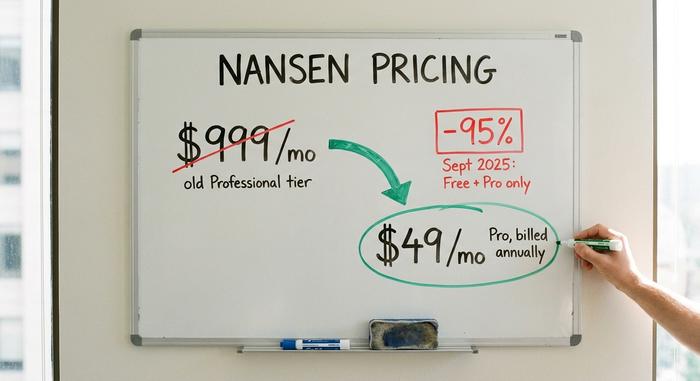
The most honest signal about Nansen's business is its own price chart. For years the top "Professional" tier ran north of $999 a month, aimed squarely at funds. In September 2025 the company gutted that, collapsing everything into a free plan plus a single paid "Pro" tier. The change reads less like a discount and more like a fight to stay relevant as cheaper rivals piled in.
| Plan | Price | Best for |
|---|---|---|
| Free | $0 (limited credits) | Trying Smart Money, casual lookups |
| Pro (annual) | $49 / month | Active traders who want full data |
| Pro (monthly) | $69 / month | Short-term or trial users |
The free tier hands you a small allowance of credits to sample the product, which run out quickly if you actually use it. For most people deciding whether Nansen is worth it, the real question is whether $49 a month of onchain data changes how you trade. If you trade rarely, it will not.

Who Owns Nansen and Who Should Use It
Nansen is privately held and still run by its founders. It raised a $75 million Series B in December 2021 at a $750 million valuation, in a round led by Accel with Andreessen Horowitz, Tiger Global, and Singapore's GIC also writing checks. Total funding sits around $88 million across three rounds.
What you do not see after 2021 is another raise. In May 2023 the company cut about 30 percent of its staff, with management saying it still had years of runway. None of that is unusual for a crypto startup that boomed in 2021 and then met a bear market, but it is worth knowing. A $750 million paper valuation from the last cycle is not the same as a company growing into it.
So who is this for? Active onchain traders who already move real size and want to see wallet flows benefit most. Funds and researchers use it for the same reason. It is worth noting how different that buyer is from the one compliance firms chase: where a Chainalysis sells surveillance to governments and banks, Nansen sells signal to the trader trying to front-run the next move. Same raw blockchain data, opposite customer. If you buy Bitcoin once a quarter and hold, Nansen is overkill, and the free tier will tell you that within a week.
Nansen vs Arkham, Dune and Glassnode
Nansen does not operate alone. The broader crypto analytics market was valued at roughly $3 billion in 2025 and is forecast to grow at about 26 percent a year through the early 2030s, which is why every tool in the space is racing to differentiate. The onchain-analytics corner splits less by features than by the user each tool is built for. Pick by who you are, not by the longest feature list.
| Tool | Core strength | Built for | Rough cost |
|---|---|---|---|
| Nansen | Smart Money labels + AI trading | Active onchain traders | $49/mo Pro |
| Arkham | Address intel, intel-to-earn, ARKM token | Investigators, traders | Free + token |
| Dune | Custom SQL dashboards | Developers, analysts | Free + paid |
| Glassnode | Bitcoin and macro metrics | Long-term investors | Paid tiers |
Arkham leans into deanonymizing entities and even pays bounties for intel, and it has a traded token. Dune is the choice if you can write SQL and want to build your own dashboards. Glassnode is where you go for Bitcoin and high-level market metrics rather than wallet-by-wallet detail. Nansen's wedge is the labeled Smart Money plus, now, the ability to act on it without leaving the app.
Is Nansen Good for Crypto? The Limits
Here is the part the reviews skip. Smart Money is lagging data, so copying a wallet is not a strategy; by the time you mirror a trade, the person you are copying may already be selling it to you. Tracking flows is not the same as making money from them. The new AI trading layer is genuinely convenient, but it bolts execution risk and per-trade fees onto what used to be a pure research tool. And there is no audited, public record proving that Nansen users beat the market. "Winners copy winners" is a slogan, not a result. Useful tool, not a money machine.
What Nansen Says About Onchain Data
Nansen is a bet that onchain transparency eventually turns into normal consumer software, the way stock data did decades ago. The labels made the chain readable; the AI layer is the next battleground, and every analytics firm is now racing toward the same trade button. The open question is whether putting that button right next to the signal makes traders smarter or just faster to lose. If you try Nansen, start on the free tier, watch the Smart Money for a few weeks, and decide whether the data actually changes a single thing you would have done anyway.