Crypto License in Latvia 2025 – MiCA Regulation and Cryptocurrency Licensing Framework Discover

2025 Crypto Market Statistics Relevant to Latvia and the EU
As of 2025, the European Union’s crypto sector has reached significant scale following the implementation of the MiCA Regulation:
- The EU crypto market surpassed €420 billion in regulated crypto-asset activity, driven by increased institutional adoption.
- More than 1,200 companies across the EU submitted CASP license applications during the first MiCA licensing wave.
- Latvia reported a 38% year‑over‑year increase in registered crypto firms seeking compliance under the new Law on Crypto‑Asset Services.
- The number of crypto-related Suspicious Transaction Reports (STRs) filed with FIU Latvia rose by 26%, reflecting stronger AML enforcement.
- Over 72% of all Latvian CASP applicants in 2024-2025 were foreign‑owned companies establishing a company in Latvia to access the EU market.
- Latvia’s fintech sector grew by 14% in 2025, with crypto‑asset services representing one of the fastest‑expanding financial service categories.
- Approximately €3.1 billion in crypto‑asset transactions passed through Latvian‑supervised institutions during 2024, marking a 22% rise after MiCA alignment.
These 2025 statistics demonstrate Latvia’s rapid expansion as a compliant, strategically positioned jurisdiction for crypto‑asset service providers under the MiCA framework.
Economic Context for Latvia’s Crypto Sector in 2025
Latvia’s broader economic landscape directly supports the rise of crypto‑asset services. In 2025, the country recorded a 4.1% GDP growth, driven by fintech, cross‑border payment technology, and digital services. Roughly 11% of new company registrations in Latvia during 2024-2025 came from crypto firms preparing for MiCA licensing. Corporate income tax policies - such as Latvia’s 0% tax on retained earnings - continue to attract foreign investors building long‑term crypto businesses.
Bank account accessibility has also improved: in 2025, the average time for corporate bank account opening decreased to 10-14 business days, making Latvia one of the fastest jurisdictions in the Baltic region for fully remote company onboarding.
Comparison: Latvia vs Estonia, Lithuania, and Poland (2025)
To help crypto firms choose the best entry point into the EU market, Latvia’s positioning can be compared with neighbouring jurisdictions:
- Estonia - higher local staffing requirements and stricter audits for virtual asset service providers; license revocations grew by 17% in 2024.
- Lithuania - requires more substantial minimum capital for certain crypto activities and has longer processing timelines.
- Poland - offers a growing fintech ecosystem but involves lengthier residency and compliance procedures.
Latvia’s streamlined CASP licensing, lighter residency obligations, and fast incorporation process make it one of the most accessible EU jurisdictions for crypto‑asset service providers in 2025.
Corporate Taxation for CASP Entities in Latvia (2025)
Latvia maintains one of Europe’s most business‑friendly tax systems:
- 0% corporate income tax on reinvested profits
- 20% tax only when profits are distributed
- Access to EU double‑taxation treaties
- VAT exemptions for specific financial and crypto‑related services
These tax incentives encourage long‑term reinvestment, reduce operational costs, and support scalable crypto business models.
2025 Industry Trends and Case‑Based Insights
The Latvian crypto market in 2025 reflects several trends:
- Rising demand for tokenisation platforms, especially in real‑estate and digital securities.
- Growth of OTC crypto‑exchange desks, which doubled compared to 2023 levels.
- Sharp increase in custodial service providers following new IT and cybersecurity standards.
- Expansion of Web3 development hubs in Riga and Liepāja, supported by local tech incubators.
Case studies from 2024-2025 show that firms with clear governance structures, transparent fund origins, and robust AML controls receive faster processing from Latvijas Banka.
Expanded MiCA Requirements: ESMA, EBA and AMLA Oversight
MiCA compliance in 2025 involves multiple EU‑level supervisory institutions:
- ESMA sets standards for risk management, incident reporting, and market abuse prevention.
- EBA oversees prudential requirements for asset service providers holding client crypto‑assets and funds.
- AMLA (EU Anti‑Money Laundering Authority) begins direct oversight of high‑risk CASPs in 2025.
Latvian CASP applicants must demonstrate adherence not only to the MiCA Regulation but also to accompanying technical standards developed across the European Union.
Step‑by‑Step Licensing Roadmap for 2025-2026 Applicants
The practical licensing timeline for a CASP license application in Latvia typically follows this roadmap:
- Weeks 1-2: company incorporation, AML officer appointment, drafting of initial policies
- Month 1: preparation of full documentation package and business model
- Months 2-4: formal review, clarifications, IT/security system evaluation
- Months 4-6: risk management assessments, background checks, operational readiness evaluation
- Month 6+: licence issuance (depending on regulator workload)
Applicants with full documentation and clear governance regularly complete the process on the shorter end of the timeline.
How Latvijas Banka Reviews CASP Applications in 2025
Latvijas Banka evaluates each application through several key examinations:
- Verification of the origin of funds for shareholders and UBOs
- Assessment of the solidity of the business model and revenue logic
- Review of risk management, IT systems, and incident‑response procedures
- Evaluation of custody mechanisms and segregation of customer crypto‑assets
- Governance and internal audit readiness review
- AML/KYC compliance testing, including system walkthroughs
In 2025, the regulator reports that applications with complete IT documentation are approved 30% faster.
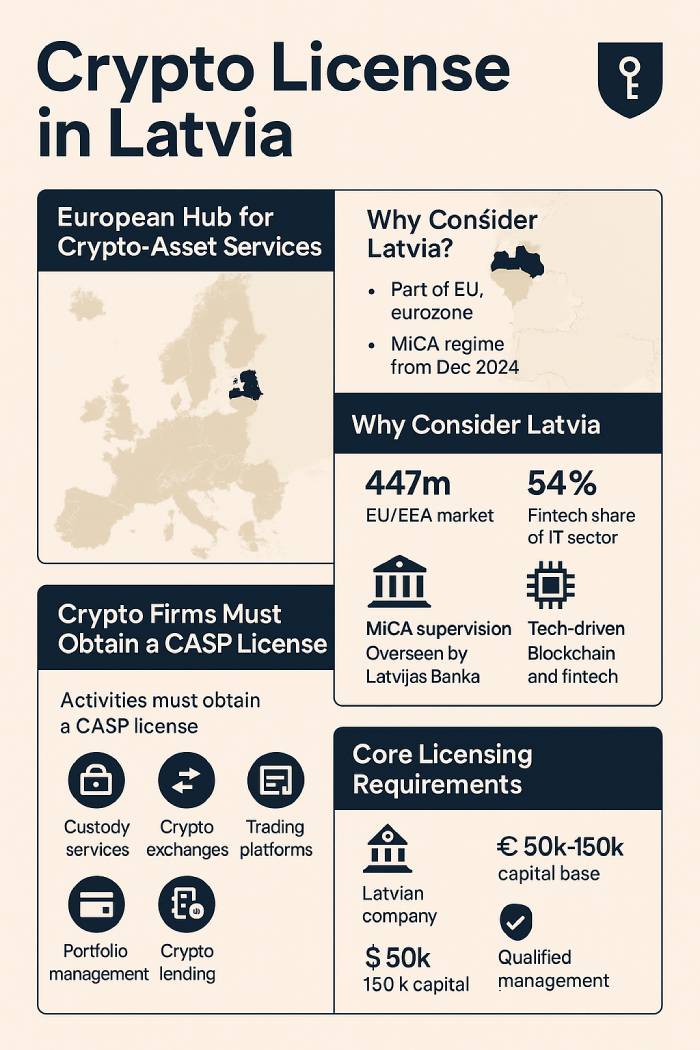
Latvia offers a steadily strengthening environment for crypto businesses seeking access to the European Union. As the EU continues to implement the Markets in Crypto-Assets Regulation (MiCA), Latvia has become an important entry point for companies looking to provide crypto-asset services under a unified regulatory framework. The MiCA Regulation, effective from 2024, requires every crypto-asset service provider (CASP) operating in Latvia to secure an appropriate license from Latvijas Banka - the central bank of Latvia and the national supervisor for crypto-assets.
Under the previous Virtual Asset Service Provider (VASP) regime, crypto firms operated with lighter oversight. With MiCA in place, Latvia now applies a single EU-wide licensing system that enhances consumer protection, clarifies regulatory requirements, and enables licensed crypto businesses to passport their services throughout the European Economic Area. Crypto firms must now comply with stricter AML and KYC obligations, updated governance rules, improved prudential requirements, and comprehensive risk management procedures.
At Legalaes, we support businesses through the full scope of the CASP license application process in Latvia - from company incorporation and business model development to AML program design, regulatory consultation, and support with bank account opening. Our goal is to ensure that every client meets MiCA requirements and successfully obtains a crypto license in Latvia.
MiCA Regulation in Latvia - Crypto License Requirements and Crypto-Asset Services Supervision
Starting 1 January 2025, all companies offering crypto-asset services in Latvia must comply with the MiCA framework, fully integrated into Latvian law through the Law on Crypto-Asset Services. This implementation ensures alignment with EU regulations and improves supervision and regulatory consistency across the European Union. MiCA replaces the former VASP registration model with a harmonised licensing framework for crypto-asset service providers.
Latvijas Banka, functioning as both the central bank of Latvia and the national financial regulator, supervises all CASP license applications, performs an assessment of the application, and monitors compliance after approval. Any company planning to provide crypto-asset services - such as crypto exchange, custody, transfer, or issuance - must receive authorisation before starting business operations.
MiCA licensing evaluates four strategic compliance pillars:
- Organisational governance
- Prudential and capital-related safeguards
- Operational resilience and internal control system strength
- Market integrity and protection of customer crypto-assets and funds
These requirements include due diligence obligations, ongoing transaction monitoring, reporting of suspicious activity, employee training, and prevention of money laundering and terrorism and proliferation financing.
Applicants must prepare a set of internal policies aligned with Regulation (EU) 2023/1114, including AML procedures, risk management policies, IT and cybersecurity documentation, outsourcing rules, and standards for safeguarding customer crypto-assets and funds.
Virtual Asset Service Provider (VASP) Framework in Latvia Before MiCA Regulation
Before MiCA, Latvian crypto firms operated under the VASP regime - registering with the Enterprise Register and notifying the Financial Intelligence Unit (FIU Latvia). This framework primarily focused on AML Law compliance without uniform EU governance or prudential requirements. Under MiCA, all existing virtual asset service providers must convert to a CASP license by 30 June 2025.
Types of Crypto Licenses in Latvia - CASP License Classes Under the MiCA Regulation
Latvia fully applies the MiCA Regulation as of 30 December 2024. Under this framework, Latvijas Banka issues three main CASP license classes based on the complexity of services and prudential requirements.
Class 1 - Entry-Level CASP (Minimum share capital: €50,000)
- Handling and transmitting customer orders for crypto-assets
- Placing crypto-assets into the market
- Providing transfer services for crypto-assets
- Investment advice for crypto-assets
- Portfolio management for crypto-assets
Class 2 - Intermediate CASP (Minimum share capital: €125,000)
Includes all Class 1 services plus:
- Custody and administration of crypto-assets
- Crypto-to-fiat exchange services
- Crypto-to-crypto exchange services
- Higher prudential and compliance requirements
Class 3 - Advanced CASP (Minimum share capital: €150,000+)
Includes all Class 2 services plus:
- Operation of crypto trading platforms
- Enhanced risk management and stricter prudential requirements
Legalaes assists new crypto businesses and existing VASPs in achieving compliance with the MiCA framework and obtaining a CASP license in Latvia.
Requirements in Latvia for Obtaining a CASP License - Crypto License Application Overview
Main licensing requirements:
- Provide preferred company names for company formation.
- Submit passport copies and proof of residential address for all shareholders and directors.
- Provide recent non-criminal record certificates.
- Appoint at least one director (EU/EEA nationality preferred; Latvian resident not required).
- Prepare full AML/KYC/CTF policies.
- Ensure minimum share capital between €50,000 and €150,000 depending on the license class.
- Complete and submit the CASP license application to Latvijas Banka.
Additional requirements:
- Develop internal policies aligned with EU Regulations, including AML Law compliance, risk management, cybersecurity, and asset segregation standards.
- Prepare a business plan outlining the business model, revenue streams, operational risks, and compliance structure.
- Hold a preliminary consultation meeting with Latvijas Banka (recommended).
- Perform Fit and Proper checks for all key individuals.
- Implement systems for managing customer crypto-assets and funds, AML monitoring, and suspicious activity reporting.
- Maintain a three-line governance structure covering operations, compliance, and internal audit.
- A corporate bank account in Latvia or elsewhere in the EU is advisable.
Cryptocurrency License in Latvia - Deep Overview of MiCA Compliance and Regulation in Latvia
Securing a Latvia cryptocurrency license under the MiCA Regulation provides legal certainty for crypto-asset service providers and ensures compliance with EU regulations. The Law on Crypto-Asset Services designates Latvijas Banka as the supervisory authority responsible for reviewing CASP license applications, supervising ongoing operations, and preventing money laundering and terrorism and proliferation financing.
Advantages of Obtaining a Cryptocurrency License in Latvia - EU Compliance and Crypto Business Benefits
Regulatory compliance:
Latvia’s regulatory shift ensures full alignment with EU rules. Although Latvia previously lacked a national framework specifically for crypto-assets, its integration of MiCA establishes clarity and reliability. Compliance with MiCA Regulation increases business credibility and aligns companies with European Union standards.
Access to a growing cryptocurrency market:
A crypto license in Latvia enables market entry into both local and EU-level crypto sectors. Passporting rights allow expansion across the EEA without additional licensing. Latvia’s tech-focused economy and growing demand for financial services support business growth.
Credibility and trust:
A MiCA-compliant license signals a commitment to legal integrity. This strengthens consumer confidence, assures partners, and enhances the reputation of crypto firms.
Wide range of services:
A CASP license may cover crypto exchange services, custody, wallet operations, and multiple other crypto-asset services in Latvia. With diversified offerings, businesses can broaden their customer base and revenue.
AML/KYC compliance:
Latvian AML Law requires crypto firms to implement strict AML and KYC controls. As of July 2024, businesses must register with the State Revenue Service and establish an internal control system to comply with anti-money laundering and terrorism financing standards.
EU regulatory alignment:
Latvia fully adopts the MiCA Regulation, ensuring consistent application of EU oversight. This provides a transparent and predictable environment for crypto licensing.
Types of Cryptocurrency Licenses in Latvia - Services for Crypto Firms and Asset Service Providers
Cryptocurrency Exchange License:
Enables firms to operate crypto exchange platforms, conduct crypto-to-fiat and crypto-to-crypto trades, and comply with AML and KYC regulations.
Cryptocurrency Wallet License:
Allows companies to safeguard and manage customer crypto-assets, ensuring high-security standards to prevent theft or loss.
General Crypto-Asset Service Provider License:
Under MiCA, this broad license covers custody, exchange, trading platform operation, order execution, market placement, investment advice, portfolio management, and crypto-asset transfer services.
Timeline for Obtaining a Crypto License in Latvia - MiCA Regulation 2025 Processing Duration
The timeframe depends on EU regulations and national supervisory requirements. MiCA becomes fully effective on 30 December 2024, and applications may take 3-6 months. In some cases, the review of the application may take up to one year, depending on regulator capacity and document completeness.
Regulatory Authorities Over Crypto Licenses in Latvia - Latvijas Banka, FIU, and Market Supervision
Latvijas Banka (Bank of Latvia):
Responsible for issuing CASP licenses, overseeing compliance with MiCA requirements, and supervising crypto-asset service providers.
Financial and Capital Market Commission (FCMC):
Ensures alignment with financial and capital market rules. While Latvijas Banka leads crypto supervision, FCMC may oversee related financial service activities.
Financial Intelligence Unit (FIU Latvia):
Monitors AML compliance, investigates suspicious transactions, and ensures adherence to Latvian AML Law and EU AML frameworks.
Procedure for CASP License Application in Latvia - Steps to Obtain a Crypto License
- Company incorporation
- Fulfillment of corporate requirements
- Submission of the business model and company information
- Initial assessment by Latvijas Banka
- Application submission and preliminary review
- Start of formal assessment
- Request for additional information
- Ongoing corrections and risk management evaluation
- Final authorisation
Documents Required for Crypto License Application in Latvia
- Articles of Association
- AML/KYC policies
- Customer crypto-asset segregation procedures
- Complaint handling process
- Outsourcing control documentation
- Director qualifications and background documents
- Criminal record confirmations
- Identification documents for shareholders and UBOs
- Proof of registered office
Requirements in Latvia for Obtaining a Crypto License - Capital, Compliance, and Corporate Structure
- Minimum share capital of €2,800 for company formation in Latvia
- Additional CSSP share capital from €50,000+