Understanding Crypto Gas Fees: A Beginner’s Guide to Ethereum

Nobody forgets watching $30 disappear on a cheap NFT mint. If it happens once, the word "gas" stops being jargon and becomes something you pay attention to forever. The good news in 2026 is that the number rarely looks that scary anymore. On April 7, the average Ethereum gas price printed at around 0.052 gwei, one of the quietest readings the network has ever logged. A plain transfer went through for a few cents. Wind back a year on the same chain and the same send could have cost five dollars in the middle of a busy afternoon.
Understanding gas fees stopped being a side quest for crypto users somewhere around the DeFi boom. With roughly 560 million people holding crypto globally, according to Triple-A's 2026 ownership index, the cost of a single transaction is not a niche question. It decides if a DeFi trade is worth opening, whether an NFT mint makes financial sense, and whether a stablecoin transfer can replace a wire. This guide walks through what a gas fee actually is, where it goes, and how the formula has shifted after two big Ethereum upgrades in 2025. It also compares gas fees in crypto across Bitcoin, Solana, BNB Chain, and the Layer 2 networks that now carry most of the day-to-day flow.
What Crypto Gas Fees Are and Why Blockchain Technology Needs Them
A crypto gas fee is the price a user pays to have a cryptocurrency transaction processed on a blockchain network. On the Ethereum network and most chains that borrowed its blueprint, that fee goes to the validator who includes the transaction in a block. The mechanism is part payment, part anti-spam shield, and part traffic signal.
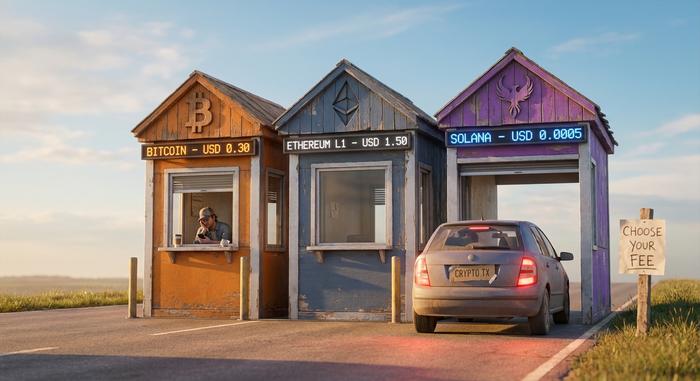
Think of the blockchain as a shared toll road. Every car wants to reach the other side, but the road only fits so many at a time. The toll does two jobs. It pays the people who keep the lanes open, and it forces drivers to decide whether the trip is worth the cost. Without a fee, nothing would stop someone from pushing millions of junk transactions through the network and grinding it to a halt.
This is why every major smart contract blockchain charges a transaction fee in some form. The wording changes from chain to chain. Ethereum and Polygon say "gas fee." Solana and Bitcoin use "transaction fee" or "network fees." The idea is the same. You pay for the computational work your request creates, and validators earn a reward for doing that work honestly.
Blockchain technology relies on this loop. A validator stakes capital, runs a node, and helps process transactions. In exchange, it earns fees and block rewards. If the reward disappears, so does the incentive to secure the network. Gas fees in crypto are not a design flaw. They are the glue that keeps the wider crypto ecosystem alive.
The part that confuses most new users is the volatility. A coffee always costs the same price. A gas fee on Ethereum moves by the minute, and the reason is baked into the way the network prices its own block space.
How Ethereum Gas Fees Work: Gas Price, Gas Limit, Gwei
You need a small vocabulary to read ethereum gas fees without squinting. Four words do most of the work, and they all trace back to ether, the native token of the Ethereum blockchain.
Every fee on the Ethereum mainnet is paid in ether. That stays true even if you are sending a dollar-pegged token like USDC or a wrapped version of bitcoin. The network only knows one currency for gas, and that currency is ether.
Gwei is the denomination everyone actually uses. One gwei equals one billionth of an eth, written 0.000000001 ETH. Ether amounts at the wei level would be full of zeros and painful to read, so wallets and trackers quote gas prices in gwei instead. When you see "12 gwei" on a gas dashboard, that is what a validator wants per unit of gas for your transaction.
Gas itself is a bit abstract. It is the unit of gas the network uses to measure computational work. Sending ether to another wallet consumes 21,000 gas units. A Uniswap swap might burn 150,000. Minting an NFT sits somewhere between 100,000 and 200,000. Every opcode in Ethereum's protocol has a fixed price, and the sum of those opcodes is the gas used by your transaction.
Gas limit sits on top of all this as a safety cap. It is the maximum amount of gas you are willing to pay for. If your transaction hits a bug or loops longer than expected, it fails at the limit and stops, which beats draining your wallet into nothing.
Most older guides boil the formula down to:
```
Gas Fee = Gas Limit × Gas Price
```
That was how fees are calculated before August 2021. Ethereum has since split gas price into two separate pieces, and the next section takes that apart.
Base Fee, Priority Fee, and the Transaction Fee Formula
Ethereum has used a two-part pricing model since the London hard fork on August 5, 2021. Every eth gas fee since then is a base fee plus an optional priority fee, and the two behave very differently.
The base fee is the protocol's reserve price for the current block. It moves on its own after every block, up to 12.5% higher if the previous block was more than half full, and down by the same amount if it was under half. Once your transaction lands, the base fee is burned, permanently removed from supply. So every transaction quietly reduces the eth circulating in the economy.
Priority fee is more of a tip. It goes straight to the validator who confirms your transaction, and it decides how eagerly they pull you out of the queue. On a quiet block, a fraction of a gwei is enough to get picked up in the next slot. On a bad day, nothing under a double-digit tip goes through.
The full transaction fee on Ethereum in 2026, where fees are paid in ether and the base fee is burned, looks like this:
```
Transaction Fee = Gas Used × (Base Fee + Priority Fee)
```
A quick example. You want to send 0.5 ETH to a friend on a quiet afternoon. Gas used is 21,000. Base fee is 4 gwei. You tip 1 gwei. The math works out to 21,000 × (4 + 1) = 105,000 gwei, or 0.000105 ETH. At $3,500 per ether, that is roughly $0.37. Drop the same transfer into a congested NFT mint and the base might jump to 80 gwei plus a 10 gwei tip, dragging the cost past $6. Same formula. Very different inputs.
EIP-1559 was designed to fix three specific problems. Wallet estimates were terrible, the fee market kept turning into an auction, and supply was inflating in a way many holders disliked. The burn has quietly added up. Around 4.6 million ETH has left circulation since the upgrade, worth more than $13 billion at mid-2025 prices. Burn rates have slowed a lot in 2026 with gas so low, but the mechanism still ticks along in the background of every block.
Why Your ETH Gas Fee Changes With Network Congestion
If the formula is fixed, why does the cost swing so wildly? Gas fees fluctuate because the base fee moves with demand. Every block has a target size. When demand for the ethereum block space outstrips that size, the base fee rises until some crypto transaction senders give up and wait. Supply and demand, refreshed every twelve seconds.
Four forces push demand up:
- Popular launches. NFT mints, memecoin launches, and airdrops draw a flood of wallets trying to transact at the same second. A single viral drop can push gas above 80 gwei for hours.
- DeFi spikes. Sudden liquidations during a market crash force liquidators and traders to compete for block space.
- Stablecoin flows. Heavy USDT and USDC movement across exchanges pulls gas up during US market hours.
- Bridge and L2 settlement bursts. Layer 2 rollups batch their proofs back to Ethereum L1. When several rollups settle at once, base fee ticks higher.
Off-peak hours tell the opposite story. Historical data from 2025 showed transactions between 02:00 and 08:00 UTC were roughly 35% to 60% cheaper than peak windows on the same day. Weekends are consistently cheaper than weekdays. That pattern survived even after the Dencun and Pectra upgrades, because L1 users are still concentrated around US and European business hours.
The trade-off is straightforward. Until Layer 2 rollups fully absorb routine activity, Ethereum users on mainnet keep feeling price pressure during peak times. That absorption is now well underway. The Ethereum base layer in early 2026 looks quieter than it has since 2019.
Gas Used, Gas Costs, and the Ethereum Virtual Machine
Every action on Ethereum has a price tag, and the price tag lives inside the Ethereum Virtual Machine, the piece of software that actually runs smart contracts on the network. The EVM tags every opcode with a gas cost. A basic arithmetic step might be 3 gas. A storage write comes in at 20,000. Deploying a brand-new contract can burn 32,000 gas before a single line of your code runs.
Gas used is just the sum of the opcodes a transaction triggers. Complex moves require more gas for the same reason a long recipe needs more ingredients than a sandwich. Sending eth shifts one balance. A Uniswap swap reads pool contracts, rebalances token reserves in a few slots, emits events, and sometimes pings an oracle. More work, more gas units, higher fee. No magic there.
The table below shows what that tax looks like in practice, using live 2026 data and an ether price around $3,500.
| Action | Gas Used | Cost at 4 gwei | Cost at 50 gwei |
|---|---|---|---|
| Simple ETH transfer | 21,000 | ~$0.29 | ~$3.68 |
| ERC-20 token transfer | 45,000–65,000 | ~$0.63–$0.91 | ~$7.88–$11.38 |
| Uniswap V3 swap | 150,000 | ~$2.10 | ~$26.25 |
| NFT mint (average) | 150,000 | ~$2.10 | ~$26.25 |
| Deploying a smart contract | 500,000+ | ~$7.00+ | ~$87.50+ |
Two things jump out. First, the gap between simple and complex transactions is real. A contract deployment can cost 20 to 30 times more than a transfer at the same gas price. Second, the 50 gwei column looks painful, but in 2026 that only shows up during rare spikes. The 4 gwei column is closer to the everyday experience since Fusaka.
Less gas means lower fees. That is why so much DeFi engineering since 2022 has focused on reducing gas per trade: tighter storage patterns, batched operations, and rollups that shift execution off the base chain.
Gas Fees in Crypto: Bitcoin vs Ethereum vs Solana
Ethereum is not the only place crypto users transact. The broader crypto space now spans dozens of chains, each with its own fee model and its own trade-offs. The table below puts the main networks side by side at April 2026 prices.
| Chain | Typical fee (2026) | Speed | Notes |
|---|---|---|---|
| Bitcoin | ~$0.30 median, ~$0.82 avg | ~10 min | Miner fees in sats per vByte; no smart contracts |
| Ethereum L1 | $0.25–$1.50 transfer, $2–10 swap | ~12 sec | EIP-1559 base fee + tip |
| Arbitrum / Base / Optimism (L2s) | $0.001–$0.05 | 1–2 sec | Settled to Ethereum via blobs |
| Solana | $0.00025–$0.002 per tx | Sub-second | 5,000 lamport base fee per signature |
| BNB Smart Chain (Binance) | $0.05–$0.50 | ~3 sec | Binance Smart Chain is EVM compatible and much cheaper than Ethereum |
| TRON (USDT transfer) | $1.50–$3.74 | ~3 sec | Energy model; rentable energy can cut cost |
| Polygon PoS | $0.0075–$0.05 | ~2 sec | EVM chain sidechain-style |
| Avalanche C-chain | $0.01–$0.25 | ~2 sec | EVM compatible |
Bitcoin and ethereum are distant cousins on fees. Bitcoin charges by the byte, priced in satoshis per vByte, with no smart contracts to worry about. Ethereum charges for computational work, priced in gwei, and the work varies wildly from a plain transfer to a DeFi swap. The two blockchains together hold more than half of the total crypto market cap, yet they behave nothing alike under stress.
Solana's low fees are a different beast. The base fee is fixed at 5,000 lamports per signature, which works out to about $0.0005 when sol is near $100. Tens of thousands of transactions can clear every second because Solana processes them in parallel rather than in a single sequential queue. The trade-off is less decentralization and the occasional outage. TRON takes another route entirely with a concept called energy, which lets frequent users effectively get bandwidth for free or close to it. A 2025 TRON governance change called Proposal #104 cut the energy unit price from 210 to 100 sun on August 29, 2025, halving USDT TRC-20 transfer costs overnight. That is partly why TRON still carries so much USDT volume in emerging markets.
If you are moving a stablecoin across borders in 2026, Ethereum L1 is almost never the cheapest option. A Layer 2, Solana, or Polygon will beat it for cost every time. But for long-term DeFi reserves, Ethereum still dominates by a wide margin, with roughly $55 billion to $57 billion in total value locked compared to about $6 billion on Solana, per DeFiLlama's April 2026 readings. The right network is whichever one fits the specific job.

Layer 2 Rollups: Use Eth Gas Without the Pain
Layer 2 rollups are the reason ethereum gas fees feel so different in 2026. A rollup is a separate chain that executes transactions off the mainnet, then posts a compressed proof back to Ethereum. Users get Ethereum-grade security without Ethereum-level fees.
Two upgrades made rollups dramatically cheaper:
- Dencun (March 2024) introduced proto-danksharding via EIP-4844. It gave rollups a new place to post their data called "blobs," separate from calldata. Early measurements showed rollup costs fell 90% to 99%. Starknet reported cost reductions of roughly 95 to 100 times.
- Pectra (May 7, 2025) and Fusaka (December 3, 2025) raised blob targets step by step. After Fusaka's BPO forks, typical L2 transactions dropped from around $0.50 in late 2025 to $0.20 to $0.30 within weeks.
The result is a big shift in where activity happens. In early 2026, L2s process around 2 million transactions per day combined, against roughly 1 million on the Ethereum mainnet. Arbitrum hit a single-day record of 5.95 million transactions in September 2025. Base alone has cleared more than 3 billion transactions year-to-date in 2026, compared to about 473 million on L1. Base, Arbitrum, and Optimism together handle close to 90% of L2 transaction volume.
L2Beat, the primary tracker for rollup data, lists the ecosystem like this at the time of writing:
| Rollup | TVL (April 2026) | Notable detail |
|---|---|---|
| Arbitrum One | ~$15.2B | Hit a daily record 5.95M transactions in September 2025 |
| Base | ~$10.9B | Fastest growing; >60% of L2 tx volume |
| Optimism | ~$9.36B | Home of the Superchain framework |
| zkSync Era | ~$760M | Zero-knowledge rollup; down from the 2024 peak |
| Starknet | sub-$500M | Separate VM, biggest cost cut post-blobs |
| Polygon zkEVM | ~$120M | Sequencer sunset announced for July 2026 |
If you plan to interact with DeFi regularly, a Layer 2 is where you go. Your wallet connects the same way. MetaMask, Rabby, Trust Wallet, and most other tools support all major rollups. The eth gas you pay is orders of magnitude smaller, and Ethereum's security still sits underneath.
Using a Gas Tracker to Time Your Transactions Right
A gas tracker is a dashboard that shows the current gas price on a network, usually with a short historical chart and estimated transaction costs. Trackers help users decide when to submit a transaction and how aggressive the tip should be.
These gas fee trackers are the most used options in 2026, each giving a gas price in real time:
- Etherscan Gas Tracker (etherscan.io/gastracker). Updates every 15 seconds. Shows low, average, and high estimates in gwei, estimated fees for common actions, and a heatmap of the last 24 hours. Most wallets pull their suggested fee from here or a similar feed.
- Blocknative Gas Platform (blocknative.com/gas-platform). Uses mempool data and machine-learning prediction. Updates every five seconds, with browser extensions for Chrome and Firefox. More useful for traders who submit time-sensitive transactions.
- L2Beat Activity Page. For anyone planning to use Arbitrum, Base, or Optimism, L2Beat shows cost per rollup and lets you pick the cheapest one at the moment.
- BaseScan and Arbiscan have their own gas tracker pages that mirror Etherscan's approach for L2 users.
For most beginners, a quick check of Etherscan's gas information before submitting is enough. If gas is above 20 gwei and the transaction is not urgent, wait. If it is below 5 gwei, you are in the low-fee window that has dominated 2025 and 2026. The rhythm is simple: U.S. market hours tend to run hot, weekends tend to run cold, and late European nights are often the cheapest windows of all.
How to Lower Your ETH Gas Fee in Practice Today
Most advice on how to reduce gas fees overcomplicates a simple decision tree. In 2026, there are four levers worth using to reduce fees on a transaction on Ethereum or any L2.
1. Move to a Layer 2. This is the single biggest change you can make. Bridging ETH or stablecoins once to Base, Arbitrum, or Optimism unlocks fees a hundred times smaller than the mainnet. The saved gas usually pays off the bridging fee within a handful of transactions.
2. Time the transaction. If the action is not urgent, open a gas tracker and wait for the base fee to drop. On-chain activity follows a weekly and daily rhythm. Weekends, early European mornings, and late Asian nights are consistently cheaper.
3. Adjust the priority fee for lower transaction fees. MetaMask, Rabby, and Trust Wallet all let you choose between Low, Market, and Aggressive modes. Dropping from Aggressive to Market can cut the cost of gas fees by half on calmer days. Just avoid going so low that the transaction sits in the mempool forever.
4. Batch or use smart accounts. The Pectra upgrade activated EIP-7702, which lets a regular wallet temporarily behave like a smart account. That means batched operations, gas sponsorship, and paying fees in USDC or USDT rather than ether. Several wallets, including Ambire and Trust Wallet, already support this today. Others are rolling out support through 2026.
Some popular tactics are less useful than they used to be. Manually lowering the gas limit can save a few cents on a transfer but causes failed transactions on anything more complex. Trying to beat the market with a custom lower gas price rarely works when block time is twelve seconds. The biggest gains in 2026 come from picking the right network, not shaving gwei. Every day, millions of transactions on a blockchain settle cheaply because their owners chose the right rail, not because they tuned the gas slider.
One more tip that is often overlooked: if a transaction is stuck, do not send a second one. Use your wallet's "Speed up" feature to replace the pending transaction with the same nonce and a higher priority fee. Rabby and MetaMask both support this. It costs less than re-sending and avoids the risk of two transactions clearing in sequence.
Historical Gas Trends After the Ethereum 2.0 Merge
Today's fee numbers make more sense with a bit of context. Historical gas on Ethereum breaks into four reasonably clear eras.
From 2017 to 2019, the early years, gas was measured in tens of gwei and nobody outside of developer Twitter really cared. Transactions cost pennies even when they did something complicated.
Then came 2020 and 2021. DeFi Summer arrived, the NFT boom followed, and suddenly the network was a bidding war. This is the era that gave people the memory of "$200 mints." Gas above 500 gwei on bad days. Ether prices climbing at the same time, so dollar fees looked even worse than they were.
September 2022 brought the Merge. Ethereum switched from proof of work to proof of stake, which is the move older coverage still calls Ethereum 2.0 or just the merge. Did it lower fees? Not directly. It cut the network's energy draw by more than 99% and changed who earned the fees, but block space stayed the same size it had always been.
The current era started in 2024 and is still running. Dencun kicked it off by giving rollups cheap blob storage. Pectra turned the blob dials up. Fusaka finished the job late last year. The average ethereum gas price in April 2026 sits roughly 90% below where it was a year earlier, and L2 fees dropped even more. On January 17, 2026, the network processed 2.6 million transactions in a single day with no fee spike, a throughput that would have set 2021 on fire.
One pattern ties the whole timeline together. Technical upgrades move the floor on gas fees. Quiet markets help, but they do not explain why fees stay calm through busy weeks. That is structural. After close to a decade of worrying about block space, Ethereum finally has room to breathe.
Reading old articles with this in mind saves a lot of confusion. A 2022 guide warning you about $100 mints is not lying. It is describing an Ethereum that no longer exists. The post-Fusaka version costs cents for most things, most of the time.
The Bottom Line on Crypto Gas Fees
Crypto gas fees are what you pay for using infrastructure nobody owns. The fee lands with the validator, blocks spam at the same time, and decides which transactions get priority in the next block. Ethereum gave the model its vocabulary: gwei, gas limit, and the EIP-1559 split between base fee and priority fee. Other chains copied parts of it, adapted other parts, or threw the whole thing out. That is why the same action can cost a cent on Solana, five cents on Base, and a few dollars on Ethereum L1 in the same hour.
If you are new to this in 2026, the playbook is shorter than it looks. Keep a little ether in your crypto wallet for things that really need Ethereum mainnet. Move routine activity to a Layer 2 like Base, Arbitrum, or Optimism. For stablecoin payments across borders, Solana, Polygon, or TRON with rented energy usually win on cost. Glance at a gas tracker before anything expensive. Tweak the priority fee instead of guessing at raw gas prices. Most of the savings come from picking the right chain, not from squeezing a few gwei.
Gas fees will keep moving. That is what a blockchain priced by supply and demand for block space does for a living. But the worst mainnet pain sits firmly in the pre-rollup era, and the next billion users of the ethereum ecosystem will probably never see 100 gwei unless they go digging for it on purpose.