Mempool explained: how Bitcoin’s transaction waiting room works and why it matters
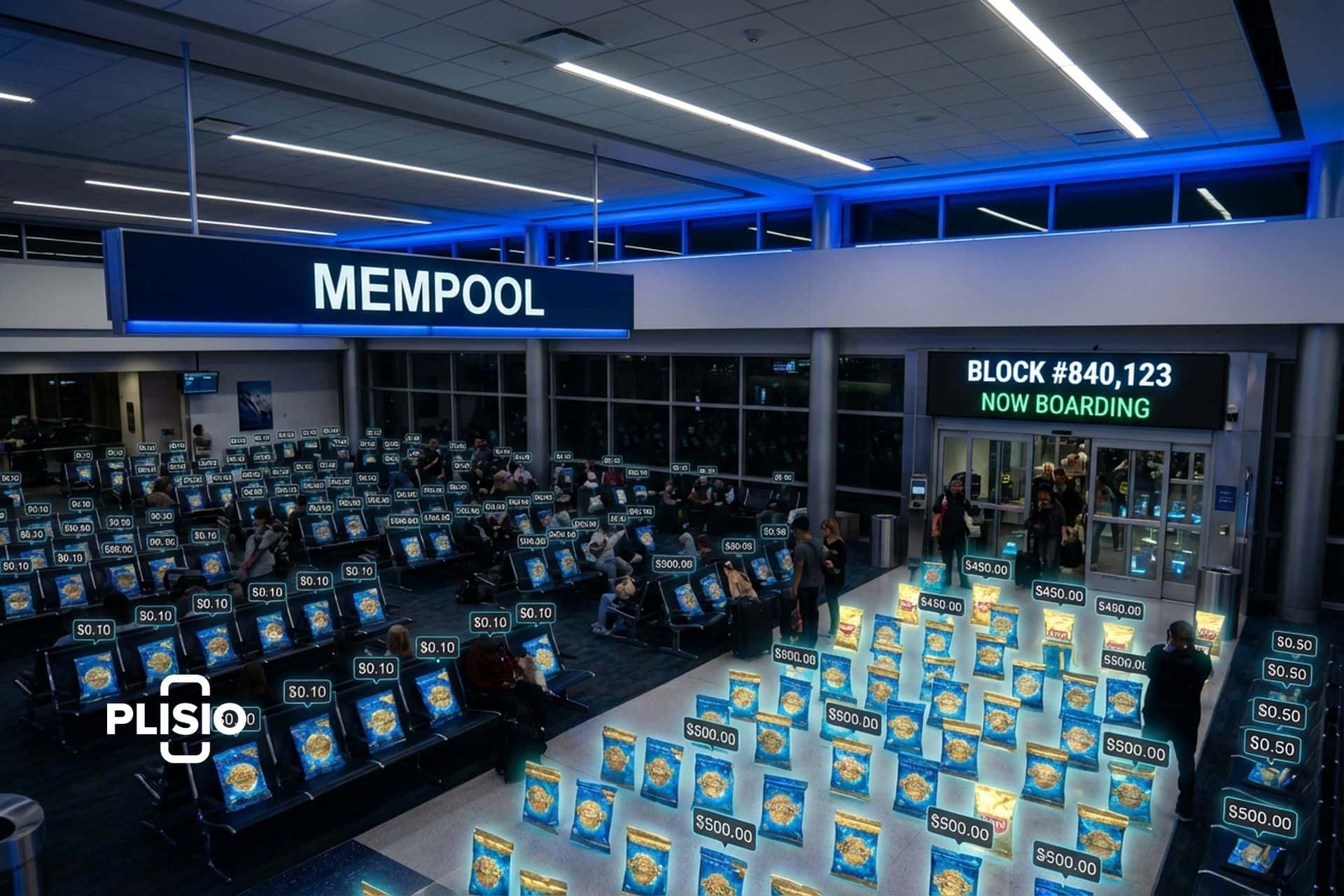
Every time you send bitcoin, your transaction doesn't go directly to the blockchain. It goes to the mempool first. Think of the mempool as a crowded waiting room at an airport: every transaction lines up, and miners decide who boards the next flight based on how much they're willing to pay. Passengers with first-class tickets (high fees) get on immediately. Economy passengers (low fees) wait, sometimes for hours.
Understanding the mempool gives you a real edge. You can time your transactions to avoid peak fees, figure out why a payment is stuck, and use tools like mempool.space to see exactly what's happening on the Bitcoin network in real time. Most crypto users treat transaction fees as a random number their wallet suggests. Once you understand the mempool, that randomness disappears.
What the mempool actually is
Mempool is short for "memory pool." When you sign a bitcoin transaction and broadcast it from your wallet, it doesn't immediately land in a block on the blockchain. Instead, it enters a holding area maintained by every node on the Bitcoin network. Each node, and there are tens of thousands of them worldwide, keeps its own copy of unconfirmed transactions in local memory.
Here's a detail that surprises most people: there is no single mempool. There's no central server where all pending transactions sit. Each Bitcoin node maintains its own independent mempool. When your wallet broadcasts a transaction, it reaches one node first, which validates it and forwards it to its peers. Within seconds, the transaction propagates across the network, appearing in thousands of individual mempools. Most nodes will have roughly the same set of unconfirmed transactions, but small differences exist because of network latency and node configuration.
A typical Bitcoin mempool holds between 5,000 and 150,000 unconfirmed transactions at any given moment, depending on network activity. During calm periods, the mempool shrinks as blocks confirm transactions faster than new ones arrive. During congestion events like Ordinals mints or BRC-20 token waves, it balloons. In December 2023, the mempool exceeded 400,000 pending transactions, and simple BTC transfers cost over $30 in fees.
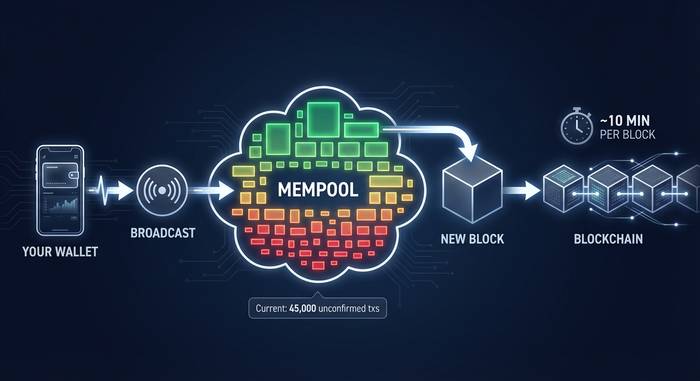
How a transaction moves through the mempool
Here's the full lifecycle of a bitcoin transaction, from your wallet to the blockchain:
Step 1: You hit "send." Your wallet constructs a transaction with inputs (where the bitcoin comes from), outputs (where it goes), and a fee. It signs the transaction with your private key.
Step 2: Broadcast. The signed transaction goes to the nearest Bitcoin node your wallet is connected to.
Step 3: Validation. That node checks: Is the signature valid? Do the inputs actually exist and haven't been spent already? Is the fee above the node's minimum relay threshold? If everything checks out, the node adds the transaction to its local mempool.
Step 4: Propagation. The node forwards the transaction to its peers. They validate it independently and add it to their mempools too. Within 5-15 seconds, the transaction is sitting in mempools across the entire network.
Step 5: Waiting. Your transaction sits in the mempool until a miner picks it up. Miners build blocks by selecting transactions from their mempool, and they almost always pick the ones with the highest fee per byte first. Your transaction competes with every other pending transaction for limited block space.
Step 6: Confirmation. A miner includes your transaction in a new block. The block gets added to the blockchain. Nodes remove your transaction from their mempools. You see your first confirmation in about 10 minutes on average.
Step 7: Settlement. Each subsequent block adds another confirmation. Most exchanges and services consider 3-6 confirmations as final, which takes roughly 30-60 minutes.
| Stage | What happens | Time |
|---|---|---|
| Broadcast | Wallet sends to first node | Instant |
| Propagation | Spreads across network | 5-15 seconds |
| Mempool wait | Competes on fee per byte | Minutes to days |
| First confirmation | Included in a block | ~10 minutes (average) |
| Full settlement | 3-6 confirmations | 30-60 minutes |
How the mempool determines your transaction fee
This is the practical part. The mempool is basically a live auction for block space, and understanding how it works saves you real money.
Every Bitcoin block can hold roughly 1-4 MB of transaction data (with SegWit, the effective capacity is closer to 2-4 MB in "weight units"). A new block arrives every ~10 minutes. If the mempool has 100 MB of pending transactions and each block clears about 2 MB, you'd need 50 blocks (about 8 hours) to clear the backlog, assuming no new transactions come in. Of course, new transactions arrive constantly, so the real dynamic is a constantly shifting queue.
Miners always pick the most profitable transactions first. They rank pending transactions by fee rate, measured in satoshis per virtual byte (sat/vB). A transaction offering 50 sat/vB will get confirmed before one offering 5 sat/vB, regardless of the dollar amount being sent.
Real-time fee estimation by mempool state:
| Mempool size | Next-block fee | 30-min confirmation | 1-hour confirmation |
|---|---|---|---|
| Under 10 MB | 1-3 sat/vB | 1-3 sat/vB | 1 sat/vB |
| 10-30 MB | 5-15 sat/vB | 3-8 sat/vB | 2-5 sat/vB |
| 30-80 MB | 15-50 sat/vB | 10-30 sat/vB | 5-15 sat/vB |
| 80-200 MB | 50-150 sat/vB | 30-80 sat/vB | 20-50 sat/vB |
| 200+ MB | 150+ sat/vB | Unpredictable | May take hours/days |
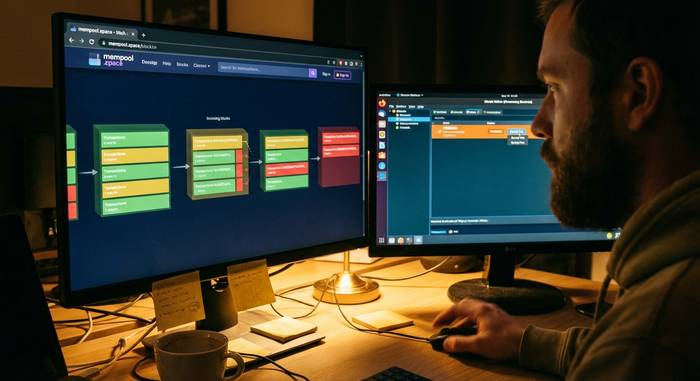
The best tool for monitoring this in real time is mempool.space, an open-source Bitcoin explorer that visualizes unconfirmed transactions, fee rates, and block history. The interface shows incoming blocks as they fill with transactions, color-coded by fee tier. You can literally watch your transaction move from the waiting queue into a block.
Why the mempool gets congested
Several things flood the mempool:
Price volatility. When BTC moves sharply up or down, trading activity spikes. More exchange deposits and withdrawals mean more on-chain transactions competing for block space.
Ordinals and BRC-20 tokens. Since early 2023, people have been inscribing data (images, tokens, text) directly onto the Bitcoin blockchain using the Ordinals protocol. Each inscription is a transaction that competes for block space. During Ordinals peaks, the mempool has swelled to record sizes, and simple BTC transfers got priced out.
Halving speculation. Around halving events, on-chain activity tends to increase as traders position and miners adjust operations.
Consolidation transactions. Miners and exchanges periodically consolidate many small UTXOs into fewer large ones. These batch transactions are big in byte size and can fill significant block space.
Block variance. Sometimes blocks come 20-30 minutes apart instead of the average 10. During those gaps, the mempool swells because no transactions are being confirmed at all. People panic, think the network is broken, and start submitting higher fees. That makes the congestion worse. Then a batch of quick blocks comes through and clears the backlog. Mining difficulty adjusts every 2,016 blocks to target 10-minute intervals, but individual block spacing is genuinely random. I've seen three blocks in four minutes followed by a 45-minute gap. It's variance, not a bug.
Spam and dust attacks. Occasionally, someone floods the mempool with thousands of tiny transactions designed to clog the network and drive fees up. This happened multiple times in 2023-2024. The transactions are economically irrational (the attacker pays fees with no financial return), which suggests the motivation is either ideological or competitive. Some of these attacks were attributed to people pushing the "big blocks" narrative or trying to make a point about Bitcoin's scalability limitations.
How to use mempool data to your advantage
Knowing how to read the mempool turns you from a passive user into someone who pays minimal fees and rarely gets stuck.
Time your transactions. Mempool activity follows daily and weekly patterns. US nighttime and weekends tend to have lower mempool sizes. If you're not in a rush, check mempool.space before sending and wait for a quiet window. The difference between sending during congestion and sending during a lull can be 10x in fee cost.
Set your fee manually. Most good wallets (Electrum, Sparrow, BlueWallet) let you set fees in sat/vB. Instead of accepting the wallet's "recommended" fee blindly, look at the current mempool depth and pick a rate that lands in the next 1-3 blocks. You often save 30-50% compared to the wallet's default estimate.
Use RBF as insurance. Always enable Replace-by-Fee when you send bitcoin. If the mempool fills up after you broadcast and your fee is suddenly too low, RBF lets you bump it. Without RBF, a stuck transaction is much harder to fix.
Watch for purge thresholds. Bitcoin nodes drop transactions below a minimum fee rate (typically 1 sat/vB) and purge old transactions after about 14 days. If your transaction's fee is above the minimum but below the current confirmation rate, it'll eventually either confirm during a quiet period or get dropped and return to your wallet.
Monitor BTC block explorer data. Beyond mempool.space, tools like Blockchair and Blockchain.com show mempool statistics, average fee trends, and historical congestion patterns. Blockchair's "mempool" tab shows the distribution of pending transactions by fee rate, helping you see exactly where your transaction sits in the queue.
The mempool on Ethereum and other blockchains
Bitcoin's mempool gets the most attention, but every blockchain has some version of the same concept. Ethereum's mempool (sometimes called the "txpool") works similarly: unconfirmed transactions wait until validators include them in blocks. The difference is that Ethereum's EIP-1559 fee system automatically adjusts the base fee each block, making fees more predictable than Bitcoin's pure auction model.
Ethereum's mempool also has a darker side: MEV (Maximal Extractable Value) bots scan the mempool for profitable opportunities. They can front-run your trade, sandwich your swap, or back-run your large order. This is why tools like Flashbots Protect exist, to route transactions through private mempools where MEV bots can't see them.
On faster chains like Solana, the mempool barely matters because blocks arrive every 400 milliseconds and transaction backlogs rarely build up. On Bitcoin, where blocks come every 10 minutes, the mempool is a defining feature of the user experience.
The mempool is also where you can see the Bitcoin network at its most transparent. Every pending transaction is public. You can watch in real time as miners assemble blocks, selecting the most profitable transactions first. Tools like mempool.space turn this data into a visual experience that's almost meditative: colored blocks filling with transaction rectangles, each sized proportionally to their fee. If you've never watched a Bitcoin block being built in real time, try it once. It makes the whole system feel tangible in a way that reading about it never does.
The mempool and the future of Bitcoin scalability
The mempool congestion problem isn't going away. As Bitcoin adoption grows, more people compete for the same ~2-4 MB of block space every 10 minutes. The Lightning Network helps by moving small payments off-chain, but channel opens and closes still require on-chain transactions. Ordinals and BRC-20 tokens added a completely new type of demand for block space that didn't exist before 2023.
Some proposals aim to reduce mempool pressure: Schnorr signatures make multi-signature transactions smaller, SegWit already increased effective block size, and future upgrades could optimize data encoding further. But the fundamental constraint remains: Bitcoin deliberately limits block space to keep the network decentralized (bigger blocks mean higher hardware requirements for node operators).
This is why the mempool won't disappear even if Bitcoin scales. It's a feature, not a bug. The fee market that emerges from mempool competition is what pays miners and secures the network. Without it, especially as block rewards trend toward zero with each halving, Bitcoin's security model would need a completely different funding mechanism. The mempool, messy and frustrating as it can be during congestion, is part of what keeps the system honest.