Crypto for dummies: a no-nonsense guide to understanding cryptocurrency
I've spent years explaining crypto to people who think they're too late, too stupid, or too busy to get it. None of those things are true. The problem isn't that cryptocurrency is impossibly complex. The problem is that most explanations are written by people who forgot what it's like to not know what "blockchain" means, and they bury simple ideas under 47 layers of jargon.
So let's fix that. Right now, about 560 million people around the world own cryptocurrency, according to Triple-A's 2026 data. That's roughly one in ten internet users. Total market value: around $2.5 trillion. About 30% of American adults have bought crypto at some point. This isn't a niche hobby anymore. But if you're part of the 90% who hasn't jumped in yet, or if you bought some bitcoin and have no idea what you actually bought, this guide is for you.
No "blockchain is revolutionizing everything." No "let me delve into the intricacies." Just how this stuff actually works, explained like a normal human talking to another normal human.

What cryptocurrency is (and isn't)
The word "cryptocurrency" is just two ideas stuck together: "cryptography" (the science of keeping information secret) and "currency" (money). It's digital money that uses encryption to work and doesn't need a bank to function.
Regular money, the kind in your bank account, is called fiat currency. Dollars, euros, yen. Governments issue it, central banks control how much exists, and banks manage the plumbing of moving it around. When you swipe a credit card at Target, a chain of institutions processes that $47 purchase: your bank, Visa or Mastercard, the merchant's bank, maybe a payment processor. Each takes a tiny cut.
Cryptocurrency cuts out that chain. You send money directly to another person through a network of computers that verify the transaction. No bank. No Visa. No payment processor. The record of every transaction is public, stored on a blockchain (I'll explain that next), and can't be altered once it's written.
Bitcoin started this whole thing in 2009. A person or group using the name Satoshi Nakamoto published a nine-page paper and released software that created a working system for peer-to-peer digital cash. Nobody knows who Satoshi is. They stopped posting online in 2010 and have never moved their estimated 1 million BTC (worth about $68 billion today).
Since then, over 15,000 different cryptocurrencies have been created. Some are genuinely useful. Most are garbage. A few, like Ethereum, Solana, and various stablecoins, have built real ecosystems. The crypto market as a whole is worth about $2.5 trillion in April 2026, with bitcoin alone accounting for roughly 57% of that at $1.4 trillion.
The blockchain explained without the buzzwords
Every crypto explainer eventually hits the word "blockchain," and that's usually where eyes glaze over. Let me try a different approach.
Imagine a Google Spreadsheet that nobody owns, everybody can read, and nobody can edit after the fact. That's basically a blockchain. When someone sends bitcoin to someone else, that transaction gets recorded in the spreadsheet. Thousands of computers around the world keep identical copies. If anyone tries to tamper with a past entry, their version won't match everyone else's and gets rejected.
Transactions are grouped into "blocks." Each block connects to the previous one. A chain of blocks. Blockchain. The name is literally that straightforward.
What makes this powerful isn't the technology by itself, it's what it replaces. Normally, you trust your bank to keep accurate records of your money. A blockchain replaces that trust with math. Instead of Wells Fargo promising "yes, you have $5,000 in your account," a network of computers independently verifies it. Nobody can cook the books because there's no single book to cook.
Bitcoin's blockchain has been running since January 3, 2009, and has never been successfully hacked at the protocol level. Individual exchanges and wallets have been hacked (FTX, Mt. Gox, etc.), but the underlying ledger itself has remained intact for 17 years. That track record is why people trust it.
Bitcoin: the one everyone knows about
Bitcoin (BTC) was the first cryptocurrency and is still the biggest by far. Here's the cheat sheet:
| Bitcoin fact | Detail |
|---|---|
| Created by | Satoshi Nakamoto (2009) |
| How it works | Proof-of-work (miners solve puzzles) |
| Max supply | 21 million coins, ever |
| Mined so far | ~19.8 million |
| Current price | ~$68,500 (Apr 2026) |
| All-time high | $126,198 (Oct 2025) |
| Bitcoin millionaires | ~192,000 globally |
Bitcoin runs on proof-of-work. Miners, which are really just warehouses full of specialized computers, race to solve a math puzzle roughly every 10 minutes. The winner adds the next batch of transactions to the blockchain and earns freshly created bitcoin as a reward. Currently 3.125 BTC per block.
The thing that makes bitcoin different from dollars is the hard cap: 21 million coins, and that number can never change. The US Federal Reserve can print unlimited dollars. Bitcoin's code makes that impossible. Every four years, the mining reward gets cut in half (called a "halving"), slowing the rate of new supply. The last bitcoin won't be mined until around 2140.
People argue endlessly about whether bitcoin is "digital gold," a working currency, a speculative tech asset, or some weird combination of all three. I've changed my mind on this about four times over the years. Right now, I think it's best understood as a bet on a monetary system that doesn't require trusting any specific government. Whether that appeals to you depends on how much faith you place in central banks. Someone in Switzerland probably feels differently about that than someone in Argentina watching the peso lose half its value in a year.
One thing that trips up newcomers: you don't need to buy a whole bitcoin. You can buy $20 worth and own a tiny fraction. Bitcoin is divisible to eight decimal places. The smallest unit, one hundred-millionth of a bitcoin, is called a satoshi. At today's prices, one satoshi costs about $0.000685. So even $10 gets you real bitcoin.
Beyond bitcoin: ethereum, altcoins, and stablecoins
Bitcoin proved digital money works without banks. Ethereum, launched in 2015 by a 21-year-old named Vitalik Buterin, asked a bigger question: what if you could run programs on a blockchain, not just payments?
Ethereum introduced smart contracts: code that executes automatically when conditions are met. Think of it as a vending machine on the internet. You put in the right inputs, the machine does its thing, no human involved. This enabled an explosion of applications: lending platforms, decentralized exchanges, games, NFTs, insurance products. The entire category of "DeFi" (decentralized finance) is mostly built on Ethereum.
Everything that isn't bitcoin is called an "altcoin." There are thousands. Most won't survive the next five years. But a few categories matter:
| Category | Examples | Why they exist |
|---|---|---|
| Smart contract platforms | Ethereum, Solana, Cardano | Run decentralized apps and contracts |
| Stablecoins | USDT, USDC, DAI | Pegged to $1, used for trading and payments |
| DeFi tokens | Aave, Uniswap, Curve | Power lending, trading, and yield |
| Layer-2 chains | Polygon, Arbitrum, Base | Make Ethereum faster and cheaper |
| Meme coins | Dogecoin, Shiba Inu | Started as jokes. Some gained real value. Most didn't. |
Stablecoins deserve your attention even if nothing else in crypto interests you. Their combined market cap exceeds $210 billion. In 2025, annual stablecoin transaction volume hit $33 trillion. Put that number next to Visa's $14 trillion and let it sink in. A technology that most people still think of as "internet funny money" is processing more than double the transaction volume of the world's biggest payment network.
For people in countries where the local currency is falling apart, stablecoins are the most immediately useful product crypto has ever created. A farmer in Nigeria can receive USDC on his phone, hold it without a bank account, and spend it or convert it to naira at any time. That's not a theoretical use case; it's happening right now. Whether you care about DeFi or NFTs or meme coins, this particular application of cryptocurrency is genuinely changing lives in places most Western crypto commentary never talks about.
How to actually buy cryptocurrency
If you want to own some crypto, here's the practical version with no filler:
Step 1: Pick an exchange. Coinbase is the simplest for Americans. Binance is the largest globally. Kraken is solid too. Sign up and verify your identity (required by law).
Step 2: Connect a bank account or card. Deposit dollars (or your local currency). Bank transfers are usually free; card payments sometimes carry a 1-3% fee.
Step 3: Buy crypto. Type "BTC" for bitcoin or "ETH" for ethereum. Enter the dollar amount. You don't need to buy a whole coin. You can buy $20 of bitcoin and own 0.00029 BTC. Hit confirm.
Step 4: Decide where to keep it. You can leave it on the exchange (easy, but you're trusting the exchange not to get hacked or go bankrupt). Or transfer it to a personal wallet. MetaMask and Trust Wallet are free software options. Ledger and Trezor are hardware devices that store your keys offline. For anything over $1,000, I'd recommend a hardware wallet.
Trading fees on major exchanges run 0.1% to 1.5%. This catches a lot of first-timers off guard. Coinbase's simple buying interface charges noticeably more than their Advanced trading mode, which uses the exact same account but presents a different interface. I've watched friends pay $5 in fees on a $100 purchase because they used the simple mode. Switching to Advanced saves real money, and it's not actually harder once you've done it twice. Always check the fee line before hitting confirm.
Wallets, keys, and the golden rule of crypto
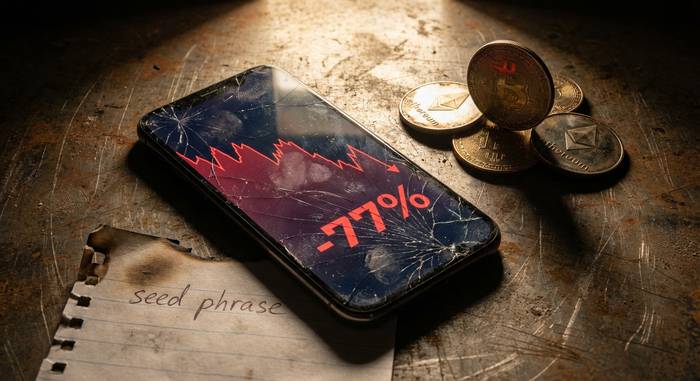
Your crypto wallet doesn't hold your coins. Your coins live on the blockchain. What the wallet holds is your private key, a long string of characters that proves ownership and lets you send your crypto. Lose the key, lose the crypto. There's no "forgot password" link. This is the single most important thing to understand about cryptocurrency.
Hot wallets (apps on your phone: MetaMask, Phantom, Trust Wallet) are connected to the internet and convenient for everyday use. Cold wallets (physical devices from Ledger or Trezor) keep keys offline and are safer for larger amounts.
"Not your keys, not your coins." People repeat this phrase so often it sounds like a bumper sticker, but the FTX disaster proved exactly why it matters. In November 2022, FTX collapsed and $8 billion in customer deposits vanished because the exchange, not the individual users, controlled the private keys. People who'd moved their coins off FTX to personal cold wallets before the collapse lost nothing. People who trusted the exchange lost everything.
I personally keep most of my crypto on a Ledger device. It costs about $80, which feels like cheap insurance when you consider the alternative. The slight inconvenience of plugging in a USB device when I want to make a transaction is a trade I'll take over trusting any company to hold my keys.
The risks nobody should ignore
I'm not going to pretend crypto is safe. It isn't. Here's what can go wrong:
Bitcoin dropped 77% from $69,000 to $16,000 in 2022. Many altcoins dropped 95%+. If you can't stomach that kind of volatility, this market isn't for you.
Scams are everywhere. Fake airdrops, phishing emails, Ponzi schemes dressed up as DeFi protocols, celebrity endorsement scams on YouTube. The rule that never fails: if someone promises guaranteed returns, they're stealing from you.
Regulation is uncertain. The US SEC has classified some tokens as securities, sued major exchanges, and created confusion that affects everyone. Laws vary by country and change frequently.
If you send crypto to the wrong address, it's gone forever. There is no chargeback, no dispute process, no bank to call. One wrong digit in an address, and your money disappears into a wallet nobody controls.
All that said: roughly 70 million Americans own crypto in 2026, according to Security.org's annual report. Spot bitcoin ETFs now trade on the NYSE and Nasdaq alongside regular stocks. Visa, PayPal, and Stripe process crypto transactions. Large institutions like BlackRock manage bitcoin funds worth tens of billions. The problems are real. But so is the adoption, and it keeps growing year over year regardless of what the critics say. The question isn't "will crypto survive?" anymore. It already did. The question is what role it plays in the financial system going forward, and whether you want to participate in figuring that out or sit on the sidelines watching.