Dogecoin Mining in 2026: How to Mine DOGE with Scrypt ASICs
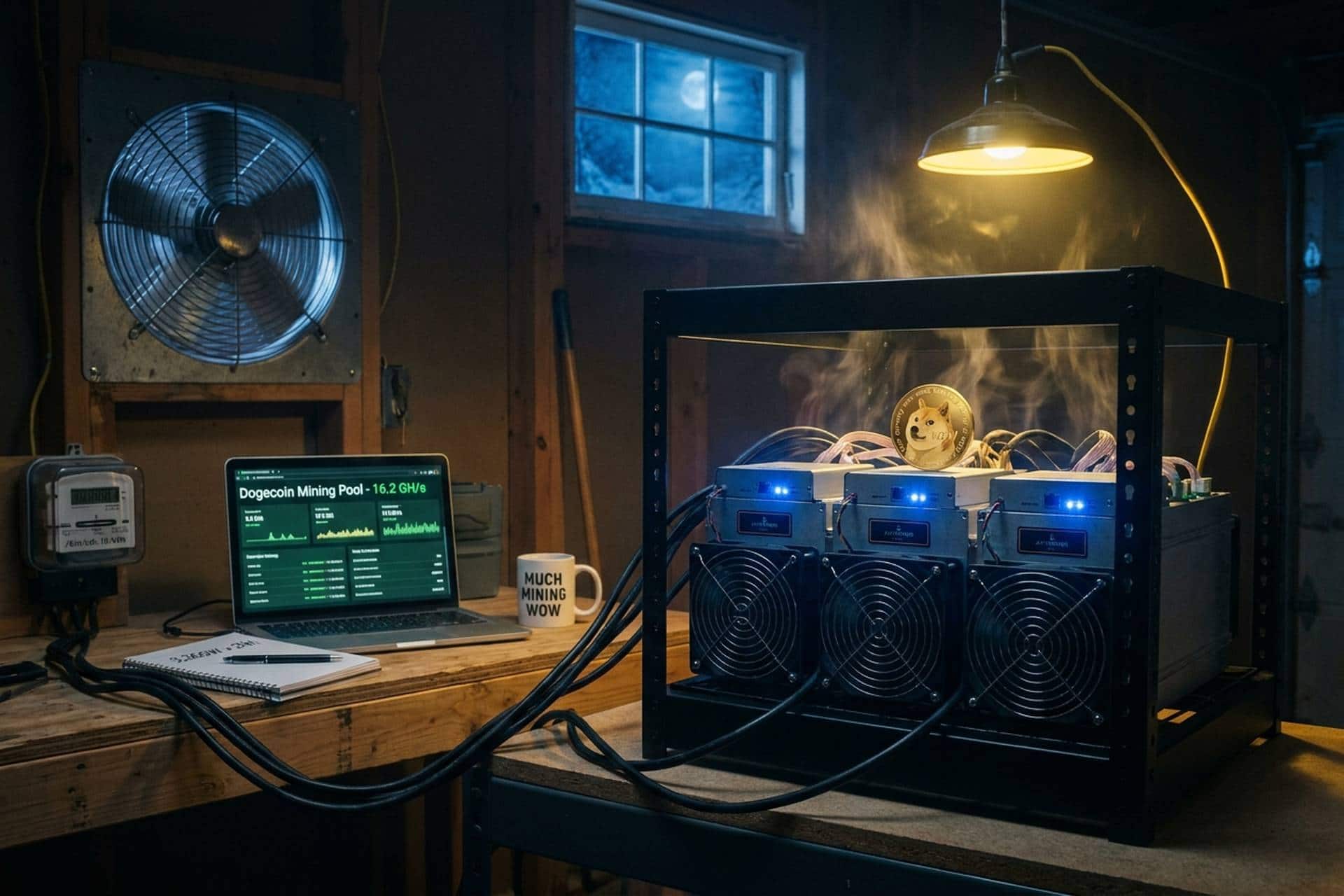
Is Dogecoin mining still worth it in 2026? Short answer. Only if your electricity is cheap. Your hardware is recent. And you have a realistic view of what the cryptocurrency might be worth in a year or two. Everything else is detail. On April 17, 2026, the Dogecoin network runs at about 3.26 PH/s of Scrypt mining hashrate, pays 10,000 dogecoins per minute as mining profits, and the coin trades near $0.10. That combination puts most home miners squarely inside a break-even band. A single Bitmain Antminer L9 loses roughly $1.09 per day if you consume power at $0.10 per kilowatt-hour. Below $0.048 per kWh the same rig makes money.
If those numbers feel off, keep reading. The full picture is more interesting than any calculator tells you. Merged mining with Litecoin quietly adds 5-8% revenue on every DOGE block. The Qubic network launched a Dogecoin parallel-mining integration on April 1, 2026, which is breathing life back into retired Antminer L3+ rigs. And three spot DOGE ETFs now trade on US exchanges. None of that existed when most mining guides were written.
This guide covers all of it. What Dogecoin mining actually is. How Scrypt and merged mining with Litecoin work. Which ASIC miner options make sense. Which pools to join. How to estimate profitability. Where the risks hide. Beginner-friendly where it has to be, specific where it counts.
What is dogecoin mining? A beginner's primer
Dogecoin mining. DOGE mining. Doge mining. Same thing, three names the community uses interchangeably. The process itself: specialized computers racing to add a new block of transactions to the Dogecoin blockchain. Think of it as a lottery. One that runs every 60 seconds. Win the round, get 10,000 DOGE plus whatever transaction fees are in that block. Lose, your rig grabs the next ticket without complaining.
Under the hood, miners run a proof of work algorithm (PoW). Their hardware tries trillions of numeric guesses per second, shoves each input into the Scrypt hash function, and waits for one that lands below a moving target. Each miner also runs as a node, meaning it validates transactions while it hashes. Scrypt is the hash function. Litecoin uses the same one. Because the protocol wants one valid block per minute no matter how much hashrate is online, difficulty adjusts every 240 blocks, which is roughly every four hours.
Now the quirk. Unlike Bitcoin, Dogecoin's block reward never halves. Every winning block has paid exactly 10,000 DOGE since January 2015. Every one will keep paying that, unless somebody changes the code. That math adds up to about 5.256 billion new dogecoins entering supply each year. Roughly 3.6% annual inflation on today's 154-billion-coin base. No fixed cap. Fixed inflow.
Scrypt algorithm and merged mining with Litecoin
Scrypt was built in 2009 to be memory-hard. Meaning the hashing process needs CPU time AND a lot of fast RAM per calculation. Back in 2014 that barrier made commodity GPUs a reasonable choice for Scrypt mining. By 2016 specialized ASIC miner hardware arrived and wiped GPU profitability off the map. Today? CPU and GPU mining of Dogecoin is technically possible. Economically pointless. Plug an RTX 4080 into DOGE and you will burn more electricity in a week than the coin produces in a year.
Merged mining is the quieter story. Maybe the more important one. Since August 2014, Dogecoin has supported AuxPoW (auxiliary proof of work), which lets one miner submit the same hash to both the Dogecoin and Litecoin networks simultaneously. Strong enough hash to meet either network's target? Counts as a valid block on that chain. Strong enough for both? The miner collects both rewards.
Today, more than 70% of Dogecoin's hashrate is merged-mined with Litecoin. The correlation between the two networks sits around 0.95. For individual miners, this is a 5-8% free revenue bump: your rig was going to hash anyway, and now the same shares pay out in two coins instead of one. You can also sometimes convert LTC into BTC straight from the pool dashboard, which some operators prefer over holding smaller altcoins. For the ecosystem, the two chains share a combined security budget that would be prohibitive for either to fund alone.
Mining hardware: ASIC miner options for DOGE
In 2026, profitable Dogecoin mining means one thing. ASIC miner hardware. Full stop. Scrypt ASIC boxes are power-dense, noisy, and expensive. They also out-hash any GPU rig by three to four orders of magnitude per watt. That is the whole game.
Here are the current workhorses. Prices shift by region, seller, and whether the unit is new or used.
| Mining machine | Hashrate | Power draw | Efficiency | Approx. price |
|---|---|---|---|---|
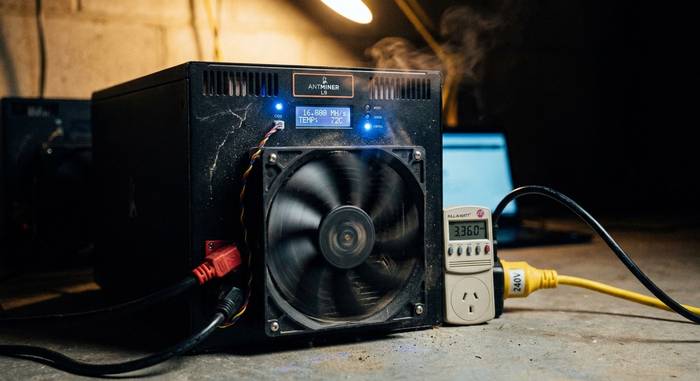
| Bitmain Antminer L9 | 16 GH/s | 3,360W | 0.21 J/MH | $14,400 new |
| Bitmain Antminer L7 | 9.5 GH/s | 3,425W | 0.36 J/MH | $720-$6,660 |
| Goldshell Mini Doge III Plus | 735 MH/s | 500W | 0.68 J/MH | $1,100 |
| Goldshell LT6 | 3.35 GH/s | 3,200W | 0.96 J/MH | $5,499 MSRP |
| Innosilicon A6+ LTCMaster | 2.2 GH/s | 2,100W | 0.95 J/MH | used only |
The Antminer L9 is the efficiency leader and the default choice for new farm deployments as of 2026. The Antminer L7 is the used-market bargain: its efficiency looks worse on paper, but the secondhand price can be a third of what a new L9 costs. The Goldshell Mini Doge III Plus is designed for home use, runs on 500W from a normal wall socket, sits on your desk, and connects via wi-fi rather than only Ethernet. Hobbyist rig, not a farm unit.
One important note: never buy a Scrypt ASIC from a random Telegram listing or a "deep discount" crypto forum. Refurbished hardware is a real market, but so are scams that ship empty cases or devices that fail within weeks. Stick with authorized resellers or well-reviewed secondhand outlets.
Dogecoin mining pools and pool fees
Solo mining a Scrypt-secured coin in 2026 is statistically close to impossible for a small operation. That is why over 95% of Dogecoin miners join a pool. A mining pool pools thousands of hashrates into one source, wins blocks more often, and pays each participant in proportion to the work they contributed. Simple.
The main pools and their pool fee and payout structures:
| Pool | Hashrate | Fee | Payout model | Notes |
|---|---|---|---|---|
| F2Pool | 733 Th/s | 4% | PPS | Largest, reliable payouts |
| ViaBTC | 643 Th/s | 2% | PPLNS | Lower fee, variable payouts |
| Antpool | 491 Th/s | ~2-4% | FPPS | Bitmain-run, stable |
| Litecoinpool.org | variable | 2% | PPS | Strong merge mining support |
| Prohashing | variable | 3.99% | FPPS | Best for merge mining rewards |
| EMCD | variable | ~2% | PPS | Popular with Eastern European miners |
| Aikapool | variable | ~1% | PPLNS | Beginner-friendly |
Three payout models dominate. PPS (Pay Per Share) pays a fixed amount per share submitted, regardless of whether the pool wins a block; stable income, slightly higher fee. PPLNS (Pay Per Last N Shares) pays only when the pool wins a block; higher variance, lower fee. FPPS (Full Pay Per Share) includes transaction fees in the payout, which matters more when the fee market is active.
For most Dogecoin miners, Prohashing or Litecoinpool.org captures merge mining value better than pools that optimize for single-coin rewards.
Solo mining vs pool mining: the lottery odds
Solo mining is mathematically a lottery. Take the Antminer L9 at 16 GH/s, and have it operate around the clock. At current network difficulty, that single box would on average take about 140 days to solve one block by itself. If it wins, the payout is 10,000 DOGE, roughly $1,000 at current prices, in one lump. If it has a bad month, zero. Most home solo miners who install and operate a single ASIC will go six to twelve months between wins at this hashrate, and the outcome distribution is wild enough that half of all miners will do worse than the average.
Pool mining trades that lottery for a steady income stream. Join a pool with 500 TH/s or so and your share of the block reward arrives daily, not every 140 days. The pool takes a small cut, usually 1-4%, but in exchange you get predictable cash flow that matches your electricity bill.
There is one narrow case where solo mining makes sense: if you have several petahashes of hashrate of your own, solo becomes a viable strategy. For anything smaller, pools win on variance alone.
How to mine Dogecoin: step-by-step setup
Zero to first share, here is the outline. Two to four hours of work if nothing goes wrong.
1. Buy ASIC hardware. Start with a single Antminer L7 if you are experimenting. Jump to the L9 if you already have stable cheap power. Verify the unit is genuine with the seller. Not the other way around.
2. Sort out electrical capacity. The L9 pulls 3,360W. That usually means a 240V circuit plus a compatible power supply unit. Some miners ship without a PSU. Check the listing before you buy.
3. Pick a spot for the miner. Treat it like a shop vacuum running 24/7. Noise is 75-80 dB. Garage, basement, or a dedicated mining room with airflow. Not the living room.
4. Connect it. Ethernet on big ASICs, wi-fi on smaller Goldshell units. Find the device IP through your router. Open the control panel in a browser.
5. Make a Dogecoin wallet. Dogecoin Core, Trust Wallet, Ledger, or Trezor all work. Copy the receiving address somewhere safe.
6. Pick a pool. Register. Configure the ASIC's pool settings. Enter the pool server URL, paste your wallet address as the worker name, set a password (often just "x"). Save.
7. Start hashing. Watch hashrate, temps, and share acceptance on the pool dashboard for the first hour. Anything looking weird, fix it before you walk away.
8. Decide your cashout plan ahead of time. Most operators flip 30-70% of mined coins to USDT or fiat weekly, and hold the rest for price appreciation. Pick your split and stick with it.
That is the whole loop. Do it once and the second miner takes 20 minutes.
Hashrate, difficulty, and mining rewards
Three numbers decide what you earn. Hashrate. Difficulty. Block reward.
Hashrate is how fast your rig calculates hashes, measured in megahashes or gigahashes per second. A single L9 hums along at 16 GH/s. The whole Dogecoin network currently does about 3.26 PH/s (roughly 3,260,000 GH/s). So one L9 controls 0.00049% of the network, give or take. Your expected mining rewards each day are just your slice of total hashrate times daily emissions. Simple math, unforgiving variables.
Difficulty moves every 240 blocks (about four hours) to keep blocks arriving once per minute. More miners online? Difficulty climbs. Miners leave? It falls. Quick example: Dogecoin hashrate briefly touched 8.72 PH/s in February 2026 during a DOGE price spike, then fell back to around 3.26 PH/s by mid-April as marginal miners switched off. The difficulty chased both moves.
Block reward is fixed at 10,000 DOGE plus fees. Network-wide, that produces 14.4 million DOGE per day. One L9 will generate about 71.5 DOGE per day on average at current difficulty, worth roughly $7.15 when DOGE sits at $0.10.
Crypto mining at this scale is ruthlessly sensitive. A 20% jump in DOGE flips an unprofitable rig into profit. A 20% rise in difficulty does the opposite, instantly. Both move weekly.
Is dogecoin mining profitable in 2026?
Depends entirely on who is asking.
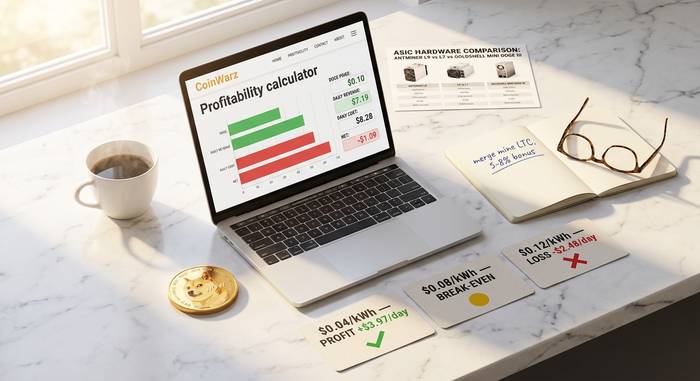
Home miner paying $0.12 per kWh with a single Antminer L9? No. Revenue comes in around $7.19 per day. Electricity alone burns $8.28. The rig loses $1.09 per day before hardware depreciation. That tracks almost perfectly with current WhatToMine and CoinWarz outputs.
Mid-sized operator at $0.06 per kWh? Yes. Same L9, same revenue, but electricity drops to $4.14. That leaves about $3 per day in gross margin. Roughly $1,100 per unit per year. An 8-year payback on a new L9, which is longer than any ASIC's useful life. Real ROI here comes from a mix of DOGE price appreciation and the secondary merge mining revenue.
Large industrial farm at $0.04 per kWh? Comfortable even with no price appreciation. Below about $0.048 per kWh, an L9 breaks even at today's DOGE price. That is why farms in Kazakhstan, parts of Canada, and specific US states with hydro or stranded natural gas dominate the hashrate share.
Short version. Dogecoin mining is a low-margin commodity business. The miners who survive have either the cheapest power, or the lowest hardware cost basis. Retail hobby mining only really pays during bull market spikes.
Electricity, power consumption, and break-even
Electricity is the single biggest variable you actually control. Pull 3,360W continuously through an Antminer L9 and energy consumption hits 80.6 kWh per day, or roughly 2,414 kWh per month. Multiply by your local rate. Subtract from daily revenue. That is your number.
Break-even table at current DOGE price (about $0.10):
| Electricity rate | L9 daily cost | Daily net | Status |
|---|---|---|---|
| $0.04/kWh | $3.22 | +$3.97 | Profitable |
| $0.06/kWh | $4.83 | +$2.36 | Marginal |
| $0.08/kWh | $6.44 | +$0.75 | Break-even |
| $0.10/kWh | $8.06 | -$0.87 | Losing |
| $0.12/kWh | $9.67 | -$2.48 | Losing hard |
These numbers shift every time DOGE's price moves. At $0.15 per coin, the L9 is profitable up to about $0.15 per kWh. At $0.05, only industrial-grade power contracts keep you positive.
Power consumption matters for cooling too. An L9 dumps roughly 11,400 BTU per hour. More than a household space heater on full blast. Without ventilation, a small room hits 40°C inside an hour. At that point the miner throttles. Or fails outright.
Cloud mining and the Dogecoin miner scam risks
Cloud mining is the option that most promises the least. Services like NiceHash rent Scrypt hashpower by the hour, with prices set by market demand, and you also see DOGE miner rental listings on the same platforms. On paper you skip the hardware purchase and run costs. In practice, rental rates reflect exactly the profitability available to hardware owners, minus a margin: you are almost always paying retail for electricity plus a markup, and if the coin price dips the contract can go underwater fast.
That is cloud mining at its most honest. The dishonest version is everywhere. Scam sites promise 5% daily returns, pitch "mining contracts" that are really Ponzi structures, or list ASIC rentals on platforms that vanish the moment withdrawal volume rises. AI-generated "reviews" have made the scam ecosystem look more legitimate than it did a year ago.
Three practical rules if you consider cloud mining:
- If the advertised daily yield is more than about 0.4% at current prices, it is a scam.
- If the contract term is fixed ("3-year contract") rather than tied to real hashing, it is probably a scam.
- If the operator has no verifiable on-chain payouts from a real mining wallet, assume it is a scam.
Legitimate alternatives include buying DOGE directly, joining a trust-grade mining pool, or investing in a mining-exposed equity or ETF (see below).
Dogecoin mining rig setup: cooling and noise
A typical Dogecoin mining rig in 2026 is one to ten ASIC units sharing a rack. Plus a 240V PDU. Plus dedicated ventilation. Plus a monitoring dashboard. For a home miner running a single L9, here is what you actually need:
- A space with continuous 3,500W of draw available. Ideally a dedicated 30A circuit.
- Inlet temperature under 30°C. Above that, the L9 throttles.
- Exhaust ventilation sized for 300-500 CFM. A wall-mounted 12-inch booster fan works fine.
- Some kind of noise isolation if the miner is anywhere near living space. ASIC fans hit 6,000 RPM and pull 75-80 dB.
Immersion cooling flips the whole equation. Drop the miner into dielectric fluid and noise drops to near zero. Temperatures stabilize. Hashboard lifespan roughly doubles. Downside? Equipment cost. A basic single-miner immersion tank runs $1,500-$3,000 before fluid. It only pays off if you plan to keep mining for more than a year.
Firmware tweaks can squeeze another 10-15% efficiency out of any box. Third-party options like Braiins OS or Vnish tune voltage and frequency below stock defaults. Lower power draw at the same hashrate, or more hashrate at the same draw. The catch: both void your warranty on the day you flash them.
Taxes, regulation, and the DOGE ETF wave
In the US, the IRS treats mined DOGE as ordinary income, valued at the fair market price on the day you receive it. Mine $200 of DOGE in a month and hold it? You still owe income tax on that $200 this year. Did not sell a thing. Doesn't matter. From the 2025 tax year onward, mining payouts from regulated US pools show up on the new Form 1099-DA. And if you later sell those coins? Separate capital gain or loss, measured from the mining-day price to the sale price.
Other countries, other rules. Kazakhstan levies 15% on mining income. China re-affirmed its mining ban on June 1, 2025. The EU's MiCA rules do not ban proof of work. They just require mining operators to publish environmental impact data. UK miners file income as miscellaneous or trading income, depending on how big the operation is.
Now the fun twist. Spot DOGE ETFs exist. REX-Osprey launched DOJE on September 18, 2025, with $17 million in first-day volume and a 1.50% expense ratio. Grayscale and Bitwise rolled out their own in November 2025. The SEC even ruled on February 27, 2025 that memecoins are not securities, which opened the regulatory door. For an investor wanting DOGE price exposure without running a rig? An ETF is the cleaner play now. For miners? It means more institutional demand for DOGE than ever before. Which is bullish for price, which is bullish for mining revenue.
Is DOGE still mineable? Future of proof-of-work
Yes. Dogecoin is mineable today, will be mineable tomorrow, and as long as no protocol change removes proof of work, the math keeps working.
Three shifts worth watching in the 2026-2028 window.
First, Qubic's April 1, 2026 launch of Dogecoin parallel mining through its network. The model pairs Scrypt ASIC mining with Qubic's CPU/GPU AI training workload, paying miners in both DOGE and QUBIC tokens. Early data suggests this turns retired Antminer L3+ units, dead weight on the secondhand market, into profitable miners again for operators willing to integrate.
Second, the question of a next-generation ASIC. Bitmain's L9 pushed efficiency to 0.21 J/MH in May 2024. No successor has been announced as of April 2026. If and when an L11 or similar appears at 0.12-0.14 J/MH, the entire used market for L7s and L9s gets revalued overnight.
Third, the slow erosion of hobby mining. Home electricity rates in most developed countries are rising faster than DOGE's price. The economic case for backyard mining thinned throughout 2024 and 2025. Industrial operators with sub-$0.05 power will probably dominate network hashrate for the foreseeable future, with hobbyists sustaining only where merge mining Litecoin plus a favorable electricity contract keeps margins positive.