
What Is Cardano (ADA)? How the Research-Driven Blockchain Works and How to Use It
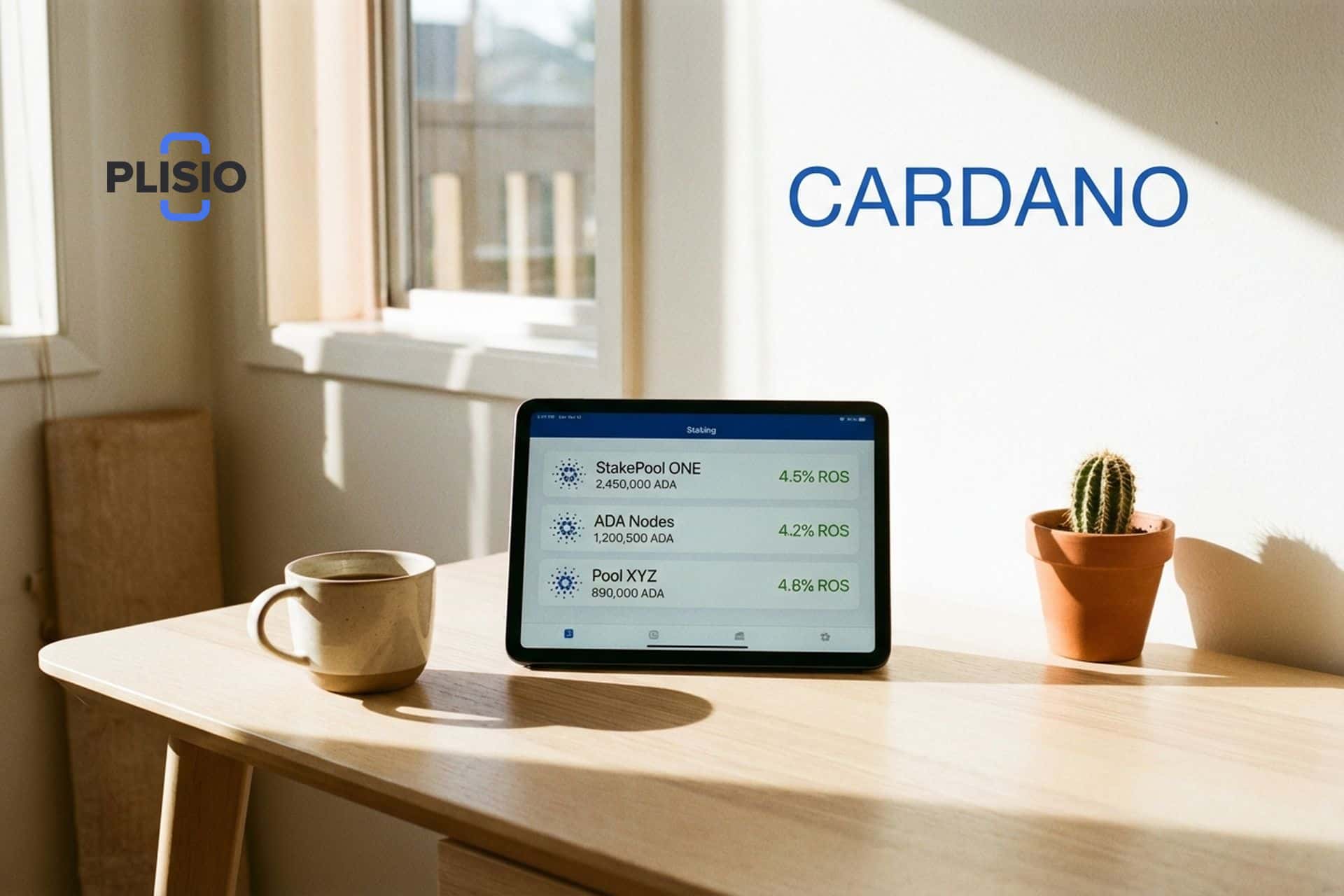
Cardano gets roasted more than any other project in crypto and I say that as someone who holds ADA. "All research, no products." "Academic blockchain with zero users." "Hoskinson talks more than the team ships." I've heard every version. When I mention Cardano in conversations with Ethereum developers, the eye rolls are visible from space.
Here's the thing though: I've been using the network since 2021 and it works. Staking is the smoothest of any proof-of-stake chain I've used. No lock-up period. Rewards every five days. Your ADA never leaves your wallet. The DeFi ecosystem is small compared to Ethereum or Solana but the protocols that exist (Minswap, Liqwid, SundaeSwap) function properly. And the eUTXO model, which confused me for months, turns out to have real advantages for certain types of transactions once you understand what it's doing.
Below I'll walk through what Cardano actually is (the parts that matter, not the academic paper abstracts), how to stake and use DeFi on it in practice, and what the eUTXO model means for you as a user versus just being a developer curiosity. Practical stuff first, theory second, tribalism nowhere.
What Cardano is: the basics
Cardano is a Layer 1 blockchain platform launched in 2017 by Charles Hoskinson, who co-founded Ethereum before leaving due to disagreements about whether the project should be commercial or nonprofit. He took the nonprofit angle and ran with it, building Cardano as a blockchain where every protocol change goes through peer-reviewed academic papers before anyone writes a line of code. Love it or hate it, that process is why Cardano moves slowly but rarely ships broken features.
Three organizations manage the ecosystem. The Cardano Foundation handles governance and adoption. Input Output Global (IOG, formerly IOHK) does the technical research and engineering. Emurgo drives commercial partnerships and business development. This three-body structure is unusual in crypto. Most projects have one company calling the shots. Cardano has three organizations that occasionally disagree with each other publicly, which is messy but arguably healthier than a single founder controlling everything.
The native token is ADA, named after Ada Lovelace. Max supply: 45 billion tokens. Circulating: roughly 35-36 billion. There's no burning mechanism like Ethereum's EIP-1559. ADA enters circulation through staking rewards drawn from a diminishing reserve. The inflation rate sits at about 1.55% annually and decreases over time as the reserve depletes.
ADA currently trades in the $0.30-0.70 range as of early 2026. Market cap keeps it in or near the top 10 depending on the week. It peaked at $3.10 in September 2021, which means most people who bought during the hype are still underwater. I mention this because a surprising amount of Cardano content online reads like it was written by someone who bought the top and is coping. I'd rather give you the real picture.
How Cardano works: Ouroboros and eUTXO
Two things make Cardano architecturally different from every other major blockchain: the Ouroboros consensus protocol and the extended UTXO accounting model.
Ouroboros is Cardano's proof-of-stake consensus. It was the first PoS protocol to be mathematically proven secure through peer-reviewed research (published at the Crypto 2017 academic conference). The name comes from the mythological serpent eating its own tail, representing the protocol's cyclical nature.
How it works in practice: time is divided into "epochs" (five days each) and "slots" (one second each). In each slot, a slot leader is randomly selected from the pool of staked ADA to produce a block. The probability of being selected is proportional to the amount of ADA staked. Slot leaders validate transactions, produce blocks, and earn rewards. If a slot leader doesn't produce a block (offline, crashed), the slot is skipped and the next leader gets their turn.
What makes this relevant for users: the system runs 24/7 with 20-second block times, handles roughly 250 transactions per second (higher with Hydra scaling), and doesn't require the energy-intensive mining that Bitcoin uses. Cardano has been proof-of-stake since its Shelley upgrade in 2020, years before Ethereum made the switch.
eUTXO (Extended Unspent Transaction Output) is Cardano's accounting model and the part that confuses people coming from Ethereum. On Ethereum, your wallet has a balance, like a bank account. You send 5 ETH and your balance decreases by 5. Simple.
Cardano uses UTXO, the same model Bitcoin uses. Your wallet doesn't have a "balance." It has a collection of unspent outputs from previous transactions. Sending ADA means consuming one or more UTXOs as inputs and creating new UTXOs as outputs. The "extended" part means Cardano's UTXOs can carry data and smart contract logic alongside the token value, which Bitcoin's UTXOs can't.
Why does this matter? Determinism. On Cardano, you can calculate the exact cost and outcome of a transaction before submitting it. No failed transactions that still charge gas (a common Ethereum frustration). No surprise fees. You know what will happen before you sign. The tradeoff: building DeFi on eUTXO is harder for developers because the concurrent transaction model is different from Ethereum's. This is part of why Cardano's DeFi ecosystem launched later and grows slower.
How to use Cardano: wallets, staking, and DeFi
Setting up a wallet. Two official options: Daedalus (full node wallet, downloads the entire blockchain, ~15 GB) and Yoroi (light wallet, browser extension, instant setup). For most users Yoroi is the right choice. Install the extension, create a wallet, write down your recovery phrase. You can also use multi-chain wallets like Eternl (formerly ccVault) or Typhon, which are built specifically for Cardano and support DeFi interactions better than Yoroi.
Buying and receiving ADA. Buy on any major exchange (Coinbase, Binance, Kraken). Withdraw to your Cardano wallet address. Make sure you're sending to a Cardano address (starts with "addr1"). Transaction fees on Cardano average about 0.17-0.19 ADA per transaction regardless of complexity, which at current prices is under $0.10.
Staking ADA. This is where Cardano genuinely shines and where my personal experience has been the most positive of any PoS chain.
Open your wallet. Click "Delegate" or "Stake." Browse stake pools (there are over 3,000 active ones). Pick a pool based on performance, saturation level, and fees (most charge 2-5% of rewards plus a fixed fee). Confirm delegation. Done.
What makes Cardano staking different from everything else:
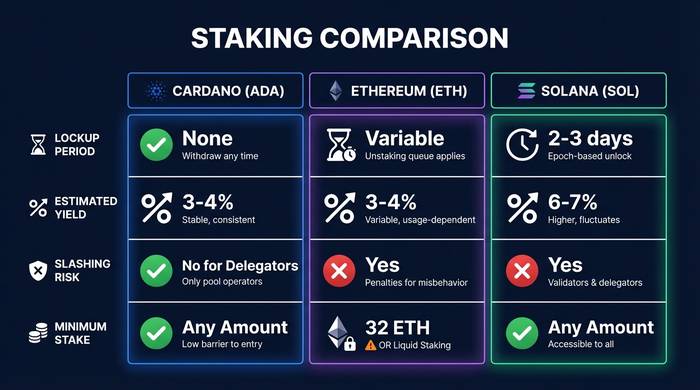
- Your ADA never leaves your wallet. You're not sending tokens to a smart contract or a validator. You're delegating your stake while keeping full custody. This is fundamentally different from Ethereum staking where your ETH goes into a deposit contract.
- No lock-up period. You can move or spend your ADA at any time. Delegation doesn't freeze your tokens. This is unique among PoS chains: Polkadot locks for 28 days, Cosmos for 21 days, even Ethereum's liquid staking requires trusting a third-party protocol.
- Rewards every epoch (five days). Current yield: roughly 3-4% APR. Not the highest in crypto but it's real yield with zero lockup and zero smart contract risk.
I've had ADA delegated to the same pool for over two years. Never unstaked. Never moved it. Never had to worry about slashing because Cardano doesn't punish delegators for validator mistakes. The rewards just keep showing up in my wallet every five days like clockwork. It's boring in the best possible way. Other chains make staking feel like a job. Cardano makes it feel like a direct deposit you forgot you set up.
One thing I wish someone had told me earlier: the first rewards take 15-20 days to arrive because of how epoch timing works. I spent two weeks thinking my delegation was broken before I realized there's a built-in delay. After that initial wait, rewards are consistent and predictable.
Using DeFi on Cardano. The ecosystem is smaller than Ethereum or Solana but the core protocols work.
Minswap is the largest DEX. Connects to your wallet, swap ADA for any Cardano native token. The interface is clean and the liquidity on major pairs (ADA/USDC, ADA/MIN) is adequate for normal-sized trades.
Liqwid is the leading lending protocol. Deposit ADA or other tokens as collateral, borrow against them. Rates are competitive with Aave on Ethereum.
SundaeSwap was one of the first DEXs and still has a user base, though Minswap has overtaken it in volume.
JPG Store is the NFT marketplace. Cardano's NFT scene is smaller than Solana's but it has a dedicated community. The native token standard on Cardano is different from Ethereum: NFTs are native assets on the ledger rather than smart contract entries. This makes minting cheaper and transfers simpler. A friend of mine who runs a small art project told me minting 1,000 NFTs on Cardano cost him less than $50 total. On Ethereum mainnet that would have been thousands in gas.
Cardano's roadmap: five eras explained quickly
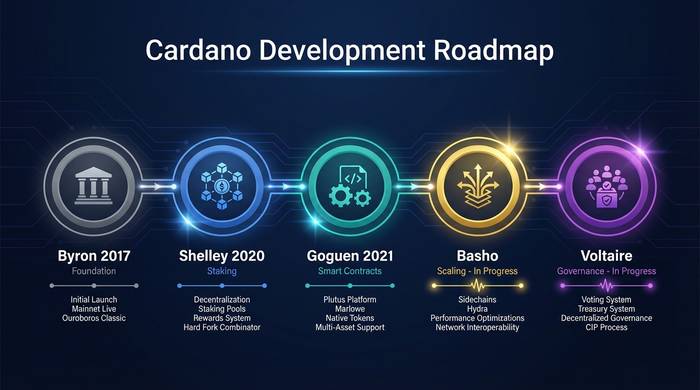
Cardano's development follows five named phases. Each introduces a major capability:
| Era | Name | What it added | Status |
|---|---|---|---|
| Byron | Foundation | Basic transactions, AVVM bootstrap | Complete (2017) |
| Shelley | Decentralization | Staking, delegation, stake pools | Complete (2020) |
| Goguen | Smart contracts | Plutus, native tokens, DeFi | Complete (2021) |
| Basho | Scaling | Hydra L2, sidechains, performance | In progress |
| Voltaire | Governance | On-chain voting, treasury, self-sustainability | In progress |
Basho and Voltaire are running simultaneously now. Hydra, the Layer 2 solution, is technically live but production usage is still early. The "1 million TPS" headline number assumes hundreds of Hydra "heads" running in parallel, each processing its own channel of transactions. In reality, the first Hydra use cases are micro-payment channels and specific application-level scaling, not general-purpose throughput for the whole chain. Cool tech. Meaningful deployment is still ahead.
Voltaire's biggest tangible achievement: Project Catalyst. This is Cardano's on-chain funding mechanism where ADA holders vote to allocate treasury funds to community proposals. Over $100 million in ADA has been distributed through Catalyst rounds. I voted in two of them. The process is clunky (you need the Catalyst app, registration takes a few steps) but the concept of a community directly funding projects through democratic voting rounds is something I haven't seen work this well anywhere else in crypto. Participation rates fluctuate, and not every funded project delivers, but the system keeps running and the treasury keeps funding builders.
Cardano vs Ethereum: honest comparison
| Feature | Cardano | Ethereum |
|---|---|---|
| Consensus | Ouroboros PoS (2020) | Casper PoS (2022) |
| Accounting | eUTXO | Account-based |
| Smart contracts | Plutus (Haskell), Aiken | Solidity, Vyper |
| TPS | ~250 (Hydra: theoretical 1M) | 15-30 (L2s: 1000+) |
| Avg fee | ~$0.08-0.10 | $0.50-5+ |
| TVL | ~$300-500M | $50B+ |
| Staking lockup | None | Variable (liquid staking needed) |
| Staking yield | 3-4% | 3-4% |
| Validator count | 3,000+ pools | 1M+ validators |
Cardano's staking is simpler and safer for passive holders. Ethereum's ecosystem is 100x larger. Cardano's fees are lower but still higher than Solana's. Ethereum has the developer network effects that Cardano hasn't matched. Both offer similar staking yields, but the experience of staking Cardano is noticeably less complicated.
My honest take after three years of using both: Cardano is a well-engineered blockchain with a small but loyal ecosystem. It's not going to "kill Ethereum" and the Cardano community needs to stop saying that because it invites ridicule. But it also doesn't need to. There's room for multiple proof-of-stake chains optimizing for different things. Cardano chose formal verification, deterministic transactions, and the smoothest staking experience in crypto. Ethereum chose ecosystem breadth and composability. Solana chose raw speed.
Different tools for different values. The crypto tribalism that demands every chain either "kills" its competitors or admits defeat is exhausting and wrong. I use Cardano for staking and occasional DeFi. I use Ethereum for deep liquidity. I use Solana when I need cheap speed. None of them is obsolete. All of them have trade-offs I wish didn't exist.



