Lightchain AI in 2026 : LCAI Token, AIVM, and Roadmap

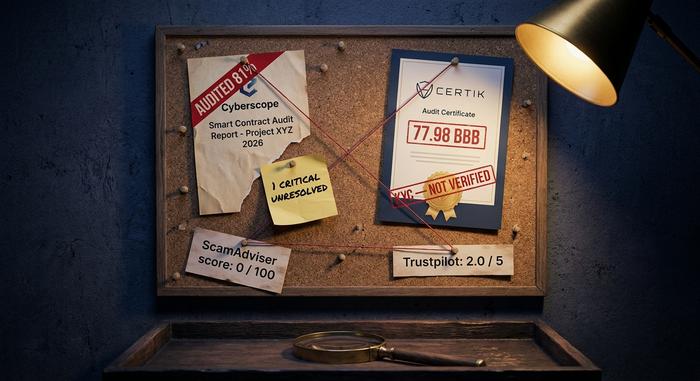
Lightchain AI sits in a strange spot in the 2026 crypto market. The project promises a blockchain that is also an AI compute network, with a custom consensus called Proof of Intelligence and an on-chain virtual machine called AIVM. It raised $20.9 million across 15 presale stages plus a bonus round and shipped its token onto Ethereum on January 2026 via a single Uniswap V3 LCAI/WETH pair. As of April 2026, LCAI carries a fully diluted valuation of roughly $54.8 million, sits at CoinMarketCap rank around #3,958, and trades roughly $228,000 of volume per day. It also raises real questions: an anonymous team, a Cyberscope audit at 81% Low Risk with one critical item still unresolved, a CertiK Skynet score of 77.98 (BBB) without KYC verification, mainnet timelines that have slipped twice, and a spot price below the late presale rate.
This deep dive walks through what the project actually claims to be, what is verifiable on-chain and on the public record, and what an investor still has to assume on faith. The goal is not to promote LCAI or dismiss it. The goal is to give you the same picture a careful researcher would build before deciding whether the asset belongs in any portfolio at all.
What Is Lightchain AI? A Cryptocurrency Project Snapshot
The short version. Lightchain AI is a Layer-1 blockchain project that wants to be both a smart contract platform and an AI compute network at the same time. Its pitch: decentralized models, distributed inference, and AI training jobs run on-chain, paid for and rewarded directly by the protocol. Validators get block rights for AI work, not raw hashing or simple capital lockup.
LCAI is the native cryptocurrency. The project asks one token to do four jobs: pay for AI tasks, secure the network through staking, unlock premium AIVM features, and run governance. Heavy load for one ticker. The token launched on Ethereum as an ERC-20 during the presale, so as of right now LCAI is, in technical terms, a regular Ethereum token. Not a coin on its own sovereign Layer-1, no matter what the marketing says.
That gap is the most important thing to keep in mind about Lightchain AI in 2026. The narrative is AI-native chain. The reality, today, is a presale-funded Ethereum token with a roadmap that still has the most interesting boxes unticked.

Lightchain Protocol AI Architecture and Blockchain Stack
The full project name is Lightchain Protocol AI. The whitepaper describes a three-layer stack: a base settlement layer for transactions and consensus, an execution layer that runs both standard EVM-style smart contracts and AI workloads, and a service layer where dApps, AI agents, and developer tooling live. The architecture is sold on two themes that recur across all the marketing material: the combination of AI and blockchain in a decentralized blockchain layer, and scalability through workload sharding across nodes.
Two design choices anchor the architecture. The first is the Proof of Intelligence consensus mechanism, which ties block production to AI work. The second is AIVM, an on-chain virtual machine intended to handle real machine-learning code rather than only generic smart contracts. Both are explained in more detail below; both are also areas where the documentation is more confident than the public delivery.
The blockchain itself is described as EVM-compatible, which is the standard 2026 default for new Layer-1s. EVM compatibility gives Lightchain AI access to existing Ethereum tooling, wallets, and developer libraries. It also means the project competes directly with much larger AI-adjacent and general-purpose chains for the same developer pool.
Proof of Intelligence (PoI) Consensus Mechanism Explained
Proof of Intelligence, abbreviated PoI, is the project's headline innovation. The PoI consensus mechanism asks validators to perform useful AI computation as part of producing blocks. Rather than burning electricity on hash puzzles or simply locking up capital, a PoI validator earns the right to propose a block by completing a task assigned by the network, then submitting a verifiable proof that the work was done correctly.
The white-paper-level description covers several task categories: model training contributions, inference, fine-tuning runs, and broader optimization tasks against benchmark datasets. Validators stake LCAI to participate, then are scored by a combination of stake size and the quality and quantity of AI work delivered. Slashing applies for both standard double-signing-style violations and for submitting AI work that fails verification.
The harder question is verification. AI computation is expensive, non-deterministic in many configurations, and easy to fake by replaying cached results. Truly trustless verification of AI work is an open research problem in 2026, and the projects that take it most seriously, such as Bittensor with its dTAO model and the various zkML startups, have struggled to scale it in production. Lightchain AI's documentation gestures at zero-knowledge proofs and committee verification, but the implementation details available to the public are thin.
For an investor, the practical question is not whether PoI sounds good in a whitepaper. The question is whether the implementation, once it ships and is independently audited, holds up against an attacker who would rather earn rewards by gaming the verification step than by doing real AI work.
AIVM: Artificial Intelligence Virtual Machine
AIVM stands for Artificial Intelligence Virtual Machine. It is the second of Lightchain AI's two flagship technical claims, sitting alongside PoI. Where the EVM runs Solidity bytecode, AIVM is supposed to run actual machine-learning workloads (inference of trained models, training updates, and certain classes of AI agent code) directly on a virtual machine the network agrees on.
The project's marketing emphasizes that the AIVM evolves through community-driven proposals. Developers contribute new opcodes or instruction extensions, validators approve them, and the runtime grows over time to support more sophisticated artificial intelligence patterns. Real-time inference and collaborative model updates are the two flagship use cases the documentation reaches for. The design intent is reasonable: a generic smart-contract VM is poorly suited to numerical workloads, and dedicated paths for matrix operations or model loading make sense. As an AI virtual machine sitting next to the EVM, it is a credible piece of architecture; the question is execution.
What is less clear is the current production state of the AIVM. As of early 2026, the public documentation describes an architecture and a roadmap rather than a working specification with reference implementations and external audits. Independent reviewers have noted that the technical depth on the AIVM side trails the marketing content. Until working demos, benchmarks, and third-party security reviews are available, the artificial intelligence virtual machine should be treated as a planned feature, not a shipped one.
PoI vs Proof of Work (PoW): Energy and Trade-offs
The natural contrast Lightchain AI invites is with proof of work. Bitcoin's PoW is the oldest and most battle-tested consensus mechanism in crypto, and it is also the most criticized for its energy footprint. The PoI pitch reframes that energy: instead of hashing, the network spends compute on AI tasks that have value outside the chain.
It is worth being careful with this comparison. PoW's strength is not energy use; it is the security model that energy buys. A PoI network has to either carry the same kind of objective, hard-to-fake security signal, or replace it with an alternative model that is at least as strong. Most of the academic and industry research on "useful proof of work" (protein folding, AI training, scientific computation) has run into the same issue: tasks that are useful tend to be either non-uniform, hard to verify trustlessly, or both. That is the design space PoI is operating in.
| Property | Bitcoin PoW | Generic Proof of Stake (PoS) | Lightchain AI PoI (claimed) |
|---|---|---|---|
| Block production cost | Hash work | Capital lockup | AI computation + stake |
| Energy use | High | Low | Medium (compute heavy) |
| Verification | Trivial (hash check) | Trivial (signature) | Hard (AI output check) |
| External value | None | None | AI training / inference |
| Production track record | 16+ years on Bitcoin | 4+ years on ETH | Early stage |
Read the table the way an engineer would. PoI has more potential upside than either pure PoW or generic PoS, because it creates real-world value while securing the chain. It also has a verification problem nobody has solved cleanly yet. That is not a dealbreaker. It is just a part of the project that is still under construction in 2026. Most public references to the consensus appear interchangeably as either "Proof of Intelligence" or the hyphenated "proof-of-intelligence"; treat them as the same mechanism with different copy editing.
LCAI Token, Tokenomics, and Total Allocation
LCAI is the native token. The headline tokenomics, as published, describe a fixed maximum supply of 10 billion tokens with the following allocation:
| Allocation bucket | Share |
|---|---|
| Presale | 40% |
| Staking and rewards | 28.5% |
| Liquidity provision | 15% |
| Treasury | 6.5% |
| Marketing | 5% |
| Team | 5% |
That allocation is unusual. A 40% presale share is high by 2026 standards, where many projects keep public-sale allocations in the 10–25% range and weight more toward ecosystem and validator rewards. A 5% team allocation is on the low end. Marketing at 5% is normal for a presale-led launch. Together, the table reads like a tokenomic model designed to maximize early investor distribution and minimize team optics, rather than to align long-term incentives.
The on-chain token contract tells a slightly different story. The verified ERC-20 contract at `0x9ca8530ca349c966fe9ef903df17a75b8a778927`, registered on Etherscan as "LightchainAI" with the LCAI ticker, lists a current supply of approximately 2.07 billion rather than the 10 billion ceiling. That is consistent with a phased emission, with most of the supply held back for staking rewards, treasury, and unreleased presale tranches, but the gap between the marketing supply and the on-chain supply is the kind of thing every prospective buyer should reconcile before sending funds.
LCAI itself trades around $0.00548 in April 2026, against a late-stage presale price of roughly $0.0067 and a bonus-round price near $0.007. The token's all-time high reached $0.008982 on March 29, 2026, a brief spike just above bonus-round entry. Its all-time low was $0.0007704 on February 6, 2026, shortly after the DEX listing. Roughly 32,900 wallets held LCAI as of late April 2026 according to Etherscan. Anyone who paid presale prices for a future utility token is, in market terms, somewhere between flat and underwater depending on the stage they entered.
Lightchain AI Presale: Stages and USD Raised
The Lightchain AI presale opened in November 2024 and ran across 15 official stages plus a final bonus round, closing in mid-2025. Each stage stepped the per-token price up incrementally. Early entrants paid roughly $0.003 per LCAI, late stages priced near $0.0067, and the bonus round landed around $0.007. Together, the schedule framed itself as "buy now or pay more later." A July 2025 GlobeNewswire release from the project pegged total presale fundraising at $20.9 million USD across those 15 stages. Public DEX trading on Uniswap V3 began in January 2026, several months after the originally scheduled mainnet date, with a single LCAI/WETH liquidity pool absorbing all on-chain volume.
Presale mechanics like this are common but not always well understood. They are useful for projects that need community capital and a wide-distribution narrative; they also create heavy structural sell pressure once tokens unlock. Investors who bought at $0.003 in early stages have an obvious incentive to sell into the first liquid markets at $0.0067; investors who bought at $0.0067 are now competing with that supply at lower prices.
The presale also raises a regulatory question that the public documentation does not fully answer. The published materials are thin on the legal entity issuing LCAI, the jurisdictions covered, and the KYC/AML controls applied to presale funds. For non-US buyers in 2026 these gaps are common; for US buyers they are a meaningful flag, and the absence of a clear stance is itself information.
Mainnet, Testnet, Nodes, and Block Explorer Status
The original launch date was July 31, 2025. That date came and went. The replacement target was Q4 2025. That window also closed without a mainnet. By April 2026 the official roadmap, plus the CertiK Skynet entry, point to "H2 2026" with no fixed day attached. Three deferrals so far.
What you actually own as a holder right now is the ERC-20. LCAI trades on a single Uniswap V3 LCAI/WETH pair, and any traffic on a separate Lightchain AI mainnet is invisible from the standard public block explorers. There is no Etherscan equivalent for Lightchain that pulls up the same way Ethereum or Solana data does. There is no widely-mirrored Lightchain explorer to spot-check claims against.
Public artifacts that do exist: a developer portal, a testnet docs page, a $150,000 grants program, a published whitepaper. The pieces a prospective investor really wants to see are mostly missing. No public node operator list. No live block explorer with on-chain throughput numbers. No third-party uptime monitor. No bug bounty program at the size established Layer-1s run. No partnership list with major DeFi protocols. No obvious Lightchain ecosystem footprint on the dashboards Ethereum dApp activity normally shows up on.
To be clear, this exact pattern is not unique to Lightchain AI. A lot of AI-themed Layer-1s in 2026 still ride on an ERC-20 placeholder before their real mainnet launch. The risk is not the placeholder. The risk is the distance between what the marketing claims (live network, AI workloads running, decentralized validators) and what a researcher can actually point to (token on Ethereum, demos limited, no public Lightchain explorer).
Decentralized AI: Inference and Model Training
The product story Lightchain AI sells is decentralized AI. The platform is supposed to let developers run inference against open models, perform model training in a distributed fashion, and pay for both with LCAI. Every node in the network can theoretically take on a slice of the workload, and validators are paid in LCAI for completing assigned tasks.
In a fully working version, the appeal is real. Centralized AI inference, dominated by a small group of cloud providers and model owners, has known privacy and pricing problems. A decentralized AI fabric that lets developers deploy inference with reasonable latency and verifiable results, while keeping data on user-controlled hardware, would deliver real utility on its own terms, and it would let token holders capture some of that value through staking and fees. The future of AI, in this telling, is collaborative and open rather than tightly held by a few labs. Projects like Bittensor, Akash, and Render have each tackled different slices of this problem with their own credentials and very different architectures.
What separates a working decentralized AI network from a marketing claim is throughput. The numbers that matter are tokens-per-second of inference, training throughput, latency to a response, and the number of independent operators producing those results. As of early 2026, Lightchain AI publishes none of these in a way that is easy to verify externally. The documentation describes the architecture; the real-world load is not visible.
Optimization Tasks and AI Computation Workloads
Beyond plain inference and training, the Lightchain AI documentation gestures at a category called optimization tasks. These are smaller AI computation workloads (feature extraction, hyperparameter searches, basic numerical tasks) that the network can hand to nodes as part of the PoI pipeline. The framing makes sense: optimization tasks are easier to verify than full model training, easier to slice across many nodes, and useful in their own right.
The realistic ceiling is whether the network can attract enough demand-side traffic to keep node operators paid and the token in genuine circulation. Crypto AI networks live and die on this loop. Without paying customers running computational workloads, validator rewards come entirely from token emission, which is not a long-term equilibrium. The project's roadmap mentions enterprise pilots, real-time AI use cases, and developer programs to bridge that gap, but, as with the rest of the technical story, the verifiable evidence is currently thin. Projects that successfully validate this kind of demand loop typically show it through public dashboards; Lightchain AI does not, yet.
Lightchain AI Community and Ecosystem Governance
The Lightchain AI community is a meaningful asset and a meaningful risk at the same time. On X (formerly Twitter), Telegram, and Discord, the project has a sizable retail following, much of it directly tied to the presale and the bonus round. Engagement is high, but also very promotional in style: large daily volumes of price-prediction posts, hype-coded "this will be the next…" comparisons, and very little technical or critical discussion.
Governance over the long term is supposed to live with LCAI token holders. The token doubles as the governance instrument, and the published documentation describes a future DAO in which holders vote on AIVM upgrades, validator parameters, and treasury usage. As of 2026, governance activity that would qualify as substantive (binding on-chain votes with real proposals) is not yet visible in the way it is on more mature networks, where forums, snapshot boards, and on-chain voting records are public. Active validator decision-making by token holders is therefore aspirational rather than current.
Healthy crypto ecosystem governance is identifiable by three things: independent technical contributors who are not paid by the foundation, contested proposals where outcomes are not predetermined, and visible operator diversity. None of these are obviously present yet for Lightchain AI in 2026; that does not mean they are absent, only that they are not visible to an outside researcher in the way that, say, the Polkadot or Optimism governance forums are.
Transparency, Audits, and Red Flags for Investors
Transparency is where the more cautious 2026 reviews focus, and the picture is mixed.
CoinSpeaker, one of the more measured public take-outs, points at a Cyberscope audit currently rated 81% Low Risk, with a single critical finding still unresolved. CertiK's Skynet dashboard scores the project 77.98 (BBB) as of April 23, 2026. Of 18 raised issues, 16 are addressed; the KYC step is explicitly not completed. Both security firms are well-known names in crypto auditing. That adds weight. The open Cyberscope critical and the missing KYC subtract weight, by an amount most investors should think about carefully.
The editorial coverage gap is the other flag. As of early 2026, no major editorial newsroom (CoinDesk, Decrypt, The Block) has run independent reporting on Lightchain AI. The CryptoSlate piece near the top of Google results is labeled paid content. Most positive coverage lives on partner-network outlets that monetize sponsored placements. By 2026, that pattern is one of the clearer ways to tell a project earning organic editorial attention from one paying for the appearance of it.
ScamAdviser scores the lightchain.ai domain 0 out of 100, citing privacy-protected WHOIS, low traffic, and other heuristics. Trustpilot rates the project 2 out of 5. None of those signals on their own is disqualifying. Stacked together, they describe a project carrying a $54M FDV without earning the trust the market is giving it.
To be fair, the legitimacy signals are not nothing. The whitepaper is published. The ERC-20 contract is verified on Etherscan with an exact source-code match. Around 32,900 holders. A testnet exists. A developer portal exists. A $150,000 grants program exists. Both Cyberscope and CertiK have published audit reports. None of that proves the network will deliver. Together they establish that something is being built, even if the final shape is still uncertain.
The honest framing for an investor goes like this. Lightchain AI is not a clear scam. It is also not a clear blue-chip. The right peer set is not Bitcoin or Ethereum. It is the catalog of presale-led Layer-1s that raised between $5M and $50M in the 2024–2025 cycle. A few shipped working tech and held their token price. Most did not. Base rates are not destiny, but they are not flattering here either.
How does the project sit in the AI-crypto sector overall? CoinGecko's 2026 AI category tracks roughly 919 projects, combined market cap near $21.85 billion. The leaders, by token value, look like this:
| Project | Token | Approx FDV (Apr 2026) | Status |
|---|---|---|---|
| Bittensor | TAO | $2.39B | Live mainnet, dTAO live |
| NEAR Protocol | NEAR | $1.74B | Live mainnet, AI agents push |
| Render | RNDR | $907M | Live network, GPU rendering |
| Fetch.ai (ASI) | FET | $452M | Live mainnet, AI agents |
| Akash | AKT | $143M | Live decentralized cloud |
| Lightchain AI | LCAI | $54.8M | ERC-20 on Ethereum, mainnet pending |
Against that field, $54.8 million FDV puts LCAI in the mid-tail. Large enough to matter to the people holding it. Nowhere near the resources of the live infrastructure projects above it.
Lightchain AI in 2026: Roadmap and Final Outlook
The published roadmap walks through eight phases. The early ones were prototype, presale execution, and audits. The middle ones cover testnet rollout, AIVM iteration, and validator onboarding. The later ones describe a fully launched mainnet, an active developer ecosystem, and listings on major exchanges. So far, none of the middle and late phases have arrived on time. The original mainnet date was July 31, 2025. By April 2026 the same target has slipped to "H2 2026" with no fixed day. Third delay.
What you actually hold, in the meantime, is a tightly bounded set of facts. A verified ERC-20 token. A single Uniswap V3 pool that absorbs all of its volume. A documented architecture. A Cyberscope audit at 81% with one open critical. A CertiK Skynet entry without KYC. An anonymous team. A thin track record of shipped on-chain product. The next twelve months are when most of these open questions get answered, one way or another. Either a real Layer-1 goes live, AI workloads show up on a public explorer, and LCAI starts earning the utility its token model claims, or the project drifts into the same long tail of half-finished AI-crypto launches that defined the 2024–2025 cycle.
If the asset still interests you, the only honest stance is treat-as-speculation. Size positions accordingly. Always verify a token contract against Etherscan directly, not against a marketing-site button. Watch for two specific milestones: a follow-up audit that resolves the Cyberscope critical, and a public block explorer showing real Lightchain AI mainnet traffic. Until both exist, the project sits in the part of the market where upside narrative is loud and downside numbers are quiet. That is a bad place to be when liquidity is thin, and Lightchain AI's liquidity, today, is one DEX pool deep.