Doctrina AI: a comprehensive look at this AI tool for exam generation, essays, and personalized learning
A college student sits down the night before a midterm and feeds her notes into a website. Three minutes later, she has a full practice exam with an answer key. A high school teacher in Mumbai uploads his lesson plan and gets a customized quiz for 30 students, each adjusted to a different skill level. Both of them used Doctrina AI, and neither paid a cent.
That is the pitch, anyway. Doctrina AI is an education platform powered by artificial intelligence, built on top of OpenAI's GPT-3, that turns class notes into quizzes, essays, and study plans. With over 300,000 users and a pricing model that tops out at a one-time $10 payment for lifetime access, it sits at the cheap end of the growing AI education market. The AI in education sector hit $6.9 billion in 2025, according to Grand View Research, and is on track to reach $41 billion by 2030. Doctrina wants a piece of that by making exam prep almost free.
But free tools come with trade-offs. How good are the exams it generates? Can teachers trust the output? And does a $10 lifetime price tag mean the company can actually stick around? Here is a closer look.
How Doctrina AI works: the AI tool behind exam and quiz generation
Doctrina AI runs on OpenAI's language models. You type in a topic, pick a question format, and the platform spits out a ready-to-use assessment. The process takes about two to three minutes for a full exam.
The exam generator is the flagship tool. You enter a subject like "photosynthesis" or "the French Revolution," pick from multiple choice, true/false, short answer, or essay format, set the number of questions, and hit generate. The output comes with an answer key. Teachers can edit any question before sending it to students.
What is happening behind the scenes? The same thing every GPT wrapper does. Your input gets packed into a prompt with rules about format, difficulty, and subject. That prompt goes to OpenAI's API. The response comes back, gets cleaned up, and lands on your screen. No curated question bank. No original research. Every question is fresh, which gives you variety but also the odd wrong answer.
Natural language processing handles the text side. The AI reads your notes, grabs the big ideas, and turns them into questions. Biology, history, economics? It does a solid job. Calculus, where one wrong symbol ruins the answer? Or a niche graduate seminar topic? That is where things get wobbly.
Machine learning and AI training data keep improving the output over time. More users means more exam patterns for the model to learn from. But this is really an OpenAI thing, not a Doctrina thing. When OpenAI updates GPT-3, Doctrina gets better by default.
Main features of Doctrina AI that students and educators actually use
Five tools. Each one does one thing. None of them try to be everything.
The exam generator pulls the most users. Teachers build assessments in minutes instead of spending hours. Students make practice tests from their own notes. You pick question count, format, difficulty, and subject. For standard high school bio or econ 101? Solid. For a niche grad-level topic? Check every single question yourself.
The essay generator hands students a skeleton. You give it a topic. It hands back an intro, a few body paragraphs, and a wrap-up. Nobody should submit this as a finished paper. It is a starting point, something to react to rather than stare at a blank screen. And honestly, any teacher who reads student papers regularly will spot a raw Doctrina essay from a mile away. The voice is too flat, too general.
Quizzes are the lighter cousin of exams. Five to twenty questions, usually multiple choice or true/false. Good for a warm-up at the start of class or a quick self-test before bed.
The notes tool takes your messy lecture scrawl and pulls out the big ideas. Paste your notes in, get a clean summary back. Active learning research says testing yourself beats re-reading every time, and this tool makes it easy to do that on the fly.
AI chat works like a tutor who never sleeps. Ask it about mitosis at 2 AM. It answers. Ask it to walk through a calculus problem step by step. It does. Think of it as ChatGPT with guardrails that keep it on school topics.
| Tool | What it does | Best for | Limitations |
|---|---|---|---|
| Exam generator | Builds full tests with answer keys | Teachers creating assessments | May need manual review for accuracy |
| Essay generator | Creates structured draft essays | Students starting writing assignments | Output is generic, not submission-ready |
| Quiz generator | Quick practice sets | Daily review, warm-ups | Fewer format options than exam tool |
| Notes summarizer | Condenses class notes | Study prep, review | Loses nuance on complex topics |
| AI chat | Real-time Q&A tutor | Homework help, concept review | Limited to text-based interaction |
Doctrina AI pricing: what is free and what costs money
Here is the part that makes other EdTech founders nervous. Most of Doctrina AI is free. The rest costs almost nothing.
The free tier gives you unlimited access to quizzes and essay creation. You can generate as many quizzes as you want, use the essay tool without limits, and access the basic interface. What you do not get for free: enriched note-taking, the exam generator, and the AI chat and talk features.
The premium tier costs $10. Not per month. Not per year. A one-time payment for lifetime access to everything. That includes quizzes, essays, enriched notes, exams, AI chat, and the talk feature. At that price, the barrier to entry is close to zero.
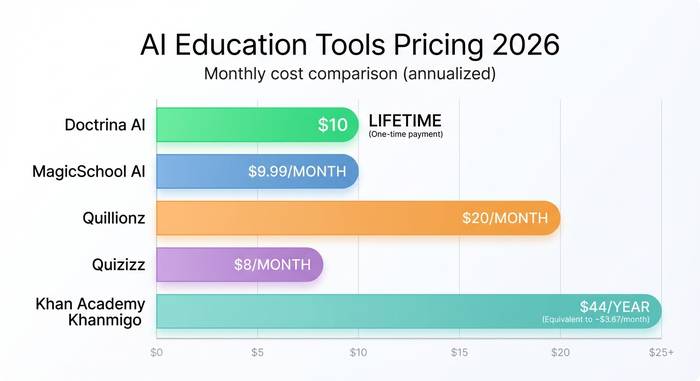
Look at how Doctrina stacks up against the competition:
| Platform | Free tier | Paid tier | Pricing model |
|---|---|---|---|
| Doctrina AI | Quizzes, essays | All features | $10 one-time lifetime |
| MagicSchool AI | Limited tools | Full suite | $9.99/month |
| Quillionz | Basic quiz gen | Advanced features | $20/month |
| Quizizz AI | Free quizzes | Premium analytics | $8/month per teacher |
| Khan Academy (Khanmigo) | Khan Academy free | AI tutor add-on | $44/year |
That $10 lifetime price raises a question: how does Doctrina AI make enough money to keep running? The platform relies on OpenAI's API, which charges per token. Every exam generated, every essay written, every chat response costs Doctrina real money in API fees. At $10 per user for lifetime access, the math gets tight as the user base grows and people generate more content. This is worth watching. EdTech startups that underprice their product to grab users sometimes run out of runway.
Applications of Doctrina AI across education and beyond
Doctrina AI markets itself for classrooms, but the tools work in places that have nothing to do with school.
The classroom use is obvious. Teachers save hours. A 2025 survey showed 82% of educators using AI tools said they spent less time on prep and taught better lessons. The 74% of students who said AI improved their grades were not just reading the output. They were making practice tests, failing, figuring out the gaps, and studying those gaps. That loop — test, fail, learn — is what decades of education research calls active learning. Doctrina makes that loop take five minutes instead of an hour.
India is a big market. Students cramming for CBSE and ICSE board exams found Doctrina early. The platform handles Class 9 and Class 10 syllabi with question styles that match the real tests. Private tutoring in India runs $20-50 per hour in cities. A free AI tool that generates the same type of questions? Parents notice.
HR departments have caught on too. Onboarding quizzes, compliance tests, skill checks — the exam generator builds all of these. A mid-size company does not need a $50,000 LMS when a $10 tool covers the basics for ongoing training.
Medical and nursing students use the exam tool for anatomy drills and pharmacology review. Patient care education benefits from quick-fire quizzes on clinical protocols. The AI chat helps with walking through differential diagnoses, though I would not trust it on anything where a wrong answer has consequences.
How Doctrina AI shapes the e-learning experience for different users
Same tool, different people, different payoff.
A tenth-grader feeds biology notes into the quiz tool at 9 PM and gets twenty practice questions. She misses four. She looks up those four topics. That is more useful than re-reading the whole chapter, and it took ten minutes.
A college junior dumps three months of poli-sci notes into the summarizer. What comes back is a five-page study guide instead of sixty pages of scrawl. She uses the exam generator to make a practice test, bombs the section on trade policy, and knows exactly where to focus before finals.
A high school teacher in Ohio needs a quiz for Monday. Friday afternoon, she types "American Civil War causes" into the exam tool, picks 25 questions, sets it to medium difficulty. Done in four minutes. She edits two questions that are too vague and sends it out. Three hours of weekend work avoided.
A school district with 2,000 teachers wants to standardize test quality across schools. The SDK integration plugs Doctrina into their existing systems. At $10 per seat, the whole rollout costs less than one classroom set of textbooks.
Honest overview of Doctrina AI: what works and what does not
Time for the honest part.
Speed is the clear win. Three minutes for a 30-question test with answer key. That is real. The free tier is generous enough that a broke student can get value without paying anything. And for standard subjects — the kind taught in millions of classrooms — the question quality is better than I expected going in.
Now the bad stuff. I tried generating an exam on "advanced organic chemistry reaction mechanisms." Two questions had wrong structures. One had a nonsensical answer key. The platform depends 100% on OpenAI's models. When GPT hallucinates, Doctrina hallucinates. There is no fact-checking layer, no second opinion, no internal question bank to catch mistakes.
No internet? No Doctrina. The whole thing lives in the cloud. Students in rural areas or places with spotty wifi are out of luck. Offline mode does not exist.
The mobile app is... there. Google Play shows under 2,000 downloads a month as of late 2025. Most people use the web version, and honestly, the web version works better.
Privacy is where things get uncomfortable. SSL encryption, sure. But the privacy policy reads like an afterthought. CommonSense Media lists Doctrina but has not given it a strong privacy rating. Schools that need FERPA or COPPA compliance in the US, or GDPR compliance in Europe, will want to read the fine print before they sign up 500 students.
Conclusion
Doctrina AI sits in an odd spot. It is better than it has any right to be at that price point. Ten bucks for lifetime access when MagicSchool charges ten a month and Khanmigo costs forty-four a year? Either the founders have figured out something the rest of the market has not, or this pricing will not last.
Specialized subjects trip it up. Privacy needs work. The mobile app is forgettable. But for a tenth-grader who needs twenty practice questions on the Civil War, or a teacher in Mumbai who needs a CBSE-aligned test by morning? It just works.
Here is the bigger picture: 84% of high school students now use some form of generative AI for studying, according to TutorBase's 2025 report. AI in education is not a question anymore. It is a fact. The real question is which tools actually help people learn and which ones are just fancy autocomplete. Doctrina AI, rough edges and all, leans toward the useful side.