Larry Fink Net Worth: BlackRock CEO’s $10 Trillion in Assets
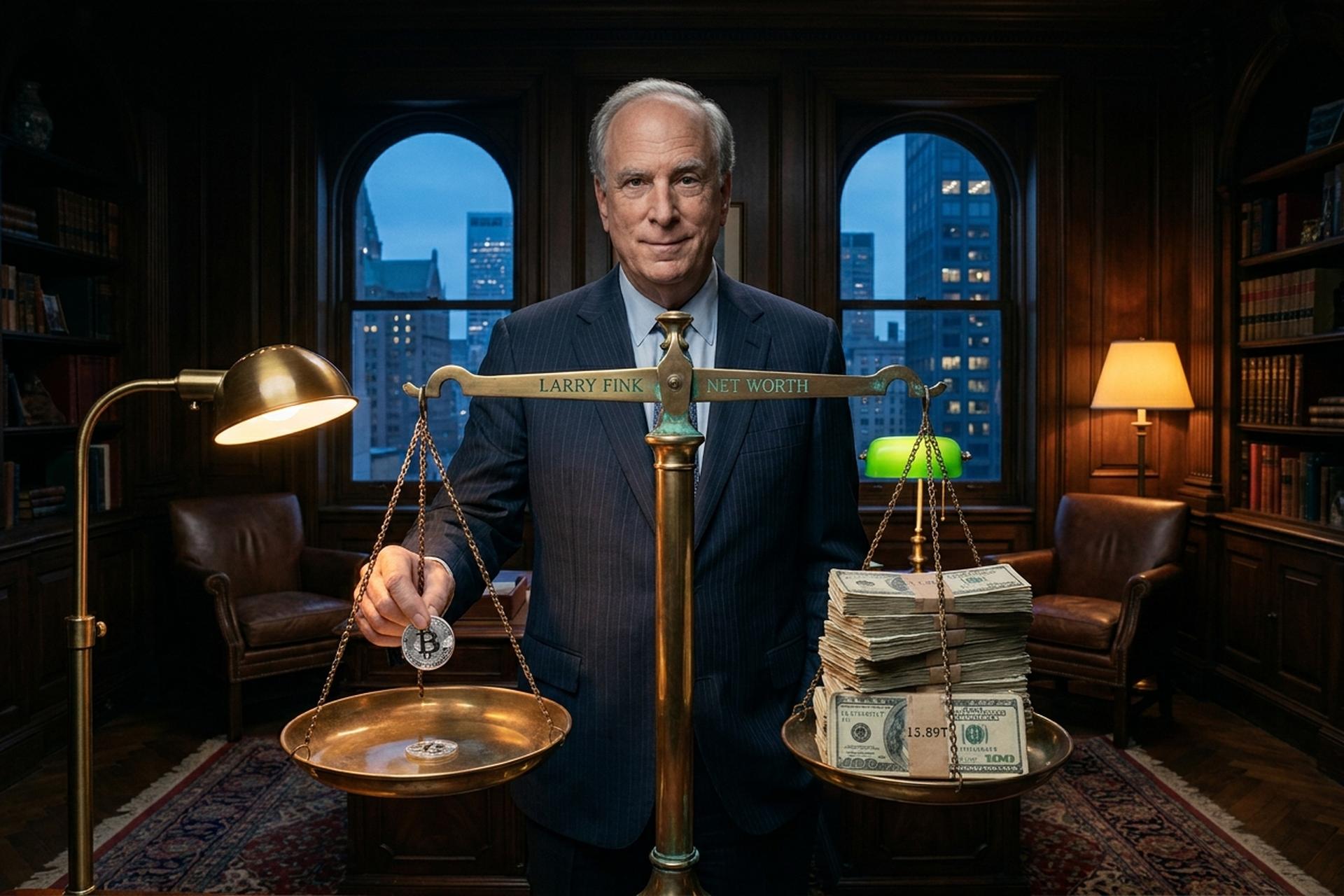
Most Wall Street billionaires make their money owning what they build. Larry Fink built something much larger than himself and owns only a sliver of it. That sliver is still worth more than a billion dollars, but it hides the real story: the man who runs the world's largest asset manager has spent the past two years quietly moving the same financial machine into Bitcoin, tokenized Treasuries, and on-chain funds. Understanding Larry Fink's net worth means understanding how a modest ownership stake in BlackRock becomes a quiet empire over global capital, and how his late turn into crypto has started to change the value of that stake.
This article walks through the numbers behind Laurence Douglas Fink's fortune, how his compensation is structured, and why his 0.27% slice of BlackRock matters so much. It also traces his unusual path into digital assets, from calling Bitcoin an "index of money laundering" in 2017 to launching the fastest-growing spot Bitcoin ETF in history. The reader will come away with a clearer sense of the wealth, the man, and the crypto bet sitting at the center of both.
Larry Fink's Net Worth in 2024 and Today According to Forbes
Forbes had Larry Fink's estimated net worth at roughly $1.2 billion in April 2024. The number has since crept up as BlackRock shares outperformed the rest of the financial sector. Forbes Real-Time Billionaires pegged him at $1.3 billion on March 30, 2026, ranking him around #2,841 globally. The exact figure moves day to day with the BlackRock share price on the New York Stock Exchange. Through mid-April 2026, the BLK ticker traded in a $1,029 to $1,067 corridor, with a 52-week high of $1,219.94 and a low of $845.82.
That sounds modest next to the tech founders, but the gap is structural. Elon Musk, Jeff Bezos, and Mark Zuckerberg each run product companies where they still own large personal stakes. Fink runs a public asset manager where equity was handed out in slices to partners, executives, and employees across three decades of acquisitions. His slice is small on purpose.
The word "billionaire" entered Fink's profile in April 2018, later than many casual readers assume. Before that, most of his wealth sat in deferred stock awards that paid out slowly over years. Forbes first confirmed his billionaire status in 2018 and has tracked him on and off the real-time list ever since. He typically falls off when BlackRock stock pulls back and returns when it rallies.
Separate Fink's net worth from the money he controls. These are different numbers. BlackRock is the largest asset manager on the planet, and its trillion in assets under management keeps climbing. BlackRock's total AUM hit a record $13.89 trillion in Q1 2026, up from $11.6 trillion a year earlier, per the earnings release dated April 14, 2026. Quarterly revenue crossed $6.70 billion, a 27% jump year over year, with net inflows of $130 billion in a single three-month window. Fink does not own that money. He steers it. That is why his name sits on every serious list of the most powerful figures in finance, not his bank balance.

The CEO of BlackRock Becomes a Billionaire Shareholder
Fink's wealth sits on one small number. That number is his shareholder stake in BlackRock. The 2025 proxy statement, filed March 28, 2025, disclosed 303,686 shares beneficially owned. A separate SEC filing from February 19, 2025, reported 520,124 direct shares, making Fink the largest individual holder of BLK stock. The two figures track different disclosure standards. Either way, the effective ownership works out to roughly 0.27% of outstanding BlackRock stock. At April 2026 prices near $1,050 per share, the direct stake alone is worth somewhere between $318 million and $546 million. The rest of Fink's net worth is spread across cash, deferred awards, real estate, and outside investments.
Once the scale sinks in, the math is obvious. BlackRock's market capitalization sat in the $163 billion to $172 billion range in April 2026. Record inflows into iShares ETF products supported that level, alongside a growing stream of fees from alternative assets. When the parent company's market value moves up, every fractional share Fink holds moves with it. When it slips, so does his net worth. Sometimes by tens of millions of dollars in a single trading session.
Some analysts argue Fink is "richer" in influence than in personal balance sheet. He doesn't have to own the pie to decide how it gets sliced. As CEO of BlackRock, he sits at the top of the largest asset manager in the world. He votes proxies on behalf of pension funds, sovereign wealth funds, insurance companies, and millions of ordinary retirement accounts. That influence rarely shows up on Forbes.
The wider Fink family holds more BlackRock stock through trusts and foundations. His three children have their own careers. Son Joshua Fink ran the hedge fund Enso Capital for years. Add it all up, and the family financial footprint is bigger than the single line next to Larry's name on the Forbes list. Even so, inside BlackRock itself, the co-founder isn't close to being the largest individual shareholder. That title sits with institutional holders and index funds. Including, a little awkwardly, BlackRock's own iShares Core S&P 500 ETF.
Fink's Pay Package: What BlackRock's CEO Earns Each Year
Fink's annual pay has sat in a narrow corridor between roughly $20 million and $40 million for over a decade. BlackRock's own proxy filings list $36 million in 2021, $26.9 million in 2023, and $30.8 million in 2024. The 2025 total landed at $37.7 million, a 23% year-on-year jump disclosed in the March 2026 proxy and first reported by Reuters. Biggest annual pay rise in years. ISS, the leading proxy advisor, recommended against the package. Shareholders approved it anyway, with roughly 67% in favor — a narrow margin by BlackRock standards.
The structure of his pay matters more than the headline number. The 2025 package breaks down as follows.
| Component | 2025 amount | What it is |
|---|---|---|
| Base salary | $1.5 million | Fixed cash, stable year to year |
| Annual cash bonus | $10.6 million | Tied to firm revenue, operating margin, AUM |
| Stock awards | $24.6 million | Restricted BlackRock shares that vest over multiple years |
| Other compensation | $1.1 million | Benefits, perquisites, deferred items |
| Total | $37.7 million | +23% vs. 2024 |
Only the first two items are cash in any given year. The larger portion is equity that only turns into money if Fink stays at the firm and the stock performs over time. That design was not accidental. After the $100 million bond-desk loss at First Boston in 1986, Fink built BlackRock around a conservative, risk-aware culture. Part of that culture was pay structure: lock senior executives to long-term outcomes. He ended up the first person subject to his own system.
That structure explains why Fink's net worth swings with the market. It also explains the relatively low cash component compared with hedge fund founders. The longer he stays, the more deferred stock vests, and the more his fortune tracks BlackRock's own growth.
How Fink Co-founded BlackRock in 1988
BlackRock didn't start as a giant. It started as a bond unit tucked inside the Blackstone Group in 1988. Fink co-founded BlackRock in 1988 with Robert Kapito, Susan Wagner, and a few other First Boston alumni who walked across Manhattan to build something different. Before that, Fink had spent twelve years at First Boston as a managing director, running the mortgage-backed securities and taxable fixed-income desk. Then came the 1986 blow-up. A $100 million loss on interest-rate bets ended his run at First Boston. It also ended up shaping the rest of his career.
The new firm was originally called Blackstone Financial Management. The pitch was simple: clients needed better risk analytics for fixed-income portfolios, and nobody was offering it at real scale. Stephen Schwarzman's Blackstone put in seed capital for a 50% stake. The unit grew fast, pushed into equities, and was renamed BlackRock by 1992. Two years later, in 1994, Fink and his partners split the business off from Blackstone after a dispute over equity dilution. Fink retained leadership. He also took the title chairman of the board, which he still holds three decades later.
A handful of milestones built the wealth he holds today. In 1999, BlackRock listed on the New York Stock Exchange; the investment management corporation finally had a traded equity currency of its own. In 2006, BlackRock absorbed Merrill Lynch Investment Managers, roughly doubling AUM; Merrill took a large stake in BlackRock as payment, a trade that haunted Merrill later during the 2008 crisis. The same year, a BlackRock-led group bought the Stuyvesant Town–Peter Cooper Village complex for $5.4 billion; it was the largest U.S. residential real estate deal to that point and later defaulted, taking down a big chunk of CalPERS capital with it.
The 2008-2009 stretch is the one most insiders still talk about. Fink helped steer the Treasury's Troubled Asset Relief Program analytics. Washington leaned on BlackRock to help unwind crisis-era assets nobody else could price. Then, in December 2009, BlackRock closed the $13.5 billion acquisition of Barclays Global Investors. That single deal pulled iShares inside the firm and set up everything that has happened since.
That sequence changed what BlackRock was. Before Barclays, BlackRock was a bond shop with strong analytics and a decent equities arm. After Barclays, BlackRock was the largest asset manager on the planet. Fink was no longer a fixed-income technician. Today BlackRock is still the largest independent asset management company on any public exchange, and Fink remains the face of American finance.
Fink Said Bitcoin Is Gold: The Big Crypto Reversal
For years, Fink was the polite skeptic. On October 13, 2017, speaking at the Institute of International Finance, he called Bitcoin "an index of money laundering." That line, short and damaging, defined his public stance for most of the decade. BlackRock kept crypto at arm's length: some research notes, a small futures position, no real product push.
Then 2023 happened. By mid-2023, BlackRock had quietly filed for a spot Bitcoin ETF. In July 2024, Fink said on CNBC, "My opinion five years ago was wrong. I believe Bitcoin is a legitimate financial instrument. It allows you to have non-correlated type of returns." By October 2024 he had upgraded Bitcoin to "digital gold," comparing its 21 million-coin supply cap to the scarcity of physical gold. His 2026 annual letter to shareholders went further again, framing tokenization as "the internet in 1996" and flagging that Bitcoin could, under some scenarios, undermine the U.S. dollar itself.
Two forces drove the shift. Client demand was one. Pension funds, family offices, and sovereign wealth funds kept asking BlackRock for regulated Bitcoin exposure they could hold as easily as any other ETF. The second was internal: BlackRock's own analysis of how Bitcoin behaved during the 2022-2023 banking stress. The data showed Bitcoin did not move in lockstep with traditional risk assets in the way critics had assumed.
On January 10, 2024, the U.S. Securities and Exchange Commission approved a batch of spot Bitcoin ETFs. The next day, BlackRock's iShares Bitcoin Trust, ticker IBIT, went live. It became the fastest ETF in history to hit $70 billion in assets. It took 341 days, per etf.com. By early 2026, IBIT held more than 800,000 BTC, over 3% of the total supply, with AUM somewhere between $54 billion and $68 billion depending on the data feed. It commanded roughly half the spot Bitcoin ETF category. Cumulative net inflows since launch were near $62.5 billion. Q1 2026 alone added $8.4 billion. The man who once compared crypto to money laundering is now the single most important institutional gatekeeper for Bitcoin access in the United States.

Fink Also Turned BlackRock into a Crypto ETF Giant
IBIT was only the opening move. Fink also pushed BlackRock into tokenized assets, on-chain fund infrastructure, and Ethereum products. The result is a small but rapidly growing set of crypto-linked lines in BlackRock's revenue statement that directly influence the BlackRock shareholder value behind Fink's personal wealth.
Three products anchor the push.
| Product | Launch | What it does | Approximate size (2026) |
|---|---|---|---|
| iShares Bitcoin Trust (IBIT) | Jan 11, 2024 | Holds spot Bitcoin in regulated custody | $54-68 billion AUM, 800,000+ BTC |
| iShares Ethereum Trust (ETHA) | Jul 23, 2024 | Spot Ethereum exposure via ETF | $6.2-7.3 billion AUM |
| BUIDL (BlackRock USD Institutional Digital Liquidity Fund) | Mar 20, 2024 | Tokenized money market fund on Ethereum | $2.85 billion AUM, ~4.5% yield |
Individually, none of these is large next to BlackRock's $13.89 trillion total AUM. Together, they represent the largest move into public blockchain infrastructure by any traditional asset manager. BUIDL alone pushed BlackRock near the front of the tokenized U.S. Treasury market, a segment that barely existed before 2024 and now totals over $5 billion, up from less than $800 million at the start of 2025. DeFi protocols, stablecoin issuers, and institutional treasurers now use these tokenized Treasuries as on-chain cash.
Fink's argument in the 2024 annual letter to shareholders framed tokenization as the next logical step after the ETF: a way to wrap any financial asset in a programmable form, settle instantly, and lower costs. In the same letter, Fink said the technology itself was neutral but the rails mattered, and that BlackRock intended to be early on those rails rather than late.
The translation to his net worth is indirect but real. IBIT alone is estimated to generate $187 million to $245 million a year in management fees at its 0.25% expense ratio, according to Bloomberg and Fortune analysis through 2025. Every basis point from IBIT, ETHA, and BUIDL flows into BlackRock's top line, contributes to the operating margin behind the firm's record $6.70 billion Q1 2026 revenue, and feeds into the share price that Fink's 0.27% stake tracks. Crypto did not create Larry Fink's billion dollars. It is, however, now one of the drivers that decides whether the number ticks higher or lower.
Larry Fink vs His Billionaire Peers: The Gap Explained
Compared to hedge fund founders like Ray Dalio, or private equity chiefs like Stephen Schwarzman, Fink sits on a much smaller pile of personal wealth. Bloomberg's Billionaires Index had Dalio near $20 billion in February 2026. That fortune comes from decades of Bridgewater carried interest. Schwarzman, whose Blackstone Group originally seeded BlackRock in 1988, was worth between $43 billion and $48 billion in early 2026. He still owns roughly a fifth of Blackstone and pulled in $1.24 billion in 2025 pay alone, mostly from carry and dividends. Jeffrey Gundlach of DoubleLine, a bond guy closer to Fink's model, lands in the $1.6 billion to $2.3 billion range.
The difference is structural. A traditional asset manager like BlackRock earns basis points on trillions, not performance fees on billions. That revenue gets spread thin across thousands of employees and public shareholders. Hedge funds and private equity partnerships concentrate the upside in a small group. Fink made a different bet: broader scale, lower margins, broader ownership. The asset management model he helped define does not mint personal billions at the same pace as a performance-fee model.
This is also why comparisons with tech founders miss the point. Mark Zuckerberg, Elon Musk, and Jeff Bezos built companies they still own outright or nearly so. Fink built a public utility for the world's savings and gave most of the equity away to partners, employees, and the market.
The Hidden Wealth of BlackRock's Larry Fink
Larry Fink's net worth will always look small compared with the size of what he controls. A little over a billion dollars does not capture the weight of voting $13.89 trillion in client capital, or the influence of being the first major traditional CEO to back spot Bitcoin ETFs at scale. It also does not capture the layered nature of his fortune: a base salary of $1.5 million, a pay package built around deferred BlackRock stock, a 0.27% shareholder stake, and a growing crypto revenue stream feeding the same share price.
The question worth watching through 2027 and beyond is whether the crypto push keeps paying. If IBIT stays dominant and tokenized finance expands as Fink predicts in his annual letter to shareholders, the BlackRock stock that makes up most of his net worth has a natural tailwind. If the thesis disappoints, the personal fortune of the world's most influential asset manager will remain where it has been for years, tied to basis points on trillions. Either way, the billionaire and the institution are no longer separable, and neither is the crypto strategy he once rejected.