What is Blur NFT marketplace? The pro-trader platform that dethroned OpenSea
In early 2023, a marketplace nobody heard of six months earlier was processing 84% of all Ethereum NFT trading volume. OpenSea, the platform that defined NFT trading for three years, was left holding 17%. The newcomer was Blur. Zero marketplace fees. Tools built for speed. Airdrops that rewarded volume over loyalty. Professional traders switched overnight.
The story since then has been more complicated. OpenSea fought back with its own token announcement. Blur's share dropped. The NFT market itself crashed hard. Blur's founder launched Blast, an Ethereum L2 that soared to $2.7 billion in TVL and then collapsed 97%. The BLUR token went from $5.02 to $0.02.
This article covers what Blur actually is, how it works, why traders chose it over OpenSea, what happened to the Blend lending protocol, the Blast connection, and where Blur stands in a 2026 NFT market that looks nothing like 2023.
How Blur works
Blur is an Ethereum NFT marketplace and aggregator built for traders, not collectors. While OpenSea focused on making NFT buying friendly for everyone, Blur focused on making it fast and cheap for people who trade NFTs like stocks.
The core features that set it apart:
Zero marketplace fees. Blur charges 0% on trades. OpenSea charges 2.5% (reduced at various points). For a trader doing $100,000 a month in volume, that fee difference is $2,500 saved. Over a year, that adds up to a car payment. Professional traders moved to Blur because the math made it obvious.
Sweep tool. You can buy dozens of NFTs from a collection in a single transaction. On OpenSea, you buy one at a time. For someone who wants to grab the 20 cheapest Pudgy Penguins in one click, the sweep tool is the reason Blur exists.
Real-time floor tracking. Blur shows live floor prices, bid depth, and collection analytics on a dashboard that looks more like a trading terminal than an art gallery. Charts, order books, portfolio views. If you have ever used a stock trading platform, Blur feels familiar.
Aggregation. Blur pulls listings from OpenSea, LooksRare, and other marketplaces into one interface. You see all available NFTs across platforms and trade from one place. That aggregator function means you do not need to check multiple sites.
The trade-off is that Blur is not for casual users. There is no curated homepage with trending art. No recommendations for first-time buyers. If you do not already understand floor prices, bid walls, and collection dynamics, the interface is overwhelming. Blur was built for people who already know what they are doing.
Blur vs OpenSea: what actually happened
The Blur vs OpenSea war was the biggest story in NFTs for over a year. Here is how it played out by the numbers.
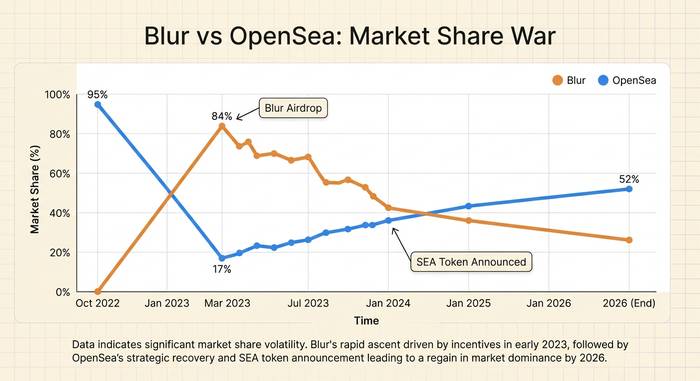
Blur launched in October 2022 with a beta period and airdrop mechanics that rewarded users for listing and bidding. By February 2023, Blur was processing more volume than OpenSea. By March, Blur held 84% of Ethereum NFT volume.
The weapon was the airdrop. Blur distributed BLUR tokens based on trading activity. The more you traded, the more tokens you earned. Traders who would have sat still suddenly had a financial incentive to move volume. Some of that volume was wash trading, people selling NFTs to themselves to farm airdrop rewards, but a huge chunk was real activity driven by a genuinely better product.
OpenSea fought back in February 2025 with the announcement of the SEA token. The market shifted overnight. OpenSea's share jumped from 25.5% to 71.5% in a single week as traders moved volume to qualify for the OpenSea airdrop. Blur's share dropped below 24%.
| Period | Blur share | OpenSea share | What happened |
|---|---|---|---|
| October 2022 | Launch | ~95% | Blur enters market |
| March 2023 | 84% | ~17% | Airdrop farming drives volume |
| August 2025 | ~80% | ~17% | Blur dominates ETH NFTs |
| February 2025 | Declining | 71.5% | OpenSea $SEA token announced |
| Early 2026 | ~25-30% | ~52% | Market normalized |
As of 2026, OpenSea has 382,000 monthly active users. Blur has about 38,300. OpenSea supports 19 blockchains. Blur is Ethereum only. The picture is clear: OpenSea reclaimed the mass market, and Blur kept the pro-trader niche.
Blend: the NFT lending protocol
Blend (Blur Lending) launched in May 2023 as a peer-to-peer NFT lending protocol. The idea: use an NFT as collateral to borrow ETH without selling it. Same concept as crypto-backed loans, but with JPEGs instead of BTC.
The numbers at peak were impressive. Blend processed 169,900 ETH ($308 million) in its first 22 days. Q1 2024 volume hit $2.02 billion. At its peak, Blend controlled 92.9% of all NFT lending, making it the dominant protocol by a massive margin.
Then the NFT market collapsed. Borrowers disappeared. 90% fewer borrowers compared to the January 2024 peak. Lenders dropped 78%. Average loan size shrank from $14,000 to $4,000. By March 2025, monthly volume was just $47 million, down from $562 million a year earlier. Gondi overtook Blend as the market leader with 54% share.
Blend is still operational. But it is a product built for a market that no longer exists at 2023-2024 scale. If NFTs recover, Blend recovers. If they do not, Blend stays a niche tool.
Blast L2: the Pacman connection
Blur's founder Tieshun Roquerre, who goes by Pacman, also created Blast, an Ethereum Layer 2 blockchain. The connection matters because Blur, Blast, and Blend are all part of the same ecosystem with the same person behind them.
Blast launched with a bold pitch: native yield on ETH and stablecoins. Your ETH earns staking yield just by sitting on the network. Your stablecoins earn RWA yield automatically. No staking required. The TVL response was explosive. $400 million in deposits in the first three days. $2.7 billion TVL at peak in June 2024. 180,000 daily active users. Over 200 dApps launched.
Then it cratered. TVL dropped 97% to about $65 million. Daily users fell to 3,800. Revenue hit effectively zero. Many of the dApps that launched on Blast moved to other chains or shut down.
Blur traders and BLUR holders received 1% of the BLAST token supply through the Season 3 airdrop. The Blur Foundation received 3%. This created an incentive loop: use Blur, earn BLUR, stake BLUR, earn BLAST. In theory it was a flywheel. In practice, both tokens lost over 95% of their value from highs.
The honest assessment: Pacman is good at launching products that attract massive initial interest. Sustaining that interest has proven harder. Both Blur and Blast had explosive starts followed by steep declines as the underlying markets (NFTs, L2 competition) moved against them.
The BLUR token
BLUR launched via airdrop in February 2023. Initial price: $5.02. Current price in April 2026: $0.0178. That is a 99.6% drop.
Total supply is 3 billion BLUR. About 2.8 billion are circulating. The community treasury holds 51% of supply, with contributors at 29% and investors at 19%. Final token unlocks for team and investor allocations run through February 2027.
What BLUR does: governance voting on protocol changes and marketplace parameters. A fee switch proposal (BIP-1) suggested adding a 0.5% protocol fee to fund buybacks for BLUR stakers. A separate proposal from Arca pushed for a 1% fee with daily buyback-and-burn. Neither has passed as of April 2026. Blur still operates with zero marketplace fees and the BLUR token has no direct fee accrual.
| BLUR token snapshot | Value |
|---|---|
| Price (Apr 2026) | $0.0178 |
| Market cap | ~$49 million |
| All-time high | $5.02 (Feb 2023) |
| Total supply | 3 billion |
| Circulating | ~2.8 billion (93%) |
| Community allocation | 51% |
| Fee switch status | Not passed |
Where Blur stands in 2026
The NFT market in 2026 is a shadow of 2022. Total transaction volume dropped from a peak above $17 billion to roughly $5.5 billion in 2025. NFT market cap fell below $1.5 billion, pre-2021 levels. The market is shifting from speculation to utility: gaming NFTs now represent 38% of all transaction volume.
Blur still processes meaningful volume on Ethereum. In August 2025, Blur did $135 million against OpenSea's $65 million. But user counts tell a different story. OpenSea has 10x more monthly active users. Magic Eden dominates Solana and Bitcoin Ordinals. The competitive field is wider than it was in 2023.
The fundamental question for Blur is whether pro-trader NFT tools still have a market when the asset class they trade has shrunk by 70%. The zero-fee model works when volume is high. When volume drops, there is no revenue. And without a fee switch, the BLUR token captures none of the activity that does exist.
Blur is not dead. The product still works. The tools are still the best for Ethereum NFT trading. But the market Blur was built for is a fraction of what it was, and the token reflects that.