Sort Code and Account Number: UK Bank Details Explained
Every UK bank account has two core identifiers: a sort code and an account number. They're the backbone of the domestic payment system — without them, no transfer, Direct Debit, or payroll run goes anywhere. If you've been asked for your bank details and weren't sure what a sort code and account number actually are, or how they compare to IBAN and SWIFT codes used in international transfers, this article breaks down both in plain terms.
What Is a Sort Code in UK Banking
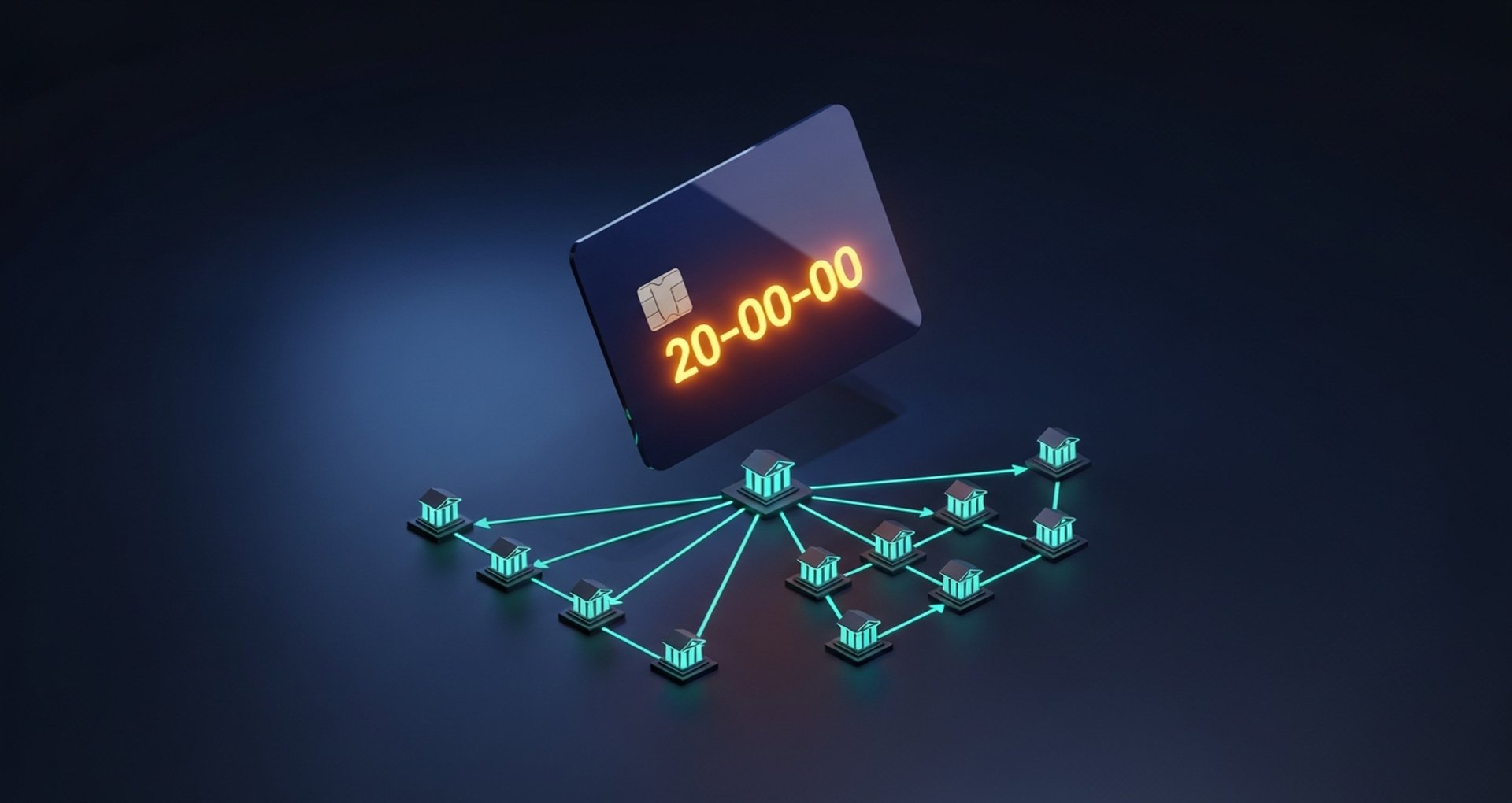
Take any UK debit card and you'll find a six-digit number on it, typically grouped as three pairs separated by hyphens. That's the sort code. 20-00-00 is Barclays; 30-00-00 is Lloyds. Each pair does a different job:
- First two digits — identify the bank (20 = Barclays, 09 = Santander)
- Middle two digits — identify the region or processing centre
- Last two digits — identify the specific branch
The system goes back to 1957. UK banks needed a way to automate cheque clearing, so they built a six-digit code into every account. Clerks used to sort payment slips by hand — hence the word "sort." The name stuck after the process went digital.
Sort codes exist only in the UK and Republic of Ireland. No equivalent runs anywhere else. Developers and businesses building integrations with UK payment systems often look for a sort code equivalent in their own country's system — there isn't one.
Every sort code is registered with the UK Payments Administration (UKPA) and linked to the Payment Scheme Registration database. Before processing a transfer, banks query that database to confirm the routing details are valid.
What Is a Bank Account Number and How Many Digits
Your bank account number is the unique identifier for that specific account. Not the bank, not the branch — the account itself. Open a current account and a savings account at the same bank and you'll get the same sort code but two completely different account numbers.
In the UK, bank account numbers are 8 digits. Some older accounts were issued with 6 or 7 digits originally; modern payment systems pad those with leading zeros to hit the 8-digit standard.
Here's how account identifiers compare across major banking systems:
| Country / Region | Identifier | Length | Used For |
|---|---|---|---|
| UK | Sort code + account number | 6 + 8 digits | Domestic transfers |
| USA | Routing number + account number | 9 + up to 17 digits | Domestic transfers (ACH/wire) |
| Europe | IBAN | Up to 34 characters | Cross-border + domestic transfers |
| Australia | BSB + account number | 6 + 6–10 digits | Domestic transfers |
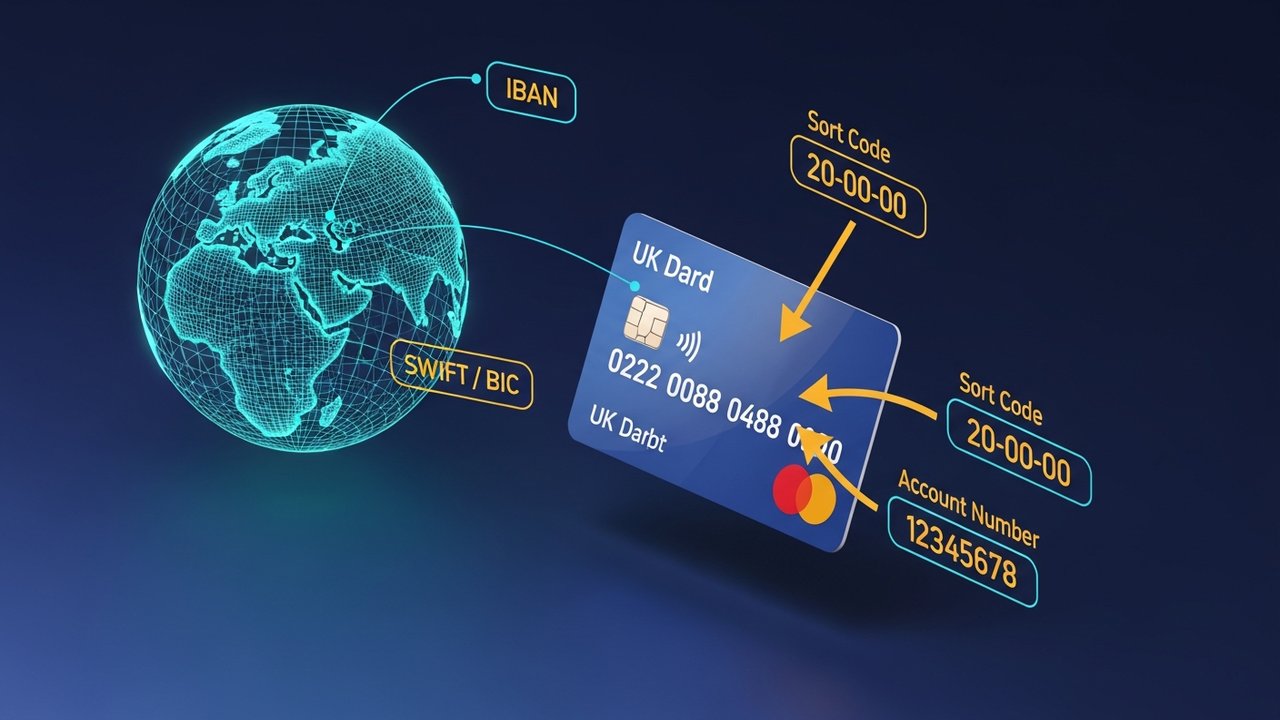
A UK IBAN isn't a separate piece of information. It encodes your sort code and account number within it — starting with GB, then 2 check digits, a 4-letter bank code, the 6-digit sort code, and the 8-digit account number. Total: 22 characters. When sending money internationally from a UK account, the receiving bank will ask for the IBAN rather than the sort code by itself.
Where to Find Your Sort Code and Account Number
Four places to check:
- Debit card — most UK banks print the sort code and account number on the front or back of the card, below the 16-digit card number. Some neobanks like Monzo and Starling only show these in the app, not on the physical card.
- Online banking or mobile app — log in and go to account details. Sort code and account number sit on the main account screen for practically every UK bank.
- Bank statements — printed and digital bank statements both list the sort code and account number near the top. If you've recently switched banks, this is the most reliable place to check.
- Cheque book — the bottom strip of every cheque shows three number groups: cheque number, sort code (six digits, no hyphens), and account number, in that order left to right.
Still can't find them? Call your bank or visit a branch. After verifying your identity, they'll confirm both details directly.
When Do You Need a Sort Code and Account Number
Any time money moves through the UK domestic banking system, both numbers are required. That covers:
- Setting up a Direct Debit — utility bills, subscriptions, mortgage repayments, and gym memberships all pull payments this way
- Receiving your salary — employers run payroll through Bacs, which routes each payment using the employee's sort code
- Making a domestic bank transfer — whether through Faster Payments, Bacs, or CHAPS, you need both to send money to another UK account
- Standing orders — recurring payments like rent go through the same routing system
- Getting paid by clients or customers — anyone sending money to your UK bank account will ask for your sort code and account number
The UK has three main payment rails that all depend on sort codes:
- Faster Payments — near-instant, 24/7, up to £1 million per transaction
- Bacs — used for payroll and Direct Debits, three working days to settle
- CHAPS — same-day settlement, no upper limit, mainly used for property transactions
Sort Code vs IBAN vs SWIFT/BIC Code
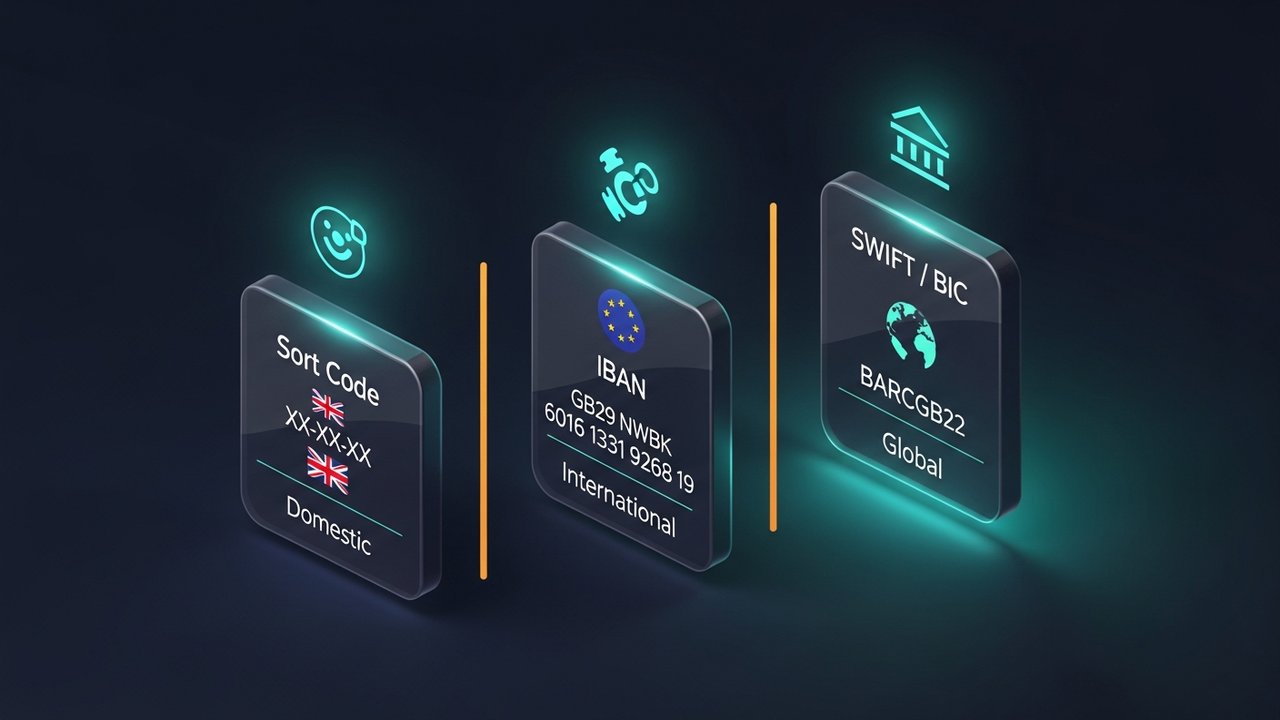
A sort code handles UK domestic transfers. Cross a border and you need different identifiers. Mixing them up causes failed payments and delays that can take days to unwind.
| Identifier | Scope | Format | Typical Use Case |
|---|---|---|---|
| Sort code | UK domestic only | XX-XX-XX (6 digits) | UK bank-to-bank transfers |
| IBAN | International (especially EU) | Up to 34 alphanumeric chars | Cross-border EU transfers, UK international payments |
| SWIFT / BIC code | Global | 8–11 alphanumeric chars | International wire transfers |
A BIC (Bank Identifier Code) and a SWIFT code refer to the same thing. BIC is the ISO standard name; SWIFT is the messaging network that uses it. When a foreign bank sends money to a UK account, it uses the IBAN to identify the destination account and the BIC to route the payment through the SWIFT network.
Wire transfer limits also vary by payment type. International wires through SWIFT often carry bank fees and intermediary charges that domestic sort code transfers don't.
Is It Safe to Share Your Sort Code and Account Number
Your sort code and account number are meant to be shared. Anyone paying you needs them — employers, clients, customers, even a friend splitting a bill. Without them, the money has nowhere to go. On their own, these details can't move funds out of your account.
A few things to keep in mind anyway:
- Never give out your PIN — with your card in hand, that's direct account access for whoever has it
- Don't share your full debit card number at the same time — that combination enables specific types of fraud
- Keep your CVV private — the three digits on the back of the card are for online card payments, not bank transfers
The scam most people don't recognise: someone calls claiming to be from your bank, already knowing your sort code and account number, then asks for the one-time passcode that just landed on your phone. That passcode is all they actually need — it authorises outgoing transactions. Hang up.
The UK's Confirmation of Payee (CoP) system adds a safety net on transfers. When you enter a sort code and account number, your bank checks that the name on the account matches what you typed. A mismatch doesn't stop the payment, but it does flag a warning before anything moves.
How to Validate a Sort Code and Account Number
Payroll processors, marketplaces, and lending platforms all collect UK bank details from users — and they all need to verify those details are real before sending a payment. Two tools exist for this.
Sort code checker tools confirm that a sort code exists and is active. Most pull from the UKPA's publicly available sort code directory. Run a lookup and you get back the bank name, branch address, and which payment schemes — Bacs, Faster Payments, CHAPS — that sort code supports.
Modulus checking is a deeper validation. Vocalink, the company that operates the UK's payment infrastructure, publishes an algorithm that checks whether a sort code and account number are mathematically compatible. UK banks run this check automatically before processing any transfer. Developers can implement the same logic using open-source libraries or third-party APIs. A single API call can catch a transposed digit before it becomes a failed payroll run.
Account number validation at scale is genuinely useful — customer complaints about misdirected payments are almost entirely preventable.
Sort Codes vs Routing Numbers: UK vs US
The question comes up constantly in fintech: is a sort code the same as a US routing number? Functionally yes, structurally no.
The US ABA routing number is 9 digits, introduced in 1910 by the American Bankers Association. It identifies the financial institution and the Federal Reserve district. US account numbers are submitted separately and vary from 8 to 12 digits.
A UK sort code is 6 digits and maps to both the bank and the branch. That's different from the US system, where a routing number like Chase's 021000021 applies to the same bank across thousands of branches. In the UK, the branch where you opened your account affects your sort code — move your account and it can change.
This matters when building multi-currency platforms. UK payment integrations take a sort code plus an 8-digit account number. US ACH integrations take a routing number plus a separate account number. They're not interchangeable, and assuming otherwise is one of the more reliable ways to break an onboarding flow.
Crypto Payments as an Alternative to Sort Code Transfers
Send money across a UK town and a sort code handles it in seconds. Send money to another country and it gets complicated fast — IBAN conversion, SWIFT routing, intermediary banks taking fees at each step, and potentially five working days before anything lands.
Crypto payments don't work that way. There's no sort code, no IBAN, no chain of correspondent banks. Someone with a crypto wallet in Singapore can pay a business in Manchester and the funds arrive in minutes. The fee is the same whether you're moving £50 or £50,000.
For online businesses with customers outside the UK, this matters. Direct debit mandates don't work for international buyers. Wire transfers are slow and expensive. Setting up a cryptocurrency payment gateway sidesteps both problems.
When figuring out which gateway fits, choosing a crypto payment gateway that handles the right assets and connects cleanly to your checkout is the first call to make.
Plisio covers Bitcoin, Ethereum, Litecoin, USDT, and a dozen more at a flat 0.5% fee. No merchant KYC. The API typically takes an afternoon to wire in.
Conclusion
The sort code tells the banking system which bank and branch to reach. The account number tells it which account. Both are needed for every domestic transfer, Direct Debit, and payroll payment in the UK. For anyone living or doing business in the UK, knowing your sort code and account number — and understanding what they do — is basic financial literacy.
For developers and businesses working across borders, sorting out how sort codes relate to IBAN, SWIFT/BIC, and US routing numbers removes a recurring point of confusion in payment integrations.
And for businesses that want to skip the routing infrastructure altogether, crypto payments have become a practical alternative to traditional UK bank transfers for international transactions.