What Is Tokenomics? 2026 Guide to Crypto Tokens
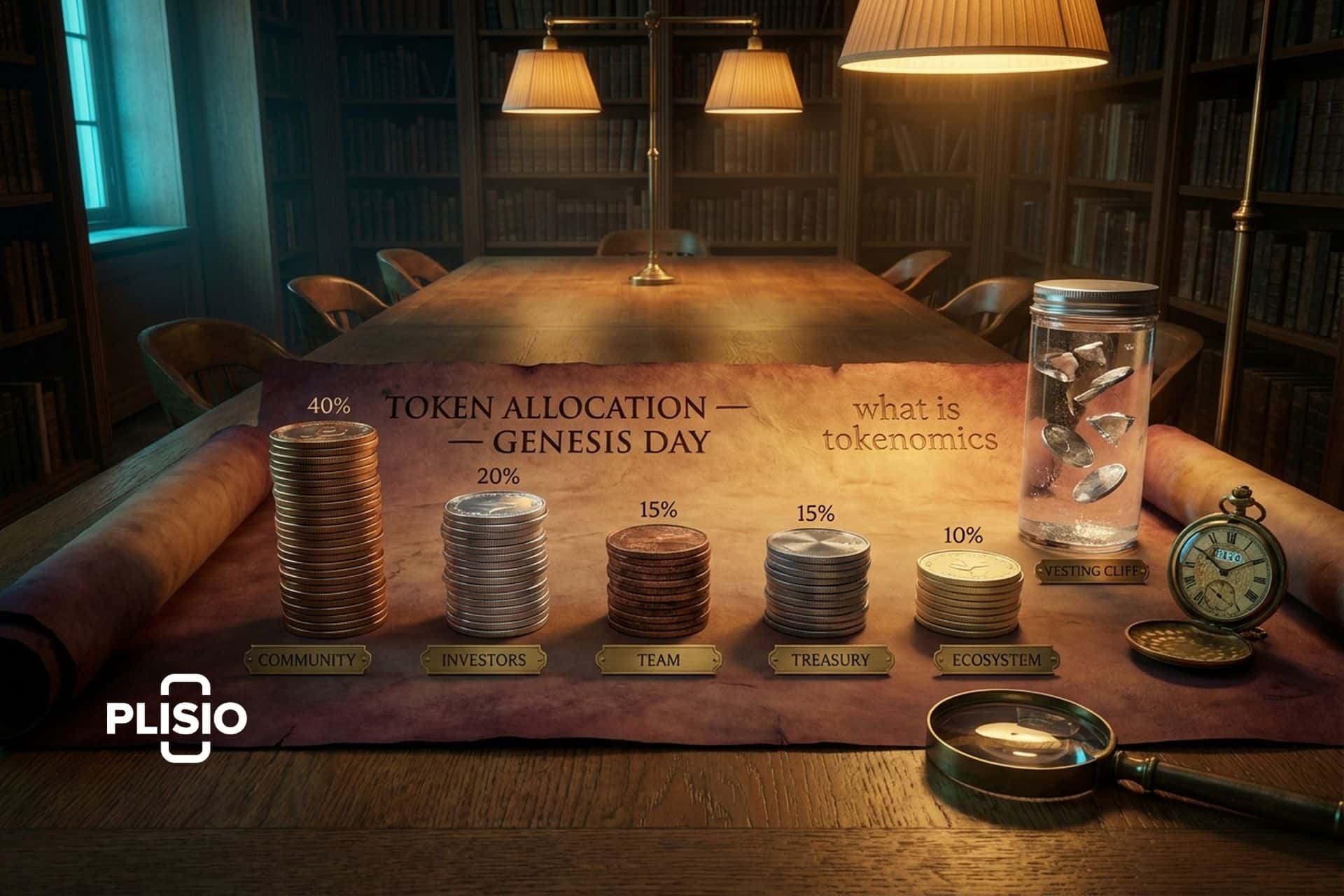
Ask ten crypto investors what killed a project they used to hold. Half of them will name a chart that looked fine until an unlock hit. Not a hack. Not a rugpull. A scheduled release of tokens nobody was ready to buy, coming out of a vesting schedule someone wrote into the protocol two years earlier. That is tokenomics in action. It is the boring part of crypto. It is also the part that quietly decides who makes money and who does not.
Tokenomics is the economic design of a crypto token: how many exist, who owns them, how new ones come into circulation, what they are used to pay for, and what happens when they get used. The word tokenomics combines "token" and "economics," and it shows up in every serious investor checklist from a16z to Messari to Binance Research. This guide walks through what tokenomics actually is, the fundamentals every holder should understand, how to study a project's tokenomics on any chain, which red flags matter, and the real 2024-2026 token launches that either validated or blew up their own tokenomic assumptions. Understanding tokenomics is not just a theoretical exercise; it is the closest thing crypto has to reading a company's cap table before buying shares.
What is tokenomics and why it matters in crypto
Tokenomics studies the supply, demand, and value-capture design of a cryptocurrency. Wikipedia's entry defines it as "the study and analysis of the economic aspects of a cryptocurrency or blockchain project," and every major educational source (CoinGecko, CoinMarketCap, Nansen, Arkham Intelligence) converges on the same basic idea: tokenomics tells you what a digital asset is, what its use cases are, who holds it, and why it might be worth something later. Both inflationary and deflationary tokenomics models fit under this umbrella, and different cryptocurrencies pick different trade-offs between the two.
The reason it matters is simple. A crypto project can have brilliant engineers, a real product, and a huge user base and still see its token collapse if the tokenomics are broken. The opposite is also true. Bitcoin has the simplest possible tokenomics (supply capped at 21 million, halving emission, no utility beyond being held or sent) and that simplicity is exactly why BTC works as a monetary asset. Token design is where monetary policies meet the smart contract code, and once the contract is deployed to the blockchain network, the rules are very hard to change. Classic game theory says the incentives you set at launch are the incentives you live with.
In March 2025, a16z Crypto's Miles Jennings, Scott Duke Kominers, and Eddy Lazzarin argued that even "tokenomics" is too narrow a frame and proposed a broader term, "tokenology," to cover mechanism design, governance, and coordination. That debate is worth knowing about, but for a working investor the word "tokenomics" still does the job. Call it what you want. The questions are the same.
The fundamentals of tokenomics every investor should know
The fundamentals of tokenomics break down into a handful of categories that every institutional framework covers. Tokenomics includes supply mechanics, distribution logic, utility, and value accrual, and Messari, Delphi Digital, Binance Research and a16z all publish variations of the same checklist. Understanding the factors below is the difference between reading a whitepaper and trading on vibes. Here is the short version.
- Supply: how many tokens exist, how many are in circulation today, and how many can ever exist (the max supply or hard cap).
- Allocation: who got tokens at launch, meaning founders, early investors, community, treasury, ecosystem fund.
- Emission and vesting: the schedule on which locked tokens unlock into circulation, including cliffs and linear unlocks.
- Utility: the specific things the token can actually do inside the ecosystem.
- Incentives and sinks: the mechanisms that pull tokens out of circulation or reward holding (staking, burns, buybacks, fee-switches).
- Value accrual: whether the token actually captures value generated by the protocol, or sits on the sidelines as a governance stub.
Miss any of these and your investment thesis is incomplete. Get all six right and you are doing the same work a fundamental VC analyst does before wiring a check.
Token supply in cryptocurrency: total, max, circulating
Every token has three supply numbers, and they are easy to confuse. Tokenomics plays out in the relationship between them more than in any single figure.
- Circulating supply is what is actually tradeable right now, held in public wallets and exchanges.
- Total token supply is everything that exists, including locked team tokens, vested investor allocations, and treasury reserves not yet released.
- Maximum supply is the absolute cap on the supply of tokens, the ceiling hard-coded in the contract. Bitcoin's is 21 million. Many crypto projects have no max, which means new tokens are created and distributed forever.
The ratio of circulating supply to total supply is called the float. A low float (say 12 percent) means most of the supply is still locked and scheduled to unlock later. Binance Research's May 2024 paper "Low Float & High FDV: How Did We Get Here?" documented that tokens launched in 2024 averaged a market-cap-to-fully-diluted-valuation ratio of just 12.3 percent, which is a technical way of saying most 2024 launches sold a tiny slice of the total supply at an inflated price. An estimated $155 billion in tokens will unlock between 2024 and 2030 across existing vesting schedules.
The token's supply curve and the token unlock schedule are the two numbers that drive this. That overhang is the single biggest source of predictable sell pressure in the crypto market right now, and the effect on market cap can be brutal. A Keyrock study of more than 16,000 historical unlock events found that unlocks are almost universally negative for price, with team-token unlocks the sharpest at around minus 25 percent average drawdown. Ecosystem unlocks were slightly positive (plus 1.2 percent) because they usually go into incentive programs rather than hitting an order book.
Token distribution and vesting schedules explained
Token distribution is how tokens are distributed across stakeholders at launch. The categories are fairly standard across projects, and they decide what portion of their token supply each group controls.
- Community: airdrops, retroactive rewards, public sales, liquidity mining.
- Investors: seed, Series A, pre-sale rounds, typically with one-year cliffs and two-to-three-year vesting.
- Team and core contributors: founder and employee allocations, usually with the longest lockups.
- Treasury: protocol-controlled reserves for future grants, development, and strategy.
- Foundation and ecosystem: grants, partnerships, research pools.
Vesting schedules dictate when each bucket unlocks. A cliff is a hard date when a tranche drops into circulation in a single step (Celestia's October 30, 2024 cliff released 175.59 million TIA, about $920 million, in a single day, expanding circulating supply by 79.6 percent overnight according to CoinDesk). A linear unlock releases tokens in equal daily or monthly steps over a longer period. Most professional analysts prefer linear unlocks because the price impact is smoother, though Keyrock's data shows large cliffs actually recover better at the 30-day mark in some cases.
If a project's team plus investor share is over 30 percent with a vesting cliff under two years, treat that as a flashing red warning light. That is the template for the 2024-2025 low-float-high-FDV trade that Messari's March 2026 report found produced only 6 profitable token sales out of 41 since the start of 2025, averaging minus 46 percent.
Token utility: why crypto tokens need a real job
Token utility is the answer to a very direct question: what is the utility of a token, and what does the token issuer actually let it do? A token might be used to validate transactions, to allow users to access premium features, to pay transaction fees, or to collateralize lending. If the honest answer is "nothing except voting," be careful. Governance-only tokens can work, but they need a real governance surface, a real treasury worth governing, and a clear value-accrual story. Most do not have all three. Well-designed tokenomics always includes at least one hard use case that goes beyond governance.
Strong utility tokens tend to do one or more of these:
- Pay for a real service (ETH for gas fees, LINK for oracle feeds, RENDER for GPU time).
- Secure the network (ETH staked by validators, SOL staked by delegators, JTO for Solana MEV).
- Act as collateral (stETH, wBTC, frxETH routed through DeFi lending).
- Unlock product features (BNB fee discounts, JTO fee priority, GMX points).
Governance tokens sit in their own category. A governance token only exists to be voted with, and if the protocol generates revenue that flows entirely to equity holders in the parent company, the governance token is a governance stub. This was the criticism leveled at UNI for years until Uniswap's December 26, 2025 "UNIfication" proposal finally passed, activating protocol fees and redirecting them to a UNI burn mechanism. About 125 million UNI voted in favor, 742 against. Talos analysis estimated the mechanism would have burned roughly $150 million of UNI year-to-date if it had been live. That is what real value accrual looks like.
Incentives, governance and decentralized tokenomic design
Incentives shape behavior. Governance decides the rules. Decentralized design tries to keep both out of the hands of any single party. Good tokenomics ties these three together so that the people who use a protocol and the people who hold its token are the same people, most of the time.
Staking rewards and yield farming programs are how protocols bootstrap participation. They give out tokens to early users to make the blockchain network liquid and functional. The problem with emission-heavy incentives is that they inflate circulating supply and create sell pressure from users who never intended to lock up their tokens. The fix, in modern tokenomic design, is to pair incentives with sinks: token burns that permanently remove tokens from circulation, fee-switches that buy and burn, staking lockups with multi-year vesting, and vote-escrow models like Curve's veCRV. These sinks are what keep a token valuation from eroding every time a new batch of emissions hits the market. Curve has one of the longest-running working examples: 50 percent of Curve pool trading fees and 100 percent of crvUSD stablecoin interest flow to veCRV lockers, rewarding long commitment directly.
Governance, meanwhile, is worth looking at on two axes: who can vote, and what can they actually decide. A DAO that can move the treasury, change the fee-switch, and upgrade the core contracts has a real token. A DAO that can vote on the color of the front end does not.
How to run a tokenomics analysis on any project
Tokenomics analysis is a repeatable process, not a vibe check. Here is the ten-point framework most institutional analysts walk through, compressed. Use it as a checklist, not a philosophy.
1. Pull the supply numbers. Max, total, circulating, and the market-cap-to-FDV ratio. Anything under 20 percent float is a flag.
2. Read the allocation chart. Team, investors, community, treasury. Add up insider share. Over 30 percent is a caution.
3. Pull the vesting schedule. Cliffs, linear unlocks, end dates. Use tokenomist.ai or cryptorank.io.
4. Identify the utility. Describe the token's job in one sentence. If that sentence has the word "governance" alone, dig deeper.
5. Map the sinks and faucets. What emits tokens? What removes them? Is the ratio sustainable?
6. Check value accrual. Does the token capture protocol revenue in a hard, code-level way?
7. Check fair distribution. Was this an airdrop, an ICO, a fair launch, or a VC round?
8. Check liquidity. Real CEX and DEX depth, not just FDV on paper.
9. Check governance concentration. Who controls the top 10 voting wallets?
10. Check transparency. Is the unlock schedule on-chain, auditable, and verifiable?
If a project scores well on eight of those ten, the tokenomics are probably sound. If it fails on three or more, especially on float and vesting, the price chart is living on borrowed time. Simple as that.
Bitcoin and Ethereum as reference tokenomics models
You cannot understand tokenomics without understanding the two tokens that set the template. Bitcoin and Ethereum are the reference points every later design is measured against.
Bitcoin has a 21 million coin hard cap. About 20.01 million BTC have been mined as of April 2026, roughly 93 percent of the total. The fourth halving on April 20, 2024 cut the block reward from 6.25 to 3.125 BTC, pushing annualized supply growth below 1 percent for the first time in history. Daily new issuance dropped from roughly 900 BTC to about 450. The next halving is expected around April 17, 2028. The design is simple and transparent, which is the entire point. You can verify every part of the Bitcoin tokenomics by reading the code and the block explorer.
Ethereum is a live experiment in monetary policy. The Ethereum blockchain is also the native token home for most of the Web3 economy, so decisions about ETH ripple across DeFi, NFTs, and the broader blockchain ecosystem. Post-Merge issuance fell about 90 percent to roughly 1,700 ETH per day compared with 13,000 ETH under proof-of-work. EIP-1559 has burned approximately 4.5 million ETH since August 2021 according to ultrasound.money. But after the March 2024 Dencun upgrade lowered L2 fees and reduced L1 burn, net ETH supply flipped back to slight inflation. Total ETH supply sits near 120.69 million, up from 120.07 million a year earlier. The "ultrasound money" narrative is contested now. It is worth knowing about because it shows that even transparent tokenomics can produce unexpected results when the environment changes.
| Project | Max supply | Emission | Value accrual |
|---|---|---|---|
| Bitcoin (BTC) | 21,000,000 | Halving every ~4 years | Scarcity + network security |
| Ethereum (ETH) | No hard cap | ~1,700 ETH/day staking issuance, EIP-1559 burn | Gas fees burned, staking yield |
| Binance Coin (BNB) | 165.1M (after burns) | Quarterly burns to reduce supply | Fee discounts, launchpad access |
| Uniswap (UNI) | 1,000,000,000 | Linear schedule through 2024 | Fee switch burn (UNIfication, Dec 2025) |
Red flags: common tokenomics mistakes to spot
Across Messari, Delphi Digital, Binance Research and every reputable VC memo, the same red flags come up over and over. If any of these describe a project you are looking at, the tokenomics are almost certainly wrong. Not probably. Almost certainly.
- Massive insider share with short vesting. Team plus investor over 30 percent plus cliff under two years is the classic trap.
- Low float at launch with huge unlock schedule behind it. The 12.3 percent average MC/FDV ratio of the 2024 launch cohort is a warning, not a model.
- No value accrual to the token. Protocol makes money, token holders do not.
- Unlimited emission with no burn. If new tokens keep appearing and nothing removes them, the token is an inflation tax on holders.
- Unsustainable staking yields. If the yield only exists because the protocol is printing new tokens, the APY number is theater.
- Complex nested economics. If the whitepaper needs three diagrams to explain one token flow, be skeptical.
- Opaque unlock schedule. If you cannot pull the exact vesting dates from an on-chain source, you are flying blind.
- Affiliate-only demand. FTX's FTT token is the worst-case example. It held $3.66 billion on Alameda's balance sheet in November 2022 with almost no external demand sink, and when Binance signaled it would sell its FTT, the token collapsed within days, exposing an estimated $8 billion hole in FTX customer accounts.
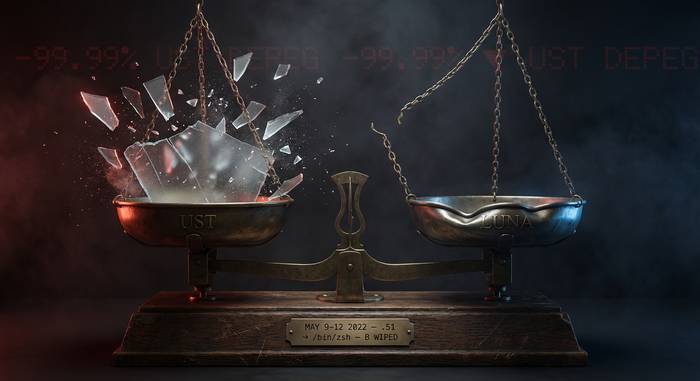
Terra's UST collapse in May 2022 is the canonical algorithmic failure. UST began depegging on May 9, 2022, and within a week LUNA fell from an all-time high of $119.51 to effectively zero, erasing more than $50 billion in UST and LUNA value and an estimated $400 billion across the broader crypto market (Harvard Law School Forum on Corporate Governance). The mechanism relied on a reflexive mint-and-burn loop between UST and LUNA with no external collateral. Once confidence cracked, every redemption minted more LUNA, which meant every step of the unwind made the death spiral worse.
Real 2024-2026 token launches: wins and failures
The 2024-2026 cohort is where every tokenomics lesson from the previous decade showed up in live trading. Here are the ones worth knowing about.
| Project | Total supply | Insider % | Community % | Key detail |
|---|---|---|---|---|
| Worldcoin (WLD) | 10B | ~14% investors, 10% team | 75% | Daily emission cut 43% on July 24, 2026 (5.1M to 2.9M) |
| Celestia (TIA) | 1B+ | Large cliff structure | Mixed | Oct 30, 2024 cliff unlocked 175.59M TIA (~$920M) |
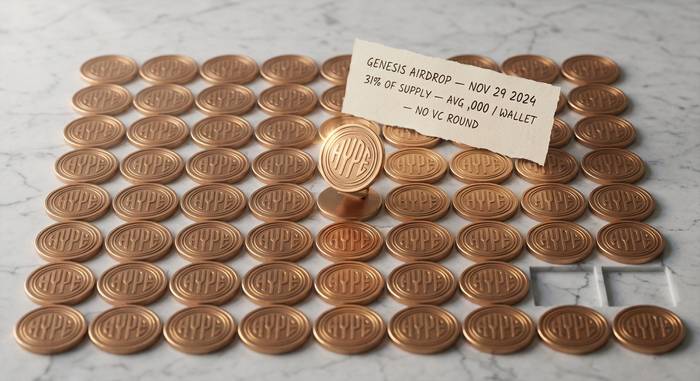
| Hyperliquid (HYPE) | 1B | 23.8% core contributors | 76.2% | Nov 29, 2024 airdrop to 94,000 users, avg ~$45,000 |
| EigenLayer (EIGEN) | 1.67B | 29.5% investors, 25.5% early | 45% ecosystem | 1-year full lock then 4% monthly over 24 months |
| Berachain (BERA) | 500M genesis | 34.3% investors, 16.8% team | 48.9% | Feb 6, 2025 mainnet, ~10% annual inflation |
| Monad (MON) | 100B | 27% team, 19.7% investors | Mixed | Nov 24, 2025 launch, 49.4% unlocked Day 1 |
| Arbitrum (ARB) | 10B | 44% insiders total | 56% | ~92.65M ARB unlocked every 6 months through 2027 |
Hyperliquid is the 2024-2025 reference for how to do a launch right. The team openly rejected venture funding. Genesis airdrop on November 29, 2024 pushed 31 percent of total supply to 94,000 users, and core contributors got locked for a minimum of one year. Average airdrop value landed around $45,000 per wallet. People remember that number. The community-first allocation and the absence of any VC cliff meant there was no overhead of pending unlocks dragging the price during the first year.
Celestia is the cautionary counterweight. Its October 30, 2024 cliff unlock expanded circulating supply by 79.6 percent overnight. Price had already fallen roughly 80 percent from its February 2024 peak of $21 in anticipation. The unlock was public. The date was on every calendar. Everyone saw it coming. It still hit the chart.
Messari's end-of-Q1 2026 analysis put the broader story in context: only 6 of 41 token sales conducted since the start of 2025 are profitable, and the cohort averages minus 46 percent. Fair-launch tokens outperformed VC-backed launches in aggregate during 2024, according to Messari, which supports the thesis that allocation structure matters more than raw product quality for price in the short-to-medium term.
Why crypto tokenomics important for long-term holders
Crypto tokenomics is important because it is the part of an investment thesis you can actually verify before committing capital. Product-market fit is a guess. User numbers can be faked. But the supply schedule, the vesting cliff, the insider share, and the value-accrual mechanism are all readable on-chain or in the whitepaper. That is exactly why every serious investor treats tokenomics important as the first checklist item, not a footnote. The information asymmetry between early insiders and retail holders is largest at launch, which is exactly when tokenomics should do the most work.
Two things are worth keeping in mind. First, tokenomics can only explain so much. Bitcoin has great tokenomics and still had 80 percent drawdowns. FTT had bad tokenomics and spent years going up. Over long horizons, though, the pattern reverts. Tokens with fair distribution, real utility, transparent unlocks, and working value accrual tend to outperform tokens with insider-heavy allocations and nothing holding the price up but narrative.
Second, tokenomics is not static. The Uniswap UNIfication vote in December 2025 is the most recent example of a protocol changing its tokenomics mid-life. Curve adjusted its emission curve multiple times. Ethereum has flipped between deflation and inflation through two major upgrades. Reading tokenomics is not a one-time exercise. Every major governance vote and protocol upgrade can rewrite the model you thought you understood.
The bottom line on tokenomics analysis
Tokenomics is the boring, load-bearing layer of crypto investment. Tokenomics is essential because every token that survived a full cycle did so because its economic system was designed to reward people who stuck around, not the people who got in first and sold at launch. Every token that died mid-cycle usually had a vesting schedule, an insider concentration, or a value-capture hole that was visible in the whitepaper if anyone bothered to read it. Tokenomics is an important early-warning system, and the factors that influence long-term price action are almost always baked into the token at genesis. Tokenomics plays a decisive role in determining which projects outlast the next correction.
If you are going to hold a crypto asset for more than a few weeks, the tokenomics analysis is not optional. Pull the supply numbers, read the vesting schedule, map the incentives, ask what the token actually does, and decide whether the design rewards your time horizon or someone else's. The rest is narrative. Narrative moves prices short term. Tokenomics moves them long term.