How to Buy Bitcoin in Brazil: Beginner’s BRL Guide 2026
How to buy bitcoin in Brazil in a single sentence: open an account on a BCB-licensed Brazilian exchange, complete KYC with your CPF, deposit reais via PIX, and press buy. You can be holding your first fraction of a Bitcoin within 15 minutes, for as little as R$10. The longer answer has a few interesting wrinkles. Tax rules changed in 2025. A full regulatory overhaul just kicked in on February 2, 2026. Binance became the first crypto firm to hold a Brazilian broker-dealer license. And PIX fraud hit R$6.5 billion last year, so the safety part matters more than ever.
Brazil is now the fifth-biggest country in the world by cryptocurrency adoption, up from tenth in 2024, according to Chainalysis. Reais flowed into digital assets at roughly $318.8 billion in the 12 months through June 2025, a 109.9% jump year over year. That puts Brazil ahead of Germany, Mexico, and the UK, and behind only India, the US, Pakistan, and Vietnam. If you live in São Paulo, Rio, or anywhere else in the country, the local cryptocurrency market has never been bigger, and buying bitcoin in Brazil is now one of the most mainstream financial actions you can take, with more licensed venues, lower fees, and better PIX integration than any other LatAm market.
This guide walks you through it step by step, covering how to purchase bitcoin, how to trade bitcoin, how to sell bitcoin, and how to hold it safely. No jargon, no fluff. Just the exact path a beginner can follow today, with a look at cryptocurrencies like bitcoin and the wider bitcoin and cryptocurrency tools available in the country.
Buying Bitcoin in Brazil in 2026: what changed
The landscape looks different this year. A lot different, actually.
On November 10, 2025, the Banco Central do Brasil published three new rules: Resolutions 519, 520, and 521. They are the first real operational rulebook for what Brazil now calls SPSAVs. The full name is a mouthful (Sociedades Prestadoras de Serviços de Ativos Virtuais), but in practice it just means "licensed crypto platforms." The rules went live February 2, 2026. Existing exchanges have until October 30, 2026 to come fully into compliance under a 270-day grandfathering window. Minimum capital for a new license runs from R$10.8 million (crypto custody) up to R$37.2 million (full-service broker).
What does that mean for you as a buyer? The exchanges still standing in late 2026 will be the ones with real capital, proper KYC workflows, asset segregation, and Travel Rule compliance. The sketchy offshore platforms that used to court Brazilian users with anonymous trading? They are already quietly closing BRL access.
Running alongside all that, Receita Federal rolled out DeCripto in July 2025. It replaced the older IN 1888 framework. Every crypto transaction on a Brazilian-licensed exchange gets auto-reported monthly now. You do not have to file separately for purchases on domestic platforms. You do still need to file anything held on foreign exchanges, like Kraken or Coinbase Global.
And last piece of news: Binance Brasil closed its acquisition of broker-dealer Sim;paul on December 31, 2024, after BCB approval. That makes Binance the first crypto-native firm to hold a full Brazilian broker-dealer license. It gives them direct banking rails and faster PIX integration than most offshore competitors can offer.
Is buying bitcoin legal in Brazil right now?
Short answer? Yes, completely.
Bitcoin is legal in Brazil. So are other crypto assets. You can own them, buy them, sell them, mine them, gift them, or spend them. No restrictions. The legal basis is Lei 14.478 from December 2022, which actually took effect in June 2023. The Central Bank of Brazil leads crypto regulation and runs the SPSAV licensing regime. The CVM handles anything that counts as a tokenized security, using the Howey-style test Brazil borrowed years ago.
What is not legal? Running an unlicensed exchange after the transition period ends. And dodging tax reporting. Both apply to operators, not to you as a buyer. Ordinary Brazilians can move reais into BTC, hold it, move it wallet to wallet, and sell it, all without permission. You just have to report gains on the annual IRPF once you cross the exemption threshold.
Brazil is also building a CBDC. DREX, the Real Digital, is scheduled for Phase 1 (centralized) in H1 2026. Phase 2, the blockchain version, got pushed back. DREX will not replace Bitcoin or stablecoins. It will probably reshape how crypto exchanges settle BRL, though, over the next two or three years.
The easiest way to buy Bitcoin in Brazil today
For most beginners, the easiest way to buy bitcoin in Brazil, the simplest easy way to buy bitcoin in small amounts quickly, is this simple sequence. It is also the easiest way to purchase bitcoin for the first time and the fastest option to buy bitcoins that you fully control.
1. Pick a BCB-registered domestic bitcoin exchange. Mercado Bitcoin, Foxbit, Novadax, or Binance Brasil are the four most common starting points.
2. Create an account using your email, a strong password, and your CPF (Cadastro de Pessoa Física, the Brazilian tax ID every resident has).
3. Go through the identity verification process: upload a selfie plus a photo of your RG or CNH. The verification process usually finishes within minutes to a few hours.
4. Transfer BRL, your local currency, from your bank account into the exchange via PIX. Funds usually land in under ten seconds.
5. Open the BTC/BRL trading pair, type the amount of reais you want to spend, and hit buy.
6. After buying, if you plan to hold for more than a few weeks, withdraw the BTC to a self-custodial wallet you control (more on that below). Your wallet address is the destination you paste when withdrawing.
Minimum purchase on most domestic exchanges is R$10, roughly two dollars. You do not need to buy a whole Bitcoin, and nobody does. BTC is divisible into 100 million satoshis, so R$10 will buy you several thousand sats. If you simply want to invest in bitcoin with a small amount, this is the smoothest path.
Best place to buy bitcoin: top BRL exchanges
The best place to buy bitcoin in Brazil depends on how much you want to trade, how you want to pay, and how important the lowest fee is. Here is a compact comparison of the main options using BRL trading pairs.
| Exchange | Users | BRL trading fee | PIX deposit | BCB status | Strength |
|---|---|---|---|---|---|
| Mercado Bitcoin | 4 million+ | 0.30% maker / 0.70% taker | Yes, instant | Licensed | Largest domestic, automated tax reporting |
| Foxbit | 1.4 million+ | 0.25% maker / 0.50% taker | Yes, instant | Licensed | 11 years old, strong OTC desk |
| Novadax | ~300K active | 0.10% / 0.50% | Yes | Licensed | Widest altcoin selection (693 pairs) |
| Binance Brasil | Millions | 0.10% / 0.10% | Yes, instant | Broker-dealer licensed | Lowest fees, huge asset list |
| Bitso | 8 million LatAm | 0.50% / 1.00% | Yes | Licensed | Cross-border LatAm payments |
| Coinext | 400K+ active | 0.25% / 0.50% | Yes | Licensed | Simple UI, Portuguese support |
Mercado Bitcoin is the default choice for a first-time Brazilian buyer. It has automated tax reporting that pulls your trading history into a Receita-compliant format, a clean Portuguese interface, and four million customers, which is the kind of network depth that tends to keep an exchange safe. It is not the cheapest on fees; Binance Brasil or Novadax will save you money on active trading.
Foxbit's OTC desk is useful if you are buying more than R$100,000 at once, where exchange order books would move against you. Bitso is useful if you frequently send money between Brazil, Mexico, Argentina, or Colombia.
Payment method options: PIX, card, bank, cash
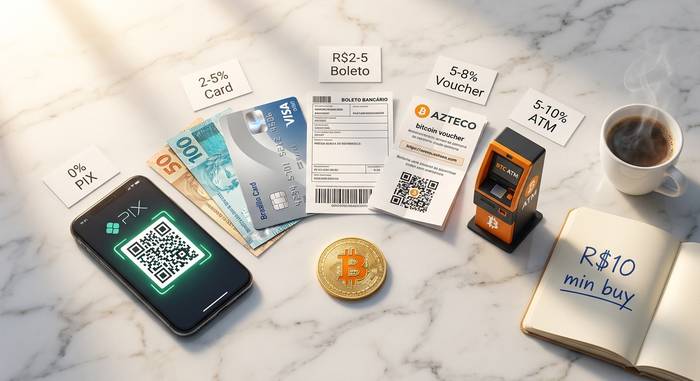
Brazil has the single best payment rail for buying crypto of any major country, and that rail is PIX. Launched by the BCB in November 2020, PIX settles bank-to-bank transfers in under ten seconds, 24 hours a day, every day of the year, with zero fees for individual users on most banks. Around 98% of retail crypto on-ramping in Brazil now moves through PIX.
Other payment method options exist, with different trade-offs.
- PIX. Instant, free, integrated into every licensed exchange. Confirmed use by Mercado Bitcoin, Foxbit, Binance Brasil, Novadax, Bitso, Coinext, and global onramps like MoonPay, Changelly, Ramp, and BingX. This is the default.
- TED or DOC bank transfer. Older systems. Still work but take hours. No reason to use them when PIX exists.
- Credit or debit card. Some exchanges and onramps accept Visa or Mastercard. If you want to buy bitcoin with a credit or debit card, most global onramps support this. Buying bitcoin with a credit card usually carries a 2-5% markup. Useful only if your bank account has PIX problems or you want to buy abroad in USD or other fiat currencies.
- Boleto Bancário. The Brazilian printable payment slip. Slower than PIX, settles overnight, but works at any Lotérica. Fallback option.
- Cash via Azteco bitcoin vouchers. Buy a prepaid BTC voucher with cash, debit, or PIX at one of 125,000+ Brazilian retail points (Lotéricas, Caixa Econômica, Bradesco Expresso). Redeem the 16-digit code or QR code in any Bitcoin wallet. No account needed.
- P2P. Direct peer-to-peer trades on Binance P2P or Paxful, usually in BRL via PIX. Flexible on price but carries counterparty risk; use only escrow-backed platforms.
- Bitcoin ATM. Rare in Brazil, mostly in São Paulo and Rio. Fees run 5-10%. Useful for privacy but not for price.
Side by side, these payment options look like this in terms of real-world trade-offs:
| Payment method | Typical fee | Settlement time | KYC required | Best for |
|---|---|---|---|---|
| PIX | 0% (user side) | Under 10 seconds | Yes | Default choice for any amount |
| TED bank transfer | R$5-20 | 1-3 hours | Yes | Fallback if PIX fails |
| Credit or debit card | 2-5% | Instant | Yes | Small urgent buys only |
| Boleto Bancário | R$2-5 | Overnight | Yes | No-bank-app buyers |
| Azteco bitcoin vouchers | ~5-8% | Minutes to redeem | No | Cash, gifts, privacy |
| P2P (Binance P2P) | 0-1% | 10-30 minutes | Yes | Small-volume flexibility |
| Bitcoin ATM | 5-10% | Instant | Partial | Cash-only, high fee |
For most first-time buyers, the PIX-to-exchange path is the cheapest, fastest, and safest.
Account setup and KYC for crypto in Brazil
Every licensed exchange in Brazil has to verify you before you can buy crypto in Brazil. This is a Lei 14.478 requirement. The BCB enforces it, no exceptions. One detail catches beginners off guard: the CPF on your exchange account has to match the CPF on the bank account sending the PIX. Different CPFs? Your deposit bounces.
What you normally need to gather upfront:
- A Brazilian CPF number. Foreign residents pick one up at any Receita Federal branch. Short-term visitors can apply online.
- A government-issued photo ID. RG, CNH, or passport, any works.
- A selfie. On some exchanges it is a short liveness video, where you tilt your head left and right.
- Proof of address on some accounts. A recent utility bill is fine.
- A source-of-funds declaration, if you plan to move more than R$30,000 per month.
Approval is usually automatic. Most people are cleared in minutes. A few sit in review for a couple of hours, rarely longer. Once you are live, turn on two-factor authentication with an app (not SMS, SIM-swap attacks are common in Brazil). Enable withdrawal address whitelisting. Then fund.
Your first BTC trade: buy and sell safely
Your first buy and sell cycle is worth walking through slowly so you know what every button does.
Log in to your exchange. Navigate to the BTC/BRL trading pair (sometimes shown as Bitcoin or BTC). You will see a buy BTC box and a separate sell box.
For the first buy, use a market order, not a limit order. A market order buys at whatever price is currently on the book, which for BTC/BRL at the top of the spread means you pay a tiny bit above spot. A limit order lets you set the price you want to pay, but if you are new and the market is moving, you can sit there unfilled. You can buy or sell at any time; the choice between buy and sell bitcoin orders is always available on the same page.
Enter the amount of BRL you want to spend, not the amount of BTC. Say R$500. The exchange will calculate how much BTC that equals at current prices and show you the total including fees. Confirm. The BTC lands in your exchange wallet within a second.
To sell later, the process is the same in reverse. Open the trading pair, pick market order, enter the amount of BTC you want to sell, confirm. BRL lands in your exchange balance instantly. Withdraw via PIX back to your bank account.
One tip from experience: place a tiny first sell of maybe R$10 of BTC right after your first buy. This teaches you the full buy and sell loop before you have real money on the line.
Bitcoin vouchers, bitcoin ATM, and other way to buy bitcoin
For readers who want to skip exchanges entirely, three alternatives deserve mention.
Bitcoin vouchers. Azteco sells prepaid bitcoin vouchers and bitcoin gift cards in Brazil starting at $10. Buy them at a Lotérica or Caixa Econômica Federal with cash, PIX, or card, receive a 16-digit code by email, and redeem into any Bitcoin wallet in under a minute. No KYC, no exchange account. Best for very small buys, privacy, and gifts. Not useful for trading.
Bitcoin ATM. Brazil has a scattered network of crypto ATMs, mostly in São Paulo and Rio. They accept reais in cash and send BTC to your wallet. Fees are high, usually 5-10%. Use them for privacy or cash conversion, not price.
Non-custodial onramps. Services like Ramp Network, MoonPay, Swapped.com, or Changelly let you buy BTC directly into a self-custodial wallet like MetaMask, Trust Wallet, or Zengo, with PIX or card. Minimums start around R$50 to R$100. No exchange account needed, but fees are usually 1-3% above exchange spot.
Each of these is an "other way to buy bitcoin" that bypasses the standard exchange path. For most people they are useful as supplements, not replacements.
Picking a bitcoin wallet: keep your bitcoin safe
Planning to hold Bitcoin more than a few weeks? Get it off the exchange. Into a bitcoin wallet or general crypto wallet you actually control. Brazilian exchanges have clean track records so far, but the Mt. Gox and FTX lesson still holds. Not your keys, not your coins. That phrase is older than most of the people reading this.
Three tiers of bitcoin wallets, from easiest to most secure:
- Hot wallets (mobile or browser). Free apps. MetaMask, Trust Wallet, Zengo, Electrum. Great for small active balances you want to spend quickly. The trade-off is exposure. They sit on an internet-connected device, which means any malware on that device can become a problem.
- Hardware wallets (cold storage). Physical devices. Ledger Nano X, Ledger Flex, Trezor Model T. Your keys never leave the chip. Best for anything above R$5,000 or so. Buy only from the manufacturer. Never secondhand. In Brazil, Ledger ships through Amazon Brazil, Kabum, and Mercado Livre as authorized retailers. Double-check the seller name before clicking buy.
- Paper or metal seed backup. Not a wallet, exactly, a backup for your seed phrase. Write your 12 or 24 words on paper the first day. Better, stamp them on a steel plate (fireproof, flood-proof). Store in two separate physical locations. Never take a photo. Never paste into Google Docs, email, or a cloud note.
Want to keep your bitcoin safe long term? Four rules matter more than anything else. Write the seed on paper day one. Never type it into any website. Never share it with anyone claiming to be "support" from any exchange or wallet brand. Never store it in a screenshot.
Those four rules, followed, keep out more than 95% of the attacks that drain new holders.
Crypto exchange fees and the price of bitcoin in BRL
Two numbers to watch before you trade: the fee and the bitcoin price.
Crypto exchange fees at Brazilian platforms run from about 0.10% on Binance Brasil and Novadax to 0.70% on Mercado Bitcoin's taker side. On top of that, there is the spread, the difference between the bid and ask price at any moment. On liquid BTC/BRL pairs, spreads are usually tight, a few reais on a R$360,000 Bitcoin. On thin altcoin pairs, they widen considerably.
The bitcoin price in BRL has moved dramatically in the last 18 months. Bitcoin's BRL all-time high was R$685,780, hit in early October 2025 per CoinGecko data. On April 17, 2026, BTC is trading between roughly R$359,000 and R$377,000 depending on the venue, about 45% off that peak. The price of bitcoin in BRL is influenced both by the dollar BTC price and by the USD/BRL exchange rate, so Brazilian holders get a kind of built-in dollar exposure whenever they hold BTC.
Small rounding detail many beginners miss: most exchanges quote Bitcoin in BRL to the real or centavo. So a "R$377,682.45" quote is the actual per-coin price. Since you are rarely buying a full coin, look at the BRL amount you spend, not the BTC decimals.
Tax in Brazil: what you owe on your crypto asset
Tax rules got interesting last year. Here is the 2026 version, simplified.
If your crypto sits on a Brazilian exchange, you get a monthly exemption. R$35,000. Sell less than that in a calendar month? Zero capital gains tax. Cross the line? The whole gain becomes taxable on a progressive scale. 15% up to R$5 million. 17.5% from R$5M to R$10M. 20% from R$10M to R$30M. 22.5% above that.
If your crypto sits on a foreign exchange instead (think Kraken, Coinbase Global, Bybit), the rules flip. Law 14.754/2023, effective January 1, 2024, hits you with a flat 15% on annual gains above R$6,000. No monthly exemption. One bucket, once a year.
Late 2025, Congress almost changed everything. MP 1303/2025 would have scrapped the progressive rates and moved everyone to a flat 17.5%. The Chamber of Deputies voted it down, 251 against and 193 in favor. So the R$35K monthly exemption survived, and domestic sellers dodged a meaningful tax hike.
Reporting also changed. In July 2025, Receita launched DeCripto, which replaced the old IN 1888 regime. Brazilian exchanges now auto-report your monthly activity straight to the tax authority. You still file your positions on the annual IRPF return under Bens e Direitos (ficha 81). Foreign holdings go under the foreign investment section, separately.
Three rules that save real money:
- Stay under R$35K per month when selling BRL. By far the biggest lever.
- Track cost basis per transaction, in reais. A spreadsheet works. Mercado Bitcoin and Foxbit now ship Receita-ready reports too.
- Moving between your own wallets is not a tax event. Do not accidentally pay tax on it. Only selling, swapping, or spending triggers tax.
Available in Brazil: bitcoin and other cryptocurrencies
A question new buyers always ask is what exactly is available in Brazil beyond Bitcoin. The short answer: basically everything.
Bitcoin is the dominant asset by name recognition, but stablecoins actually dominate volume. According to Receita Federal data released in November 2025 and confirmed by BCB President Gabriel Galipolo, stablecoins (primarily USDT and USDC) represent about 90% of all bitcoin transactions and broader crypto transaction volume in Brazil. That makes Brazil closer to a stablecoin market with Bitcoin as the headline store-of-value asset than a pure BTC market.
Beyond BTC and stablecoins, domestic exchanges let you buy cryptocurrency of almost every kind: ETH, SOL, BNB, XRP, ADA, and hundreds of altcoins. Novadax lists 693 trading pairs. Binance Brasil offers 400+ assets. Mercado Bitcoin offers 300+. The full menu of bitcoin and other cryptocurrencies, bitcoin and other digital assets, tokenized real-world assets, and even equity-backed tokens is available without leaving Brazilian platforms. A growing number of Brazilian merchants are also accepting bitcoin and other crypto directly for bitcoin payments, though this is still a small share of total volume.
For remittances and dollar-denominated savings, stablecoins are the workhorse. For growth and macro hedging, Bitcoin does most of the work. Many Brazilian holders keep both.