Gyat Meaning: Gyatt, Videos, and What Kids Are Saying Now
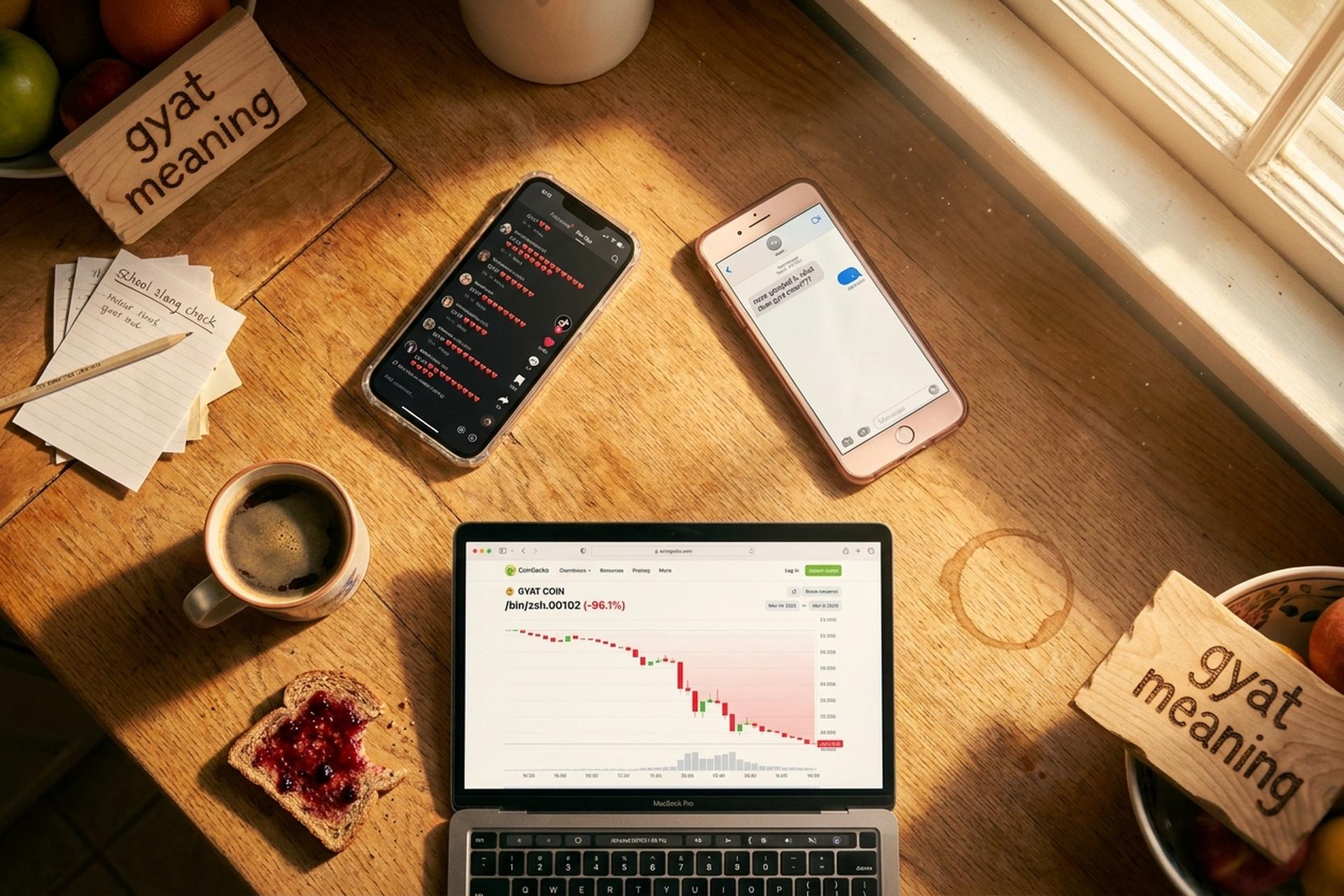
Picture this. A kid shouts "GYAT!" at a soccer highlight. His mom looks up, confused. He shrugs. Meanwhile an aunt three chats away types the same word under a Kim Kardashian post. And by the time anyone over thirty pins down what gyat means, the meaning has shifted twice and spawned a Solana meme coin nobody asked for.
That's gyat in 2026. One small word. Born on a Twitch stream. Scaled by TikTok. Argued about at the American Dialect Society. Then turned, inevitably, into speculative crypto tokens by traders who treat viral slang like raw material. Throwaway exclamation on the surface. A strange little case study underneath, in how language, culture, and crypto now move at identical speeds.
So here's what I'll walk through. Where gyat came from. What it actually means now. Why people still argue over the spelling. How it shows up in your kid's comment sections. Whether to worry. And how a one-syllable noise got its own token on pump.fun. You'll leave knowing more than most parents, and more than most traders.
What does gyat actually mean in 2026?
Short answer: gyat is an exclamation of strong reaction, usually surprise, excitement, or physical admiration. Pronounced "gee-yat." Used like "god damn" or "whoa," only louder and almost always online. In the right context, a single gyat is a humorous over-the-top expression of enthusiasm.
The most common usage today is a reaction to physical appearance, typically an attractive person on screen, particularly a curvaceous woman. That is the version your kid is probably seeing in TikTok comments. It is also why parents keep asking about it.
But the word does two other jobs worth knowing about:
- As a standalone exclamation, unrelated to appearance. A skateboard landing a big trick, a basketball hitting an impossible three-pointer, a Fortnite clip with a clean headshot. "Gyat, that was insane."
- As a meme or ironic filler. Gen Alpha uses it deliberately over-the-top to mock the very culture that produced it. The joke is that the word itself is cringe, and saying it on purpose becomes funny.
There is a popular backronym floating around: "Girl Your A** Thicc." It is not the original meaning. Linguists are unanimous that this acronym is a reverse-engineered folk etymology attached after the fact to explain a word that was never an acronym to begin with. The real source is different, which brings us to the origin story.
The gyat origin: from Twitch slang to TikTok viral
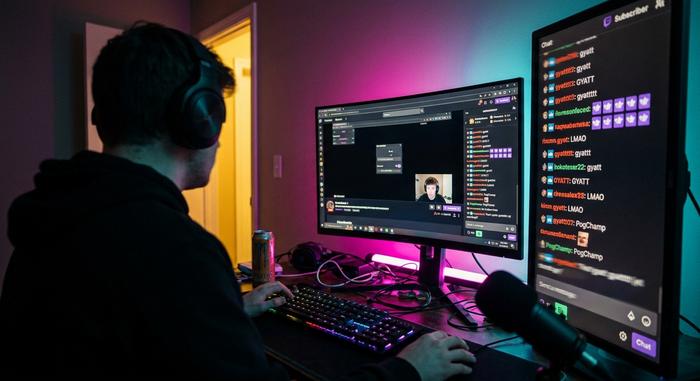
Origin traces back to a Twitch streamer who goes by YourRAGE. Started as a speech quirk in 2020. Went viral on his own stream in June 2021. He pronounced "goddamn" with a specific exaggerated shape. His chat heard something closer to "gyatt" and spammed that spelling back at him as a joke. The phonetic misreading stuck. Urban Dictionary's earliest entry crediting him is dated 4 July 2021.
Then the term leaked out of his chat and into the rest of the Twitch ecosystem. Kai Cenat, already one of Twitch's biggest streamers, amplified it through his own over-the-top reactions. He has since broken every record on the platform, including the all-time subscription record of 1,112,947 subs on 30 September 2025 during Mafiathon 3. Merriam-Webster's slang entry, last updated 1 April 2026, explicitly credits Cenat as the streamer who carried "gyatt" to a mainstream audience. Between YourRAGE, Cenat, and their heavy audience overlap, gyat was in constant rotation by late 2022, well before most of TikTok had heard it.
Then TikTok found it. The New York Times, in a 9 November 2023 Madison Kircher feature, pointed to a specific TikTok posted by @ovp.9 on 2 October 2023 as the "key" inflection point: a Fortnite character singing a parody of Suicidal-Idol's "ecstacy". That clip lit the fuse that ran through every Gen Alpha For You page for months.
One earlier trace worth noting: rapper Nicki Minaj tweeted "gyat damn" on 18 January 2012. Eleven years before the word went viral. Which proves the phonetic variant was already floating around culturally long before YourRAGE's chat turned it into a written meme.
Why does the pronunciation drift happen in the first place? Columbia linguist John McWhorter and AAVE researcher Kelly Elizabeth Wright of Virginia Tech, both quoted by the NYT, trace it back a long way. The consonant shift from "goddamn" to "gyatt" isn't random noise. It sits squarely inside features of Black Southern speech, Jamaican Patois, and broader African-American Vernacular English, where this particular kind of consonant-softening has existed for generations. The online meme wrapped itself around a linguistic tradition that predates streaming by more than a century.
Gyat vs gyatt: spelling, usage, and pronunciation
Both spellings roam the internet. Here's how to tell which is which.
| Form | Typical register | When you see it |
|---|---|---|
| gyat | Reactive, casual | Quick comment, mid-conversation shorthand |
| gyatt | Exaggerated, intentional | Streamer-style emphasis, meme context |
| gyattttt | Hyperbolic, mocking | TikTok captions, comment sections piling on |
| GYAT | Yelling, loud reaction | All-caps comments, video-text overlays |
Pronunciation stays the same across all of them. Two syllables. "Gee-YAT." Stress on the second. Those extra t's in "gyatt" or "gyattttt"? Purely visual. They don't change how the word sounds out loud.
One thing worth flagging on usage: gyat has already run through the cringe cycle every viral slang goes through. By late 2024 it was getting eye-rolls from the older Gen Z crowd who first used it. Gen Alpha kept it alive longer. By 2026, sincere use is almost dead. What's left is ironic use, where the whole joke is that saying the word seriously would be embarrassing. Using it now signals either a twelve-year-old or an adult leaning into the bit on purpose. That's the normal lifecycle.
How teens use gyat in comments and videos
The natural habitat of gyat is the short-form video comment section, a kind of digital expression that thrives on platforms like TikTok, Instagram Reels, YouTube Shorts, Twitch chat, Discord servers, and Snapchat reactions. These social media platforms each carry a slightly different tone, but the teenage slang itself travels unchanged. You will see it less often in text messages, and almost never spoken out loud except as a joke.
Common usage patterns:
- Reaction comment on a performance or feat. A creator posts a dance cover or a sports highlight. The top comment is a single "GYAT." It functions as applause.
- Appearance reaction. A creator posts a selfie or a fit check. Comments flood with "gyat," "gyattttt," and variations. This is where parental concerns usually surface, because the word gets attached to people including minors.
- Shared-reference inside joke. Friends drop gyat in a group chat at something neither outside observer would recognize. It signals membership in the same internet corner.
- Irony and mockery. A Gen Z creator posts a parody of someone saying gyat sincerely. Comments pile on with more gyats, but they are mocking the word itself, not the subject.
The word travels with a broader Gen Alpha slang vocabulary: rizz, sigma, skibidi, ohio, fanum tax, mog, gooning, looksmaxxing. Most of these originated in the same streamer ecosystem. Oxford University Press named "brain rot" its 2024 Word of the Year on 2 December 2024, after 37,000+ public votes and a 230% year-over-year surge in usage. Oxford explicitly cited gyatt, skibidi and rizz as examples of the phenomenon the term describes. In other words, the publisher of the Oxford English Dictionary treated gyat as canonical enough to define an entire category around it.

Gyat and the world of Gen Z slang terms
The confusing part for anyone older than twenty-five is that gyat is not one word, it is a marker in a system. Internet slang terms now arrive in bundles, often from the same streamers, and spread through the same algorithmic pipelines.
A rough map of where gyat sits among adjacent terms:
| Slang term | Rough meaning | Primary origin |
|---|---|---|
| gyat / gyatt | Strong reaction, often to appearance | YourRAGE / Kai Cenat streams, 2021-2022 |
| rizz | Charisma, social smoothness | Kai Cenat streams, 2022 (Oxford WotY 2023) |
| sigma | Lone-wolf male archetype | Manosphere memes, repurposed ironically |
| skibidi | Absurd, chaotic, meme-nonsense | Skibidi Toilet YouTube series, 2023 |
| ohio | Weird or cursed | Ohio-as-punchline memes, 2021 onward |
| mog | To outshine or dominate | Incel / looksmaxxing forums, repurposed |
| gooning | Prolonged over-stimulation | Porn-adjacent forums, now ironic |
The common thread: almost none of these words mean precisely what a dictionary would say. They carry tone, tribal identity, and irony in equal measure. Using them correctly signals you know the reference. Using them incorrectly signals you are outside the group.
For marketers, teachers, and parents, this is the important bit. You cannot defeat slang by banning words. The vocabulary rotates every six to twelve months. The bundle is more important than any single term.
GYAT meme coins and the usage of slang in crypto
Here is where the story gets weirder. Almost any viral Gen Z slang now spawns a speculative crypto token within days. Gyat was no exception.
On Solana's pump.fun launchpad, where anyone can spin up a new token for a couple of dollars, dozens have launched under tickers like GYAT, GYATT, GYATGIRL, and GYATTTTT since 2023. The most prominent GYAT Coin (contract EfgEGG9PxLhyk1wqtqgGnwgfVC7JYic3vC9BCWLvpump on Solana) peaked at about $0.026 per token on its way up, then collapsed. CoinGecko currently prices it near $0.001 with a market cap under $1.1 million, ranked #3998 by market cap. Classic micro-cap meme coin, not a Dogecoin-tier phenomenon.
Zoom out and the scale becomes clearer. The broader Solana meme-coin category held a combined market cap of $3.88 billion across 1,834 tracked tokens as of April 2026 on CoinGecko. That is a real market, even if most individual tokens inside it behave like fireworks.
Why does this happen?
- Low launch cost. Creating a Solana memecoin on pump.fun costs roughly two to five dollars in network fees.
- Attention arbitrage. The token's ticker rides an existing piece of attention. You do not need marketing if TikTok is already doing it for you.
- No utility required. A meme coin does not claim to do anything. That is the entire point and the entire risk.
- Psychological hook. Buying the token feels like buying a piece of a cultural moment.
The infrastructure itself is huge. Pump.fun, which launched in January 2024, has produced more than 11.9 million tokens, captured up to 71 percent of daily Solana token launches, and generated over $775 million in cumulative revenue, according to Messari and 21Shares. Its own PUMP token sold out in twelve minutes on 12 July 2025, raising roughly $1.3 billion between public and private allocations.
The quality of what gets launched on that infrastructure is a different story. A May 2025 Solidus Labs report found that 98.6 percent of the more than 7 million tokens launched on pump.fun between January 2024 and March 2025 exhibited rug-pull or pump-and-dump patterns. Chainalysis's 2026 Crypto Crime Report, published 13 January 2026, estimated total crypto scam losses at about $17 billion for 2025, with memecoin rug pulls a major category. For earlier context, the FBI's 2024 Internet Crime Report logged $9.3 billion in crypto fraud losses, up 66 percent year over year.
The practical rule: any token tied to a trending slang word, with no named team, no audit, and no roadmap beyond a Telegram group, should be assumed to be a short-lived speculation vehicle or an outright exit scam. If you still want exposure, size it as entertainment, not as investment. Losing it all is the default outcome.
Is gyat offensive? What parents should know
Gyat is not a profanity in the traditional sense. You will not hear it bleeped on TV. But it sits in a grey zone that deserves a real answer rather than a lazy "yes" or "no."
The case for worry:
- Context skews toward objectification. The most common usage is a reaction to a woman's body. When kids aim the word at peers or classmates, including other minors, the behavior is closer to catcalling than compliment.
- Platform spread. The comment sections where gyat appears often host content that trends toward over-sexualized presentation of creators, including very young ones. Bark and other parental-monitoring services flag the word as a frequent indicator of exposure to age-inappropriate content.
- Classroom disruption. Teachers across US and UK schools have publicly complained about students yelling "GYAT" during lessons, often at classmates, often loudly, often at the start of a larger group reaction. Some schools have added it to informal "do not say" lists.
The case for calm:
- Most kids using it do not understand the backronym. Younger users often deploy gyat as a generic "wow" with no sexual connotation. The etymology includes the appearance reaction, but the word does not force that meaning every time.
- The cycle is already fading. By 2026, sincere use is dropping off. Ironic use is harder to police because the joke is aimed at the word itself.
- Banning a single slang term rarely works. It treats the symptom. The signal about what your kid is watching online is more useful than the word itself.
The honest middle ground most parenting experts land on: treat gyat as a conversation starter. Ask where your kid heard it, what they think it means, and who is using it around them. The answers tell you a lot more than the word does. Bark, Gabb, and other child-safety platforms all push the same approach: curiosity beats criticism, and open dialogue is worth more than a word ban.
A parent's guide to teen slang beyond gyat
The uncomfortable truth for parents is that gyat is not special. By the time you have decoded it, three new terms will be in rotation. The skill worth building is not knowing every slang word. It is knowing how to keep talking to your kid when you do not recognize the one they just used.
A few practical habits that work across terms:
1. Ask, do not accuse. "What does that mean?" lands better than "Why did you say that?" The former opens the door. The latter closes it.
2. Accept being the butt of the joke sometimes. Your kid using a word you do not know is not a crisis. Adopting the word yourself almost always is. Leave it alone.
3. Watch for behavior shifts, not vocabulary. The real signal of something wrong is rarely the word. It is who they are spending time with, online or offline, and whether they have become more secretive about it.
4. Know where the slang comes from. A surprisingly large share of Gen Alpha language originates in two or three streamer communities. Knowing that Kai Cenat, Plaqueboymax, Adin Ross, and a handful of others drive the vocabulary helps you understand the ecosystem without having to track every term.
5. Use the platforms yourself. Not as spyware. As context. Ten minutes a week on TikTok's For You feed tells you more about what is trending in your kid's world than any glossary.
6. Set clear lines on one thing: targeting people. The word itself is usually fine. Using it to catcall or demean a specific person, including online, is where the line belongs.