Falling Wedge Chart Pattern: Trader’s Wedge Trading Guide

Every serious trader eventually meets the falling wedge. It shows up on the daily Bitcoin chart, on forex majors, on stock indices, and on whatever altcoin is grinding lower that week. Price keeps making lower highs and lower lows, but the swings get shallower, the range tightens, and then, sometimes, the whole thing explodes upward. That is the setup traders have been betting on for decades. It is also one of the most misunderstood patterns in technical analysis, because the marketing version (high win rate, easy targets, clean breakouts) does not match what the empirical data actually says.
This guide walks through the falling wedge the way a realistic trader should think about it. What it really is, how to spot it on a price chart, why it can be either a bullish reversal or a continuation, how Thomas Bulkowski's numbers rank it against other chart patterns, which rules to use for entry, stop and target, and how BTC, ETH and SOL traded inside real falling wedges in 2025. By the end you should be able to read a wedge honestly, trade one with a plan, and know when to walk away.
What a falling wedge pattern actually tells you
A falling wedge is a consolidation structure that forms when a market is still making lower highs and lower lows, but each new swing is smaller than the last. Draw a trend line across the highs and another trend line across the lows, and the two lines converge downward. That converging cone is the falling wedge, sometimes called a descending wedge in older textbooks. Compared with a descending channel, where the two boundaries run parallel, a wedge tightens as it develops, which is the whole tell: sellers are still in charge, but they are losing steam.
Despite the descending geometry, the falling wedge pattern is a bullish technical pattern in both of its roles. As a bullish reversal pattern, it marks the end of a sustained downtrend. As a continuation pattern, it forms inside a larger uptrend when price is pulling back against the move. Either way, the pattern signals that the resolution is expected to be upward, which is why traders treat the shape as a potential bullish signal even when every candlestick inside it is red. The wedge is a technical construction, not a prediction, and the pattern provides a framework for how to think about the next move rather than a guarantee about it. The wedge slopes downward while pressure is shifting, and that shift is what the pattern indicates.
The psychology matters more than the geometry. Each lower low is smaller because fewer sellers are willing to push the market down at that level. Buyers start showing up earlier. Volume usually bleeds out during the pattern, a sign the wedge is typically late in its life cycle. Then a single breakout candle announces that the balance has flipped and a new bullish phase may be starting.
Identify falling wedge formations on any price chart
To spot a falling wedge on a real price chart, you need at least two reaction highs and two reaction lows, each one lower than the last, with a clear converging slope. Think of it as a pattern of lower highs and lower lows that keeps compressing: the highs and lows inside the wedge must both trend down, not sideways. Three touches on each trendline make the pattern much more reliable, and practitioners agree that patterns with five total touches (three on one side, two on the other) are the minimum standard for a tradable wedge.
Five practical rules to identify a falling wedge on a real price chart:
- The prior trend should be a clear downtrend, or a pullback inside an uptrend. Patterns drawn into sideways chop usually fail.
- The upper and lower trendlines both slope down, and they converge. If the lines are parallel, you are looking at a channel, not a wedge.
- The pattern should last at least three weeks on a daily chart. Anything shorter is closer to a pennant, which has different statistics.
- Volume should generally decline as the wedge develops. Bulkowski's data shows volume trending down through formation 72% to 75% of the time.
- The pattern is not confirmed until price closes above the upper trendline with an expansion in volume.
If any of those rules are missing, you are guessing. Drawing a wedge is easy; drawing a valid wedge that meets the five conditions above is much harder, and it is the single biggest reason retail traders lose money when trading CFDs and leveraged crypto based on weak pattern reads. Every serious trading platform, from TradingView to MT5, now ships wedge-identification helpers, but the software cannot tell you whether the surrounding trend makes sense. That judgment still has to come from you.
Falling wedge as a bullish reversal pattern or continuation
This is where a lot of confusion lives. The same geometry delivers two different signals, and whether the wedge is a reversal or continuation depends entirely on the trend that came before it. Before labeling the pattern in technical analysis terms, always ask the reversal or continuation question.
A falling wedge pattern forms at the end of a downtrend, usually a long one, and in that role it is a reversal pattern. It is the classic trend reversal setup, and the one most traders are hunting for on the daily chart. The wedge is often seen at market bottoms, after selling has flushed out and liquidity is thin, and its formation in a bearish phase is part of why the eventual break carries so much energy. StockCharts' ChartSchool recommends that the preceding downtrend be at least three months old before the wedge is treated as a reversal, and clean reversal wedges often take three to six months to form on daily charts. The breakout signals that sellers are exhausted and the bottom is in.
A falling wedge as a continuation pattern sits inside an existing uptrend. Price rallies, pulls back into a shallow wedge, then resumes the rally. The continuation version is usually faster, forms over weeks rather than months, and resolves in the direction of the larger trend. Bulkowski and most educators treat both cases as bullish; only the surrounding structure changes the label from reversal to continuation.
The practical test: where does the pattern sit relative to the higher-timeframe trend? If price is still below a falling 200-day moving average, you are probably trading a reversal attempt. If it is clearly above a rising 200-day, you are trading a continuation. That single filter removes most of the ambiguity.
Trading the falling wedge: entry, stop, target levels
The standard rule set for trading a falling wedge has been stable for thirty years, and the same playbook works whether you are trading stocks, forex trading majors, or crypto. Entry and exit points come directly from the trendlines; there is no discretionary guessing once the pattern is drawn.
Entry: wait for a candle to close above the upper trendline of the wedge. This breakout above the upper trendline is the moment the wedge officially confirms. Wait for a breakout that is accompanied by increased trading volume before committing capital. Some traders enter immediately on the breakout close. More conservative traders wait for price to pull back and retest the broken resistance as new support, and enter on a bullish candle at the retest. The retest entry has a tighter stop but a higher miss rate, because only about 62% of upward-breakout wedges throw back to the trendline before running.
Stop-loss: place the stop just below the most recent low inside the wedge, or below the lower trendline. If the market re-enters the wedge and takes out that low, the pattern has failed and there is no reason to hang on.
Target: use the measured move as your profit target. Take the vertical height of the wedge at its widest point (usually the left side) and add that distance to the breakout point. For a wedge that spanned $10 at its widest, the projected target is $10 above the breakout level. Bulkowski's data shows that the measured move is hit roughly 62% of the time, which is not as clean as trading marketing material implies, so realistic traders scale out in thirds: one third at the midpoint, one third at the measured target, and a final third on a trailing stop if momentum continues.
The minimum acceptable risk to reward for a wedge trade is 1:2. A lot of professional traders will not take a setup below 1:3. That rule alone filters out most of the marginal wedges a new trader is tempted to trade.
Volume confirmation and the wedge breakout signal
Every source that has actually tested wedge patterns agrees on the same thing: the breakout should be accompanied by a clear increase in trading volume, and without it the signal is unreliable. Bulkowski's dataset, built from more than 800 trades, shows volume declining during formation 72% to 75% of the time. That decline is part of the setup, because it means the selling pressure is drying up. The breakout is where volume needs to come back.
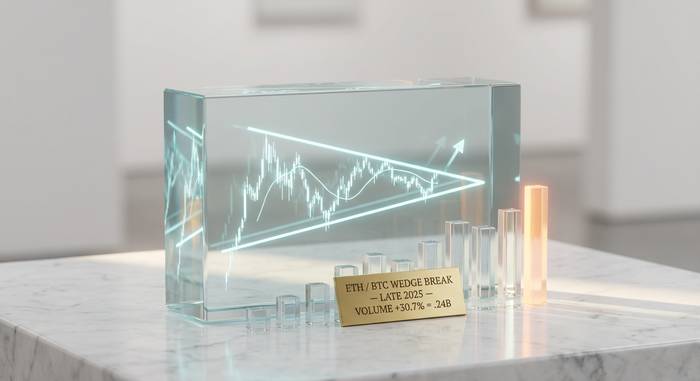
The commonly cited rule across LuxAlgo, Warrior Trading, FXOpen and CMT-aligned authors is that the breakout candle should print at 1.5 to 2 times the 20-day average volume. A weak, low-volume breakout is where false signals hide. In late 2025, the ETH/BTC pair broke out of a multi-month wedge with trading volume expanding 30.7% to $19.24 billion, and that volume expansion is exactly what a valid signal looks like. If volume is flat or falling on the break, treat the move as suspicious and wait for the retest.
This is how experienced traders confirm the falling wedge: price action, volume expansion, and a clean close above the upper trendline. Traders also watch for a sudden breakout from the lower trendline as a failure signal; if price breaks down instead of up, the wedge has failed and any long bias is wrong. Confirmation of the bullish break is the volume expansion and a clean close above the upper trendline, nothing else. Two secondary indicators pair well with the volume filter. Bullish divergence on RSI (price making lower lows inside the wedge while RSI makes higher lows) is one of the strongest confirmations. A bullish MACD crossover on the same bar as the breakout is another. Neither of these turns a bad wedge into a good one, but when both are present alongside the volume spike, the probability of a real move rises sharply.
Falling wedge vs rising wedge: bullish or bearish?
The two patterns are mirrors of each other, and the only way to keep them straight is to remember that the breakout direction, not the slope, determines the bias.
| Feature | Falling wedge | Rising wedge |
|---|---|---|
| Price action | Lower highs and lower lows | Higher highs and higher lows |
| Slope of trendlines | Both sloping down, converging | Both sloping up, converging |
| Typical context | Downtrend (reversal) or uptrend pullback (continuation) | Uptrend (reversal) or downtrend rally (continuation) |
| Expected breakout | Upward | Downward |
| Bias | Bullish | Bearish |
| Volume during formation | Declining 72 to 75% of time | Declining, similar behavior |
When you look at a rising wedge, you should be thinking short. A rising wedge, sometimes labeled an ascending wedge in older charting texts, indicates weakening buying pressure behind a rising price, and the rising wedge pattern is the setup short sellers love because upward slopes can look strong while the momentum quietly fades. A falling wedge is the opposite: the falling wedge suggests that selling is almost out, and it is the setup long-only traders are hunting for because downward slopes look ugly while the selling quietly dries up. Both are consolidation patterns, and both reward patience over opinion. Rising and falling wedge patterns are among the most commonly drawn wedge shapes in modern trading, but they are also among the most commonly misread.
Falling wedge success rate: Bulkowski's stats
Here is the part most trading educators quietly skip. Thomas Bulkowski's Encyclopedia of Chart Patterns is the canonical empirical reference for every major chart pattern, and his published figures for the falling wedge are not as flattering as the marketing version suggests.
| Metric | Falling wedge value |
|---|---|
| Performance rank (upward breakout) | 31 out of 39 patterns |
| Average rise after upward breakout | 38% |
| Percent meeting price target (upward) | 62% |
| Break-even failure rate (upward) | 26% |
| Throwback rate | 62% |
| Probability the breakout is upward | 68% |
| Typical volume trend during formation | Down 72 to 75% of cases |
| Minimum duration | 3 weeks |
| Sample size | 800+ trades |
Those numbers are worth reading slowly. A 38% average rise and a 62% hit rate on the measured target sound great on their own, but the 31st-place ranking means there are thirty chart patterns that perform better on upward breakouts. The 26% break-even failure rate means roughly one in four wedges fails before it can earn two standard deviations of movement. And the 62% throwback rate means that more than half the time price will come back to retest the upper trendline before running, which is both an opportunity (a second entry) and a trap (stops get hit if you chased the breakout candle).
Liberated Stock Trader's replication study cites essentially the same headline numbers, reinforcing the 74% bull-market success rate and 38% average gain. These figures are not precise across every market and every timeframe, but they are the most honest public benchmark available. Bulkowski himself writes that his statistics come from "perfect trades" on daily US equity data, so intraday and crypto performance can differ meaningfully.
The takeaway is not that the falling wedge is a bad pattern. The takeaway is that it is an average pattern, and average patterns make money only when they are traded with strict rules. Entry confirmation, volume filter, measured-move target, and a stop that gets honored. Drop any of those and the 62% target hit rate drops with them.
Real crypto falling wedge breakouts in 2025
Crypto traders spent most of 2025 staring at falling wedges on BTC, ETH and SOL charts, and the setups produced a usable sample of real-world examples.
- Bitcoin, November 2025: Phemex News reported BTC trading inside a multi-week daily falling wedge with resistance at $105,000. Analysts projected a measured-move target around $120,000 on a clean break, based on the wedge height.
- Bitcoin, Q4 2025: A more aggressive read from analyst Crypto Rover, shared via Blockchain.news, identified a larger multi-month wedge projecting toward $185,000 if BTC broke the upper boundary with volume.
- Ethereum, March 2025: CoinGape published a falling wedge analysis on ETH projecting a measured-move target of $3,793, tying the trendline break to Coinglass liquidation data.
- Ethereum, later in 2025: CoinCentral tracked a bigger ETH wedge with a $4,416 measured-move target as price compressed inside converging lines through the summer.
- Solana, November 2025: FXStreet projected a 22% breakout to $200 if SOL cleared $140, based on a textbook falling wedge on the daily chart. A December 2025 FX Leaders update put the critical breakout level at $131 after further compression.
- ETH/BTC pair, late 2025: The pair broke out of a multi-month wedge with trading volume expanding 30.7% to $19.24 billion, a textbook volume-confirmation example.
Not every one of those calls hit its target, and the point is not to treat any of them as a recommendation. They are useful as practice reps: pull up each chart on TradingView, redraw the wedge, mark the resistance for a falling wedge and the support for the lower boundary, and check whether the setup would have met the five rules from earlier. That exercise is how pattern recognition actually gets learned, in crypto and in every other market as well. Trading conditions in 2025 rewarded traders who waited for full confirmation and punished those who did not.
Falling and rising wedge patterns compared to other formations
Traders confuse falling wedge chart patterns with two neighbors more than anything else: the descending triangle and the bull flag. Both are technical analysis chart pattern shapes that sit close to a wedge on a price chart, but they carry different signals. A quick way to keep the two patterns apart:
- Falling wedge: both trendlines slope downward and converge. Bullish in both reversal and continuation roles.
- Descending triangle: a flat horizontal support line with a downward-sloping resistance line. Read as bearish continuation in most cases. If you see flat support, it is not a wedge.
- Bull flag: parallel, not converging, trendlines sloping slightly down after a strong upward move. Bullish continuation only, and the flag is shorter in duration than a wedge.
- Falling channel: both lines slope down and stay parallel. It is a trend, not a consolidation, and it does not carry the same breakout expectation as a wedge.
The difference between these patterns is geometric, not vibes-based. If the lines do not converge into a wedge shape, it is not a wedge, no matter how much you want it to be. Each triangle pattern and each bull flag has its own entry rules, and mixing them with wedge rules is one of the fastest ways to misread a setup.

Common mistakes when trading the breakout
Most trades that lose money on this setup lose for predictable reasons. None of them have anything to do with the falling wedge trading pattern itself. Trading breakouts without discipline is how many trading accounts lose money when trading CFDs and leveraged crypto, even on patterns with decent base rates.
The first mistake is drawing the pattern after the breakout. Retail traders see a rally, find a converging shape that fits, and call it a wedge in retrospect. A valid wedge has to be drawable before the breakout candle, using at least four completed reaction points. If you can only see it on the break, you are narrating, not trading.
The second mistake is ignoring volume. A falling wedge without a volume drop during formation and a volume spike on breakout is just a downtrend that got narrower. The volume filter exists precisely because without it, the success rate collapses.
The third mistake is chasing the breakout candle. The throwback rate of 62% means that more than half the time price comes back to retest the upper trendline. Traders who enter on the breakout candle alone get stopped out on that retest and then watch the target they expected hit them with no money on. A plan that allows for a partial entry on breakout and a second entry on the throwback survives that dynamic.
The fourth mistake is using an arbitrary profit target. The measured move exists for a reason. Targeting "the previous swing high" or "a nice round number" without measuring the wedge height is how traders leave 15% of the move on the table, or worse, hold past the realistic target and give it all back.
The fifth mistake is trading wedges on intraday charts without knowing the numbers. Secondary sources in the trading education space cite a roughly 72% daily-chart reliability for confirmed falling wedges versus around 51% on 5-minute charts. Swing-traders who step down to intraday are trading half the hit rate.
The bottom line on falling wedge trading
Some trading educators call the falling wedge a powerful reversal tool, but the honest version is simpler: the falling wedge is a useful pattern, not a magical one, and it is not a powerful get-rich trade. It is a disciplined setup that creates trading opportunities when the conditions line up. The data tells a consistent story: about two thirds of confirmed breakouts hit their measured target, the average move is 38%, and the pattern ranks in the lower half of all chart patterns for upward-breakout performance. That is good enough to trade profitably with discipline, and not good enough to trade lazily.
What moves a wedge trade from average to real edge is the same short list every time. Draw the pattern before the breakout, wait for the volume confirmation, honor the measured-move target, and size the position so the stop below the lower trendline is survivable. Most traders who lose money on this setup are not losing to the pattern. They are losing to their own process.
If you are new to chart patterns and want a concrete place to start trading the wedge with discipline, pull up the BTC daily chart from mid-2025 onward, draw every falling wedge you can find, and compare what you drew to how each one resolved. Live trading a pattern you have not back-tested first is how confirmation bias becomes loss. Ten reps is worth more than ten articles, including this one.