Crypto Mining Rigs in 2026: GPU & ASIC Miner Profitability
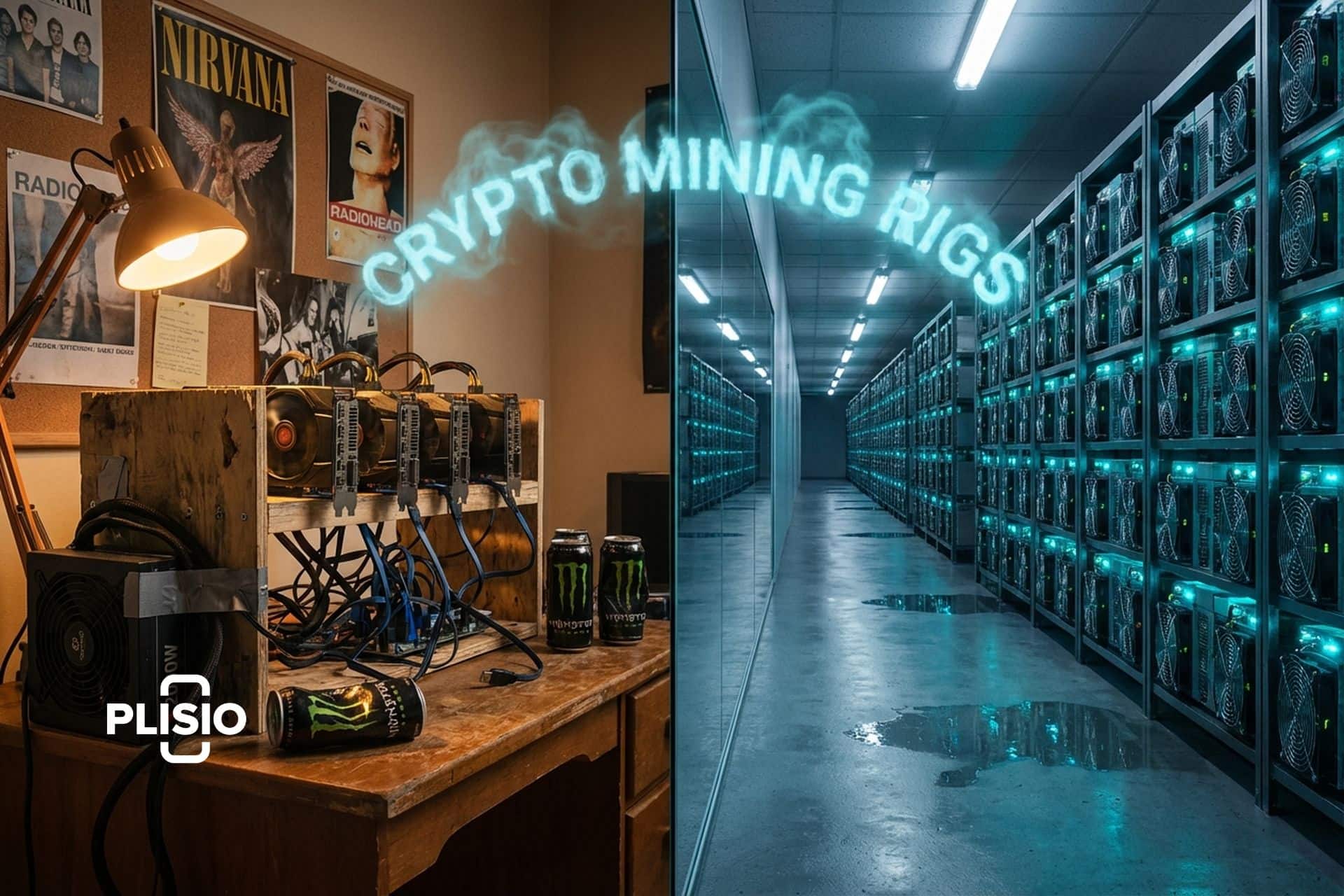
For most of the past decade, "crypto mining rigs" meant the same picture in everyone's head: a metal frame holding a row of graphics cards in someone's spare bedroom, fans roaring, electricity bill quietly climbing. That picture is mostly history now. By April 2026 the Bitcoin network has crossed the 1 zettahash per second milestone, the new flagship Bitmain S23 Hydro burns less than 10 joules per terahash, and the public miners running the show are starting to repurpose half their floors for AI compute. Mining did not disappear. It grew up, and it grew expensive.
This guide is a reset for anyone trying to understand crypto mining rigs today. It covers what crypto mining rigs actually are, how CPU, GPU, and ASIC miner setups differ, which Bitcoin mining hardware is worth looking at in 2026, what it costs to run one, and whether home mining still makes any sense at current prices and difficulty. The numbers are sourced and dated. The goal is to leave you with a real answer, not a sales pitch about crypto mining rigs.
What Is a Crypto Mining Rig and How Does It Work?
Forget the shiny marketing for a second. A crypto mining rig is just a computer that has been bullied into doing one job: guessing numbers, very fast, until it stumbles onto the right one. The "right one" is whatever passes the cryptographic puzzle that locks the next block of transactions on a Proof-of-Work chain like Bitcoin. Get it first and the network hands you the block reward, currently 3.125 BTC since the April 2024 halving. Get it second and you get nothing for the same work.
That guessing speed has a name. People call it hashrate, and it is basically the only number on a rig's spec sheet that matters. A modern Bitcoin ASIC chews through hundreds of terahashes a second; the whole Bitcoin network now grinds out over a zettahash per second, which is roughly a million times more again. So a rig is just a box engineered to push that number up while keeping the wattage down. The two values together are what decide whether you make money or you heat your garage for free.
Almost nobody mines alone anymore, and there is a good reason. If you tried to solo mine a Bitcoin block from a single home unit today, you would, on average, die of old age waiting. So miners pool their hashrate together, find blocks as a group, and split the rewards by share. The lottery becomes a steady drip instead of a once-a-decade jackpot.
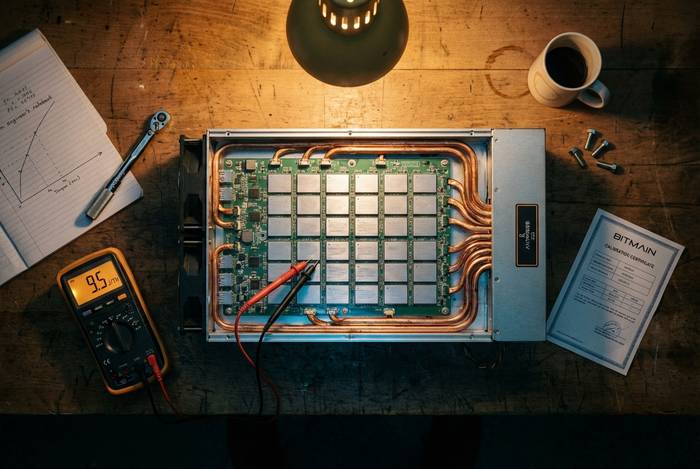
CPU Mining: Where the Bitcoin Mining Story Began
Wind back to 2009. Satoshi was running Bitcoin off a regular laptop. So was almost everyone else who showed up early. CPUs (central processing units, the chips inside any normal computer) were enough because the network was tiny and nobody else was competing for blocks. A reasonable desktop in those days could realistically pull down a block in a day or two of grinding. That window slammed shut sometime in 2010 and never reopened.
These days, CPU mining for any serious chain is hopeless. Compare the numbers and the conversation ends quickly: a high-end consumer CPU might do a few kilohashes a second, while one 2026 ASIC pushes through hundreds of trillions. We are talking about a gap of roughly a hundred billion to one. You could leave a brand-new gaming PC running on Bitcoin for the next century and probably not earn enough to cover the year's coffee budget.
There is one corner where CPU mining is alive on purpose. Monero, the privacy coin, runs an algorithm called RandomX that was specifically built to favor regular processors and frustrate ASIC manufacturers. Bytecoin and a handful of smaller projects use the same trick. Monero treats this as a feature: keeping mining on commodity hardware spreads the network out and makes it harder for any one company to capture it. If CPU mining still appeals to you in 2026, Monero is roughly the entire reason to bother.
GPU Mining and the Rise of the GPU Miner
When mining moved from CPUs to graphics cards around 2010, it was the first big jump in scale. A single GPU could outperform a CPU by roughly two thousand times, and miners quickly figured out how to wire six, eight, or even twelve GPUs onto a single motherboard with risers, custom frames, and a beefy power supply unit. The classic GPU rig was born, and for the next decade the GPU miner built on consumer hardware was the symbol of crypto mining.
Two things killed the volume side of GPU mining. The first was Ethereum's switch to Proof-of-Stake in September 2022, which removed the largest GPU-mineable coin overnight. The second was the steady invasion of ASIC manufacturers into smaller chains, including Kaspa, which used to be a GPU darling and is now ASIC-dominated. What is left for graphics cards is a thin niche of ASIC-resistant projects: Ergo, Ravencoin, Alephium, and a rotating cast of low-cap chains that hobbyist GPU miners hop between.
If you already have a gaming rig with a strong card, mining one of these on the side can pay for some of your electricity. As a primary investment vehicle in 2026, a GPU rig is no longer competitive with anything in the Bitcoin world.
ASIC Miner: The Standard for Bitcoin Mining Hardware
Acronym time. ASIC stands for application-specific integrated circuit, which is engineering-speak for "a chip that does exactly one job and refuses to do anything else." For Bitcoin that one job is calculating SHA-256 as fast and as cheaply as silicon allows. The first proper Bitcoin ASICs came out of Bitmain and Canaan back in 2013, and within a few months they had killed off any serious case for mining BTC on graphics cards. Every chip generation since then has chased the same pair of numbers in opposite directions: more TH/s, fewer joules.
Three manufacturers run almost the entire market in 2026. Bitmain, the company behind the Antminer brand, is far and away the biggest. MicroBT, which makes the Whatsminer line, sits in a comfortable second. Canaan, with its Avalon series, holds down third. Smaller brands exist, of course. But if you crack open any 2026 mining publication, just about every rig on the page comes from those three names.
ASICs have an obvious downside that nobody likes to talk about until they own one. The chip is genuinely good at one thing and absolutely useless at everything else. A SHA-256 box cannot mine Litecoin, cannot mine Ethereum Classic, cannot stream Netflix, cannot run Doom. So when Bitmain ships the next generation and your hardware becomes uncompetitive, you cannot repurpose it. The standard lifespan for a flagship rig at a serious farm is around two to three years, after which it gets shipped off to somewhere with even cheaper electricity or quietly scrapped for parts.
Top Bitcoin Mining Hardware to Buy in 2026
If your last serious look at Bitcoin mining hardware was a year or two ago, basically nothing on the shelves looks the same. The big story is the Bitmain Antminer S23 Hydro, which Bitmain showed off at the 2025 World Digital Mining Summit and started shipping in the first quarter of 2026. It became the first commercial SHA-256 box to crack 500 terahashes a second while keeping efficiency below 10 joules per terahash, and it has more or less reset what people mean when they say "high end." Here is what the rest of the field looks like next to it.
| Model | Hashrate | Power | Efficiency | Released |
|---|---|---|---|---|
| Bitmain Antminer S23 Hydro | 580 TH/s | 5,510 W | 9.5 J/TH | Q1 2026 |
| Bitmain Antminer S23 Air | 318 TH/s | 3,498 W | 11 J/TH | Q1 2026 |
| Bitmain Antminer S21 XP Hydro | 473 TH/s | 5,676 W | 12 J/TH | Oct 2024 |
| Bitmain Antminer S21 Pro | 234 TH/s | 3,510 W | 15 J/TH | Jul 2024 |
| Whatsminer M66S++ | 348 TH/s | 5,394 W | 15.5 J/TH | 2025 |
| Whatsminer M63S+ | 450 TH/s | 7,650 W | 17 J/TH | 2025 |
| Canaan Avalon A1566 | 185 TH/s | 3,420 W | 18.5 J/TH | Oct 2024 |
Sources: Blockspace, Mining Now, ASIC Miner Value, Q1 2026.
A handful of practical rules for reading the table. Past 25 J/TH, you are looking at a rig that is essentially a paperweight unless your electricity is free or close to it. Between 18 and 25 J/TH is where the used market lives, and it can still pencil out for hosted setups on cheap power. Anything below 18 J/TH counts as current generation and should hold its value for at least another year. The S23 Hydro at 9.5 J/TH is the new ceiling, and it will probably stay the ceiling until late 2026. Retail price tags for top units float somewhere around $20 to $30 per terahash once distributor discounts kick in, which puts a 580 TH/s S23 Hydro at roughly $14,800 list before any haggling.
How to Build a Mining Rig at Home or Skip It
Reading older guides, you might think that to build a mining rig you need a specific motherboard, eight GPUs, USB risers, a 2000W power supply, a metal frame, and a weekend. That advice still applies if you genuinely want a GPU rig for altcoins, but it does not apply to Bitcoin. A modern Bitcoin home setup is much simpler: one ASIC unit, one beefy power outlet, an ethernet cable, and somewhere to put 75 to 90 decibels of fan noise where it will not destroy your relationship with your neighbors.
The components for a real GPU rig still look familiar. You need a basic motherboard with multiple PCIe slots, a low-end CPU just to boot the operating system, between four and eight GPUs depending on your goal, a 2000W power supply unit (or two PSUs linked), USB PCI-e risers, a custom frame for ventilation, a basic cooling system, and mining software like NiceHash, T-Rex, or HiveOS. Plan for between $700 and $4,000 in hardware depending on which graphics cards you choose, then add the electricity bill on top.
For a Bitcoin ASIC, the build is closer to plugging in a microwave. The complications are in the environment around it. Heat dissipation, soundproofing, and electrical capacity are the three things that catch home miners off guard. An Antminer S21 Pro draws around 3.5 kilowatts continuously, which is more than most domestic circuits in Europe were designed for, and it dumps almost all of that energy back into the room as heat. Many home miners end up running a single unit in a garage or shed, ducting the hot air outside in summer, and pretending they are not violating their landlord's lease.
Cloud Mining vs Hosted Crypto Mining
If buying a rig and finding cheap power sounds like too much, two shortcuts exist. The first is cloud mining, where you pay a provider to allocate hash power to you from their data center and you receive whatever rewards that share earns. The pitch is appealing, the execution is mostly bad. Cloud mining contracts have a long, well-documented history of exit scams, hidden fees, and unfavorable math, and any contract with a fixed price and no transparent fee structure should be treated as suspicious until proven otherwise.
The second shortcut is hosted mining, sometimes called colocation. You buy your own ASIC, ship it to a professional mining farm, and pay them a flat per-kilowatt-hour rate to run it. You keep ownership of the hardware and all of the rewards minus the hosting fee. Pricing in 2026 typically runs from about $0.06 to $0.08 per kilowatt-hour all-in at competitive US providers, and around $102 per kilowatt per month at facilities that quote on a kW basis with a 10 kW minimum. That works out to break-even electricity on hardware where home mining is hopeless.
Hosted mining is the realistic path for most readers who want to actually mine Bitcoin in 2026 without quitting their day job. It removes the noise, the heat, the electrical work, and the cooling problems, and replaces them with a monthly invoice.
Profitability: Mining vs Just Buy Bitcoin in 2026
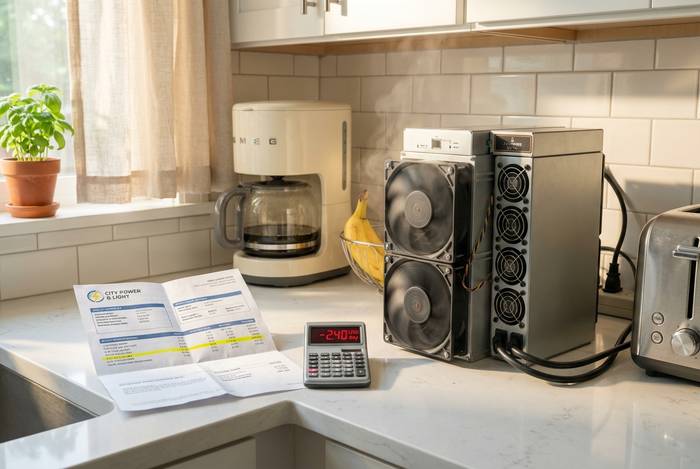
Here is the honest math. Bitcoin traded between $66,650 and $72,200 in early April 2026 and closed April 13 at $71,188.84, the block reward is 3.125 BTC, and network difficulty in early April was 133.79 trillion after a 7.76% downward adjustment, the second negative move of the year. Plug those into any reasonable calculator and the picture looks like this: top 2026 hardware running at around 15 J/TH or better, on electricity at $0.07 per kilowatt-hour, generates a small but real positive return. Anything above $0.10 per kilowatt-hour starts to look marginal. Anything above $0.14 is reliably a loss except when Bitcoin spikes.
Average US residential electricity in 2026 sits in the $0.13 to $0.17 per kilowatt-hour range. That is the ceiling that kills most home mining. Public miners survive at much lower per-kilowatt-hour rates because they negotiate directly with grid operators, build next to gas plants, use stranded power, and capture demand response payments that no household can access. CleanSpark, for example, operated 248,394 miners across 808 megawatts of power in January 2026 and hit a peak hashrate of 50.0 EH/s. Those are economies of scale a residential setup will never match.
| Electricity rate ($/kWh) | Verdict for top crypto mining rigs (≤15 J/TH) | Typical setting |
|---|---|---|
| Below $0.05 | Reliably profitable | Industrial farms, cheap-power countries |
| $0.05 to $0.07 | Profitable, healthy margin | Hosted colocation in the US |
| $0.07 to $0.10 | Marginal, sensitive to BTC price | Lower-cost residential or small commercial |
| $0.10 to $0.14 | Often unprofitable | Average US residential |
| Above $0.14 | Unprofitable except in price spikes | Most European residential |
Sources: CCN, Sazmining, EZ Blockchain, 2025-2026.
There is also the second track now. MARA Holdings ended 2025 with 66.4 EH/s of energized hashrate but reported a $1.7 billion fourth-quarter loss and announced a sharp pivot toward AI compute, repurposing some of its data center capacity for GPU clusters that earn more per kilowatt than Bitcoin does. Riot Platforms, by contrast, ended Q1 2026 with 42.5 EH/s deployed at 20.2 J/TH and stayed Bitcoin-pure, selling 3,778 BTC to fund expansion. The 2026 industry is splitting into miners that diversify into AI and miners that double down on hashrate.
For a typical retail reader, the question "should I buy crypto mining rigs or just buy Bitcoin?" almost always lands on the same answer. If your electricity is below $0.07 and you have somewhere to put a noisy rig, mining can still work for you. Otherwise, paying the lower price of pure exposure by just buying BTC on an exchange beats the math on home mining most of the time, before you even count the cost of a new heat pump.
Mining at Scale: Hashrate, Difficulty, Blockchains
Step away from the rigs themselves and the broader picture has moved a long way in a short time. Bitcoin's network hashrate finally crossed 1 zettahash per second on a sustained basis in early 2026, with the seven-day moving average peaking somewhere around 1.05 to 1.13 ZH/s in mid-to-late January, per CoinWarz and Bitcoin.com News tracking. By late March it was still grinding away near 1.02 ZH/s. To put that in perspective, the network is now running at more than ten times the level it had in early 2022.
The map has shifted just as hard. The United States now hosts about 37.8% of all Bitcoin hashrate per Hashrate Index, with Kazakhstan, Russia, and Canada filling out the next slots. Together, those four countries account for somewhere close to 68% of the network. The China-heavy world that mining people remember from 2019 is fully gone, and it does not look like it is coming back.
Energy is the part that nearly always catches people off guard. The Cambridge Centre for Alternative Finance puts non-fossil energy at 52.4% of Bitcoin mining (42.6% renewables plus 9.8% nuclear), and newer 2026 estimates push that share north of 56%. Total annual mining consumption is now in the neighborhood of 211.6 terawatt-hours, which is roughly 0.83% of global electricity demand. That is not a small number. It is also not the climate disaster the 2018-era press releases predicted, and the trend line is moving in exactly the direction those releases said it could not.
Crypto Mining Rigs vs the Lower Price of Pure HODL
Say you are looking at a $5,000 to $15,000 budget. The realistic comparison is short: a new top-tier ASIC at hosted rates of $0.07 per kilowatt-hour, at current difficulty and BTC price, pays back its hardware cost in roughly 14 to 22 months under steady conditions, and is then exposed to two more years of falling efficiency relative to whatever Bitmain ships next. Buying the same dollar amount of BTC outright costs you nothing per month, makes no noise, and rides the same price action.
Mining beats spot exposure in a few specific situations: your electricity is unusually cheap, your tax situation treats mining income differently from spot gains, or you actually want to help secure the network and not just trade the price. Outside of those, the math leans toward direct exposure. None of this counts as investment advice, and the next halving will tighten the screws again, but the honest 2026 answer for most readers is closer to "buy and hold" than to "build a rig." The companies running the actual network are getting larger, more professional, and operating at a scale that retail simply cannot match.