Bitcoin Mining With Your Smartphone: A Beginner Mobile Phone Guide
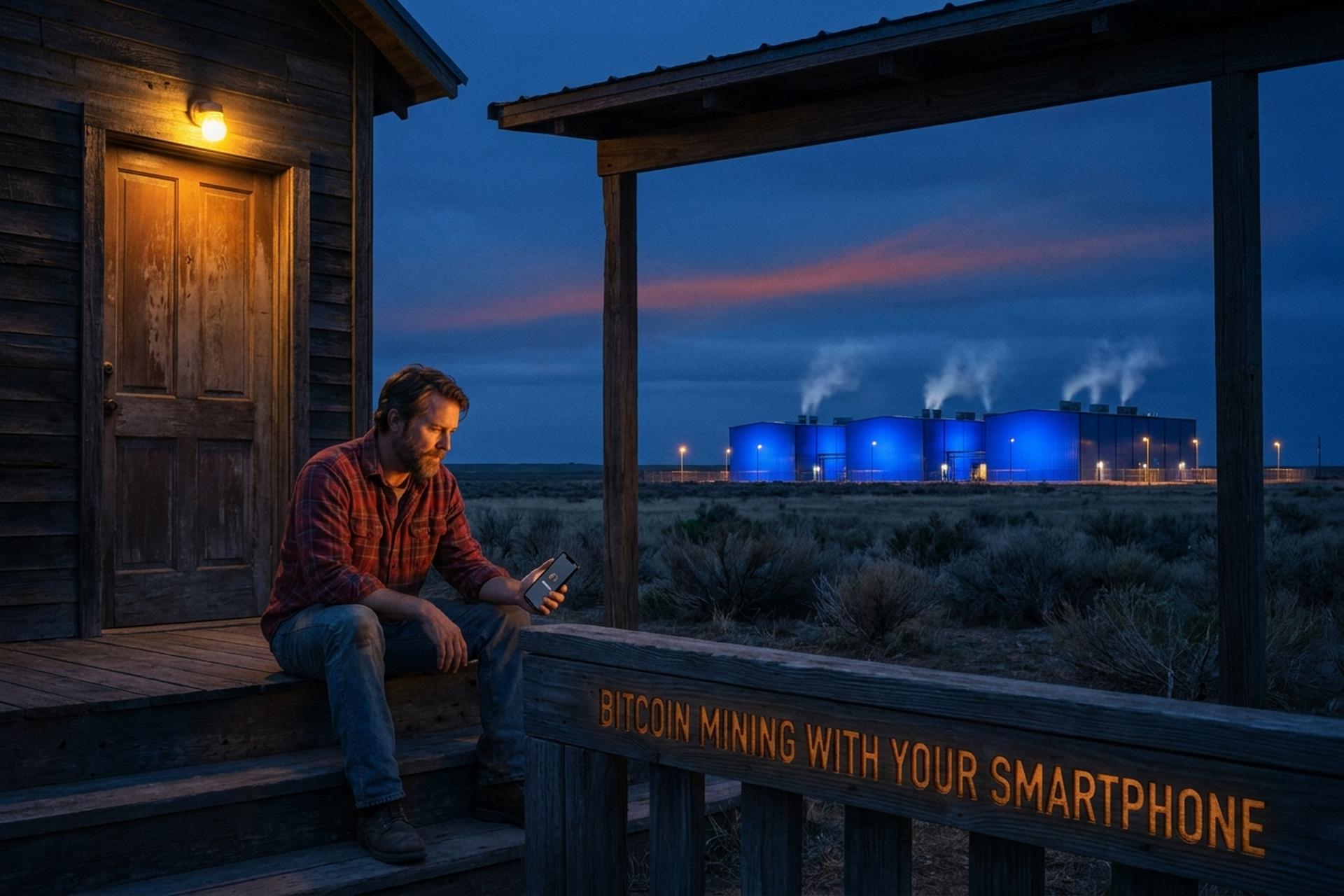
So you've been scrolling app stores looking for a way to mine bitcoin on your phone on the bus to work. Short answer: you can't. Not really. Not in 2026.
Sure, you can install apps that look like mining. A counter ticks up. Sometimes a few cents land in a wallet. But real Bitcoin mining, the kind that validates transactions and pays 3.125 BTC every ten minutes, happens on industrial ASIC machines hashing at 234 trillion tries per second. Your phone, running the same algorithm, is off by a factor so large it belongs in an astronomy textbook.
Still, the topic isn't useless. Worth knowing what mobile mining apps actually do. Worth knowing why serious cryptocurrency mining operations dropped smartphones back in 2018. And worth knowing where the small legit edges still live (cloud mining, Monero pools, reward-based micro-earnings) before a scam app eats your wallet. That's what the rest of this guide covers.
How bitcoin mining actually works in 2026
Quick primer first. Mining is how miners validate transactions on the blockchain and stamp out fresh supply. Same playbook runs across other proof-of-work cryptocurrencies. Ethereum bailed on proof-of-work in 2022. But Monero and Litecoin still lean on miner-validated blocks.
Here's the flow. You send some BTC. Payment drops into the mempool, basically a waiting room for pending transfers. A miner grabs transactions out of that pool, wraps them into a candidate block, and races every other miner to find a cryptographic hash that beats the current difficulty target. First to the line appends the block, pockets the reward. Simple.
Two numbers drive the whole game. Reward: after April 2024's halving, 3.125 BTC per block plus transaction fees. At today's prices, that's roughly $200,000 per winning block. Difficulty: after the 17 April adjustment, 135.80 trillion per CoinWarz. What's difficulty? A lever the protocol yanks every 2,016 blocks so blocks keep showing up every ten minutes, no matter how much hash power joins the party.
More hash power? Puzzles get harder. Harder puzzles? You need more hash power just to keep up. Treadmill. And that treadmill is why your smartphone, which would've been a credible CPU miner back in 2010, is nowhere on the leaderboard today.
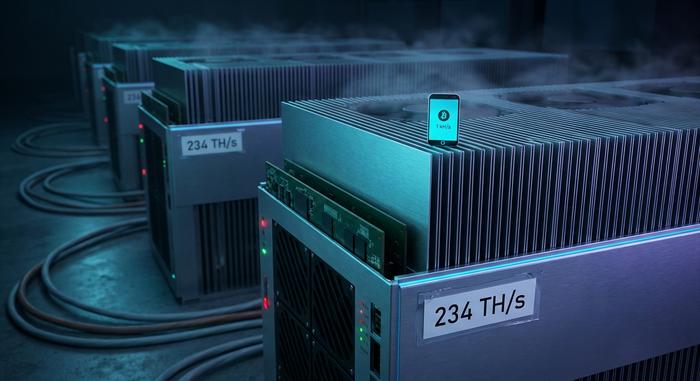
Zettahash era: smartphones vs modern bitcoin miners
Numbers first. CoinWarz pegged the Bitcoin network hashrate at 1.132 ZH/s on 19 April 2026. That's down from an all-time peak of 1.442 ZH/s on 20 September 2025. What's a zettahash? One sextillion hashes per second. One with twenty-one zeros. CoinDesk, citing Glassnode, clocked the 7-day average crossing 1 zettahash for the first time in early September 2025.
Zoom in. A single Bitmain Antminer S21 Pro, one of the most popular bitcoin miners on the market today, does 234 TH/s at 3,510 watts. The hydro-cooled S21 XP variant pushes 473 TH/s at 5,676 watts. Your smartphone's SoC, say a Snapdragon 8 Elite, peaks around 6 or 7 watts under sustained load. It wasn't engineered to grind SHA-256 puzzles all night. It was engineered to render Instagram Reels without melting your pocket.
Stack it side by side:
| Device | SHA-256 Hashrate | Power Draw | Relative to S21 Pro |
|---|---|---|---|
| Antminer S21 Pro (ASIC) | 234 TH/s | 3,510 W | 1x (baseline) |
| Antminer S21 XP Hydro | 473 TH/s | 5,676 W | ~2x |
| Bitaxe home miner (GH-range) | ~1.2 TH/s | ~15 W | ~0.0005x |
| Flagship smartphone (theoretical) | ~1-5 kH/s | 6-7 W | ~0.00000000002x |
A flagship phone? Roughly ten billion times slower than a single S21 Pro. Now picture millions of those S21 Pros plugged in across Texas, Paraguay, and Kazakhstan. That's what your phone is up against. Not a fair fight.
Can you mine bitcoin on your phone today?
Technically, yes. A smartphone can compute SHA-256 hashes. That is a fact about the hardware. Practically, no. Nobody mines bitcoin on a phone and earns bitcoin, because the probability of your phone finding a valid block hash before a 400-megawatt Texas mining farm does is indistinguishable from zero.
One data point sticks with me. In 2024, a lucky solo miner running a 6 TH/s machine beat 1-in-180-million odds to mine a block worth about $265,000, according to The Block. A smartphone is roughly ten billion times less powerful than that 6 TH/s machine. The math is unkind.
If you run the expected value: at 1 kH/s against a 1.132 ZH/s network, your smartphone would need to run continuously for longer than the current age of the universe before it could expect to mine one block, even ignoring difficulty increases. That is why every cryptocurrency mining guide written after 2018 that still says "start mining bitcoin on your smartphone" is either selling you something or out of date.
What mobile mining apps actually do
Pretty much every app selling itself as a way to mine bitcoin on your phone is one of four things. None of them is doing real proof-of-work on your device.
1. Cloud mining dashboards. You pay upfront. The company runs mining operations in a data center. A portion of the output, minus fees, drips into your account. ECOS, Hashing24, Bitdeer, BeMine. The app's just a front end. Hashing happens elsewhere. Most of these providers run mining pools and throw in a free trial at the entry tier.
2. Hash-power marketplaces. NiceHash mobile is the obvious one. The app lets you rent hash power or babysit a PC rig from the train. Your phone is a control panel, not a miner.
3. Reward and faucet apps. Bitcoin Miner by Fumb Games leads the pack in 2026. Tap a virtual pickaxe, watch ads, collect satoshis via Lightning. Decrypt clocked it at around 236 satoshis (16 cents) per five hours of play. Yes, really.
4. Engagement-points systems dressed as mining. Pi Network is the canonical example. It runs on the Stellar Consensus Protocol, not proof-of-work. Tap the daily button, Pi tokens drip out, your balance grows with your referral tree. Open Mainnet launched 20 February 2025 with 16 million migrated users, per Pi's anniversary post.
Why doesn't any app use your phone's CPU directly anymore? Both app stores banned it. Apple's App Store Review Guidelines, section 3.1.5(b), updated at WWDC on 11 June 2018, say apps "may not mine for cryptocurrencies unless the processing is performed off device." On 26 July 2018, Google updated Play Store policy with the blunt line: "We don't allow apps that mine cryptocurrency on devices." MinerGate's mobile miner, AA Miner, Free BCH Miner? All gone that year. Any app still promising on-device bitcoin mining in 2026 is either in violation, distributed outside the store, or lying about what it does.
Cloud mining and the legit way to mine crypto from a mobile phone
Cloud mining is the closest thing to a legal, functional version of what the phrase "bitcoin mining with your smartphone" implies. You pay a provider a fee, the provider runs hashing hardware at an industrial site, and you receive a share of the mined bitcoin (or the fiat equivalent) after fees.
The economics swing with BTC price, network difficulty, and how much the provider charges per terahash per day. BingX's 2026 guide lists entry prices from $100 trial contracts at AutoHash up to $8,000+ full-unit ASIC fractions at BeMine, with daily maintenance fees of roughly $0.05 to $0.33 per terahash per second. ECOS, licensed and operating from the Free Economic Zone in Armenia, serves over 900,000 users, per KuCoin's 2025 listing. NiceHash reports over 1.2 million daily active miners across its marketplace.
Pros of cloud mining apps for a beginner:
- No hardware to buy, no electricity bill to pay.
- No phone overheating or battery drain on your device.
- Small entry ticket, sometimes under $150.
- You can monitor mining progress from your phone without running anything on it.
Cons, and they matter:
- You are fully trusting a third party. If the company shuts down or vanishes, your contract is worthless. This has happened repeatedly.
- Profitability is variable. If BTC price drops or difficulty rises, your contract can go negative net of fees. Mining performance and the amount you earn are not guaranteed.
- Mining contracts often have minimum terms of 6 to 50 months, which locks in your risk exposure. Accepted payment methods vary: some providers take only crypto, others let you pay with cards.
The category is also swamped with fake mining apps. In August 2021, Trend Micro documented eight fraudulent cloud mining apps removed from Google Play. One, BitFunds, had been installed 100,000 times before takedown. Sophos separately identified 167 fake Android and iOS trading and crypto apps that same year. Cloud-mining-style scams drained at least $500 million from users in 2024 alone, according to industry figures aggregated by CoinLaw.
Mobile crypto mining for altcoins and cryptocurrencies beyond Bitcoin
A nuance the surface-level articles tend to skip: Bitcoin SHA-256 is hopeless on a phone, but a handful of cryptocurrencies run algorithms built specifically to resist ASICs and reward plain old CPUs.
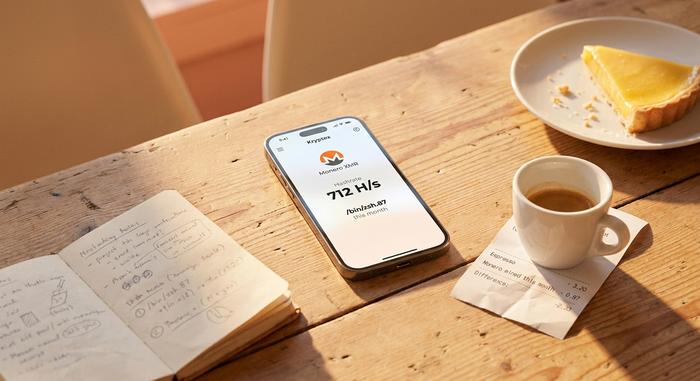
Monero is the textbook case. Its RandomX proof-of-work algorithm went live on 30 November 2019, designed to keep mining democratic by punishing specialized hardware. Flagship phones today, Samsung Galaxy S25 or Google Pixel 10, deliver 650 to 750 hashes per second on RandomX per Kryptex Pool benchmarks. Mid-range hardware (Poco X3 Pro, Redmi Note 12 Pro+) lands at 470 to 550 H/s. Still tiny versus the 5.8 GH/s Monero network, yes, but a real share, not zero.
Earnings at XMR near $339 and current difficulty? Roughly $0.50 to $1.00 per phone per month, before you pay for electricity. That's not a business plan. That's a coffee on a good month.
A quick comparison of the coins people actually talk about when they talk about mobile cryptocurrency mining:
| Coin | Mineable on phone? | How it works on mobile | Realistic monthly earnings |
|---|---|---|---|
| Bitcoin (BTC) | No | Only via cloud mining or faucet-style apps | Faucet apps: pennies. Real mining: zero. |
| Monero (XMR) | Yes, via RandomX | CPU mining in a legitimate pool like Kryptex | $0.50-$1.00 on a flagship, minus electricity |
| Pi Network (PI) | No (not real mining) | Tap a button; Stellar Consensus points | Pi tokens; liquidity depends on exchanges |
| Electroneum (ETN) | No (since 2019) | Proof of Responsibility, not PoW; rebranded to ETN Rewards Jan 2020 | Small app rewards tied to activity |
| Bitcoin Miner (Fumb Games) | No (ad-funded game) | Lightning satoshi payout per ad view | ~$1 per 30 hours played |
One caveat on the physics. Even on Monero, phones thermally throttle hard. Kryptex's data shows a 20 to 40 percent hashrate drop after 10 to 15 minutes of sustained load, a direct consequence of limited processing power in a passively cooled device. The phone is trying to protect itself. Which brings us to the red flags section.
Red flags in crypto mining apps for mobile devices
Install a mining app? Assume from minute one it isn't what it claims to be. Fraud in this space is loud enough to earn its own subcategory in crime reports.
The FBI's 2024 Internet Crime Report clocked $9.3 billion in cryptocurrency fraud losses. Up 66 percent year over year. Spread across 149,686 complaints. Chainalysis, in its 2026 Crypto Crime Report published 13 January, put scam losses for 2025 at around $17 billion. Average payment sizes? Up 253 percent to $2,764. Cloud-mining-style scams alone pulled in at least $500 million during 2024.
Warning signs, ranked by how much they should rattle you:
- The app demands an upfront "activation fee" or asks you to send crypto to start mining.
- Promised returns are stated as guaranteed or fixed. Real mining rewards are never guaranteed; they move with hashrate and price.
- The company has no registered office, no named team, no audit history, and no verifiable data-center location.
- The app is distributed outside Google Play or the App Store, often via a Telegram link or a third-party site. Reputable apps accept the cost of store listing for the distribution.
- Permissions are excessive. A mining app that needs contacts, SMS, or camera access without a clear reason is almost always harvesting data or pushing toward phishing. A few basic habits protect your data: audit permissions, enable 2FA, use strong unique passwords.
- Withdrawal rules keep moving. You reach a threshold, then a new threshold appears; then a "tax" appears. This is the standard operation pattern of pig butchering scams, which the FBI logged at $5.8 billion in 2024 alone.
Kaspersky also flags cryptojacking malware disguised as legitimate apps, which hijacks your phone's CPU to mine for the attacker. Symptoms: your phone runs hot for no reason, the battery drains unusually fast, and the device feels sluggish during idle periods.
A beginner guide to cryptocurrency mining on a phone
If, despite all that, you still want hands-on time with mobile mining, here's a pragmatic path. Treat it as a learning exercise, not an income stream.
1. Pick Monero and a phone you can afford to stress. Use a pool like Kryptex. It publishes hashrate expectations by device and lets you check your earnings right in the app. Expect $0.50 to $1.00 a month before electricity on a flagship.
2. Keep sessions short. Fifteen to thirty minutes, then long cooldowns. That's the compromise between collecting useful data and cooking the battery. Battery University data shows lithium-ion phone batteries degrade roughly twice as fast at 45°C versus 25°C, which is exactly where your phone lands under sustained mining.
3. Don't charge and mine at the same time. Charging while mining shoves the SoC and battery into high-temp zones simultaneously. A 2024 ScienceDirect paper linked sustained battery exposure above 45°C to SEI decomposition and dendrite growth, the exact mechanisms that kill battery life. If you must do both, cap charging at 80 percent.
4. Watch processing power and temperature. Android apps like CPU Monitor or Device Info HW show real-time temps. Stop mining the moment the CPU crosses 55°C. No exceptions.
5. Use a dedicated old device if you can. A retired Android, kept cool, plugged in, kept indoors, is the least bad way to keep the mining process running without torching your primary phone or cutting its lifespan in half. At 6 to 7 watts your electricity bills stay negligible. Nothing like the high electricity bills of an ASIC rig.
6. Use cloud mining for Bitcoin exposure, not on-device apps. If your goal is BTC and only BTC, pick a licensed cloud mining provider, read every line of the contract, start small, verify payouts, then scale if (and only if) the math still works.
One hard rule. Never install an app that promises meaningful on-device bitcoin mining on your phone. Every such app since the 2018 store bans is either a scam, cryptojacking malware, or a front-end for something the developer didn't disclose. There are no exceptions.
What to do with the cryptocurrency you actually earn on a phone
Earnings can come from a cloud mining contract, a Monero pool, or a Lightning-paying satoshi game. Doesn't matter which. Your next question is custody. Leaving crypto in a mining app's integrated wallet is the worst default you can pick. The app holds the keys. App vanishes? Coins go with it.
Move mined crypto out regularly. For small amounts and day-to-day use, a non-custodial mobile wallet (BlueWallet, Exodus, Muun) keeps your keys on the device and handles quick transfers. For bigger balances, a hardware wallet (Ledger, Trezor) stores keys offline and signs transactions without exposing the seed. Either way: back up the seed phrase on paper or metal, stash it somewhere that isn't the phone.
Two quick points before you close this tab. Mining income is taxable in most jurisdictions, valued at fair market price the day you receive it, so keep records. And if your "mining" was really a faucet or rewards app, the amounts are usually too small to matter for tax, but withdrawals to an exchange can still get flagged. Check your local rules before you assume you're under the line.