DEXTRADE Review 2026 : P2P Platform vs Dex-Trade Exchange
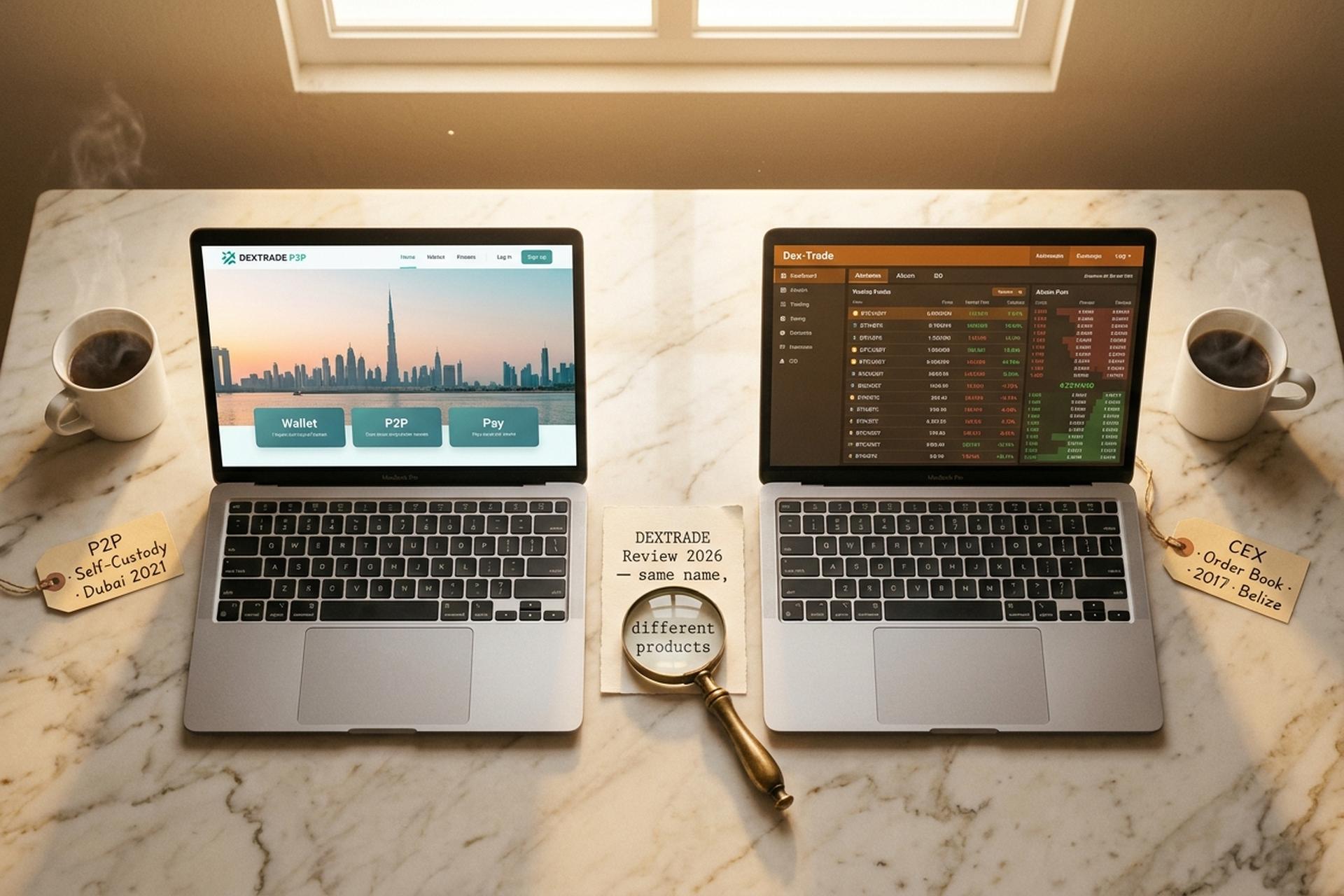
When a reader types "dextrade" into Google in May 2026, they reach two different products. The two share most of a name and almost none of a security model. The first is DEXTRADE P2P at dextrade.com. It is a non-custodial peer-to-peer trading platform with a built-in multi-chain wallet, a payments product, and a Dubai-licensed operator. The second is Dex-Trade at dex-trade.com. It is an older centralized cryptocurrency exchange with a 2017 founding, mid-tier trade volume, and a long list of altcoin pairs. Most of the confused user reviews online come from people who did not know which one they signed up for.
This review separates the two cleanly. It walks through what DEXTRADE P2P actually is, how its fees and KYC model work, what Dex-Trade exchange offers as a centralized platform, and how to pick between them when the goal is real activity rather than browsing. Every claim below comes from official pages, app listings, and third-party trackers; figures that conflict between sources are flagged inline.
Two brands, one keyword: DEXTRADE vs Dex-Trade
The disambiguation matters because the two platforms answer different questions. DEXTRADE P2P is run by RNDCEX TECHNOLOGIES FZCO out of Dubai Silicon Oasis (registration DSO-FZCO-41208). It is a non-custodial environment. You trade directly with another user, your private keys never leave your device, and the product line covers P2P swaps, an asset wallet, and a Pay rail for crypto payments. According to its LinkedIn page, the operating company DexTrade was founded in 2021 and lists 11-50 employees, with seven currently visible on the platform.
Dex-Trade is a different company entirely. Its centralized exchange is registered, depending on the data source, under jurisdictions ranging from Belize to Seychelles to Estonia, with the Belize footprint most consistently reported. It launched on January 1, 2017, processes daily trade volume between roughly $115 million and $145 million across major data trackers, and operates more like a traditional crypto exchange with order books, custodial deposits, and IEOs. The two are not the same legal entity, the same product, or the same asset model. Treating them as one is the single biggest mistake new users make.

What DEXTRADE P2P actually is for traders
DEXTRADE P2P aims to decentralize three product categories that are usually offered by separate companies: peer-to-peer trade matching, a self-custody wallet for cryptocurrencies, and a crypto-to-fiat payment processor. The official site frames the trio as DexTrade P2P, DexTrade Wallet, and DexTrade Pay. Each leans on the same non-custodial model. Funds never sit on a centralized order book waiting for a withdrawal queue. They sit in the user's wallet, locally, until a trade settles between two parties.
The P2P side of the platform supports a focused set of assets. Bitcoin, Ethereum, EOS, Tron, and Litecoin work at the chain level. Tokens issued under the ERC-20, BEP-20, and ERC-721 standards work too. That coverage is intentionally narrow compared with a typical centralized crypto exchange. DEXTRADE P2P is built around active corridors rather than long-tail listings. Because the wallet handles custody, you do not need to deposit to a platform address to start a trade; an exchanger sets terms in an ad, and you complete the swap directly.
For asset pairs that share a compatible hashing algorithm, DEXTRADE supports atomic swaps, which let two users trade across blockchains without an intermediary. A trade either executes on both chains or on neither, removing the counterparty risk that haunts most peer-to-peer crypto matchmaking. Where atomic swaps are not available — typically the fiat side — the platform leans on a rating and review system, verified exchanger badges, and an in-app chat that doubles as dispute evidence. Native token swaps inside DexTrade carry reduced fees, which is the team's primary commercial lever.
The team behind the operation is small but identifiable: Roman Leleko, plus engineers Dmytro Khikhmatulin and Ruslan Mykoliuk lead a roster of around seven public profiles on LinkedIn. That transparency is unusual for the P2P category, where many competitors operate behind pseudonyms. The independent wallet auditor WalletScrutiny tested the Android build and recorded five of seven verifiability checks as passing, with the source code closed; that is mid-tier on its scale, and worth weighing for users who treat reproducible builds as a baseline.
A noteworthy 2025 update: on May 14, 2025, DexTrade announced a partnership with Reactive Network to enable gasless cross-chain swaps across the P2P interface. The integration adds Solana support via WalletConnect and lets users swap between EVM chains without holding gas tokens on each network — useful in a cryptocurrency exchange landscape where fees still gate small trades.
DEXTRADE P2P fees, KYC, and security
The fee model is unusual enough to deserve a careful read. DEXTRADE P2P does not charge a platform fee on top of trades. The user pays the network transaction fee for the underlying chain, and an individual exchanger may price a fiat-to-crypto swap with a transparent margin shown before confirmation. There is no maker-taker schedule, no withdrawal fee, and no account maintenance charge. For active P2P traders, that structure compares favourably with the 0.1 to 0.2 percent ranges typical of centralized crypto exchange spot books.
KYC follows the same opt-in logic. Identity verification is not required to open the wallet or to swap on-chain. KYC becomes relevant only when an exchanger requests it on a specific ad, which is most common for fiat-to-crypto trades where the seller wants compliance cover. Optional AML and KYC packages are offered for users who want a verified badge to attract counterparties.
Security is the trade-off. Because there is no custodian, there is no centralized wallet to hack. The flip side is that disputes hinge on the rating system rather than a custodian's ability to reverse a transaction. Atomic swaps remove this risk in compatible corridors, where the trade is mathematically secure on both sides, but fiat trades depend on counterparty quality, which is why the platform invests in verified exchanger flags, ratings, and chat-based evidence. Users who would rather pay a fee for a guaranteed dispute resolution at a centralized crypto exchange should not use a non-custodial P2P system. Users who want privacy and lower fees in exchange for managing their own counterparties usually find this trade-off worthwhile.
DEXTRADE Wallet and Pay: assets, tokens, deposit
The wallet is the layer most users actually interact with daily. It supports send and receive of every asset DEXTRADE accepts, runs across iOS, Android, and direct APK download, stores seed phrases locally, and uses biometric or password locks at the device level. The mobile app is positioned as the primary access point; the web platform exists, but the team's emphasis on mobile is visible in the release cadence and the number of features that ship to phones first.
DexTrade Pay extends the same logic into payments. Merchants and users can settle in major coins, with the platform applying reduced fees when the native DexTrade token is used in the swap path. The product positions itself as an alternative to traditional fiat payment rails for crypto-native businesses. It is a smaller part of the company's surface area in 2026, but it is the bridge between the P2P side and a more conventional payments use case.
Dex-Trade exchange: what the older CEX actually is
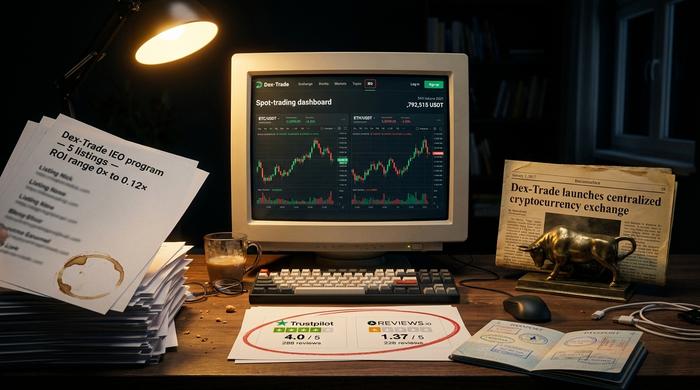
Dex-Trade is a separate centralized cryptocurrency exchange that has operated since the start of 2017. It is closer to a mid-tier altcoin venue than to a top-ten exchange, and its public metrics line up with that positioning. Across the major trackers, 24-hour trade volume sits in a band: $138.79 million on CoinMarketCap, $145.39 million on Coinranking, $115 million on LiveCoinWatch. Coinranking ranks the exchange at number 80 among centralized venues with a 0.21 percent market share, while LiveCoinWatch reports a more modest 0.12 share. The variance reflects how different aggregators weight self-reported volume, but the order of magnitude is consistent.
Pair coverage is broader than the P2P platform's. Dex-Trade lists 187 markets across 119 to 151 coin tickers, with the BTC/USDT pair carrying around $76.15 million of daily volume on its own and ETH/USDT another $18 million. After those, the active pairs include TRX, XRP, DOGE, BNB, ADA, LINK, and SUI against USDT and BTC. The exchange runs spot trading, a referral program, and a demo mode aimed at beginners testing strategies without risking funds. It also operates an IEO program. Risk-free demo trading is available before deposit. Advertised high liquidity is concentrated in the BTC and ETH pairs. Customer service is listed as round-the-clock on the official site, though that claim should be checked against current Trustpilot complaints rather than taken at face value.
Jurisdiction is messier than a single answer can capture. Coinranking lists Belize, CoinMarketCap reports Seychelles, LiveCoinWatch shows Estonia, and the iOS App Store metadata names a Chile-based developer entity. A reasonable read is that Dex-Trade uses a layered registration structure across multiple jurisdictions. This is common among mid-tier centralized crypto exchange businesses. It is worth flagging for users who want a single regulated counterparty. The iOS app, version 2.1.9, was last updated on May 11, 2023, and carries a 2.8 out of 5 rating across 19 reviews. Trading fees are 0.2 percent maker and 0.1 percent taker on spot. Listed reserves run around $1.6 million, which is light for a CEX of this volume profile.
User reviews are split. Trustpilot lists Dex-Trade at 4 out of 5 stars across 288 reviews. The independent reviews.io dashboard shows 1.37 out of 5 across 226 reviews. That gap is unusual and points to either review-farming on one side or unresolved complaint clusters on the other; either way, prospective users should read both before depositing. The IEO history is also unflattering: across the five tokens listed under Dex-Trade's IEO program tracked by CoinCodex, return on investment ranged from zero to 0.12×, meaning every IEO underperformed the listing price.
| Source | 24h volume | Rank / share | Markets / coins |
|---|---|---|---|
| CoinMarketCap | $138.79M | n/a | n/a (loading) |
| Coinranking | $145.39M | #80 / 0.21% | 187 markets / 151 coins |
| LiveCoinWatch | $115.00M | 0.12 share | 93 markets |
| Signal | DEXTRADE P2P | Dex-Trade exchange |
|---|---|---|
| Operator entity | RNDCEX TECHNOLOGIES FZCO (Dubai) | Layered Belize / Seychelles / Estonia / Chile |
| Founded | 2021 (LinkedIn); iOS app from Aug 2022 | January 1, 2017 |
| Custody model | Non-custodial, local seed phrase | Custodial CEX with deposits |
| Fees | No platform fee (network + exchanger margin) | 0.2% maker / 0.1% taker |
| KYC | Optional, exchanger-driven | Standard CEX KYC |
| Third-party audits | WalletScrutiny 5/7 pass, source closed | No public audit; reserves ~$1.6M |
| User sentiment | Small footprint, no aggregator listings | Trustpilot 4/5 (288), reviews.io 1.37/5 (226) |
| Recent upgrades | Reactive Network gasless swaps May 2025 | iOS app last updated May 2023 |
DEXTRADE coins and trading pairs
The two platforms answer different questions on coverage. DEXTRADE P2P limits its supported assets to the chains where active P2P liquidity actually exists: Bitcoin, Ethereum, EOS, Tron, and Litecoin natively, plus any token issued under the ERC-20, BEP-20, or ERC-721 standards. That focus keeps the platform's matchmaking surface tight and reduces the risk of orphaned trade pairs. Dex-Trade goes the opposite way, listing far more altcoins and trading pairs in pursuit of long-tail volume. USDT is the central denomination on both platforms; on Dex-Trade, USDT pairs make up the dominant share of daily turnover. A trader who wants to buy Bitcoin against USDT or who needs deep BTC and ETH liquidity finds both venues acceptable. A trader who needs SUI/USDT or DOGE/USDT will find Dex-Trade a more natural fit, while a trader looking for fiat-on-ramp via a P2P counterparty is more naturally served on DEXTRADE P2P.
Accessibility, mobile apps, and referral programs
Mobile is where the product philosophies diverge. DEXTRADE P2P ships an iOS app, an Android app, and a direct APK download, with the APK route designed for users in regions where Google Play distribution is restricted. The wallet and trade interfaces are mobile-first, and most of the in-app onboarding assumes a phone-only user. Dex-Trade's iOS app was last updated on May 11, 2023, sits at version 2.1.9, and carries 19 reviews averaging 2.8 stars. The exchange's web interface remains the primary surface, with the apps supplementing rather than replacing it. Both platforms run referral programs, and Dex-Trade's demo mode is a useful trial for new traders who do not want to commit funds before exploring the order types.
Privacy, verification, and which one to pick
DEXTRADE P2P is the better fit for privacy-first users who want self-custody, optional KYC, no platform fees, and direct trade with a counterparty whose history is visible. Dex-Trade is the better fit for traders who want a centralized order book, dozens of altcoin pairs, IEO access, and a demo mode. The two products coexist because they answer different jobs, not because they compete head to head, and the most common funding mistake — sending an asset to one address while logged into the other site — comes from confusing them. Verify the URL before you transfer. Read each platform's privacy policy on the official domain before signing up. A decentralized exchange in the broader sense (Uniswap, Jupiter, Raydium) is yet another category. The search results sometimes pull in those results by mistake, with no relation to either of the two DexTrade brands here.
What DEXTRADE means as a crypto platform 2026
The accurate read of "DEXTRADE" today is two parallel businesses with overlapping branding and very different security and pricing models. The newer DEXTRADE P2P stack is built around non-custody, mobile, and the elimination of platform fees; the older Dex-Trade exchange is built around order books, IEOs, and breadth of altcoin coverage. Both are legitimate options inside their categories. Neither is a substitute for the other. The rest depends on what you actually want to do with crypto.