What is TRON (TRX): the blockchain that quietly became crypto’s stablecoin highway

TRON doesn't get the respect it deserves in Western crypto circles. People dismiss it as Justin Sun's vanity project, a copycat chain that forked Ethereum's code and built a hype machine around it. And honestly, some of that criticism landed early on. The white paper plagiarism controversy in 2018 was embarrassing. Sun's relentless self-promotion feels exhausting to a lot of the crypto community.
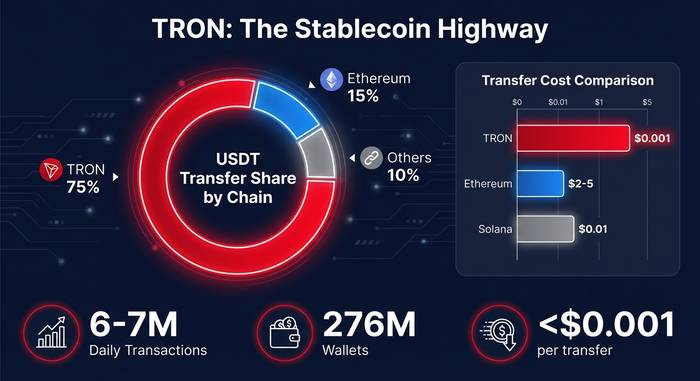
But here's what the critics miss: TRON processes 6-7 million transactions per day. It hosts over 75% of all Tether (USDT) transfers globally. The network has 276 million wallet addresses. TVL sat above $4.5 billion at the end of 2025. Revolut just integrated TRX staking for 65 million European users. Whatever you think of the founder, those numbers represent a real blockchain doing real work.
This article breaks down how TRON actually works, what the TRX token does, where the network fits in the 2026 landscape, and whether the investment case makes sense at today's $0.31 price.
How the TRON blockchain works
TRON launched its own mainnet in June 2018 after starting life as an ERC-20 token on Ethereum. The migration involved swapping Ethereum-based tokens for native TRX on the new TRON blockchain. Since then, the network has operated independently with its own consensus mechanism, virtual machine, and developer ecosystem.
The core architecture has three layers:
Storage layer: Separates blockchain data (the permanent historical record of every transaction) from state data (current balances, smart contract statuses). This split improves query performance and makes the chain more efficient to operate.
Core layer: Processes instructions written in Solidity or Java and feeds them to the TRON Virtual Machine (TVM). The TVM is compatible with Ethereum's EVM, which means developers can port Ethereum dApps to TRON with minimal code changes. That compatibility was strategic: it lowered the barrier for developer adoption massively.
Application layer: Where wallets, dApps, and tools built on TRON live. Developers deploy smart contracts through this layer using TRC-20 (similar to Ethereum's ERC-20) token standards.
TRON uses Delegated Proof of Stake (DPoS) for consensus. Instead of thousands of validators like Ethereum, TRON elects 27 "Super Representatives" who take turns producing blocks. These SRs are elected by TRX holders who stake their tokens and vote. Elections happen every 6 hours. Block time is 3 seconds, and each block producer earns 32 TRX as a reward.
The result: TRON is fast. Really fast. The network handles over 6 million transactions per day and claims a capacity of 2,000 per second. But only 27 entities control which blocks get produced. Compare that to Ethereum's 900,000+ validators. The centralization trade-off is obvious, and TRON's critics bring it up constantly. My take: for moving USDT, nobody cares about maximum decentralization. They care about speed and cost. For storing your life savings on-chain, you might want more validators standing between you and a potential attack. Different use cases have different risk tolerances, and TRON optimized hard for the payments use case.
The TRX token: what it does and how the economics work
TRX is the native cryptocurrency of the TRON network. Its uses:
Gas fees: Every transaction on TRON costs a small amount of TRX. The fees are extremely low, often under $0.001 for a simple transfer. That's why TRON became the default network for USDT transfers in developing countries: sending $100 in Tether costs practically nothing.
Staking and governance: Lock TRX to gain "TRON Power" and vote for Super Representatives. Staking earns rewards from block production fees. Revolut's recent integration lets users stake TRX directly in the app with zero commission.
Bandwidth and energy: TRON has a unique resource model. Instead of paying gas fees directly in TRX for every transaction, users can freeze (stake) TRX to obtain "bandwidth" and "energy" credits. Bandwidth covers simple transfers. Energy covers smart contract executions. If you hold enough frozen TRX, your transactions are essentially free. If you run out of bandwidth or energy, TRX gets burned as a fee instead.
Token creation: Anyone can issue TRC-20 tokens on TRON, just like ERC-20 on Ethereum. The TRON ecosystem hosts thousands of tokens, with USDT being by far the most significant.
| TRX fact | Detail |
|---|---|
| Launch | 2017 (ERC-20), mainnet June 2018 |
| Founder | Justin Sun |
| Max supply | No hard cap (inflationary, offset by burns) |
| Circulating supply | ~86.4 billion TRX |
| Current price (Apr 2026) | ~$0.31 |
| Market cap | ~$27 billion |
| Daily transactions | 6-7 million |
| Wallet addresses | 276 million |
| Consensus | DPoS (27 Super Representatives) |
| Block time | 3 seconds |
TRON's stablecoin dominance: the real story
If you only read one section of this article, make it this one. TRON's most important function in 2026 isn't DeFi, gaming, or dApps. It's moving stablecoins.
Over 75% of all USDT (Tether) transfers happen on the TRON network. Not Ethereum. Not Solana. TRON. The reason is simple economics: sending USDT on Ethereum mainnet costs $1-5 in gas. On TRON, the same transfer costs $0.001 or less. For someone in Nigeria, Vietnam, or Turkey sending $200 in remittances, that cost difference matters.
TRON handles 78% of peer-to-peer USDT transactions and 56% of global retail-sized transfers (under $1,000), according to data from Chainalysis and TRON network statistics. Decentralized exchanges on the TRON blockchain process $3.2 billion in weekly stablecoin volume.
This is the part of TRON that doesn't get enough coverage. While crypto media focuses on Ethereum DeFi innovations and Solana's memecoin culture, TRON quietly built the infrastructure that most of the developing world uses to move money. In countries with capital controls, collapsing currencies, or limited banking access, USDT on TRON has become a parallel financial system.
Justin Sun understood this early. Low fees and fast confirmations made TRON the optimal chain for stablecoin transfers, and Tether's decision to deploy heavily on TRON cemented that position. Whether you like the network or not, the stablecoin use case is real, measurable, and growing.
TRON's DeFi and dApp ecosystem
Beyond stablecoins, TRON hosts a broader ecosystem of decentralized applications, though it's smaller and less innovative than Ethereum's or Solana's.
DeFi: JustLend is the biggest lending protocol. SunSwap handles decentralized trading. Total DeFi TVL on TRON peaked above $9 billion in 2025 before pulling back to $4.5 billion by Q4 2025. That's still enough to rank TRON among the top 5 Layer-1 blockchains by TVL.
NFTs and gaming: TRON has an NFT ecosystem, though it's considerably smaller than Ethereum's or Solana's. The APENFT marketplace is the primary venue. Gaming hasn't been a major focus compared to competitors.
Content sharing: When Justin Sun bought BitTorrent for $140 million in 2018, the pitch was that TRON would become the backbone of decentralized content. BitTorrent had 100 million monthly users. The BTT token launched in 2019. In practice, the grand content vision never fully landed. BitTorrent still works, people still torrent files, but the idea of creators getting paid in crypto for their content through TRON hasn't taken off the way the 2018 roadmap promised. What did happen is that the BitTorrent acquisition gave TRON brand visibility and a massive user base to cross-sell the blockchain to.
Developer activity: TRON's developer community is real but smaller than the top chains. Electric Capital's annual developer report consistently ranks TRON behind Ethereum, Solana, Polygon, and Arbitrum in active developer count. The saving grace is EVM compatibility: any Solidity developer can deploy on TRON with minimal changes to their code. That lowers the barrier, even if it doesn't attract cutting-edge research the way Ethereum does.
New partnerships: Revolut's 2026 integration is worth highlighting. The fintech giant (65 million users in the EEA) now offers in-app TRX staking with zero commission, one-tap USDT conversions, and stablecoin remittances through TRON. That's the kind of mainstream distribution that most crypto projects dream about. It validates TRON's position as the go-to rails for stablecoin payments in the traditional fintech world.
Risks and controversies
Justin Sun: TRON's founder is one of the most polarizing figures in crypto. He's been accused of market manipulation, sued by the SEC for alleged unregistered securities offerings, and criticized for lavish spending (he paid $4.57 million for lunch with Warren Buffett). Whether these controversies affect the network's technical merit is debatable, but they affect sentiment and institutional perception.
Centralization: Twenty-seven Super Representatives is a very small validator set. The top SRs tend to be controlled by large exchanges and entities close to the TRON Foundation. This makes the network faster but less censorship-resistant than more decentralized chains.
Regulatory risk: The SEC filed charges against Justin Sun and the TRON Foundation in March 2023 for unregistered securities and market manipulation. The case is still being litigated as of 2026. An unfavorable outcome could affect TRX's availability on US exchanges.
Inflationary tokenomics: TRX has no hard supply cap. New tokens are created as block rewards every 3 seconds. TRON offsets this with a burn mechanism: when users don't have enough frozen bandwidth or energy credits, TRX gets burned to cover the fee. The network has been net deflationary during periods of high usage (more TRX burned than created). But the math isn't guaranteed to stay that way. If usage dips, inflation wins. That puts TRX in a different category than hard-capped assets like bitcoin. Whether that matters depends on how much you care about monetary policy in your crypto.
One more thing worth noting: TRON processes over 10 billion cumulative transactions as of mid-2025, a 19% increase year-over-year. Daily active users sit above 2.8 million. Those aren't vanity numbers on a ghost chain. Actual people use TRON every day, mostly for payments. The gap between TRON's reputation in Western crypto media and its actual usage in Asia, Africa, and Latin America is one of the biggest perception mismatches in the market.