
What is NEAR Protocol? The blockchain for AI built by a transformer co-author
The co-author of the most cited paper in AI history is running a blockchain. Illia Polosukhin helped write "Attention Is All You Need" in 2017, the paper that introduced transformer architecture and made ChatGPT, Gemini, and every other large language model possible. Then he left Google and built NEAR Protocol.
That background matters. Most blockchain founders came up through fintech or distributed systems. Polosukhin came from the lab that birthed modern AI. NEAR started as a startup in 2017 focused on program synthesis before pivoting to blockchain in 2018. In 2026, the circle closes. NEAR Protocol is the blockchain for ai, an ai-native platform where autonomous agents transact across chains, hold wallets, and interact with decentralized applications on their own.
What follows is the full picture: how NEAR Protocol works under the hood, why Nightshade sharding outperforms most L1 competitors, what chain abstraction and NEAR Intents actually do, and whether the NEAR token deserves a spot in your portfolio at the current near protocol price.
How NEAR Protocol works: sharded, scalable, cheap
NEAR Protocol hit mainnet in April 2020. Illia Polosukhin and Alexander Skidanov built it after raising over $500 million from investors including Andreessen Horowitz and Tiger Global. Skidanov was previously director of engineering at MemSQL and worked at Microsoft. Polosukhin came from Google Research. They wanted a Layer 1 that did not choke under load the way Ethereum did during the 2021 NFT craze, when gas fees regularly spiked past $50.
Their answer was sharding, but not the theoretical kind that Ethereum has been promising since 2018. NEAR actually shipped it. The protocol breaks the network into parallel processing lanes called shards. Think of it like a highway. One lane backs up fast. Six lanes handle more cars. Each shard runs its own validator set and processes its own transactions, independently of the others.
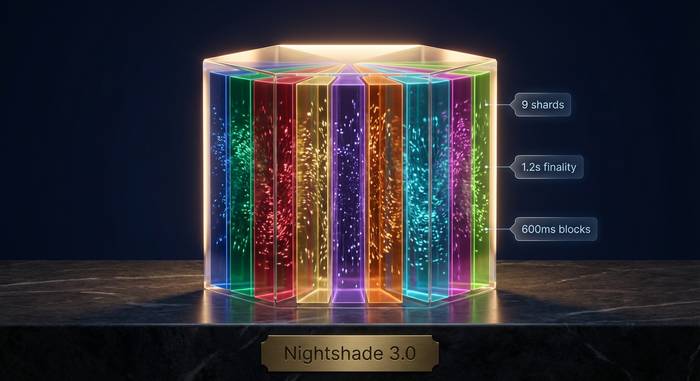
NEAR calls their sharding design Nightshade. Every block on the chain contains "chunks" from each active shard, stitched together so the whole thing looks like a single blockchain to anyone using it. You do not see the shards. You just see fast, cheap transactions. Finality in 1-2 seconds. Fees under a penny. And the capacity grows by adding more shards, not by making everyone run bigger computers.
| Feature | NEAR Protocol | Ethereum | Solana | Avalanche |
|---|---|---|---|---|
| Consensus | Proof of stake (TPoS) | Proof of stake | Proof of history + PoS | Avalanche consensus |
| Sharding | Nightshade (dynamic) | Planned (danksharding) | None | Subnets |
| Block finality | ~1-2 seconds | ~12-15 minutes (with finality) | ~400ms | ~2 seconds |
| Avg transaction fee | <$0.01 | $1-50+ | <$0.01 | $0.01-0.10 |
| Smart contract languages | Rust, JavaScript | Solidity, Vyper | Rust | Solidity |
One detail that developers actually care about: NEAR lets you write smart contracts in JavaScript and Rust. Solidity dominates Ethereum, but the broader developer world lives in JavaScript. Lowering the barrier means more builders can ship decentralized applications without learning a new language from scratch.
Human readable account names are another NEAR thing. Instead of 0x7a3b... addresses, you get alice.near. Small detail, big difference for anyone who has ever sent crypto to the wrong hex string.
Nightshade and Stateless Validation: the scaling engine
Nightshade has gone through several upgrades since launch. The biggest recent one: Stateless Validation.
Old problem: every validator had to store the full state of whatever shard they were assigned to. As the chain grew, so did the hardware bill. That pushed validation toward well-funded operators running beefy AWS instances. A Messari report from 2023 found roughly 35% of NEAR's staked tokens sitting on Amazon Web Services. The Nakamoto coefficient was about 1.3, which means a small number of infrastructure providers could theoretically disrupt the network. Not great for a project that sells itself on decentralization.
Stateless Validation fixes the storage problem. Validators now get a "state witness" packaged with each chunk of transactions. The witness contains a cryptographic proof of everything needed to verify that chunk, no local state storage required. Cheaper hardware. More potential validators. Better geographic distribution.
Next up on the roadmap: dynamic sharding. The number of shards would adjust on the fly based on how busy the network gets. Rush hour? Spin up more shards. Quiet Sunday? Consolidate. The network scales to match demand instead of running at a fixed ceiling. NEAR near uses this approach already in limited form but full dynamic sharding is still in development.
Chain abstraction: one account, every blockchain
Ask someone to use three different blockchains in one afternoon. They will need three wallets, three gas tokens, two bridges, and roughly four hours of frustration. Chain abstraction is NEAR's answer to that mess.
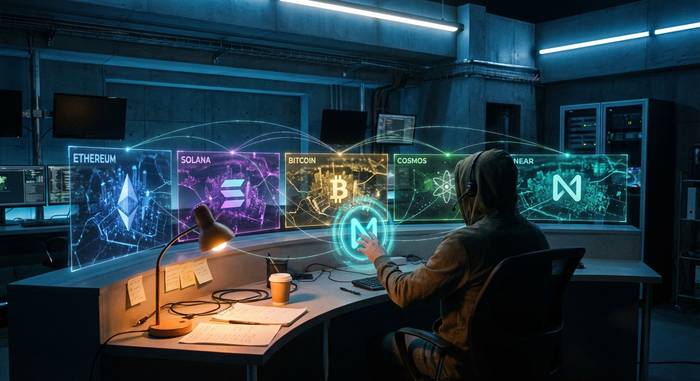
The pitch: one account, every blockchain. Your alice.near address works on NEAR, but also on Ethereum, Bitcoin, Solana, wherever chain signatures can reach. No bridge hopping. No wrapped tokens. Your NEAR account signs transactions on foreign chains through a decentralized MPC network where no single party holds the private key. You control assets across chains from one place.
NEAR Intents takes this further. You tell the protocol what you want: "swap my USDC for ETH at the best available price." You do not specify a chain, a DEX, or a routing path. Solvers compete to fill that intent efficiently. Maybe the best rate lives on Arbitrum today and Base tomorrow. You do not care. The solver handles it, the intent gets resolved, and the assets land in your account.
This is the seamless web3 experience people have been talking about since 2020. NEAR actually built the pieces: chain signatures for cross-chain signing, intents for execution, and account abstraction for the UX. Whether it works at scale with million users and real liquidity is the test that still matters. Early integrations look promising. Mass adoption is a different beast.
NEAR AI: user-owned AI on the blockchain
This is the part where Polosukhin's transformer architecture background stops being a fun fact and becomes a product strategy.
NEAR AI launched as the protocol's initiative to bring artificial intelligence on chain. The thesis: AI is going to need a blockchain. Not for the AI models themselves, but for the agents those models create. AI agents need wallets and the ability to transact. They need to negotiate with other agents and carry verifiable identities. All of that requires blockchain infrastructure, and NEAR is positioning itself as that infrastructure.
The concept is user-owned AI. Instead of your AI assistant living inside Google or OpenAI where the company controls it, a user-owned AI agent runs on NEAR where you control the keys. Your agent has its own near account, holds funds, executes trades, signs contracts, interacts with dApps. You own it. You control it. Nobody can shut it down or change its behavior without your permission.
Chain signatures and intents act as the primitive building blocks that make AI agents on NEAR actually useful. NEAR is also exploring trusted execution environments for running AI models in a verifiable way. The problem with AI on chain is that running large models inside a blockchain is impractical. TEEs allow the computation to happen off chain while providing cryptographic guarantees that the model ran correctly and was not tampered with. It is a compromise between full on-chain execution and trusting a centralized API.
The AI agents concept builds on chain abstraction. An AI agent on NEAR could manage a portfolio across Ethereum, Solana, and Bitcoin simultaneously using chain signatures. It could find the best yield farming opportunity across chains, execute the transactions, rebalance based on conditions, and report back. All without the user touching anything.
NEAR put $20 million into a dedicated AI development fund in September 2025. OceanPal Inc. invested $120 million specifically for AI initiatives. At NEARCON 2026, the team unveiled IronClaw, an AI assistant, and a Confidential GPU Marketplace for decentralized AI computation. Venice AI partnered with NEAR in March 2026 for private inference using trusted execution environments.
Whether this vision materializes depends on developer adoption, the pace of AI agents technology broadly, and whether NEAR can compete with Fetch.ai, Virtuals Protocol, and other projects chasing the "blockchain for ai" narrative. Polosukhin, the co-author of the transformer paper, has credibility nobody else in this space can match. But credibility alone does not build an ecosystem.
The NEAR token: price, staking, and supply
NEAR is the native cryptocurrency that powers everything on the protocol. You pay transaction fees in NEAR. You stake NEAR to participate in validation. You use NEAR for governance.
The token launched with an initial supply of 1 billion NEAR. There is no fixed maximum supply. Annual inflation runs at about 5%, which rewards validators and stakers. The deflationary counterweight: 70% of all transaction fees get burned. If network usage grows fast enough, the burn could theoretically outpace inflation and make NEAR deflationary. It has not happened yet at current usage levels, but the mechanism exists.
| NEAR token snapshot | Value |
|---|---|
| Price (Apr 2026) | ~$1.28 |
| Market cap | ~$1.65 billion |
| CMC rank | #43 |
| Circulating supply | ~1,292 million NEAR |
| Initial supply | 1 billion NEAR |
| Inflation rate | ~5% annually |
| Fee burn | 70% of transaction fees |
| All-time high | $20.44 (Jan 2022) |
| Staking APY | ~4.7-8% |
| Fully diluted valuation | ~$1.65B |
About 45-48% of all circulating near tokens are staked, earning holders somewhere between 4.7-8% APY depending on the validator. Around 370 validators secure the network through a proof-of-stake consensus mechanism, with a cap at 500 total slots.
Token allocation at genesis: epoch rewards/staking (39.3%), backers (14.4%), community grants (10.5%), core contributors (8.5%), community sale (7.3%), early ecosystem (7.1%), operational grants (6.9%), foundation endowment (6.1%). All vesting has fully unlocked by 2026.
The near protocol price today sits at about $1.28, roughly 93.7% below the all-time high from January 2022. The 24-hour trading volume typically ranges between $80-150 million. The near protocol markets and current market activity mostly track the broader cryptocurrency market rather than anything NEAR-specific.
The near price and live price of near protocol are available on every major aggregator. The marketcap ranks NEAR at #43 on CoinMarketCap. In the last 24 hours, typical trading volume ranges $80-150 million. You can check live charts on CoinGecko or TradingView for the price of near protocol in real time.
You can buy near protocol on Coinbase, Kraken, Binance, and most major exchanges.
The NEAR ecosystem: what is actually being built
A blockchain is only as valuable as what runs on it. NEAR's ecosystem covers DeFi, gaming, NFTs, and AI applications.
RHEA Finance (a merger of Ref Finance and Burrow) controls about 95% of NEAR's DeFi TVL, which sits around $150-155 million. That is a concentration problem. Mintbase handles NFTs. Sweat Economy drove 1.6 million monthly active users in 2025 through its move-to-earn model. HOT Wallet contributed 530,000 daily active addresses.
Here is where it gets interesting: NEAR recorded 46-51 million monthly active users in May 2025, putting it among the top 2 Layer 1 blockchains by that metric. The nearprotocol ecosystem has real users. But the DeFi TVL tells a different story. Ethereum sits at $50+ billion. Solana at $7+ billion. Avalanche at $1.2 billion. NEAR at $155 million. Lots of users, not a lot of capital locked in DeFi. The near protocol statistics say "used" but the TVL says "not yet for DeFi."
The protocol is open-source and supports .near human readable accounts, gas fee rebates where developers subsidize user costs, and a high-performance developer experience built around JavaScript and Rust. NEAR Intents has processed over $13 billion in cumulative swap volume with 15.7 million swaps since launch. Brave Wallet integrated NEAR Intents in March 2026.
Partnerships span Alibaba Cloud, Google Cloud, Polygon, and the ADI Foundation (50+ institutions across real estate, energy, and payments). NEAR is the blockchain for builders who want a usable blockchain without Solidity lock-in and a scalable foundation for the next generation of apps.
Funding, team, and NEAR Foundation
NEAR raised about $542 million across 8 rounds from 90 investors. The big ones: $21.6 million from a16z in May 2020, $150 million from Three Arrows Capital and others in January 2022, and $350 million from Tiger Global in April 2022 (two months before Three Arrows went bankrupt). Yes, that Three Arrows Capital. NEAR kept building anyway.
Illia Polosukhin and Alexander Skidanov still run things. Polosukhin as CEO, Skidanov as CTO. Marieke Flament heads the NEAR Foundation. Polosukhin's credibility comes from co-authoring the transformer paper at Google Research alongside seven other researchers including Ashish Vaswani. That paper has been cited over 100,000 times. No other blockchain founder has that kind of AI research pedigree.
The NEAR Foundation, based in Switzerland, oversees ecosystem development, grants, and strategic partnerships. It was set up as a non-profit to manage the 10% foundation endowment from the token allocation.
Near protocol's annual chain revenue sits at about $1 million, which is very low. The market value reflects that. One challenge NEAR faces: brand recognition. Ask a random crypto investor to name five L1 blockchains and they will say Ethereum, Solana, Cardano, Avalanche, maybe Polygon. NEAR often gets missed despite having comparable or superior technology. The AI narrative could change that. If Polosukhin's connection to the transformer paper enters mainstream awareness, it gives NEAR a story that no other blockchain can tell.



