
How to Cash Out Your Crypto: Sell Bitcoin and Withdraw
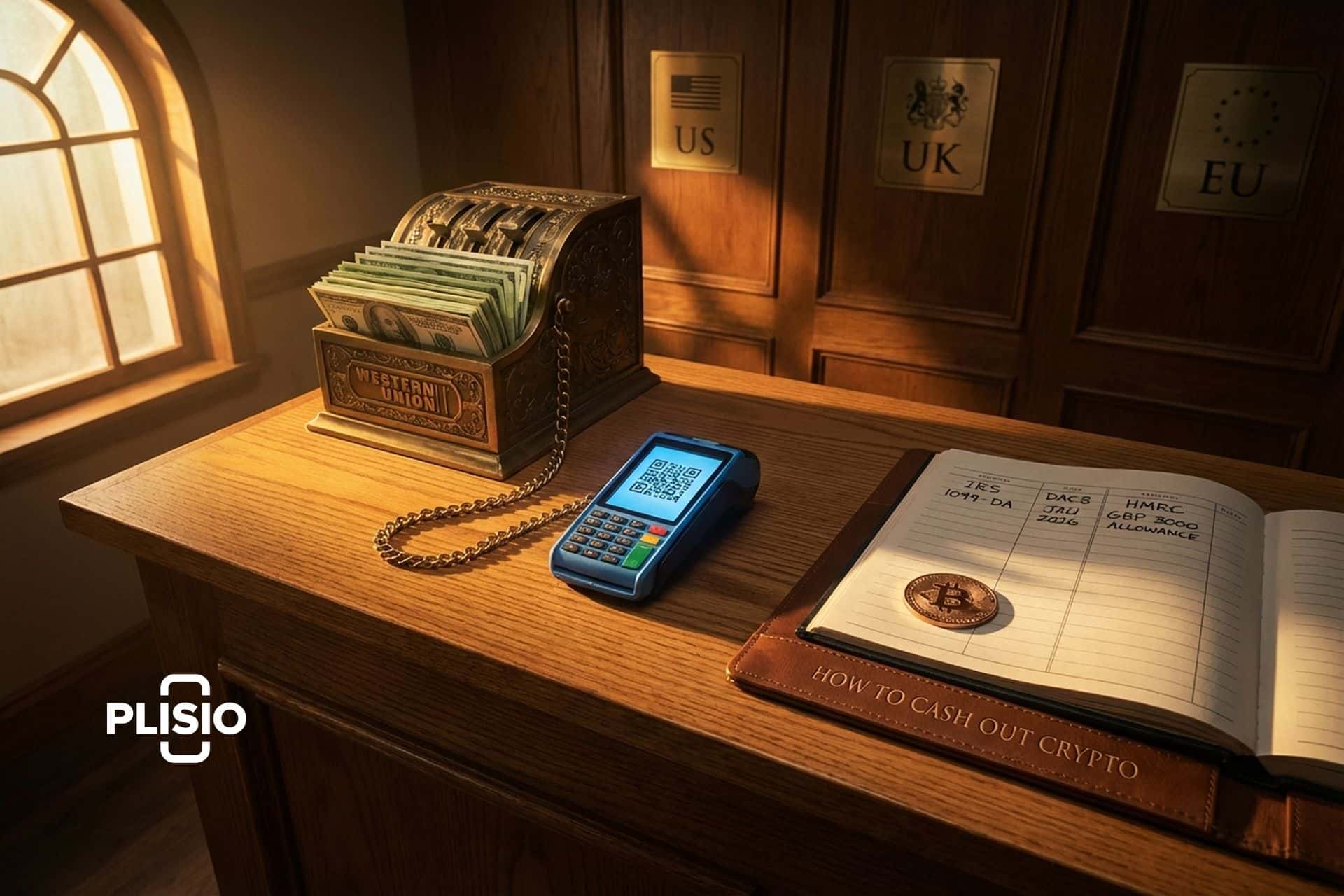
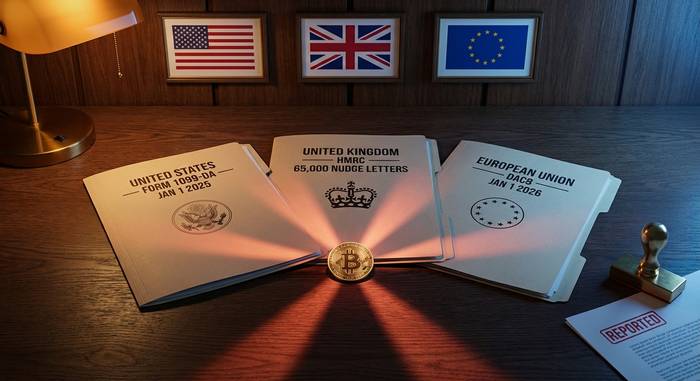
Something shifted in 2025 that most retail crypto holders still have not processed. On January 1 last year, US brokers quietly started handing your crypto sale proceeds to the IRS on a brand new form called 1099-DA. A year later, they added cost basis reporting for covered digital assets. The same day, the EU's DAC8 directive kicked in. Now every MiCA-licensed crypto exchange in Europe has to report user transaction data to national tax authorities. Oh, and the UK quietly raised capital gains tax on crypto from 10/20% to 18/24% overnight in late 2024, then followed up with roughly 65,000 nudge letters to suspected tax evaders. That is one shift a year, across three major jurisdictions. Nothing flies under the radar anymore.
The good news is that the actual mechanics of cashing out are simpler than ever. Centralized exchanges, P2P marketplaces, Bitcoin ATMs, crypto debit cards, brokerages, OTC desks. All of them still work, each with its own fees and trade-offs. The hard part is not the button to hit Sell. It is picking the right method for your amount, your jurisdiction, and your tax situation. This guide covers how to cash out crypto in 2026 from end to end. How to cash out your crypto on every major venue. What each method really costs in fees and timing. Which exchanges handle dollar, euro, and pound rails cleanly. How the 2026 tax rules really hit in the US, UK, and EU. And how to stay on the right side of the new reporting regime without losing sleep over a nudge letter.
What it means to cash out your cryptocurrency
Cashing out your cryptocurrency means one thing: converting it into government-issued fiat (USD, EUR, GBP, JPY) or into a stablecoin that is itself redeemable for fiat. Simple concept. Ugly tax implications. Selling crypto is a disposal event in almost every tax jurisdiction. A capital gain or loss kicks in based on the difference between what you paid and what you received. Bank account, debit card, physical cash from a Bitcoin ATM — none of that matters. The taxable moment is the second the crypto leaves your wallet in exchange for value.
One wrinkle trips up most people. Moving crypto between two wallets you control is not a disposal, because you still own the same asset. But selling crypto, swapping one token for another, spending crypto at a merchant, and converting crypto to stablecoins are all taxable events under US rules and most other Western jurisdictions. This is the single biggest misconception among retail users: "I only owe tax when I withdraw to my bank." Wrong. You owe tax the moment you dispose of the crypto, regardless of where the resulting value sits after.
How to sell crypto on a centralized exchange
For most users, a centralized exchange is the cheapest and fastest legal route. The flow is nearly identical across Coinbase, Kraken, Gemini, Binance, OKX: deposit crypto to the exchange's hot wallet, sell it for fiat on the order book or via a simple Sell button, withdraw the fiat to a linked bank account. Every major exchange walks you through the steps with a sell button, instant conversion, and a built-in withdrawal flow. Six clicks, give or take.
Here is the actual workflow you will run.
First, log in to a verified account. No KYC, no fiat withdrawal, period. The drill is the same everywhere: government ID, selfie, proof of address. Second, send crypto from your external wallet to the exchange's deposit address for that specific asset. Copy the wallet address carefully. One wrong character and the funds are gone forever. Third, wait for confirmations. BTC typically needs 3 to 6 confirmations. ETH needs 12 to 30. Blockchain transactions usually clear within 10 to 30 minutes, sometimes faster on L2s. Fourth, go to the trading pair (BTC/USD, ETH/EUR, whatever you need) and place a market or limit sell. The fiat lands in your cash balance. Fifth, hit Withdraw, pick your linked bank account, choose ACH, SEPA, SWIFT or instant card cashout, confirm. Sixth, the funds arrive. Timing ranges from a few minutes on instant card cashout to roughly five business days for international wires to appear.
Trading fees run 0.1 to 0.5 percent on most major exchanges, plus whatever the exchange charges on the fiat rail itself. But the real cost is often the spread baked into the market order, not the headline commission. Always check both before you hit confirm.
Cash out cryptocurrencies via Kraken and Coinbase
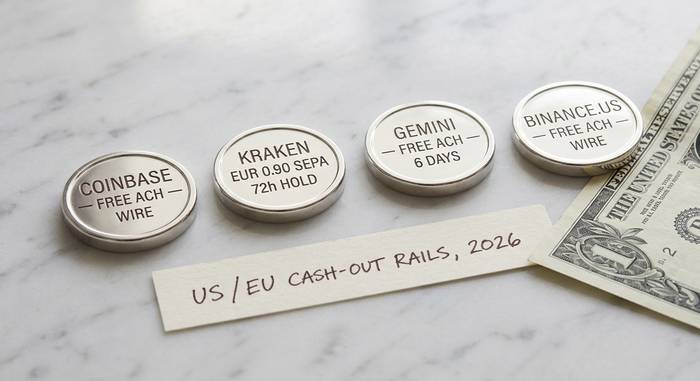
Kraken and Coinbase are the default CEX picks for US residents. Both take you straight to fiat. Coinbase had roughly 120 million verified users worldwide as of 2025, up about 20 percent year-over-year. Kraken sits at about 15 million active users. Different scale, same basic rails. Quick comparison of the main fiat paths.
| Exchange | ACH / SEPA withdraw | Wire / SWIFT | Instant card cashout | Notes |
|---|---|---|---|---|
| Coinbase | Free ACH, EUR 0.15 SEPA | $25 wire | Up to 1.5% (min $0.55) | 1-3 business days ACH, SEPA same-day |
| Kraken | Free ACH, EUR 0.90-1.00 SEPA | EUR 5-35 SWIFT | Limited (regional) | 72-hour hold on ACH withdrawals |
| Gemini | Free ACH | Wire available | N/A | ACH takes ~6 business days, $100k daily limit |
| Binance.US | Free ACH | $25 wire | N/A | ACH rails restored Feb 2025 |
| Binance global | Varies by region | Varies | N/A | KYC L1 daily $50k, L2 up to $2M |
| OKX | Same-day to 2 days | Available | Regional | 0.1-0.5% trading fees, supports PayPal in some regions |
For US users, the cheapest path is almost always a free ACH pull from Coinbase, Kraken, Gemini or Binance.US. Speed costs you the instant-cashout premium. In Europe, SEPA is near-free on Coinbase (EUR 0.15) and cheap on Kraken (EUR 0.90 to 1.00). Binance KYC Level 1 caps fiat withdrawals at $50,000 a day; Level 2 raises that to $2 million a day, which is more than enough for almost any retail user. Verify your identity to the highest tier before you actually need the limits. Why? Because the verification process can take hours or days during busy periods, and you do not want to discover that at 2 a.m. when you are trying to cash out at the top.
Using the Crypto.com app and Cash App for withdrawals
Mobile-first apps are the second common path for cashing out your cryptocurrency. Crypto.com lets you sell crypto straight from your in-app wallet and send the fiat to a linked bank account or to the Crypto.com Visa debit card. The flow? Open the Crypto.com app, tap Sell, pick the crypto and the amount, confirm at the quoted price, then either leave the funds on the card or withdraw them to your bank. The Crypto.com Visa also lets you spend crypto directly, but remember: each purchase is technically a disposal for US tax purposes. Every tap of the card is a taxable event under current IRS rules.
Cash App is the other popular mobile route for US users. Bitcoin only, but the sell-and-withdraw flow is clean: tap the Bitcoin tab, tap Sell, enter the amount, confirm, and the USD hits your Cash App balance instantly. From there you can push it to a linked debit card or bank account. Cash App bakes a small spread into the sell price rather than charging a separate headline fee, so the fee shows up in the quoted rate instead of as a line item. Both apps require full identity verification before you can move meaningful amounts. No shortcut.
P2P and peer-to-peer crypto to cash methods
Peer-to-peer marketplaces let you sell crypto straight to another user and accept payment through any method you both agree on: bank transfer, PayPal, mobile money, physical cash meetup, gift cards. Binance P2P is now the biggest regulated P2P venue by volume. Regional maker fees run from 0.15% in Eastern Europe to roughly 0.35% in US and Canadian markets. The upside is flexibility on payment methods. The downside is longer settlement times and the occasional scam risk, even with escrow in place.
Paxful is gone. Permanently. Once the second-biggest P2P marketplace with over 12 million users and 350+ payment options, the platform had a brief April 2023 shutdown, bounced back in May 2023, then announced in October 2025 that it would wind down for good by November 1, 2025. The reason? Historic co-founder misconduct and the cost of staying compliant. LocalBitcoins had already closed in February 2023. The retail non-KYC P2P era is mostly over. The venues that survived all run KYC under heavy regulatory watch.
Still want a peer-to-peer path in 2026? Binance P2P and HodlHodl are the credible options. Use escrow. Confirm the payment actually hit your account before releasing the crypto. Start with small trades to build reputation before moving real money. The fraud risk never goes to zero.
Bitcoin ATMs and brokerage cash-out options
Bitcoin ATMs give you physical cash in minutes. The trade-off is that they charge the highest fees of any cash-out route. Full stop. As of November 2025, CoinATMRadar counted roughly 28,000 Bitcoin ATMs in the US and more than 38,000 globally. Three operators run more than half of them. Bitcoin Depot with about 8,486 kiosks. CoinFlip with 5,289. Athena Bitcoin with 3,797. Typical fees run 6.5 to 20 percent depending on which kiosk you walk up to. CoinFlip sits near the lower end around 4.99 percent for sells. Bitcoin Depot often lands in the 12 to 20 percent range. At 20 percent, a $1,000 cash-out leaves you with $800 in your hand. Brutal when you do the math. Compared to any CEX rail, ATMs only make sense in very specific situations. You need physical cash right now. You are in a location without CEX access. Or the amount is small enough that the percentage fee is less painful than the friction of setting up an exchange account. Outside those cases, skip them.
Brokerages are the other route for people who already have a Robinhood, Webull or Cash App account. Robinhood lets you buy and sell Bitcoin, Ethereum, and a growing list of altcoins, then withdraw USD to a linked bank account for free. External ATM withdrawals cost $2.50, refunded with qualifying direct deposits. Webull supports crypto trading but does not allow external crypto withdrawals, so you can only cash out through Webull itself. Both platforms added spot Bitcoin ETFs in 2024 as an alternative: instead of selling your BTC directly, you sell IBIT or FBTC shares and receive USD the next trading day. Same capital gains treatment as direct BTC sales, though.
Moving funds to your bank account and limits
Most cash-outs end the same way: money sitting in a linked bank account. The limits and timing as of early 2026 depend on which rail you pick. ACH transfers in the US are free on most major exchanges and clear in 1 to 3 business days, with no hard daily cap on the exchange side beyond verification tiers. SEPA for EU and UK users going through EU banks is near-zero fee, same-day to 1 business day, and SEPA Instant takes seconds on most banks that support it. International SWIFT wires cost $25 to $35 flat on most exchanges, take 1 to 3 business days, and handle high limits cleanly. Instant card cashout runs 1 to 1.5 percent and arrives within minutes on a linked debit card. UK Faster Payments is free, near-instant, and GBP-only.
Link your bank account to the exchange well before you plan to withdraw. The first withdrawal to a new bank account often triggers extra verification checks or a 24 to 48 hour hold. Whitelist your bank details inside the exchange to avoid last-minute surprises when you actually need to move money. Nothing worse than wanting to sell at the top and getting stuck behind a verification queue.
Withdraw to fiat: payment methods and timing
The payment methods you pick dictate the timing you get. Need the cash today? Instant card cashout (Coinbase) or a same-day SEPA transfer is your answer. Can wait a day or two? ACH and standard SEPA are effectively free. Moving big amounts across borders? SWIFT is the only real option and the $25 to $35 flat fee is small compared to the total. Peer-to-peer and ATMs are situational, not default choices.
Compare the headline fees before you commit. Coinbase ACH is free and clears in 1 to 3 business days, while a wire costs a flat $25. The instant card cashout runs up to 1.5 percent (minimum $0.55). On the euro side, Coinbase SEPA is effectively nothing at EUR 0.15 and Kraken sits at EUR 0.90 to 1.00. Kraken SWIFT runs from EUR 5 to EUR 35 depending on the bank and country, and ACH on Kraken is free but comes with a 72-hour hold. Gemini ACH is also free but takes roughly 6 business days to settle, which is annoying when you want to move fast. Binance.US matches the pattern: free ACH, $25 wires. Bitcoin ATMs land at 6.5 to 20 percent, far above anything else. Binance P2P sits at 0.15 to 0.35 percent maker fee depending on the region.
The exchange spread baked into the sell order is often bigger than the headline withdrawal fee. Always check the effective rate against a live market price before you hit Confirm. Especially on mobile apps that hide fees inside the spread.
Verification, KYC and identity checks before cashing
Every regulated cash-out path requires KYC. You need to verify your identity before an exchange lets you withdraw fiat. The verification process typically wants four things: a government-issued ID (driver's license, passport, or national ID card), a selfie or live video check to confirm the ID actually matches you, a proof of address document from the past three months (utility bill, bank statement, or official letter), and source-of-funds questions for larger accounts (how you earned the crypto, where it came from). None of this is optional anymore.
Most exchanges run tiered verification. Level 1 typically unlocks small deposits and withdrawals after basic ID. Level 2 opens higher limits after proof of address and sometimes a bank-link check. Binance KYC Level 1 caps fiat withdrawals at $50,000 per day. Level 2 raises that ceiling to $2 million per day. Push your verification to the highest tier available before you need the higher limits, because the verification process can take anywhere from minutes to several days during busy periods. Timing matters.
Do you really need to verify your identity? Yes. Always. The entire non-KYC exchange corner of the market is now effectively impossible to use for cashing out to a bank account under MiCA, DAC8, and the US 1099-DA regime. Accept it, move on, and keep your documents ready.
Ethereum, MetaMask and self-custody cashout flows
Holding your crypto in a MetaMask wallet or a hardware wallet? The cash-out flow adds one extra step: send crypto to a custodial exchange first. The process looks like this. Open MetaMask, click Send, paste the deposit address from your exchange, pay the gas fee, wait for Ethereum (or whichever chain you are on) to confirm, then sell on the exchange and withdraw to fiat. Keep it secure by triple-checking the recipient address character by character. One wrong digit and the funds are gone. Forever.
There are also hybrid routes. Services like MoonPay, Ramp, and Transak integrate directly into self-custody wallets and let you sell crypto right inside the wallet interface, with the fiat sent to your bank. MoonPay's sell flow supports cards and SEPA in most European countries. These aggregators typically charge 2 to 5 percent in spread plus a small fixed fee. More expensive than a CEX, but much more convenient if you work out of a hardware wallet. For serious self-custody users, the CEX route is still cheaper. For occasional users moving small amounts, the convenience often wins.
Crypto tax implications in 2026: US, UK, EU
This is where most retail crypto users trip over their own feet. Every cash-out is a disposal. Every disposal is a taxable event. The rate depends on how long you held the crypto and which jurisdiction you are in. That is the entire game.
| Jurisdiction | Short-term rate | Long-term rate | Annual allowance | Reporting |
|---|---|---|---|---|
| US | Up to 37% (ordinary income) | 0% / 15% / 20% after 1 year | None | Form 1099-DA + Form 8949 + Schedule D |
| UK | 18% / 24% flat (post-Oct 30, 2024) | Same | GBP 3,000 | Self-assessment, CARF from 2027 |
| EU | Varies by country (typical 20-30%) | Often flat | Varies | DAC8 CASP reporting from Jan 1, 2026 |
| Germany | 0% after 1 year hold | 0% | EUR 1,000 | Self-declaration |
| Portugal | 28% if < 365 days | 0% if > 365 days | None | Annual return |
In the US, short-term capital gains (anything under a year of holding) get taxed as ordinary income up to 37 percent. Long-term gains after the one-year mark sit at 0, 15 or 20 percent depending on your income. The wash sale rule still does not apply to crypto because the IRS still treats it as property, not a security. That means you can harvest losses without waiting 30 days. One of the few tax advantages crypto still has over stocks, and the IRS keeps hinting it wants to close the gap. Starting January 1, 2025, US brokers must file Form 1099-DA reporting your gross proceeds to the IRS. Cost basis reporting for covered digital assets kicked in January 1, 2026.
In the UK, the Autumn 2024 Budget raised CGT on crypto from 10 percent (basic band) and 20 percent (higher band) to 18 and 24 percent effective for disposals on or after October 30, 2024. The annual exempt amount stayed at GBP 3,000 for 2024/25 and 2025/26, down from GBP 12,300 just two years earlier. HMRC sent roughly 65,000 nudge letters to suspected crypto tax evaders in 2024/25, more than double the prior year. The UK CARF reporting regime begins in spring 2026 with first reports due May 31, 2027.
In the EU, DAC8 kicked in January 1, 2026. Every MiCA-licensed CASP now has to collect user tax IDs and report transaction data to national tax authorities. First reports are due between January and September 2027. If you are an EU resident cashing out through a licensed European exchange in 2026, your tax authority already has your transaction data. Assume visibility, plan accordingly.
Understand the tax implications before you sell. Always keep records of your cost basis, dates of acquisition and disposal, and the fiat value at both ends. Software like Koinly, CoinTracker or Blockpit automates all of this if you have more than a handful of transactions. The cheapest legal tax strategy remains tax-loss harvesting: realize losing positions in the same year as winning ones to offset the gains. In the US, excess losses offset up to $3,000 of ordinary income per year and the rest carry forward.
Best way to buy bitcoin vs best way to sell it
The best way to buy bitcoin and the best way to sell it are not always the same venue. Most users buy on whichever platform they first heard of (Coinbase, Robinhood, Cash App) and stay there, which is fine for small amounts. When it comes time to cash out, the optimization changes. For sells, you want the lowest trading spread, the cheapest fiat withdrawal rail, and the highest daily limit without hitting extra verification. That usually points toward a different exchange than the one you first bought on. Especially if your first exchange was a mobile app with a baked-in spread.
Rule of thumb: buy bitcoin through whichever app you find easiest, sell bitcoin through whichever venue has the lowest total cost. For US users above $1,000, that usually means Kraken Pro or Coinbase Advanced Trade, not the main Coinbase app. For EU users, Bitstamp and Kraken both run clean SEPA rails. For UK users, Kraken's GBP rails via Faster Payments are typically the fastest. Small optimizations, real money saved.
The bottom line on cashing out crypto in 2026
Cashing out crypto in 2026 is mechanically easy and legally strict. The mechanics: pick a regulated venue, sell at market, withdraw to a bank account through the cheapest available rail. The legal side is what has genuinely changed. US brokers now report your proceeds to the IRS. The EU's DAC8 forces CASP reporting from January 1, 2026. The UK's HMRC has moved from education to enforcement, with a 134 percent year-over-year jump in nudge letters. Assume every cash-out on a regulated exchange is visible to your tax authority. Because it is.
Short version of how to cash out crypto in 2026: use a licensed centralized exchange for anything under $100k, an OTC desk for anything above, and keep clean records. For amounts under $10,000, a CEX with free ACH (Coinbase, Kraken, Gemini, Binance.US) is the right default for cash out crypto flows. For amounts above $100,000, an OTC desk like Cumberland (minimum $100k) is worth the call because you skip slippage on the public order book. Bitcoin ATMs are a convenience tool, not a strategy. P2P is a flexibility tool for users in regions without decent banking rails. Always factor in tax implications before you hit Sell. The difference between an 18 percent long-term rate and a 37 percent short-term rate can wipe out every fee you saved on the withdrawal side. Easily.



