Best Crypto Exchanges in the USA for 2026

The SEC sued Coinbase. Then Coinbase won. The SEC sued Kraken. Kraken settled. Binance.US almost disappeared. And somehow, the US crypto exchange market in 2026 is bigger and more regulated than ever. Spot bitcoin ETFs brought institutional money. Spot ethereum ETFs followed. A crypto-friendly administration moved into the White House and started undoing years of regulatory hostility.
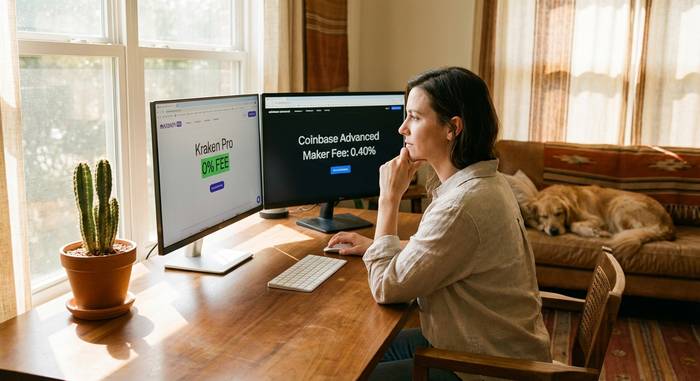
None of that matters if you pick the wrong exchange. Coinbase charges up to 0.40% per trade on Advanced. Kraken charges zero for Kraken+ members. Gemini charges 1.49% on simple buys. Robinhood wraps crypto fees into spread markups you cannot see. The difference between the cheapest and most expensive option on this list can cost you thousands per year if you trade regularly.
About 30% of US adults, roughly 70.4 million people, now hold crypto. This guide compares the best crypto exchanges in the USA for 2026, breaks down fees that actually matter, explains how new regulation changes the game, and helps you buy crypto on a platform that fits.
Best crypto exchange comparison table
| Exchange | Trading fee | Coins | USD deposit | Best for |
|---|---|---|---|---|
| Kraken | 0-0.40% (Kraken+: 0%) | 450+ | Free ACH | Lowest fees, advanced tools |
| Coinbase | 0-0.40% (Advanced) | 240+ | Free ACH, $10 wire | Biggest US exchange, staking |
| Gemini | 0.20-1.49% | 99 | Free ACH, 3.49% card | Security certifications |
| Crypto.com | 0-0.50% | 400+ | Free ACH | Visa card, earn program |
| Robinhood | 0% (spread markup) | 30+ | Free ACH | Stocks and crypto together |
| Binance.US | 0.10% | Limited | Restricted | Avoid (regulatory issues) |
| Bitstamp | 0-0.40% | 80+ | Free ACH | European heritage, clean record |
| River | 0-0.20% | BTC only | Free ACH | Bitcoin-only, auto DCA |
| Swan Bitcoin | 0-0.99% | BTC only | Free ACH | Long-term bitcoin accumulators |
| eToro | 1% + spread | 100+ | Free bank transfer | Social trading, copy portfolios |
Fees shown are for the exchange's most competitive tier. Simple buy, instant, and card-based purchases typically cost more. Always check the fee you see on the actual purchase screen.
How to choose the best crypto exchange
Ask ten first-time crypto buyers which exchange they picked and seven of them say Coinbase. It is the name people know. But knowing a name and getting the best deal are two different things.
Fees first? Kraken+ charges nothing. Zero. There is a monthly subscription, but the trades themselves are free. Without the sub, you pay 0.25% maker and 0.40% taker. Anyone moving a few hundred bucks a month saves money on Kraken's low fees versus Coinbase's 0.40%.
Already on Robinhood for stocks? You can add bitcoin, ethereum, solana, and about 30 more tokens without opening a new account. No visible fee, but Robinhood hides the cost inside the spread. Independent estimates put it at 0.5-1.5% per trade. Cheap? Not really. You also could not withdraw crypto for years. Robinhood now allows transfers, but the crypto-first crowd still eyes it suspiciously.
Paranoid about security? Gemini stacks certifications: SOC 1 Type 2, SOC 2 Type 2, ISO 27001. Only exchange in the US with all three. Hot wallet fully insured. Regulated by NYDFS in New York, the toughest state regulator. Fees are higher. You are paying for the compliance infrastructure.
Bitcoin only? River (0-0.20%) and Swan Bitcoin (0-0.99%) sell nothing except BTC. No altcoins. No distractions. Automatic recurring buys. Both available in all 50 states.
Coinbase: buy crypto with the most coins
100 million users. Publicly traded on NASDAQ (COIN). 300+ cryptocurrencies. Available in all 50 states. Coinbase is the largest crypto exchange in the US by every measure that counts.
The fee structure has layers. Coinbase Advanced charges 0-0.40% depending on 30-day volume. The simple buy interface can hit 1.49% for bank transfers and 3.99% for cards. Staking offers yields on ETH, SOL, and other tokens. The Coinbase One subscription ($29.99/month) removes trading fees entirely for most transactions.
ACH deposits are free and settle same-day. Wire transfers cost $10 in, $25 out. 98% of digital assets sit in cold storage. The Coinbase Wallet is a separate self-custody product that connects to DeFi protocols.
The SEC sued Coinbase in June 2023, alleging it operated as an unregistered securities exchange. The case went back and forth through 2024 and into 2025. Under the new administration's more crypto-friendly SEC leadership, enforcement pressure eased significantly. As of 2026, Coinbase continues operating without major restrictions.
Kraken: lowest trading fees for pro users
Founded in 2011. Based in Wyoming. 450+ cryptocurrencies. Kraken has one of the longest security track records in the industry: no customer funds have ever been lost to a hack. ISO/IEC 27001 certified. SOC 2 Type 1 and Type 2 compliant. Proof of reserves audits published regularly.
The Kraken+ subscription launched in 2025 and offers zero trading fees for a monthly fee, making it the cheapest way to trade crypto in the US for active users. Without the subscription, standard fees run 0.25% maker and 0.40% taker. ACH and SWIFT deposits are free.
Margin trading, futures, and staking are available. The Pro interface includes advanced charting, multiple order types, and API access. Customer support is 24/7 with phone access, which is rare among exchanges.
Kraken settled with the SEC in 2023 over its staking service, paying $30 million and shutting down US staking. The staking product has since returned under modified terms. The settlement did not affect the core trading platform.
Gemini: best for security and stake rewards
Founded in 2014 by the Winklevoss twins. 99 cryptocurrencies. 655 trading pairs. Gemini went public on NASDAQ in September 2025. Before that, it went through a rough stretch when its Earn product (a lending program through Genesis) collapsed in late 2022, locking up customer funds. Earn users eventually received recovery payments, but the episode damaged trust.
On the security front, Gemini is arguably the most credentialed exchange in the US. SOC 1 Type 2, SOC 2 Type 2, and ISO 27001, the only exchange that stacks all three. Hot wallet funds are insured. Cold storage handles the majority of assets. Based in New York and regulated by the NYDFS, which applies the strictest state-level oversight in the country (BitLicense).
The fee structure is tiered. ActiveTrader starts at 0.20% maker and 0.40% taker. Simple buy runs up to 1.49%. Card purchases hit 3.49%. ACH deposits are free. Staking yields go up to 12% APR on select assets.
Crypto.com: best for digital asset variety
400+ cryptocurrencies. The Visa card with crypto cashback (up to 5% in CRO rewards) is the main draw. Fee tiers run from 0% to 0.50% depending on 30-day volume and CRO stake level. ACH deposits are free. The earn program pays yield on deposited crypto.
Crypto.com added US-specific features after securing state money transmitter licenses across the country. The mobile app is solid. Desktop trading through the exchange works but feels secondary to the app experience.
The concern: Crypto.com is headquartered in Singapore, not the US. Some users prefer domestically-based exchanges for regulatory clarity. But Crypto.com has secured money transmitter licenses across US states, which is not a trivial regulatory lift. The compliance investment is real, even if the headquarters are overseas.
For users who want a single app that handles buying, earning yield, spending with a card, and tracking a crypto portfolio, Crypto.com packs more features per screen than almost anyone else. Whether you need all that or whether it just adds complexity is a personal call.
Robinhood: crypto trade with zero commission
Zero commission on crypto trades. Thirty-plus tokens. The catch: Robinhood makes money on the spread between the buy and sell price, and that spread is wider than what dedicated crypto exchanges charge. Independent analyses put the effective cost at 0.5-1.5% per trade.
The app gives you stocks, ETFs, options, and crypto in one place. For investors who want a small crypto allocation alongside their stock portfolio without opening a separate exchange account, Robinhood is the path of least resistance.
The limitation: limited coin selection, no advanced trading features, no staking, and historically no crypto withdrawals (though Robinhood has since enabled transfers to external wallets). For serious crypto traders, Robinhood is not built for you.
Binance.US: what happened and where it stands
June 2023. SEC files suit against Binance and Binance.US. Securities violations. Alleged commingling of customer funds. Banking partners bolted. USD deposits gone. Volume collapsed overnight.
Where does it stand now, early 2026? Limping. Fewer coins. Fiat access spotty at best. Three CEO changes and counting. Whatever trust Binance.US had with American users evaporated somewhere between the second lawsuit filing and the day they could not process dollar withdrawals.
The takeaway is blunt. The largest crypto exchange on Earth by global volume got kneecapped in the United States because it did not play by the rules. SEC, DOJ, CFTC, all at once. The SEC eventually dropped the Binance.US lawsuit with prejudice in May 2025. But by then the damage was done. Coinbase, Kraken, and Gemini all survived their own regulatory scrapes because they engaged instead of evading. In fact, seven SEC crypto cases were dismissed starting February 2025, including Coinbase and Kraken.
OKX paid over $500 million in a settlement for AML failures. Bybit got hacked for over a billion in 2025. The pattern keeps repeating: shortcuts on compliance or security end badly. For US users, sticking with domestically regulated exchanges is not conservative. It is common sense.
How bitcoin ETFs changed US crypto exchanges
January 2024. The SEC approved spot bitcoin ETFs. Eleven of them launched the same day. Net inflows hit $31.8 billion through 2025. Ether ETFs overtook Bitcoin ETF inflows by August 2025. Altcoin ETFs for SOL, XRP, and even DOGE followed. Then spot ethereum ETFs followed in mid-2024.
What this did to exchanges is subtle but real. Investors who just want bitcoin exposure no longer need an exchange account at all. They buy IBIT or FBTC through Fidelity, Schwab, or Robinhood the same way they buy any stock. No wallets. No seed phrases. No gas fees.
For exchanges, that means competing for the users who want more than just BTC and ETH price exposure. Altcoin traders, DeFi users, stakers, and people who want self-custody still need Coinbase or Kraken. But the casual "I want 5% of my portfolio in bitcoin" investor? The ETFs took that market. Trading volumes on some exchanges dipped in the months after ETF approval as capital moved to the simpler product.
US crypto exchange regulation in 2026
The regulatory picture in the US shifted dramatically between 2024 and 2026. Here is what changed:
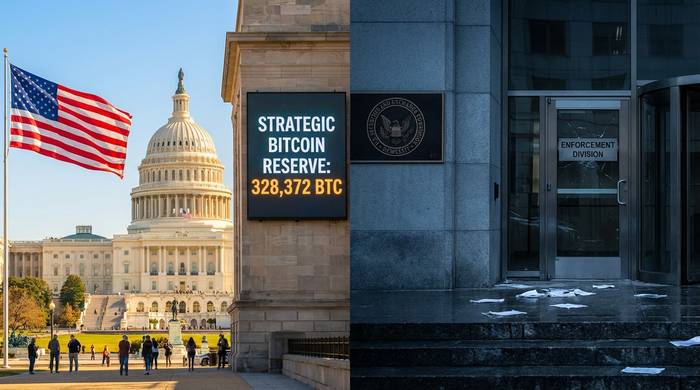
Trump executive order (January 23, 2025). The new administration signed an executive order establishing a Working Group on Digital Assets, explicitly aiming to make the US "the crypto capital of the world." A second EO on March 6, 2025 created the Strategic Bitcoin Reserve within the Treasury, holding approximately 328,372 BTC obtained through forfeiture. The crypto-skeptic SEC chair Gary Gensler left. The "regulation by enforcement" era appears to be winding down.
FIT21 Act. The Financial Innovation and Technology for the 21st Century Act passed the House in May 2024 with bipartisan support. It clarifies which crypto assets fall under SEC jurisdiction (securities) versus CFTC jurisdiction (commodities). As of 2026, the Senate version is still being negotiated, but the direction is clear: a dual-regulator framework is coming.
GENIUS Act (signed July 18, 2025). The first federal stablecoin law. Requires 100% reserve backing with liquid assets, monthly public disclosures, and bans issuer-paid yield. Payment stablecoins are explicitly declared not securities, not commodities, not deposits. Banks, nonbanks, and credit unions can issue stablecoins under defined conditions. Three-year phase-in to July 2028.
State licensing. New York's BitLicense remains the strictest state requirement. Only 37 companies have received one out of 100+ applications since 2015. Gemini and Coinbase hold it. Kraken exited New York rather than apply. Many smaller exchanges avoid the state entirely. Other states require money transmitter licenses, which most major exchanges have obtained.
IRS reporting. Starting with tax year 2025 (filed in 2026), crypto exchanges must issue 1099 forms to users and the IRS. This is the same reporting standard that stock brokers follow. The era of unreported crypto gains is over for anyone using a US-regulated exchange.
Bitcoin and crypto taxes: IRS reporting rules
IRS calls crypto property. Sell it, swap it, spend it on a sandwich. Taxable event, every time. That part has been true since 2014. What changed is enforcement.
Hold less than a year before selling? Ordinary income rate, 10% to 37% depending on your bracket. Hold longer than a year? Capital gains rate: 0%, 15%, or 20%. Lose money? You can offset gains and carry the leftover loss forward, up to $3,000 per year against regular income. Tax loss harvesting actually works in crypto, unlike India where you cannot offset at all.
| Holding period | Tax rate | Applies to |
|---|---|---|
| Less than 1 year | 10-37% (ordinary income) | Short-term trades |
| More than 1 year | 0-20% (capital gains) | Long-term holds |
| Staking/mining income | Ordinary income rate | When received |
| Losses | Offset gains, carry forward | $3,000/year against income |
New for 2026: exchanges must issue 1099-DA forms reporting your transaction history. The IRS gets a copy. Software like TurboTax, CoinTracker, and Koinly integrates with most US exchanges to auto-generate your tax filings.
What each exchange offers for your crypto portfolio
Most US exchanges now offer tools that go beyond simple buy and sell. Coinbase has recurring buys and portfolio tracking. Kraken has staking across dozens of tokens. Gemini offers ActiveTrader for experienced users. Crypto.com has thematic bundles.
For a basic crypto portfolio on a US cryptocurrency exchange, the approach is straightforward: pick 2-3 assets (bitcoin and ethereum cover 60%+ of the market, with litecoin and solana as common additions), set up recurring weekly or monthly buys on the blockchain of your choice, and do not check prices every hour. Most exchanges offer enough liquidity on major pairs that your order fills instantly. Dollar cost averaging through automated purchases on Coinbase or Kraken eliminates the temptation to time the market.
For larger portfolios, self-custody matters. Buy on the exchange, then transfer to a hardware wallet (Ledger, Trezor). No exchange is immune to failure. Unlike stocks held through a broker, crypto on an exchange is not covered by SIPC insurance. FDIC does not apply either. Your coins sit on someone else's server, protected only by that company's security practices and whatever insurance they carry privately.