iDenfy Review: Identity Verification Service & Pricing

A crypto exchange can lose half a billion dollars over a weak front door. Not a hypothetical. In February 2025, a U.S. Department of Justice settlement cost OKX about $504 million over anti-money-laundering and customer-onboarding failures. Half a billion. Numbers like that change how you read a tool like iDenfy. Identity verification stopped being back-office plumbing the moment regulators started treating a missed fraudster as the exchange's problem, not the fraudster's.
So this is a practical look at iDenfy: what it is, how its identity verification service actually works, what it costs, and whether it earns a place in a crypto business that has to get KYC right. The promise is simple. Let a remote user verify who they are in seconds, and let you prove to a regulator that you checked. The interesting part, as always, is in the details. I'll flag what holds up and what is still just marketing.
Who is iDenfy, and who is behind it
Start with the unglamorous question: who actually runs this thing? iDenfy is not a venture-inflated unicorn. It is a small, bootstrapped, and (for RegTech, unusually) profitable shop in Vilnius, Lithuania, founded in 2017 and registered as Identifikaciniai Projektai UAB. Boring, in the best way.
Boring also means the numbers are public. The company's filing with Lithuania's company registry shows roughly 6.04 million euros in revenue for 2024, up about 57% in a year, at a net margin near 43%. Read that again. Forty-three percent, on no outside money. Most identity-verification vendors will not show you a balance sheet at all. iDenfy also says it verifies users for more than 1,000 businesses, though that one is self-reported, like a few of the figures on its site.
So what did it do with the cash? It widened the product. The early version was a single document check. Today it is a full identity stack: Know Your Customer (KYC), AML, business verification, and a spread of fraud signals. All of it paid for out of revenue rather than a funding round, which usually means a feature had to earn its place before it shipped.
Does company size matter here? In compliance, yes. You are buying a relationship that has to outlive a few audit cycles, and a profitable vendor is less likely to vanish or pivot than one burning someone else's cash. The honest flip side: iDenfy is smaller than the marquee names, so you are trusting a leaner team. For most small and mid-sized crypto operators that is a fair trade. For a top-ten exchange onboarding millions a month, scale and dedicated support tiers might tip you the other way.
How iDenfy identity verification works
The trick is to fold three questions into one flow: is the document real, is the person real, and is the person a risk? Answer all three in the time it takes to pour a coffee, and you have onboarding. Here is how the pieces fit.
Document and biometric checks
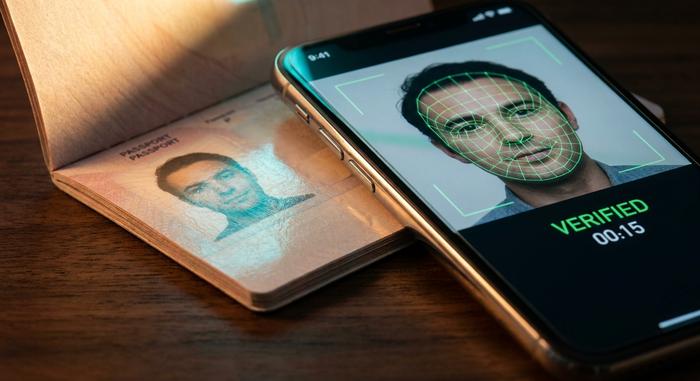
A user points their phone at a government ID, then at their own face. iDenfy reads the document, matches it to a live selfie, and decides. The coverage is wide: more than 3,500 document types across 200-plus countries, with data extraction the company clocks at 0.02 seconds. You pick the friction level. 3D liveness detection asks the user to move on camera; a passive check works off a single still. Most cases clear automatically in about 15 seconds. The rest go to a human, who reviews within three minutes, around the clock.
Here is the part crypto teams care about. Once someone is verified, iDenfy can keep that result and re-verify them later with a quick face match instead of another full scan. Reusable identity sounds minor. It is not. Dragging a returning customer through ID verification a second time is exactly where people rage-quit the signup. For higher-assurance tiers, NFC chip reading pulls data straight off the secure chip in a modern passport.
Now the caveat. Those speed and accuracy figures, including the much-quoted 99.99% accuracy, come from iDenfy, not an auditor. I could not find an independent benchmark, and "accuracy" in this field bends to whichever documents and fraud patterns you test against. So treat the numbers as claims. The flow is genuinely fast and the coverage genuinely broad, but run your own traffic before you repeat any figure to a regulator.
AML screening and ongoing monitoring
A clean ID does not make a safe customer. iDenfy's AML layer screens every person against sanctions lists, watchlists, and PEP (politically exposed person) databases, plus adverse media, the bad-news reporting that surfaces someone before any formal listing does. Adverse media is the underrated piece. It catches the person named in a fraud probe who has not yet hit an official list, which is precisely the gap a careful bad actor walks through.
And screening once is not enough. Regulators know it, so iDenfy keeps watching after onboarding. A customer who lands on a sanctions list next year trips an alert instead of slipping by. For a platform clearing transaction volume in real-time, that ongoing monitoring is what keeps a compliance officer employed, since it also generates the suspicious-activity flags an auditor will eventually want to see.
Business verification (KYB)
Corporate clients are a different animal. iDenfy handles them through Know Your Business checks, pulling from 180-plus company registries across roughly 120 countries, tracing ultimate beneficial owners, and attaching credit reports where they exist. For a crypto firm taking on institutional accounts or partner exchanges, KYB is where a shell company with a clean-looking director finally gets caught.
iDenfy key features at a glance
Breadth is the whole pitch. Instead of one narrow check, iDenfy bundles most of the identity and fraud tooling a regulated business needs behind a single contract and a single API. That matters more than it sounds. Stitching one vendor for documents to another for AML and a third for business checks is how integrations rot and audits get messy. The table below is the short version of what you get.
| Capability | What it covers | Why it matters for crypto |
|---|---|---|
| KYC document verification | 3,500+ ID types, 200+ countries | Onboard users globally without manual review |
| Biometric / liveness detection | 3D active or passive face match | Stops stolen-document and deepfake fraud |
| AML screening | Sanctions, PEP, watchlist, adverse media | Required for VASP licensing |
| Business verification (KYB) | 180+ registries, UBO tracing | Vets corporate and partner accounts |
| Proof of address | Document-based address checks | Tighter risk scoring for high-value users |
| Age verification | Standalone age gate | Jurisdiction-specific access rules |
| NFC and chip reading | Reads e-passport chips | Higher assurance for premium tiers |
| Fraud and IP signals | Proxy and credential-abuse detection | Catches account-farming rings early |
None of it is one-size-fits-all. You can tune the rules, the branding, and which checks fire for which users, so a low-risk signup and a high-value withdrawal do not have to clear the same gauntlet.
iDenfy pricing and plans explained
Here is where iDenfy gets genuinely interesting, if you read past the headline number. Its honest selling point is the pay-per-approved model. You are billed only for verifications that succeed. Reject a fraudster, and the attempt costs you nothing. Most providers charge per attempt, so this quietly hands the cost of fraud back to where it belongs. You stop paying to turn bad actors away at the door.
The published rates run from roughly $1.35 per verification on the entry plan down to about $0.55 at enterprise volume, with approved-only billing offered as an add-on. Watch the unit, though. Software directories quote a starting figure of $1.20 per user per year, which sounds cheaper but measures something else entirely. Real crypto onboarding is priced per verification, not per seat, so do not anchor on the directory number. And use the free trial properly: run real documents from the countries your users actually come from, then watch the rejection rate before you sign anything.
| Plan tier | Approx. price per verification | Best for |
|---|---|---|
| Basic | ~$1.35 | Startups, low monthly volume |
| Growth | $0.55-$1.20 (volume-based) | Scaling exchanges and wallets |
| Enterprise | ~$0.55 + custom | High-volume VASPs, custom SLAs |
Price will not keep you compliant on its own. But a billing model that does not punish you for rejecting fraud is a sane place to start.

How crypto businesses use iDenfy for KYC and AML compliance
Here is the practical question: why does a crypto company actually buy this? Because the 2026 rulebook leaves little room to improvise. Under the EU's MiCA framework, crypto-asset service providers need full CASP authorization, and the grandfathering window for firms operating under older national rules closes on 1 July 2026. Miss the bar and the penalties are not symbolic: MiCA allows fines up to 15 million euros or 12.5% of annual turnover.
Layer on the EU Travel Rule, which applies to crypto transfers with no minimum threshold (every transaction carries identity data), plus the FATF guidance that pushed the Travel Rule worldwide, and the compliance surface gets large fast. iDenfy positions itself squarely at that surface: KYC at onboarding, AML screening against live sanctions data, KYB for corporate clients, and reusable verification so a returning user is not re-checked from scratch.
In practice the flow looks like this. A new user signs up, runs document and liveness checks, and gets screened against sanctions and PEP lists before the account goes live. The result is logged so you can show a regulator exactly who you verified and when. Corporate clients route through KYB instead, with beneficial-owner tracing. From then on, ongoing monitoring watches for anyone who later lands on a list. Integration runs through a documented API, hosted flows, and mobile SDKs, with connectors for tools like Zapier, WordPress, and WooCommerce for businesses that are not running a custom stack, so a smaller operator can switch on KYC without building it from scratch.
The OKX settlement is the cautionary version of all this. The cost of getting onboarding wrong now dwarfs the cost of any verification vendor. That asymmetry — cheap to do right, ruinous to do wrong — is the whole reason this category exists.
iDenfy strengths, limits, and alternatives
So where does iDenfy earn its keep, and where would I keep my guard up? The user signal is genuinely good. It holds a 4.7 out of 5 on both SoftwareAdvice and GetApp, and 4.6 across 225 ratings for its mobile app. Reviewers keep coming back to the same three things: speed, easy setup, and customer support that actually answers during an integration, which crypto teams shipping against a deadline feel acutely.
The strengths are real. You get unusually broad coverage for the price, the pay-per-approved billing, fast integration through SDKs and no-code connectors, built-in fraud prevention across the whole document and biometric stack, and a bill a small team can actually absorb. The cautions are just as real. It is not the cheapest option per check. Integration still eats engineering time, connectors or not. The flagship accuracy and speed numbers are self-reported, as noted. And the certifications (iDenfy lists ISO 27001, SOC 2 Type II, and eIDAS) only count if they are current, so check the renewal dates before you wave them at your own regulator.
iDenfy is also smaller than the household names, and a fair review names them. Treat the table below as positioning, not a full bake-off.
| Provider | Rough positioning | Notable trade-off |
|---|---|---|
| iDenfy | Full-stack KYC/KYB/AML, SMB-friendly pricing | Smaller scale than the leaders |
| Sumsub | Broad crypto focus, large feature set | Enterprise-tier pricing |
| Veriff | Strong biometrics, high volume | Less KYB depth |
| Onfido | Heavy enterprise and banking use | Costlier for small teams |
| Jumio | Established, wide compliance coverage | Built for large deployments |
For a small or mid-sized crypto business, iDenfy's pitch is strong: most of what the big four offer, at a price you can actually model. For a large exchange with bespoke needs, one of the alternatives may fit better.
Is iDenfy worth it for crypto onboarding
Identity verification used to be the thing you bolted on at the end. The OKX penalty made it the thing that can sink you. iDenfy answers that with a credible, cost-controlled, full-stack KYC, KYB, and AML service that a smaller crypto company can actually deploy before the July 2026 MiCA deadline. Just do the homework the marketing won't: confirm the certifications are live, treat the accuracy figures as claims until you test them on your own traffic, and price it per approved verification, not per the directory headline. Get that right, and the front door stops being your biggest liability.