KuCoin Review 2026: Is This Crypto Exchange Safe?

You can buy almost any coin on KuCoin. The same company is also a convicted felon in the United States. Both statements are true, and squaring them is the whole point of this KuCoin review. KuCoin is one of the largest altcoin exchanges in the world, with a coin list that dwarfs what you will find on a regulated US platform. It also pleaded guilty to a federal crime in 2025 and walked away from the American market. So the question is not really "is KuCoin good?" It is "good for whom, and at what risk?"
What KuCoin is as a crypto exchange
KuCoin launched in 2017 and built its reputation on one thing: listing coins before anyone else did. If a token was too small, too new, or too strange for Coinbase, KuCoin usually had it. That reputation stuck, and the platform grew into a genuine heavyweight. By April 2025 the KuCoin exchange reported more than 40 million registered users, and its 2025 trading volumes crossed roughly $1.25 trillion, putting it among the top three spot venues by market share in early 2026.
Think of KuCoin less as a beginner's first wallet and more as an altcoin supermarket. People do not usually start their crypto journey here. They arrive after they have outgrown the short menu on a mainstream exchange and want access to the long tail. That single fact shapes everything else in this review.
| KuCoin at a glance | Detail |
|---|---|
| Founded | 2017 |
| Registered users | 40 million+ (Apr 2025) |
| Listed cryptocurrencies | ~900–1,000+ |
| 2025 trading volume | ~$1.25 trillion |
| Native token | KCS (KuCoin Token) |
| US availability | Banned (DOJ plea, 2025) |
| Mandatory KYC | Yes, since 2023 |
How safe is KuCoin? Security and the hack
Here is the part most reviews get backwards. KuCoin's 2020 breach is usually filed under "reasons to worry." I read it the other way around. The hack is one of the better data points we have on KuCoin security, because it shows what the company does when things go wrong. Getting robbed proves nothing about a crypto exchange. How it treats users afterward proves quite a lot.
The $281M breach of 2020
In September 2020, attackers drained roughly $281 million in bitcoin, ether, and various tokens out of KuCoin's hot wallets after obtaining private keys. Blockchain analytics firm Chainalysis later attributed the theft to the Lazarus Group, the state-linked operation tied to a string of large crypto thefts. For a few days it looked like a catastrophe.
Recovery, reserves, and what's verifiable
Then KuCoin did something unusual. It chased the funds. Through a mix of on-chain tracing, frozen tokens, and cooperation with other platforms, the exchange clawed back about $204 million, roughly 84% of the stolen amount, and covered the rest from its insurance fund so that no user lost money. That response is the credential, not the breach.
Today KuCoin publishes a proof-of-reserves report. As of May 31, 2026, it showed reserve ratios above 100% for the major assets: around 115% for BTC, 120% for ETH, 125% for USDT, and 122% for USDC. Pair that with the usual protections — 2FA, a separate trading password, and withdrawal whitelists — and the asset-safety picture is reasonable. One honest caveat: KuCoin's frequently cited "95% cold storage" figure is not something I can trace to a primary disclosure, so treat it as a claim, not a fact.
The DOJ guilty plea and KuCoin's US ban
If the hack is KuCoin's redemption story, the regulators are its reckoning. And this, not the breach, is the trust problem you should actually weigh.
What KuCoin pleaded guilty to
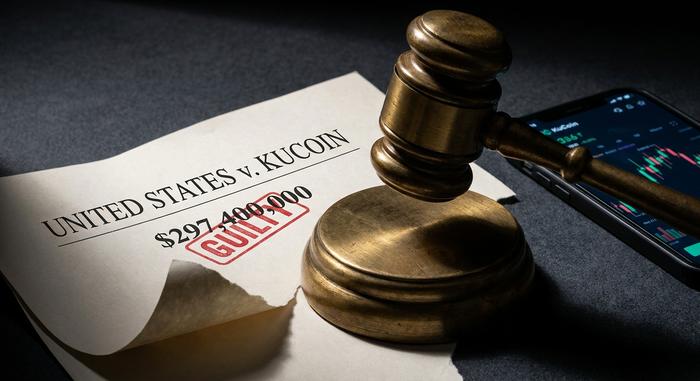
On January 27, 2025, KuCoin pleaded guilty in a US federal court to operating an unlicensed money-transmitting business in violation of the Bank Secrecy Act. In plain terms, it had served American users for years without the anti-money-laundering and know-your-customer controls the law requires. According to the U.S. Department of Justice, the penalty came to about $297.4 million, split between $184.5 million in criminal forfeiture and a $112.9 million fine, and KuCoin agreed to leave the US market for at least two years. Its two founders avoided personal prosecution through deferred agreements.
| KuCoin trust timeline | What happened |
|---|---|
| Sep 2020 | $281M hack; ~84% recovered, rest covered by insurance fund |
| Jul 2023 | Mandatory KYC introduced for all users |
| Jan 2025 | Guilty plea to US authorities; ~$297.4M in penalties; 2-year US exit |
| Mar 2026 | CFTC consent order permanently bars KuCoin from the US |
Where you can and can't use it now
The US door is now bolted. In March 2026 the CFTC issued a consent order with a $500,000 civil penalty that permanently bars KuCoin from American markets unless it registers properly. Europe is messy too. KuCoin's EU entity holds a MiCA-related license in Austria, yet the regulator there kept its operations prohibited through early 2026 over compliance shortfalls, and the UK's FCA has an active warning on the brand. The practical takeaway is blunt. If you are in the US, do not try to VPN your way onto KuCoin. You would be trading on a platform a federal court has told to stay away, with no recourse if something goes sideways.
KuCoin fees and the KCS discount explained
On price, KuCoin is hard to argue with. This is one of the cheaper big exchanges, and for active traders the savings are real. But fees are never just the headline number, and KuCoin quietly recovers some of that goodwill on the way out the door.
Spot and futures trading fees
The base spot trading fee is a flat 0.1% for both maker and taker, which already undercuts the standard Coinbase rate by a wide margin. High-volume traders drop into VIP tiers that lower it further. Futures trading is cheaper still, with maker fees near 0.02% and taker fees near 0.06%. Where the friendliness fades is on the way out: KuCoin charges a network-based withdrawal fee that can sting on congested chains.
| Fee type | Standard | With KCS discount |
|---|---|---|
| Spot maker | 0.10% | ~0.08% |
| Spot taker | 0.10% | ~0.08% |
| Futures maker | ~0.02% | lower via VIP tiers |
| Futures taker | ~0.06% | lower via VIP tiers |
| Crypto deposit | Free | Free |
| Withdrawal | Varies by network | Varies by network |
Cutting costs with KCS
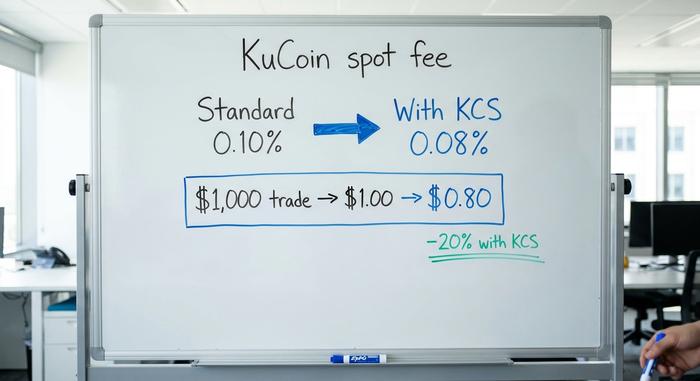
Hold KuCoin Token and pay your trading fee in it, and you get roughly a 20% discount. On a $1,000 spot trade, the standard fee is about $1; with the KCS discount it drops to roughly $0.80. That looks trivial on one trade and stops looking trivial once you have made a few hundred. For anyone who trades on KuCoin regularly, flipping the fee-payment toggle to KCS is the single easiest saving on the platform.
Deposits, withdrawals, and USDT transfers
Funding a KuCoin account is straightforward as long as you arrive with crypto. Crypto deposits are free and usually quick. The weak spot is fiat. Direct bank rails were never KuCoin's strength, and they got thinner after the US exit, so most people fund through P2P trading or a third-party card processor, then convert.
Getting money out deserves a moment of planning. Withdrawal fees depend on the network you choose, not on KuCoin being greedy in the abstract. Sending USDT over Tron costs a fraction of sending the same USDT over Ethereum, where gas can spike. The lesson for any beginner is simple: before you hit withdraw, check which chain you are using. The right network turns a painful fee into a rounding error.
Supported coins and trading pairs
This is the reason people put up with everything else. KuCoin lists somewhere around 900 to 1,000+ cryptocurrencies and well over 1,200 trading pairs, and it tends to add promising tokens early through its KuCoin Labs and Launchpad pipeline. If your interest runs past bitcoin and a handful of blue chips into smaller, earlier projects, few mainstream platforms come close. That breadth is genuinely useful and genuinely double-edged — more obscure tokens also means more thinly traded, higher-risk ones.
Trading tools, bots, and how trading works
KuCoin packs a lot into one app: spot, margin, futures, and an Earn section for staking, all reachable without leaving the platform. The standout, though, is the free trading bots. Grid bots and dollar-cost-averaging bots come built in at no extra charge, which is unusual; plenty of competitors either omit automated trading or sell it as a subscription.
For a passive user, that matters more than it sounds. You can set a grid bot to buy dips and sell rips inside a range, or a DCA bot to accumulate a coin on a schedule, and let it run. KuCoin trading does not have to mean staring at candlesticks all day. The interface leans toward intermediate and advanced users, so beginners face a learning curve, but the tools themselves are some of the more generous in the industry.
KCS: the KuCoin token and its perks
KCS, the KuCoin Token, is part loyalty card and part dividend. Beyond the fee discount already covered, holding KCS in your account earns a small daily bonus paid out of the exchange's trading-fee revenue. The more the platform trades, the more KCS holders receive, which neatly ties the token to the venue's actual activity.
As of June 25, 2026, KCS traded around $7.17 with a market capitalization near $965 million and a circulating supply of about 134.65 million tokens. Is it an investment thesis? I would not buy KCS expecting it to moon. As a tool that pays you back for activity you were doing anyway, though, it earns its place for regular users.
KYC and verification: know your customer
The no-KYC KuCoin that early adopters remember is gone. Since 2023 the exchange has required know-your-customer verification from all users, and unverified accounts are now effectively locked out of withdrawals and most real functionality. If you opened an old account and never finished verification, expect to do it now before you can move anything.
Verification runs in tiers. Basic KYC, an ID document and a selfie, unlocks standard trading and withdrawal limits; higher tiers raise those limits. It is friction, and some longtime users resent it, but it is also the predictable cost of an exchange trying to climb out of the regulatory hole described above.
How to use KuCoin: a quick-start guide
For a first-timer, the path is short. Register with an email or phone number. Complete KYC verification before you do anything else, because skipping it only means hitting a wall at withdrawal time. Then fund the account, ideally by depositing crypto you already hold rather than fighting with fiat rails.
Before your first trade, turn on every security toggle KuCoin offers: 2FA through an authenticator app, a separate trading password, and an anti-phishing code. Do this on day one, not after a scare. Only then place a first order, and start with a small spot trade to learn the interface. Treat the whole setup as the boring, non-negotiable part. It is.
What KuCoin user reviews reveal
Read enough KuCoin user reviews and a clear split emerges. Long-term holders praise the same things: the enormous coin selection, the low 0.1% fees, the fast app, and the KCS perks. Plenty of people have used the exchange since 2017 without drama.
Then there are the complaints, and they cluster tightly. The recurring one, by far, is frozen accounts and stuck withdrawals, often triggered when an account gets flagged for review. Customer support is generally responsive for ordinary questions but turns slow and scripted exactly when users need it most, during a freeze. Higher withdrawal fees and KYC friction round out the gripes. One note for context: KuCoin's Trustpilot page was suspended over review manipulation, so I would not lean on any single star rating. The honest read is a capable platform with a real, documented pattern of account-freeze frustration. Go in with your own security tight and the bulk of your stack in self-custody.
The verdict: who should use KuCoin
KuCoin is a strong second exchange for non-US traders who want deep altcoin access, cheap fees, and free bots, and who are disciplined enough to self-custody and lock down every setting. It is the wrong choice for anyone in the United States — full stop — and for anyone who wants a single, boring, fully regulated home for their entire portfolio. The platform is cheap and deep; it is not clean and quiet. Which of those two things matters more to you is the real question this KuCoin review leaves you with.