
Coinbase Review 2026: Fees, Safety, and the Honest Verdict
Most Americans who buy their first Bitcoin do it on Coinbase. Plenty of seasoned traders, meanwhile, keep it at arm's length and move their volume elsewhere. Both habits make sense once you understand the platform, and reconciling them is what this Coinbase review sets out to do. No other US crypto exchange is as trusted or as tightly regulated. Few charge beginners as much. The scale alone is hard to wave away: by early 2026 the platform was holding roughly $294 billion in customer assets for about 8.2 million monthly transacting users, according to its Q1 2026 filing. People leave money here because they trust it. The thing worth figuring out is whether that trust earns back what it quietly costs you.
What Coinbase is and why it dominates the US
Coinbase launched in 2012, founded by Brian Armstrong and Fred Ehrsam with a deliberately dull pitch: a cryptocurrency exchange that behaves like a bank. It worked. The company went public on the Nasdaq in 2021, later joined the S&P 500, and now files quarterly reports the same way Apple or JPMorgan does. Its full-year 2025 revenue was about $7.2 billion, up roughly 9% on the year.
That public, audited status is the product. Around 12% of all the crypto on earth sits in Coinbase custody, much of it for institutions and spot Bitcoin ETFs that need a regulated custodian they can name in a filing. Picture a first-time buyer in Ohio who wants one Bitcoin and would rather not lie awake wondering whether the exchange will vanish overnight. For her, Coinbase is the obvious answer. The compliance is the moat — and, as you will see, the bill.
One more thing worth keeping in mind: Coinbase is a company you can buy shares in, ticker COIN. That forces a level of disclosure no offshore exchange matches. When crypto runs hot, Coinbase prints money. In the quiet stretches it bleeds, because most of its revenue still leans on trading fees. Why does that matter to you as a customer rather than an investor? Because the cyclicality shapes everything downstream, from staking commissions to how hard the app pushes you toward paid products.
Coinbase fees: where the real cost hides
Here is the single most important thing in any honest Coinbase review: the advertised fee is not the fee. The number that actually empties your wallet is the spread baked into the simple buy screen — and the entire app is designed to funnel beginners straight into it. I'm not convinced that layout is an accident.
What a $100 buy actually costs
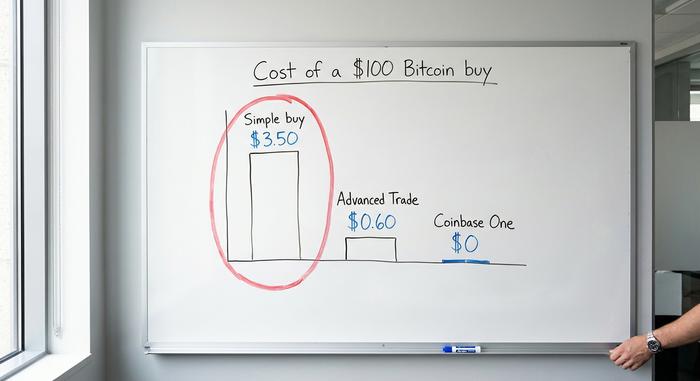
When you tap "Buy" in the main Coinbase app, you pay a flat fee plus a spread of roughly half a percent on top of the price. On small orders those combine into an effective cost of around 2% to 4%. Switch to Coinbase Advanced Trade, the order-book interface (formerly Coinbase Pro) hidden one tab over, and the same purchase costs a flat 0.40% maker or 0.60% taker fee at the base tier, according to Coinbase's published fee schedule (as of 2026). Same company, same coins, a fraction of the cost. You also get real advanced charting and a live price chart the simple screen keeps out of sight.
| Buying $100 of Bitcoin | Headline cost | Real all-in cost (approx.) |
|---|---|---|
| Simple buy (main Coinbase app) | flat fee + ~0.5% spread | $2.50–$4.00 (2.5–4%) |
| Advanced Trade (taker) | 0.60% | ~$0.60 |
| Advanced Trade + Coinbase One | 0% trading fee | ~$0 (spread may still apply) |
The lesson is blunt. If you only ever touch the simple screen, you are paying tourist prices. Moving to Advanced Trade is free and takes one tap, and it is the first thing every Coinbase user should do.
Coinbase One and the break-even
Coinbase One is the subscription answer to the fee complaint. The standard tier runs $29.99 a month and waives trading fees on most activity; more than a million people now pay for it. The math is simple. At a 0.60% taker rate, $29.99 buys back the fees on about $5,000 of monthly trading. Above that, the subscription pays for itself. Below it, you are donating thirty dollars a month for a perk you barely use. For an active trader it is a clear win. For someone who buys $200 of Ether twice a year, it is a waste, and Coinbase is careful not to spell that out.
The fees nobody mentions until checkout
Trading fees are only the headline. There are quieter charges too. Sending crypto off the platform incurs a network fee that Coinbase passes through, and on congested chains like Ethereum that can sting. Converting one coin directly into another carries its own spread, often around 1% to 2%, which is easy to miss because it never appears as a separate line. One genuine bright spot: buying or holding USDC, the dollar stablecoin Coinbase co-founded, is free, and you can move it between Coinbase products without paying to trade. If you want to sidestep fees entirely while you decide what to buy, parking funds in USDC is the closest thing to a loophole the platform offers.
Is Coinbase safe? Security and the 2025 breach
On paper, Coinbase is about as safe as a crypto exchange gets. The harder question is what "safe" actually survived in 2025, because the company lived through its worst security event ever — and it had nothing to do with hacking the vault.
Cold storage, 2FA, and insured cash
The fundamentals are solid. Coinbase says it keeps the vast majority of customer crypto, somewhere around 98%, in offline cold storage that never touches the internet. Your dollar balance is covered by FDIC pass-through insurance up to $250,000 through partner banks, the same safety net a checking account gets. Two-factor authentication comes as standard, and these days the app keeps prodding you toward passkeys and hardware keys as part of its broader security measures. And because this is a public company, those claims have to survive an auditor rather than just a marketing team.
What the May 2025 breach actually was
In May 2025, Coinbase disclosed in an SEC filing dated May 14, 2025 that overseas customer-support contractors had been bribed to hand over user data. The personal information of 69,461 customers was exposed, fewer than 1% of users, and Coinbase estimated the cleanup and reimbursement would cost between $180 million and $400 million. It refused to pay the ransom the attackers demanded and promised to repay anyone tricked into sending funds.
The detail that matters most is what the attackers never got. They did not touch private keys, and they never reached the cold storage where customer crypto actually sits. The cryptography held; some underpaid contractors on another continent did not. Most reviews either gloss over that or spin it into a scare headline, and both miss the point. You cannot cold-store your way out of a bribed support agent, and no exchange on earth has solved that problem yet.

Regulation and the SEC case Coinbase won
Hackers are one threat. A regulator deciding your business should not exist is another, and 2025 finally settled that second question in Coinbase's favor. The SEC had sued the company in 2023 over claims it ran an unregistered securities exchange. That case was dropped in February 2025, with prejudice and no fine, which lifted the heaviest legal cloud the company had carried for years. Coinbase also won a MiCA license to operate across the European Union, adding to the New York BitLicense it has held since the early days.
This matters to ordinary users more than it sounds. Banks, pension funds, and ETF issuers will only push billions through a venue their own compliance teams sign off on, and that institutional flow is part of what keeps Coinbase deep and liquid for everyone else. It is also what separates Coinbase from the offshore exchanges that keep blowing up or getting shut out of the US market. The premium you pay is, in part, the cost of a company that chose to play by the rules.
Beyond buying: Coinbase Wallet, staking, and the card
Coinbase is more than a buy button, and across its suite of digital assets and services the extras are where it gets interesting and occasionally expensive. Coinbase Wallet is a separate, self-custody app where you, not Coinbase, hold the private keys; it connects to DeFi and NFT apps the main exchange will not touch. The Coinbase Card lets you spend crypto like a debit card and earns rewards. The company also runs Base, its own fast Ethereum layer-2 network.
Then there is staking, and here a number hides in plain sight. When you stake assets like Ethereum or Solana through Coinbase, the platform takes a commission of around 35% of the staking rewards you earn. You still come out ahead of holding idle coins — but a third of your yield quietly goes to the house. Coinbase One members pay a lower cut. It is a real cost, and it almost never shows up in the glossy feature lists.
There is also Learn and Earn, a feature that pays you small amounts of crypto for watching short lessons about a new token. It is genuinely free money, usually a few dollars per quiz, though the catch is obvious enough: you are being introduced to assets a project wants promoted. Treat it as a harmless way to pick up your first coins, not investment advice. Taken together, the extras make Coinbase feel less like an exchange and more like a full crypto bank, which is exactly the impression the company wants to leave.
Coinbase vs Kraken: how this crypto exchange compares
Put the fees side by side and Coinbase comes last by a wide margin. What you get for that markup is regulatory cover and a first experience that does not intimidate, spread across more than 250 cryptocurrencies. Whether the markup is justified depends almost entirely on the kind of user you are.
| Coinbase | Kraken | Binance | |
|---|---|---|---|
| Base taker fee | 0.60% | 0.40% | 0.10% |
| Base maker fee | 0.40% | 0.25% | 0.10% |
| Listed assets (approx.) | 250+ | 200+ | 350+ |
| US availability | Full | Full | Limited (separate US arm) |
| Standing | Nasdaq-listed, S&P 500 | Private, US-regulated | Offshore, past settlements |
Binance runs about a sixth of Coinbase's base taker fee, which sounds decisive until you remember it never fully reopened to US customers and still carries the baggage of past settlements with American regulators. Kraken is the comparison I find more honest. It is genuinely cheaper, just as well regulated, and only a little rougher around the edges for someone placing their very first order. In practice I send cost-sensitive friends to Kraken and nervous first-timers to Coinbase, and that one sentence captures most of the decision. The realistic alternatives to Coinbase come down to Kraken inside the US and Binance for much of the world beyond it.
Getting started: opening a Coinbase account
Opening a Coinbase account is genuinely a ten-minute job, and the user-friendly onboarding is one reason beginners gravitate here. You sign up with an email, then verify your identity with a photo of your ID and a selfie, which is standard for any regulated crypto exchange. Once you are approved, you link a payment method: a bank transfer over ACH is cheap but takes a few days to settle, while a debit card is instant and costs more.
Before you buy anything, turn on two-factor authentication. Do it immediately, not later. The only real surprise for new users comes at the first purchase, when the simple-buy fee lands and the math does not match the price they saw a second ago. Now you know to use Advanced Trade instead. That one habit will save a regular buyer more than any other tip in this review.
Customer support: Coinbase's persistent weak spot
If Coinbase has an Achilles' heel beyond fees, it is support. For years the complaint was identical across every review: frozen accounts, a chatbot wall, and no human to reach when your money was locked. It has improved. There is now a 24/7 phone line, and Coinbase One members get faster live chat. But the "why can't I get my money out" frustration still surfaces, usually tied to security holds or incomplete verification rather than anything sinister. It is also the moment scammers pounce, so it pays to recognize a Coinbase withdrawal-code phishing text before you act on it. Support is better than it was. It is still the part of the experience most likely to make you angry.
The verdict: is Coinbase worth it in 2026?
So is Coinbase worth it? For the right person, yes. If you are a beginner, a US resident who values protection, or someone who buys and holds rather than trades daily, the security and regulatory standing justify the premium, as long as you use Advanced Trade or Coinbase One to dodge the worst fees. If you are a high-frequency or deeply fee-sensitive trader who is comfortable self-custodying, you will save real money elsewhere. Whether it counts as the best crypto exchange for you really does come down to those priorities. The honest takeaway from this Coinbase review is that this trading platform is excellent at what it is for — and quietly punishing if you use it wrong. Learn where the costs hide, and it becomes one of the safest on-ramps in crypto.



