
Sumsub: One Verification Platform for KYC and AML

Every business that touches money faces the same question at the front door: who do you let in? Let the wrong people through, and a regulator eventually mails you a fine and a press release. Screen too aggressively, and half your sign-ups rage-quit before they finish. Open the gate, or guard it. Pick wrong either way and it costs you.
That squeeze is where identity verification lives, and it is the job Sumsub took on. You have almost certainly run into it without noticing, probably the last time a crypto app made you photograph your passport. Sumsub is one of the bigger names among KYC and AML vendors, and in ten years it went from a scrappy startup to a billion-dollar company. So is it any good, and what does it actually do? That is what the rest of this guide sorts out, jargon translated.
What Sumsub is and what the platform does
So what is Sumsub, exactly? Underneath the branding, it is the software that decides whether your selfie and your ID are good enough to open an account on a crypto exchange or a banking app. Most users never see the name. The businesses that buy it see it every single day.
It began in 2015 as Sum & Substance Ltd. London is home base, with outposts in Berlin, Miami, Tel Aviv and Singapore. The milestone it brags about came in January 2026, when it joined the World Economic Forum's Unicorn Community, the official nod that its valuation had topped a billion dollars. The rest of the numbers are the kind vendors love to flash on a slide. More than 4,000 client companies. Over 220 countries. Some 14,000 types of identity document on file.
So what separates it from a plain document checker? Scope. Sumsub sells itself as a full-cycle verification platform, a roundabout way of saying it covers the whole user journey rather than one checkpoint: onboarding a customer, screening them against sanctions lists, watching their transactions later, verifying companies as well as people. The pitch is convenience, one vendor instead of five. The catch, worth saying out loud, is lock-in. Once onboarding, monitoring and case management all run through a single platform, leaving gets expensive.
How Sumsub identity verification actually works
Strip away the marketing and the verification process is short. A user hands over a document and a selfie. Software confirms the document is genuine, the face matches, and a real person is sitting there right now. Then comes the part that actually matters: what you do with the answer. Approve, reject, send it back for more.
Document and biometric checks
Sumsub asks the user to photograph an ID and, usually, record a quick video selfie. The software reads the document, compares it against the 14,000-plus templates it knows, and hunts for signs of tampering. A liveness check makes sure the selfie is a live person, not a photo of a photo or a screen propped up to the lens. Face-matching links the two. Sumsub says the whole thing averages under 20 seconds and that onboarding conversion clears 90 percent in its main markets. One caveat: those numbers come from Sumsub, so read them as a vendor's best day, not an audited fact. In countries with national digital-ID schemes it can skip the passport photo altogether and run a document-free database check instead.
Verification levels and the no-code workflow builder
Here is the piece compliance teams quietly care about most, and it is not the machine learning. It is the workflow builder. Sumsub lets you set verification levels, lighter checks for a small depositor, heavier ones for a high-value corporate client, and rearrange them by dragging boxes around instead of filing engineering tickets. The same flow ships through a REST API, mobile and web SDKs, or a no-code hosted link called Unilink. A regulator changes a rule on Friday. The compliance officer needs the flow updated by Monday. That kind of flexibility beats any single detection feature.
Reusable KYC and ongoing monitoring
Verification is never one and done. Sanctions lists update, dormant customers reappear, risk scores drift. So Sumsub keeps re-screening users after onboarding and pushes anything odd into a case-management queue where a human makes the final call. It also offers reusable KYC: a verified identity can travel across several services without making the person start from scratch each time. Handy for users, and a quiet engine behind the platform's ai-driven automation push.
KYC, KYB and AML: the compliance stack
Three acronyms run this whole industry, and they are simpler than the jargon makes them look. Get them straight and the regulatory requirements behind any financial product stop reading like alphabet soup.
KYC vs KYB: verifying people vs businesses
KYC, Know Your Customer, means confirming a person is who they claim to be before they touch a financial service. KYB, Know Your Business, does the same for a company, and a company hides more. You verify the legal entity, then chase down the ultimate beneficial owners, the actual humans pulling the strings behind layers of holding structures. Business verification is slower and messier than checking one individual. That is exactly why platforms charge more for it, and why plenty of smaller vendors quietly skip it.
AML screening and transaction monitoring
AML, Anti-Money Laundering, is the bigger legal goal that KYC and KYB serve. In plain terms: screen every customer against sanctions lists, politically exposed person databases and watchlists, then watch their transactions for patterns that smell like laundering. Trip a rule and the system fires an alert, and where needed helps file a suspicious activity report. The honest catch? False positives. Real-time monitoring flags far more innocent activity than guilty, and a human has to clear each one by hand.
The Travel Rule and crypto VASPs
Crypto piles on one more layer. The Travel Rule makes virtual asset service providers, exchanges, custodians, some wallets, pass sender and recipient details alongside any transfer above a threshold, the way banks already do for wire transfers. Sumsub runs a Travel Rule directory that, per its 2025 crypto report, links more than 1,800 VASPs. Why does a directory matter? Because the rule only works if both ends of a transfer speak the same protocol. No shared plumbing, and a compliant exchange simply cannot trade with a compliant peer.

Why KYC and AML compliance matters
It is fair to ask why any of this deserves a whole industry. The answer is that getting it wrong is expensive in both directions, and the numbers have grown large enough to reshape how companies budget.
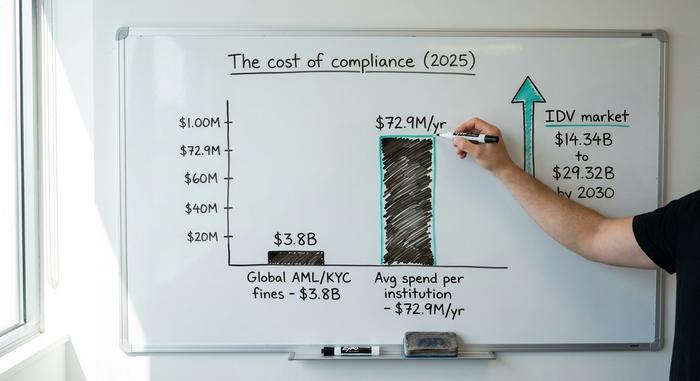
Start with the punishments. Regulators handed out roughly $3.8 billion in AML and KYC-related fines in 2025, by Fenergo's count. That was down 18 percent globally, but the pain moved rather than vanished: European penalties jumped 767 percent. And honestly, the fines are the small part. Fenergo pegs the average anti-money-laundering and KYC spend at $72.9 million per institution per year. Most of that is people clearing alerts by hand, not software.
So of course demand for anything that trims that bill keeps climbing. The identity verification market was worth $14.34 billion in 2025 and is headed for $29.32 billion by 2030, growing 15.4 percent a year, according to MarketsandMarkets. That is the wave every provider here is riding. It also explains how a company that sells, when you strip it down, a better front door can be worth a billion dollars.
| Metric | Value | Year | Source |
|---|---|---|---|
| Global AML/KYC fines | $3.8 billion | 2025 | Fenergo |
| Average AML/KYC spend per institution | $72.9 million/year | 2025 | Fenergo |
| Identity verification market | $14.34B to $29.32B | 2025–2030 | MarketsandMarkets |
| Market CAGR | 15.4% | 2025–2030 | MarketsandMarkets |
Fraud prevention in the age of AI deepfakes
The case for automated verification has gotten stronger for an uncomfortable reason: the fraud got better. Sumsub's 2025–2026 Identity Fraud Report, built on more than four million verification attempts, found that sophisticated, multi-step fraud rose 180 percent year over year. Roughly one in fifty forged documents is now AI-generated, and deepfaked selfies that would have looked absurd two years ago now pass a casual glance.
Crypto feels this sharply. The same report put the sector's fraud rate at 2.2 percent in 2025, up 48 percent from the year before. The global average sat at the same 2.2 percent, which tells you crypto is no longer the outlier it once was. Digital fraud has spread evenly across regulated finance.
This is the part where I would push back on the marketing. AI detection helps, and a platform that sees millions of attempts a month spots new fraud patterns faster than any single bank could. But it is an arms race, not a cure. The same generative tools that make the fakes also train the detectors, and every gain on one side teaches the other. Treat any vendor's fraud numbers as a snapshot of a moving target, not a guarantee.
Sumsub for crypto exchanges and onboarding
For Sumsub, crypto is not a side market. It is the core. And the ground under crypto has shifted fast enough that the no-KYC exchange is becoming a museum piece.
Look at the regulators. The Financial Action Task Force counted 85 of 117 reviewed jurisdictions enforcing the Travel Rule by mid-2025, up from 65 a year earlier; 96 now demand that virtual asset service providers be licensed or registered. The EU went further and folded crypto firms into one regime through the MiCA framework. The takeaway for an exchange or wallet is blunt. Skip proper KYC and AML, and you are not edgy. You are unlicensed.
Here is where a platform that already speaks crypto pays for itself. Sumsub bundles the document checks, sanctions screening and Travel Rule plumbing a virtual asset business needs to onboard users across dozens of countries, no local compliance team required in each one. So for anyone weighing how to accept crypto payments or run an exchange, the verification layer is not optional infrastructure anymore. It is the license to operate.
Sumsub pricing, pros and cons reviewed
So is Sumsub worth it? The product is strong; the friction is real. Both things are true at once.
Pricing is usage-based and, like most enterprise software, partly hidden behind sales calls. Public figures put verification at roughly $1.35 per check with volume discounts, an entry subscription around $149 a month, and custom contracts for large clients. Reviews run warm. The platform holds ratings of 4.6 to 4.7 stars across independent sites, with one Capterra listing showing 4.7 from about 70 reviewers and strong marks for value and integration.
The complaints are consistent enough to take seriously. Support can lag during busy periods, the kind of delay that stings when verifications are stuck and users are waiting. False positives surface often enough that teams budget for manual review. Some users disliked a redesigned applicant interface, and Sumsub's own mobile app carries a weak 2.0 rating, a reminder that the polished SDK and the consumer app are not the same product.
Sumsub does not sit alone in this market. The table below sets it against the providers a buyer usually weighs it against.
| Provider | Founded | Funding / valuation | Notable for |
|---|---|---|---|
| Sumsub | 2015 | Unicorn, over $1B (2026) | Full-cycle KYC, KYB, AML and Travel Rule |
| Onfido | 2012 | Acquired by Entrust (2024) | Document and biometric verification |
| Jumio | 2010 | $150M (Great Hill Partners) | Enterprise identity and AML |
| Veriff | 2015 | $1.5B valuation | High-automation identity verification |
| Persona | 2018 | $200M, $2B valuation (2025) | Configurable identity infrastructure |
The AI agent shift reshaping KYC in 2026
Looking ahead, Sumsub is betting on AI agents, and not just as chatbots. In late 2025 it claimed to be the first verification platform to give AI agents access to the configuration layer itself, letting them adjust verification flows rather than merely run them. It frames this as one of "five shifts reshaping KYC in 2026," alongside reusable KYC and more automated account management.
Take the first-mover claim with a grain of salt; every vendor wants to own the AI narrative right now. But the direction is real. If fraud is increasingly machine-generated, the defense will be machine-run too, and the open question is whether handing configuration to software makes compliance faster or just harder to audit when it fails.
Is Sumsub the right verification platform
Sumsub is a serious, mature option in a market that has stopped being optional. If you run a regulated fintech or a crypto business that needs global verification across many jurisdictions and would rather buy the whole compliance stack from one vendor, it belongs on the shortlist. If you are a tiny startup that just needs the single cheapest identity check, the breadth you are paying for is breadth you will not use.
The deeper question is not which vendor you pick. It is that verification has moved from a box you tick to the gate your entire business depends on, and the people trying to break that gate now have the same AI you are using to guard it.



