What Is a CEX? How Centralized Crypto Exchanges Work and Why They Still Dominate

My first Bitcoin purchase happened on Coinbase, sometime in 2017. App, bank link, "buy" button, done. I didn't know what an order book was. Didn't care. I just wanted the coin and Coinbase made it feel like buying something on Amazon.
That experience, the "just tap and it works" version of crypto, runs on centralized exchanges. Binance. Coinbase. Kraken. OKX. Bybit. Every time somebody buys their first Bitcoin with a credit card, there's a CEX in the middle of that trade.
And CEXs are massive. Perpetual futures volume on centralized platforms hit $86.2 trillion in 2025. Year over year growth of 47.4%. On the spot trading side, CEXs still process roughly 76% of all crypto volume. DEXs have grown from 1% to 24% over the past five years, which is genuinely impressive, but three quarters of trading still happens on centralized platforms.
I've been through maybe thirty of these exchanges at this point. Tried the good ones. Got burned by at least one. Watched one steal $8 billion and send its founder to prison. So yeah, understanding how CEXs work, where they break, and when a DEX makes more sense is worth your time regardless of how long you've been in crypto.
What a centralized exchange actually is
Strip it down and a CEX is a cryptocurrency exchange run by a single entity. A company with servers and employees and a CEO who takes a salary. Unlike decentralized alternatives, a centralized crypto exchange sits between you and every other exchange user on the platform, matching your buy order against someone else's sell order.
The traditional finance analogy works pretty well here. NYSE matches Apple share buyers with sellers. Binance matches Bitcoin and Ethereum buyers with sellers. Both use order books. Both charge fees. One key difference: crypto CEXs never close. Twenty four hours a day, every day of the year. Christmas, your birthday, the heat death of the universe. Markets are open.
"Centralized" means one outfit controls everything. They hold your money in their custodial wallets. They pick which tokens and trading pairs get listed. They run KYC checks on your personal information before you can trade. They write the rules. And if something goes sideways, at least there's a company to take to court. FTX customers learned that the hard way, but the legal entity existing at all was the reason anyone eventually got any money back.
The popular CEX platforms today: Binance is the largest exchange platform by volume worldwide, reportedly with 200 million+ users. Coinbase is the biggest in the US, publicly listed on Nasdaq, over 100 million accounts. Kraken has been around since 2011, popular with more advanced traders who want API access and margin tools. OKX and Bybit are huge in Asia. Bitstamp is one of the oldest European CEX platforms. Gemini focuses on regulatory compliance and has ISO 27001 and SOC 2 Type 2 certifications, which matter if you're a financial institution looking for audit-ready infrastructure.
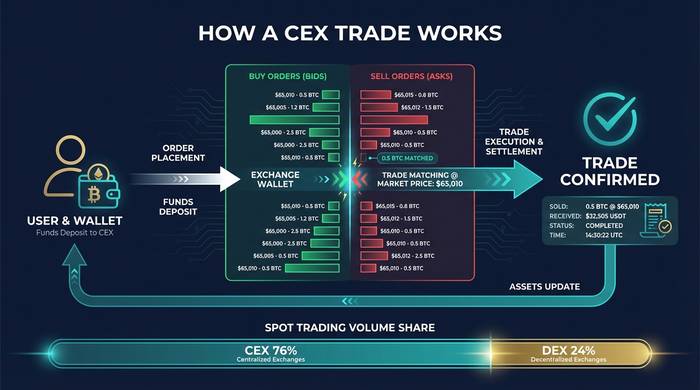
How a CEX works: order books, matching engines, and custody
Bunch of things happen behind the screen when you hit "buy" on a CEX.
The order book is where it starts. Here's how a centralized exchange works in practice: it keeps a running list of every open buy order (bids) and sell order (asks) for each trading pair. You want 1 BTC at $68,000? Your bid sits in the book. When somebody posts a matching sell, the trade fills. The software doing this matching is called the matching engine. Binance's can process 1.4 million orders per second. In a market where prices move $500 in ten seconds, that speed isn't a nice-to-have. It's the whole product.
Then there's custody, which is the part that makes crypto purists nervous. You deposit BTC or dollars into a CEX, and the exchange holds it. Not you. Your Bitcoin is in their wallet, controlled by their private keys. They show you a number on a screen. "Not your keys, not your coins" became a slogan for a reason. Until you physically withdraw crypto to a wallet you control, you're trusting the exchange to actually have what they say they have.
Settlement is where it gets interesting. When two people trade on the same CEX, no blockchain transaction happens. The exchange just updates its own database: your balance goes down, theirs goes up. This is why trades feel instant. Nothing moves on chain. It also means, and this part is important, the exchange can show you a balance without actually having the coins. FTX did exactly that. They showed users balances while the actual funds were off getting gambled by Alameda Research. When everyone tried to withdraw at once in November 2022, the money wasn't there.
| Component | What it does | Why it matters |
|---|---|---|
| Order book | Lists all open buy/sell orders | Shows real-time supply and demand |
| Matching engine | Pairs compatible orders | Speed determines execution quality |
| Custodial wallets | Holds user funds (hot + cold) | Convenience vs. "not your keys" risk |
| KYC/AML system | Verifies user identity | Regulatory compliance, fraud prevention |
| Internal ledger | Tracks balances off-chain | Enables instant trades, but requires trust |
Why people use centralized exchanges
Nobody wakes up thinking "I'd love to give a company custody of my crypto today." People use CEXs because they solve problems that most traders care about more than philosophical purity.
Fiat currency on-ramp is the big one. Want to turn dollars into Bitcoin? You need a CEX. A decentralized exchange doesn't take bank wires. Uniswap doesn't accept fiat. Neither does PancakeSwap. A centralized exchange is the bridge between your bank and the crypto world. For millions of people it's the only crypto interface they ever touch.
Liquidity is the second reason. Big CEXs have deep books. You can move a million dollars of BTC on Binance and the price barely notices. Try that on a smaller DEX and you'll eat 5-10% slippage. Institutions care about this a lot. Coinbase and EY ran a survey in 2026 showing 73% of institutional respondents plan to increase crypto allocations. That money flows through centralized platforms because it has to: no DEX has the depth for block-sized orders.
UX is the third and maybe most honest reason. CEXs have apps with password recovery. Forget your Coinbase login? Verify your identity, you're back in. Forget your DEX wallet seed phrase? Your money is gone. No customer support. No reset button. For anyone outside the crypto native bubble, that single fact ends the CEX vs DEX debate before it starts.
And then there's what a CEX offers beyond basic trading. Futures, margin, options, staking, lending, copy trading, launchpads, earn programs, OTC desks. The crypto trading experience on a modern centralized exchange looks more like a traditional brokerage every year. A trader on Binance can go long BTC with 20x leverage, earn yield on idle USDC, participate in a new token launch, and cash out to a bank account, all without leaving the platform. DEXs are catching up on spot swaps and some perps (Hyperliquid did $73% of perp DEX volume in Q2 2025), but on the full product stack they're still years behind.
The gap is closing though. And that's worth watching. Every percentage point of volume that moves from CEX to DEX is a small vote for self-custody over convenience. The trend line matters more than today's snapshot.
CEX vs DEX: the real differences that matter
Ask five crypto people about CEX vs DEX and you'll get five arguments. Most skip the parts that actually matter. Here's the honest comparison:
| Feature | CEX | DEX |
|---|---|---|
| Who holds your funds | The exchange | You (self-custody) |
| Identity required | Yes (KYC/AML) | No |
| Fiat support | Yes (bank, card, PayPal) | No (crypto only) |
| Speed | Instant (internal ledger) | Depends on blockchain confirmation |
| Liquidity | High (deep order books) | Variable (depends on pool size) |
| Available tokens | Curated, vetted | Anything anyone lists |
| Customer support | Yes | No |
| Risk if platform fails | Lose your funds | Smart contract risk, but funds stay in your wallet |
| Regulation | Subject to local laws | Mostly unregulated |
| Fees | Trading + withdrawal fees | Gas fees + swap fees |
Start with the custody question because everything else flows from it. CEX holds your keys. Exchange gets hacked, goes bankrupt, or turns out to be run by a crook? You might lose everything. DEX means you hold the keys. Smart contract bug could still hurt you, but nobody can freeze your account or block your withdrawal.
The numbers tell the rest of the story. DEXs went from 1% to 24% of spot volume in five years. Impressive. But 76% still goes through centralized platforms. Most traders, when forced to choose, pick speed, fiat access, and the ability to talk to a human when something breaks.
Security: what has gone wrong on centralized exchanges
You're trusting a company with your money. Here's how that's gone in the past.
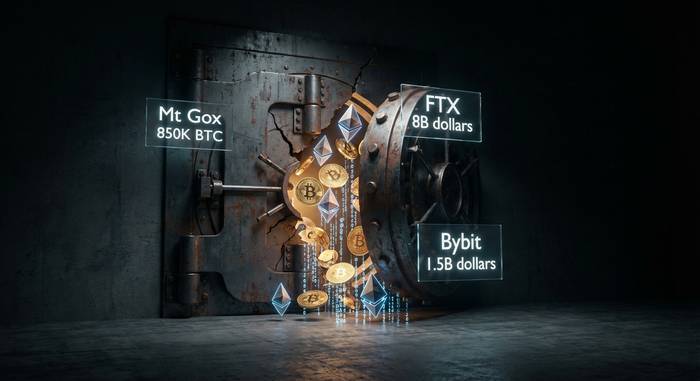
Mt. Gox, 2014. 850,000 BTC stolen. At the time that was around $450 million. At today's prices it's tens of billions. Mt. Gox was handling roughly 70% of all Bitcoin transactions on the planet. Bankruptcy. Creditors waited a decade for partial payback.
FTX, 2022. Not even a hack. Straight up fraud. Customer deposits got funneled to Alameda Research, SBF's trading firm, and gambled away. $8 billion gone. SBF convicted, 25 years in prison. The whole crypto market cratered afterward and regulators worldwide started drafting new rules.
Bybit, 2025. Security breach. Roughly $1.5 billion in ETH stolen, one of the biggest exchange hacks ever. Bybit survived because they had reserves to cover it, but that's cold comfort for an industry that keeps having these moments.
Three incidents across eleven years, each one bigger than the last. And these are just the headline ones. Smaller hacks, exit scams on minor exchanges, and "accidental" mismanagement happen constantly at the edges of the industry.
I want to be fair though: security has improved a lot since the Mt. Gox era. Cold storage for the bulk of funds, multi-sig wallets, proof of reserves audits, insurance coverage. Fund security is taken more seriously now. After FTX the industry got serious about transparency in a way it hadn't before. But the track record still reads like a warning. Every major incident, every disadvantage of centralized custody, reinforces the case for holding your own keys. The market maker on a CEX might give you high liquidity and a great trading experience, but the tradeoff is that your crypto assets sit in someone else's vault.
Regulation: how governments are shaping centralized exchanges
The rules are still being written but the direction is clear enough: more of them, everywhere.
US: Coinbase trades publicly and answers to the SEC. Binance paid $4.3 billion in 2023 for compliance failures, and CZ stepped down as CEO. The SEC has gone after multiple exchanges for listing tokens they consider unregistered securities. Hostile? Yes. But exchanges that play by the rules can operate.
Europe: MiCA (Markets in Crypto-Assets) hit full enforcement in 2024. It's now the most complete crypto regulatory framework anywhere. Exchanges in the EU need proper licenses, capital buffers, and consumer protections. If you're a CEX that wants European customers, you follow MiCA or you don't operate there.
Asia is mixed. Japan locked down exchange licensing early, right after Mt. Gox burned them. Hong Kong reopened retail trading in 2023 under a licensing regime. Singapore regulates through MAS. China banned all of it in 2021.
The trend across every jurisdiction: CEXs that want to exist in five years need to look and act like financial institutions. KYC, AML, capital reserves, audits, regular reporting. The wild west phase is over. I think that's probably a good thing for the average person using these platforms. It does mean higher costs and fewer small exchanges surviving. A bunch of the small regional CEXs that operated without licenses in 2020 are gone now. The ones that remain are either fully compliant or actively getting shut down. If you're picking a CEX today, choosing one with proper regulatory standing in your country isn't optional anymore. It's the minimum bar.