AnonVault: How Anonymous Crypto Storage Actually Works
In 2025, Surfshark counted 425.7 million accounts breached worldwide — about fourteen every second. IBM put the average cost of a data breach at $4.44 million globally and $10.22 million in the United States. That was the first year-over-year decline in five years. And in November, the House Financial Services Committee published a 130-page report. It named at least thirty crypto and tech founders who had been quietly cut off from US banking. Insiders called the practice Operation Chokepoint 2.0.
So when the term "AnonVault" began surfacing on privacy forums and SEO ghost-blogs alike, it wasn't because the product was famous. It was because the demand was. Users wanted somewhere to put files that didn't ask for an email, a phone number, or a card. Yet the strange part, when you look closely, is that AnonVault has no canonical homepage, no audit, and no team page. So what, exactly, are people actually buying?
What an anon vault is and why the name shows up everywhere
AnonVault is less a product than a category that wears one name. The label is attached to several different storage platform domains. There is anonvault.com, registered in June 2021 with WHOIS privacy enabled. ScamAdviser flags it for "high-risk cryptocurrency services." There is anonvault.net, with a middling trust score and mixed reviews. There is anonvault.video and anonvaultpremium.com, scattered variants. None publish a privacy policy, a contact form, a public GitHub repository, or a security audit. None list a company, a country, or a person, and none ask for your phone number or your email at signup. There is no whitepaper. There is no funding announcement. CoinDesk, Decrypt, The Block, and TechCrunch have never covered it.
What does exist is a fan club of roughly fifteen lookalike "review" sites (commandlinux, scope24, axis-intelligence, yooooga, techbeaz, hiveex, softcubics, icon-era) publishing near-identical AnonVault explainers. The pattern is familiar to anyone who has watched affiliate networks operate. The Plisio article you may have read first is, in fact, the most editorial piece of writing the topic has produced.
The claimed feature set, repeated across these sources, runs roughly as follows. AES-256 client-side encryption of every file. A zero-knowledge design where the platform cannot access stored content. No-email and no-phone signup that asks for neither email addresses nor phone numbers. Optional Tor routing. Distributed storage nodes across a global network. Post-quantum algorithms (CRYSTALS-Kyber and Dilithium). Crypto-only payment for premium tiers. Some sources add an immutable blockchain audit trail of file operations and biometric two-factor verification.
Taken on their own, those technical claims are coherent. The same building blocks underpin Proton Drive, Internxt, MEGA, and the older Tresorit. The trouble is that none of them, in AnonVault's case, can be verified against source code, an audit, or a named operator. So the honest framing, and the one this article will use, is that "anonvault" describes a product class people search for, not a single vetted service. If you remember nothing else, remember that distinction.
Privacy protection demand: data breaches, debanking, surveillance
Demand for anonymous storage is a trailing indicator of three different fires. The first is the sheer scale of breach exposure. Surfshark's 2025 recap counted 23 billion cumulative accounts breached since it began tracking in 2004. IBM's annual cost of a data breach study showed costs falling for the first time in half a decade. Yet the volume of leaked records went up. The second fire is financial deplatforming. The November 2025 House report identified at least thirty US crypto and tech founders whose accounts had been closed without explanation. Trump's August 2025 "Guaranteeing Fair Banking" Executive Order followed. So did a Federal Reserve proposal in February 2026 to remove "reputation risk" as a supervisory factor. The third is the steady normalization of state-level surveillance pressure. Privacy-Enhancing Technologies, as a market category, is projected to grow from $5.52 billion in 2026 to $14.3 billion by 2030. That is a 27 percent compound annual growth rate, according to Research and Markets. People do not buy that much privacy software because they are paranoid. They buy it because they have been billed for the alternative.
Inside the encryption stack: AES-256, blockchain audit trails, keys
The architecture AnonVault-class services advertise has four moving parts. Each is worth a sentence on what it actually does, and a second sentence on what is verifiable.
Client-side encryption with AES-256, sometimes marketed as "military-grade" strong encryption, means files are encrypted on the user's device before upload. The server stores ciphertext only. Your encrypted data never travels unencrypted. This is the same model Proton Drive and Internxt publish openly, and the math is sound when implemented correctly. The zero-knowledge design means the provider cannot read what it stores. Your encryption keys and decryption keys never leave the device. Files remain encrypted even if one node fails or a third-party service is compromised. Decentralized fragmentation shards each file across many nodes and rebuilds it on retrieval. That is what Filecoin and Storj do. The catch is that those networks publish on-chain proofs, and AnonVault does not. Post-quantum claims around CRYSTALS-Kyber and Dilithium are not science fiction. The National Institute of Standards and Technology finalized both as FIPS 203 and FIPS 204 in August 2024. They are real algorithms. Whether AnonVault uses them correctly is a separate question, and absent source code, it is unanswerable.
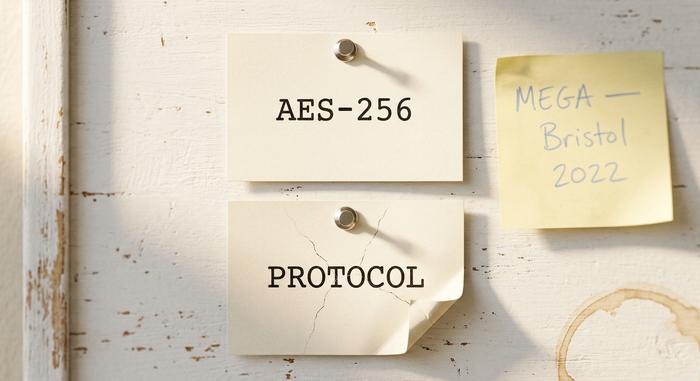
The unpleasant truth about AES-256 is that it means almost nothing on its own. In 2022, researchers at the University of Bristol published a serious cryptographic flaw in MEGA's implementation. The encryption math was right. The protocol around it was not. Without a published audit by a firm such as Trail of Bits, Cure53, or NCC Group, "AES-256" is closer to marketing than to a security guarantee. The best you can say about an unaudited zero-knowledge claim is that it might be true.
Where crypto payments fit: closing the personal information loop
A storage service that asks for no personal information and no personal data still leaves two identity hooks: payment and IP address. Plisio's role in this picture is the payment one. Plisio is a non-custodial crypto payment gateway with a merchant API and plugins for the main e-commerce platforms. It accepts Bitcoin, Ethereum, USDT, USDC, Litecoin, Dogecoin, and Tron. Merchants can take crypto without routing the buyer through Stripe-grade KYC, financial institutions, or traditional platforms that demand client data. Pair that with a service that signs you up by cryptographic key alone, and the financial and account-creation surfaces are both privacy-preserving. The third hook, IP, is handled by Tor or a paid VPN, ideally one that itself accepts crypto.
The concrete user shape this enables is small but real. Picture a freelance translator in Lisbon. She is paid in USDT through a Plisio-powered invoice. She stores client contracts and tax records in an encrypted vault she funded with the same wallet. No card, no bank statement, no Google Drive subpoena exposure. That workflow does not require AnonVault specifically; it requires the category. If the specific provider you choose is unaudited, the privacy model holds only as far as your trust does.
AnonVault vs traditional cloud storage and audited privacy tools
This is the comparison every clone article skips. Below, AnonVault's claimed feature set is placed next to four real services that publish enough information to be measured.
| Service | End-to-end encryption | Anonymous signup | Crypto payment | Public audit / source | Free tier |
|---|---|---|---|---|---|
| Proton Drive | Yes, zero-knowledge | Email required | Limited | Yes, audited; OSS apps | 5 GB |
| MEGA | Yes | Email required | Historical BTC | Partial; 2022 flaw found | 20 GB |
| Internxt | AES-256 zero-knowledge | Email required | Yes (BTC) | Open-source, audited | 1 GB |
| Filecoin / Storj | Optional client-side | Wallet only | Native token | Yes, on-chain | Pay-per-use |
| AnonVault (claimed) | AES-256 + post-quantum | No email at all | Yes, primary | None public | Varies by domain |
In any anon vault vs traditional cloud comparison, the features of anon vault that matter most are these: no-email signup, crypto-default checkout, decentralized fragments, and post-quantum readiness. On paper, AnonVault wins on each. Anon vault encrypts before upload. Anon vault maintains zero server-side knowledge of content. The database that holds the ciphertext holds nothing the operator can decrypt. Whether it wins in practice depends on whether any of those claims can be verified against an implementation. For high-stakes data, the safer answer remains an audited service with a known jurisdiction. The traditional cloud providers, Google Drive and Dropbox, are not in this table. They encrypt data at rest only. They hold the keys. And they collect heavy metadata. Comparing them to AnonVault is comparing two different threat models.
Who uses anon vault, and what file operations they protect
The user shapes are specific, and the online privacy stakes vary by user. Journalists protecting source contact lists and confidential case files outside the subpoena reach of competitor service providers have been here since long before Snowden. Activists and dissidents in jurisdictions with internet-shutdown laws care about Tor-routed uploads in particular. Debanked US founders store recovery phrases and KYC documents off any service tied to a closed account. The House report named thirty. There are likely many more. NGOs and small organizations use anon vault tooling to store evidence outside vulnerable local servers, especially under MiCA grandfathering. They do so without compromising privacy for their staff. Adult-industry creators, chronically debanked and deplatformed, need encrypted, crypto-paid storage outside Big Tech. High-net-worth crypto holders shard seed phrase backups across encrypted vaults rather than commit them to a single cloud. The common thread is not paranoia — it is exposure to a specific catalogued risk.

Red flags: verification checks before you trust an anonymous vault
Compliance officers are taught to ask, "Where are the red flags?" The same question applies to anonymous services. It applies to any privacy-focused storage solutions you cannot verify yourself. AnonVault, in its current form, raises several. There is no verifiable single operator across its many domains. There is no security audit, no public source code, no team page, no jurisdiction disclosure, and no documented protection layers against unauthorized access. The fifteen-strong SEO clone ecosystem mirrors the structure of an affiliate funnel rather than a product community. ScamAdviser flags anonvault.com for both crypto-services and adult-content categories — twin magnets for malware and phishing. And typo-domain risk is real; landing on the wrong "anonvault" is how credential phishes happen.
The regulatory backdrop adds further weight. OFAC imposed the Tornado Cash sanctions in August 2022. The Fifth Circuit struck them down in November 2024. The US Treasury formally lifted them on March 21, 2025. Developer Roman Storm's criminal trial began in July 2025. The European Union's Transfer of Funds Regulation has applied with a zero-threshold disclosure rule since December 30, 2024. MiCA enforcement varies by member state, with Germany grandfathering through December 2025 while Italy moved early. According to Hacken's 2025 tracker, more than seventy-three jurisdictions have now adopted FATF Travel Rule equivalents. Anonymous services are not illegal, but the legal weather around them is changing.
A practical verification checklist follows.
| Check | What to look for |
|---|---|
| Audit | A published report by Trail of Bits, Cure53, NCC Group, or equivalent |
| Source | A real GitHub repository with reproducible builds and signed releases |
| Jurisdiction | A named legal entity, country of incorporation, and contact channel |
| Recovery | An honest, documented "no recovery if you lose your key" policy, by design |
| Independent review | Coverage in tier-one outlets (CoinDesk, Decrypt, The Block), not SEO clone networks |
A service that fails three or more of these is not necessarily fraudulent. It is, however, asking for a level of trust that nobody has earned on its behalf.
Bottom line on anon vault privacy features and limits
Anon vault addresses one piece of a much wider privacy puzzle. Anonymous storage is a useful drawer in a defense-in-depth system, not the lockbox. It gives you confidentiality and complete control over a single file management surface. But platform access still depends on every other layer behind it. Pair it with an audited service for high-stakes data. Pair it with a password manager that publishes its threat model. Pair it with hardware-backed two-factor authentication, a crypto-paid VPN or Tor for the IP layer, and a hardware wallet for any keys that matter. Verify each provider. Prefer open-source. Read the privacy regulations that bind whoever holds your transaction records. If your data could be subpoenaed, sold, or leaked tomorrow, where would you keep it? That is the question worth answering before you upload anything.