How to earn free crypto: methods that actually pay and ones that waste your time
Let me be upfront: most "free crypto" offers are worth less than the time you spend on them. I've tried faucets that pay $0.003 per hour of clicking. I've watched learn-and-earn videos that reward you with a token that loses 80% of its value before you can sell it. I've joined airdrop waitlists that led to nothing but spam emails for months.
But some methods do work. Coinbase has given away hundreds of millions in free cryptocurrency through its learn programs. Staking ETH earns a real yield. Crypto cashback cards pay you bitcoin on purchases you'd make anyway. The trick is knowing which opportunities are worth your attention and which ones are bait for your personal data or your wallet's private keys.
Here's every legitimate way to earn free crypto in 2026, ranked roughly by how much you can realistically expect to get.
Learn and earn programs: the easiest free crypto for beginners
This is where most people should start. Major exchanges run educational campaigns where you watch short videos about a cryptocurrency project, answer a quiz, and receive free tokens deposited directly to your account. No trading, no deposit, no risk to your existing funds.
The best active platforms in 2026:
| Platform | How it works | Typical reward per lesson | Catch |
|---|---|---|---|
| Coinbase Learn | Watch video, answer quiz | $1-5 in the featured token | Requires KYC; US-focused |
| Binance Learn & Earn | Complete modules | $0.50-3 per course | Must have Binance account |
| CoinMarketCap Earn | Watch + quiz | $1-10 in new tokens | Lottery-based, not guaranteed |
| Revolut Learn | Lessons inside the app | $1-3 equivalent | Region-dependent availability |
| KuCoin Learn & Earn | Video + quiz | $0.50-2 | Smaller reward pools |
Coinbase is the most reliable here. Over the years they've distributed an estimated $200+ million in free crypto through the program. You typically earn $3-5 per lesson, and there are usually 5-10 active offerings at any time. The tokens vary, some go to zero, some appreciate. The smart move is to either convert them immediately to BTC or ETH, or just let them sit as a free bet.
One thing people miss: some learn-and-earn programs require you to sign up and complete full KYC (identity verification) before you can access the rewards. Factor that in. If you already have accounts on these platforms, it's free money for 10 minutes of clicking. If you're creating new accounts specifically for $3 in tokens, only you can decide if that's worth your time.

Crypto airdrops: free tokens with hidden strings
Airdrops are when a crypto project distributes free tokens to wallet addresses, usually to build awareness or reward early users. Some airdrops have been lifechanging. Uniswap dropped 400 UNI to every wallet that had ever used the protocol in September 2020. At peak prices, that was worth over $16,000. The Arbitrum airdrop in March 2023 gave out ARB tokens worth $1,000-10,000 depending on your activity level.
In 2026, the airdrop landscape is more mature and more competitive. Projects like LayerZero, zkSync, and others have already distributed tokens. The current airdrop farming scene involves:
- Bridging assets across chains
- Providing liquidity on testnet protocols
- Making regular transactions on new L2s
- Engaging with governance on new DAOs
Fair warning: for every legitimate airdrop, there are dozens of scams. If anyone asks for your wallet's private keys or seed phrase as part of an "airdrop," that's theft. Scam airdrops also send tokens to your wallet that, when you try to sell them, trigger a malicious smart contract that drains your real funds. Rule of thumb: if you didn't actively qualify for an airdrop, and random tokens appear in your wallet, do not interact with them.
Realistic expectation: genuine airdrops can pay anywhere from $10 to $10,000+, but they require weeks or months of on-chain activity beforehand, and there's no guarantee you qualify. This isn't passive income; it's speculative work.
Staking rewards: earn yield on crypto you already hold
If you own proof-of-stake cryptocurrencies, staking lets you earn a return by locking your tokens to help secure the blockchain network. This isn't exactly "free" since you need to already hold the asset, but the rewards cost you nothing extra beyond the token you already own.
Current staking yields in 2026:
| Asset | Approximate APY | Where to stake | Lock-up? |
|---|---|---|---|
| Ethereum (ETH) | 3-4% | Lido, Coinbase, Kraken | Liquid staking available |
| Solana (SOL) | 6-7% | Phantom, Marinade | No lock-up (liquid) |
| Cardano (ADA) | 3-4% | Daedalus, Yoroi | No lock-up |
| Polkadot (DOT) | 10-14% | Polkadot.js, exchanges | 28-day unbonding |
| Cosmos (ATOM) | 15-20% | Keplr wallet | 21-day unbonding |
The trade-off with staking is always the same: you earn yield in the token, but if the token's price drops 30%, your 5% staking reward doesn't save you. High APY usually means high inflation. ATOM paying 15-20% sounds great until you realize the supply is inflating at roughly the same rate. ETH at 3-4% with much lower inflation is arguably a better deal in real terms.
For beginners, liquid staking is the way to go. Services like Lido let you stake ETH and receive stETH in return, which you can still trade or use in DeFi while earning rewards. No lock-up, no unbonding period. You pay a small fee to Lido (10% of rewards) for the convenience.
Crypto cashback cards and shopping rewards
Several companies offer credit or debit cards that pay crypto rewards on purchases. This is genuinely free cryptocurrency if you're spending money you would have spent anyway.
The math is simple: if you spend $2,000/month on a card with 2% crypto cashback, that's $40 in bitcoin per month, $480 per year. Not lifechanging, but it compounds, and the bitcoin you earn might appreciate over time.
Active crypto cashback programs in 2026 include cards from Coinbase (up to 4% back in select tokens), Gemini (up to 3% back in any cryptocurrency they list), and Fold (1-2% back in BTC on every purchase). Fold's app also has a daily wheel spin for bonus sats. Some shopping platforms like Lolli and Satsback offer bitcoin cashback on online purchases at partner retailers.
Watch out for annual fees on some crypto cards. If a card charges $150/year and you're only earning $200 in rewards, the net gain is minimal. Compare the total cost of ownership against a standard 2% cashback card that pays in dollars.
Brave browser and BAT: get paid to browse
Brave is a privacy-focused web browser that blocks ads by default. If you opt into their ad program, you see occasional notifications (not banner ads) and earn Basic Attention Token (BAT) for viewing them. The crypto goes to a built-in wallet.
How much does it actually pay? Depends on where you live and how much you browse. US users earn more because American ad impressions cost more. In practice, expect $1-5 per month. I know people who've been running Brave for three years and accumulated a few hundred BAT, worth maybe $30-50 at current prices. Not exciting, but it cost them exactly zero effort beyond installing a different browser.
As of 2026, BAT trades around $0.15-0.20. You can withdraw it, swap it for ETH or BTC on any exchange, or tip content creators directly through Brave's built-in tipping feature. The browser itself is legitimately good, by the way. Faster than Chrome on most sites because it blocks trackers and ads by default. Even if the BAT earnings disappeared tomorrow, I'd still use it.
Play-to-earn games: diminished but not dead
The play-to-earn hype from 2021 has cooled significantly. Axie Infinity's economy collapsed. Most P2E games from that era are effectively dead. But the concept survived, and a few games with sustainable token economics are still running.
Bigger studios have moved toward "play and earn" models where crypto rewards supplement gameplay rather than being the primary draw. Pixels on the Ronin chain has an active player base. Illuvium and Big Time attracted investment from traditional gaming. These games generally don't make you rich, but they can yield $5-20 worth of tokens per week if you're playing regularly.
My honest take: if you enjoy gaming, play-to-earn can be a bonus. If you're grinding a game you hate solely for $10/week in tokens, your time is better spent elsewhere.
DeFi lending and yield farming
Decentralized finance protocols let you lend your crypto to earn interest. Aave, Compound, and other lending platforms accept deposits and pay yields that vary with market demand. Stablecoins like USDC and USDT typically offer 3-8% APY on major lending platforms, which beats most traditional savings accounts.
Yield farming takes it further. You deposit tokens into a liquidity pool on a decentralized exchange and earn trading fees plus bonus token rewards. Annual returns can reach 10-30% or more, but you're exposed to impermanent loss (your deposited tokens shift in value relative to each other) and smart contract risk (a bug or exploit could drain the pool).
A personal note on risk: the platforms that spectacularly collapsed in 2022-2023, Celsius, Voyager, BlockFi, were actually centralized lenders masquerading as DeFi, not true decentralized protocols. But the principle transfers. Celsius promised 18% on stablecoins, attracted $4.7 billion in deposits, then filed for bankruptcy and locked everyone out. If you see a yield that looks too generous, it probably is.
Stick with battle-tested protocols. Aave on Ethereum has been running since 2020 with no protocol-level exploit. Compound has a similarly clean track record. A brand-new yield farm offering 500% APY on a chain nobody has heard of is almost certainly designed to take your money, not grow it.
Referral programs and sign-up bonuses
Most crypto exchanges offer referral bonuses. You share a link, someone signs up and makes a deposit or trade, and you both earn a reward. Binance, Coinbase, Kraken, Bybit, and others all run these programs.
Typical sign-up bonuses range from $5 to $50 in crypto, usually locked behind conditions: deposit at least $50, make your first trade, or hold for 30 days. Read the terms and conditions carefully. Some bonuses require trading volume that exceeds what a casual user would generate.
Referral programs pay better if you have an audience. Crypto YouTubers and bloggers pull in thousands per month from affiliate links, and some exchange programs offer ongoing commission on referred users' trading fees. For a regular person texting a link to a few friends, the realistic number is $10-30 per successful referral. Decent beer money, not a career.
Crypto faucets: still around, barely worth it
Faucets are websites that give away tiny amounts of cryptocurrency for completing tasks like solving CAPTCHAs, watching ads, or clicking buttons. They've been around since the early bitcoin days, when one faucet gave away 5 BTC per visitor (worth about $350,000 at today's prices).
Modern faucets pay fractions of a cent. Expect $0.01-0.05 per claim, with claims available every few minutes to every few hours. At best, you might accumulate $1-3 worth of crypto per month for regular use. That's well below minimum wage for the time invested.
Are crypto faucets safe? The legitimate ones (FreeBitco.in, Cointiply) won't steal your funds, but they make money by showing you ads, so your attention is the product. Some faucets are outright scams that install malware or collect personal data. If a faucet asks you to install software or connect your wallet, walk away.
My take: faucets were interesting in 2010 when 5 BTC came out of a single tap. In 2026, the payout-to-effort ratio makes them irrelevant for anyone whose time has any monetary value at all. If you're bored on the bus and want to stack satoshis for fun, sure. But don't fool yourself into thinking this is income. The three minutes you spend on a Coinbase learn-and-earn quiz will earn you more than a full day of faucet grinding.
How to avoid free crypto scams
For every dollar of legitimate free cryptocurrency out there, there's probably $10 worth of scam attempts. Here's what to watch for:
Never share your seed phrase or private keys. No legitimate airdrop, giveaway, or earn program will ever ask for these. Anyone who does is trying to drain your wallet.
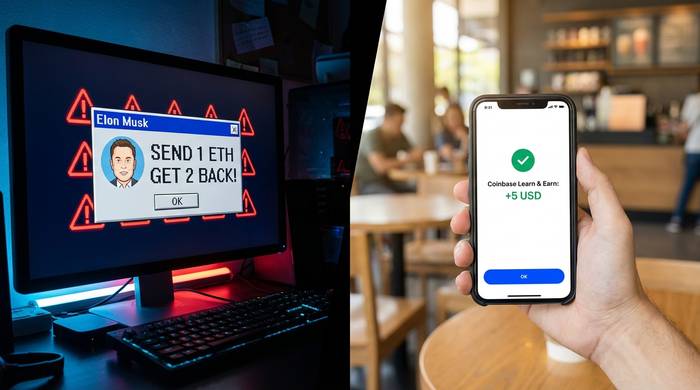
"Send 1 ETH, get 2 ETH back" is always a scam. Always. Elon Musk is not doubling your bitcoin. YouTube livestreams with fake celebrity endorsements run these scams constantly.
Airdropped tokens you didn't expect are probably malicious. Don't try to sell or interact with random tokens that appear in your wallet. They can contain smart contracts that approve unlimited spending from your wallet when you try to swap them.
If the yield seems impossible, it is. Any platform promising 50%+ returns on stablecoins is either unsustainable, a Ponzi, or both. Celsius offered high yields too, right up until it filed for bankruptcy and locked $4.7 billion in customer funds.
Read terms and conditions on sign-up bonuses. I've seen bonuses that require a $500 deposit held for 90 days plus $10,000 in trading volume to unlock a $50 reward. If the fees on that trading volume eat $30 and you're tying up $500 for three months, the "free" bonus cost you real money. Always do the full math before chasing a promotion.