
Filecoin: the decentralized storage network that wants to replace Amazon S3
In 2021, OVHcloud's data center in Strasbourg caught fire. Millions of websites went dark. Customer data evaporated. Backups stored in the same facility burned with the originals. Some businesses lost everything. One building, one fire, years of data gone.
That kind of failure is what centralized cloud storage makes possible. Your files live on someone else's computers in someone else's building. If that building floods, burns, gets seized by a government, or if the company decides to change its terms of service, your data is at their mercy. AWS, Google Cloud, and Azure control roughly 65% of the world's cloud infrastructure. Three companies, three points of failure for the majority of the internet's stored data.
Filecoin is the crypto world's answer to that concentration. A decentralized storage network where anyone with spare hard drive space can become a storage provider, and anyone who needs storage can buy it on an open market using FIL tokens. No single company controls the data. No single building failure wipes it out. Files get split across multiple providers in different locations, so even if some go offline, your data survives.
Juan Benet built Filecoin on top of IPFS, the InterPlanetary File System he created earlier. The project raised $257 million in a 2017 ICO, the largest token sale at the time. Mainnet launched in October 2020. By 2026, the Filecoin network stores over 2 exabytes of data across thousands of storage providers worldwide.
How the Filecoin network actually works
I pay AWS about $23 per month to store roughly a terabyte of project archives. It works. I click upload, files go to some data center in Virginia, and I can download them whenever I want. But I am trusting Amazon with everything. If Amazon raises prices, I eat it. If Amazon suspends my account for some terms of service violation I never read, my files go dark. If their data center has a bad day (and it has), I wait until they fix it.
Filecoin flips that relationship. Instead of paying one company, you post a storage deal on an open market. "100 GB, 6 months, best price wins." Storage providers around the world bid for your business. You pick one, pay in FIL tokens, and the data gets stored. But nobody trusts the storage provider on their word. That is where things get clever.
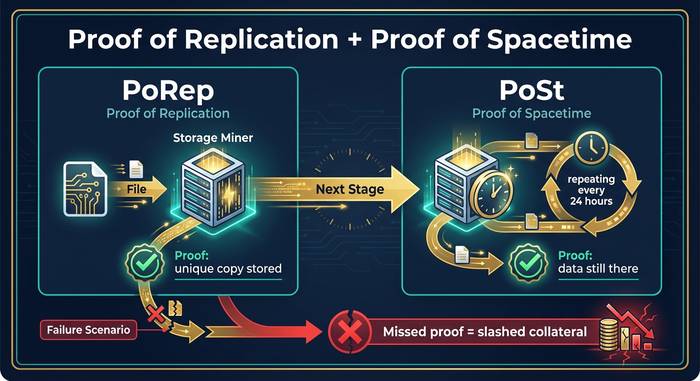
Proof of Replication forces the provider to show, cryptographically, that they actually stored your data. Not a reference to somebody else's copy. Not an IOU. A mathematical proof that your specific data sits on their specific hardware. This happens at the start of every deal.
Proof of Spacetime checks that the data is still there. Not once. Continuously. Every 24 hours the provider submits a fresh proof. Miss a proof? Part of your staked FIL gets burned. Miss enough proofs? The network kicks you out. I watched a storage provider in Asia get slashed last year for going offline during a typhoon. The protocol does not care about your weather. Store the data or lose your collateral.
That enforcement mechanism is the whole ball game. On AWS, you trust a company's reputation. On Filecoin, you trust math. The math does not have off days.
| How Filecoin compares to traditional cloud | Filecoin | AWS S3 | Google Cloud |
|---|---|---|---|
| Who stores your data | Thousands of independent providers | Amazon | |
| Pricing model | Open market (providers compete) | Fixed rate per GB/month | Fixed rate per GB/month |
| Verification | Cryptographic proofs (PoRep + PoSt) | Trust the company | Trust the company |
| Censorship resistance | High (no single authority) | Subject to company/government policy | Subject to company/government policy |
| Redundancy | Configurable (multiple providers) | Within company's data centers | Within company's data centers |
| Payment | FIL tokens | USD/credit card | USD/credit card |
Filecoin and IPFS: two pieces of the same puzzle
When I first heard about Filecoin, I thought it was just IPFS with a token slapped on. That is wrong, but the confusion is understandable because Juan Benet built both and they work together like two halves of the same system.
IPFS is how files get addressed and found. Upload a file and IPFS gives it a content identifier (CID), basically a fingerprint of the file itself. Anyone on the IPFS network who has that CID can retrieve the file from any node storing it. No central server. No URL that dies when a startup runs out of runway. Content-addressed networking instead of location-addressed. Cool technology.
The IPFS problem: nobody pays the nodes to keep your files. I uploaded a dataset to IPFS in 2022. Pinned it on my own node. When I shut the node down three months later, the file vanished from the network because nobody else was hosting it. IPFS has no built-in reason for strangers to store your stuff.
Filecoin patches that hole. Pay someone in FIL to pin your data, and the Filecoin protocol makes sure they actually do it through PoRep and PoSt. IPFS finds files. Filecoin pays for their storage and proves they are still there. Library catalog plus paid librarian who gets fired (slashed) if books go missing.
The FIL token: price, supply, and what drives value
FIL is the native cryptocurrency that powers everything on the Filecoin network. Storage providers earn FIL for storing data. Clients pay FIL to store their files. Providers stake FIL as collateral to guarantee they will keep their commitments.
The token launched with a massive ICO in 2017 that raised $257 million from investors. Mainnet went live in October 2020. FIL hit an all-time high above $230 in April 2021 during the bull run. It has been a painful ride down since then. The token trades far below those peak levels in 2026.
| FIL token snapshot | Details |
|---|---|
| Mainnet launch | October 15, 2020 |
| ICO raised | $257 million (2017) |
| All-time high | ~$237 (April 2021) |
| Consensus | Expected Consensus + PoRep + PoSt |
| Block time | ~30 seconds |
| Block reward | Variable (based on network baseline) |
| Vesting | 6-month linear vest for mining rewards |
| Use cases | Storage payment, provider collateral, gas fees |
The FIL supply model is complex. Storage providers earn block rewards that vest over 180 days. Investors from the ICO had multi-year vesting schedules, most of which have fully unlocked by 2026. The circulating supply has increased substantially from launch, creating sustained sell pressure that contributed to the price decline from the 2021 highs.
What gives FIL value? Demand for storage on the Filecoin network. More storage deals mean more FIL spent. More providers mean more FIL staked as collateral. The bull case: as decentralized storage adoption grows and the Filecoin ecosystem expands, demand for FIL increases. The bear case: actual paid storage on Filecoin remains a tiny fraction of total capacity, meaning most storage providers are mining for block rewards, not serving real customers.
You can buy FIL on Coinbase, Binance, Kraken, and most major exchanges. The Filecoin price and trading volume track the broader crypto market rather than storage demand specifically.
Filecoin Virtual Machine: turning storage into a platform
March 2023 was when Filecoin stopped being "just a hard drive network" and became something more interesting. That was when FVM shipped. The Filecoin Virtual Machine. Smart contracts running on top of a storage layer.
Before FVM: you stored files and earned FIL. That was it. After FVM: a storage provider could take the FIL they had locked as collateral and use it in DeFi through liquid staking protocols like GLIF, earning extra yield on capital that was otherwise just sitting there. A group of climate researchers could form a Data DAO, pool funds, and pay for 10 years of decentralized storage for their datasets with governance rules embedded in a smart contract. A film studio could write a programmable storage deal: "five copies, five different countries, auto-renew every year, and here is the multisig that can cancel."
I have been watching the Filecoin ecosystem evolve since FVM launched and the growth is real but slow. DeFi TVL on Filecoin is tiny compared to Ethereum or Solana. The developer community is committed but small. The Filecoin Foundation keeps signing partnerships that look great in press releases: Internet Archive, Harvard Library, USC Shoah Foundation, Starling Lab. These are meaningful for preservation but they do not move the TVL needle the way a DeFi summer would.
The Filecoin Onchain Cloud vision is the big swing. Storage was step one. Smart contracts were step two. The roadmap wants to add compute next: a decentralized alternative to the full AWS stack. Bold. Whether Filecoin actually gets there before running out of community patience is the open question nobody in the ecosystem wants to answer directly.
Who uses Filecoin and does decentralized storage actually work
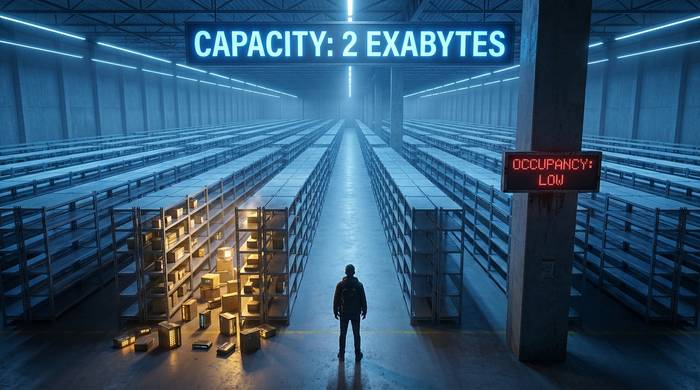
I will be straight about the elephant in the room. Filecoin has over 2 exabytes of committed storage capacity. Two exabytes. That is roughly 2 million terabytes. The amount of that capacity actually holding paid customer data? A fraction. A small one.
Most storage providers on the Filecoin network are running their rigs for block rewards, not because thousands of businesses are lining up to store files. It is like building a 500-room hotel in a town that gets 30 tourists a week. The rooms exist. The plumbing works. The beds are made. But occupancy is in the single digits.
That gap is both the biggest criticism and the biggest opportunity. The infrastructure is already built and paid for. Storage providers have sunk costs into hardware, bandwidth, and FIL collateral. If real demand arrives, the capacity is there to absorb it instantly. The question is whether that demand shows up before the storage providers run out of patience and block rewards stop being worth the electricity bill.
The reasons are building up. The Internet Archive stores backup copies of its collections on Filecoin. Scientific datasets get stored through Filecoin grants. NFT metadata and media files live on IPFS/Filecoin. The Filecoin Foundation has signed partnerships with dozens of organizations for long-term data preservation.
Enterprise adoption is where the real volume potential lives. A single media company archiving 500 TB of footage generates more storage demand than thousands of individual users. Filecoin's pricing on the storage market can undercut AWS significantly for long-term archival storage. The tradeoff: retrieval speed is slower than a centralized data center, and the developer experience is still rougher than spinning up an S3 bucket.
Filecoin vs the competition: Arweave, Storj, and centralized cloud
| Storage solution | Model | Best for | Cost model | Permanence |
|---|---|---|---|---|
| Filecoin | Marketplace (providers compete) | Archival, large datasets | Per deal (FIL tokens) | Time-limited deals (renewable) |
| Arweave | Permanent storage (pay once) | Data that never changes | One-time payment (AR tokens) | Permanent (endowment model) |
| Storj | Distributed cloud (S3-compatible) | Drop-in AWS replacement | Per GB/month (USD or STORJ) | As long as you pay |
| Sia | Renter-host marketplace | Privacy-focused storage | Per contract (SC tokens) | Time-limited contracts |
| AWS S3 | Centralized cloud | Everything | Per GB/month (USD) | As long as you pay |
Arweave and Filecoin occupy different niches. Arweave stores data permanently with a one-time payment. You pay once and the data stays forever (in theory, backed by an endowment fund). Filecoin stores data for specific time periods through renewable deals. Need archives forever? Arweave. Need flexible storage with price competition? Filecoin.
Storj appeals to developers who want decentralized storage without changing their workflow. It is S3-compatible, meaning you swap the S3 endpoint and your code works with Storj instead of AWS. No tokens required for the developer experience.
None of these decentralized options have meaningfully dented AWS, Google Cloud, or Azure's market share. Centralized cloud storage still dominates because it is faster, easier to use, and supported by decades of enterprise sales infrastructure. Decentralized storage wins on censorship resistance, price (for archival), and data sovereignty. It loses on speed, convenience, and developer experience.



