Ethereum vs Bitcoin: key differences between the two biggest cryptocurrencies
"Bitcoin or Ethereum?" Somebody asks me this at least once a week. And I never know where to start because the question assumes they're competing for the same job. They're not. That's like asking "should I buy a house or start a business?" One stores value. The other builds things. Both involve money. Beyond that, different animals entirely.
Numbers as of March 2026: BTC trades around $71K, market cap $1.33 trillion. ETH around $2,100, $233 billion. Bitcoin dominance is 58% and growing. ETH had a rough stretch in 2024-2025. Got proof of stake, got ETFs, got staking ETFs. The market shrugged. BTC kept pulling ahead.
Let me walk you through what actually makes these two different, honestly, without picking sides.
What Bitcoin does
Nobody knows who Satoshi Nakamoto actually is. One person? A group? Somebody who died years ago? We'll probably never find out. Whitepaper came out in 2008. Network launched January 2009. Then Satoshi vanished. The code's been running on its own ever since.
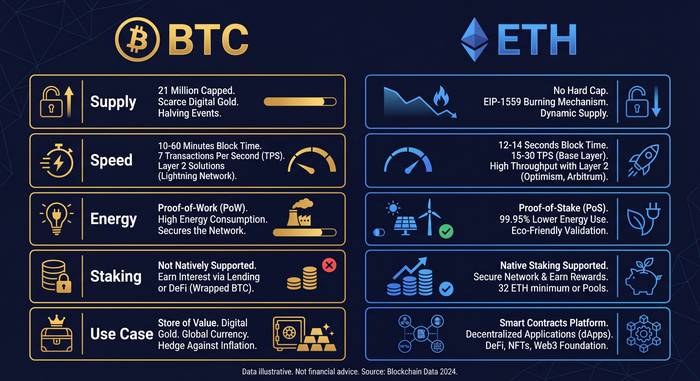
Originally this was supposed to be electronic cash. Pay anyone anywhere, no bank in the middle. Didn't really turn out that way. Once people figured out there would only ever be 21 million BTC, the hoarding instinct kicked in. Why spend something that might be worth ten times more in five years? 19.8 million coins exist right now. Mining rewards get chopped in half every four years. The April 2024 halving brought it to 3.125 BTC per block. Final coin comes around 2140. This is why everyone calls it digital gold. The scarcity math is baked into the protocol and nobody can change it.
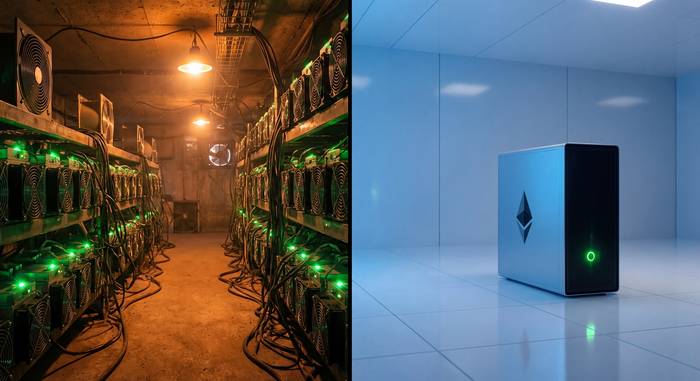
Proof of work keeps the whole thing running. Miners burn actual electricity solving math problems. One new block every ten minutes. Slow on purpose. Expensive on purpose. The energy cost is the security. Faking it would cost more than most countries' military budgets. Bitcoin people love this. Ethereum people think it's wasteful. Both sides have a point.
Big institutional moment: January 2024. SEC approved 11 spot Bitcoin ETFs all at once. BlackRock, Fidelity, the works. Suddenly my aunt could buy BTC in her Schwab account next to her index funds. That's when Bitcoin stopped being "nerdy internet money" and became a real asset class. Whether you like that or not, it happened.
What Ethereum does
Vitalik Buterin was 19, writing for Bitcoin Magazine, and annoyed. He thought Bitcoin's blockchain was wasting its potential by only tracking who sent coins to whom. What if you could run actual programs on a blockchain? He couldn't convince the Bitcoin community, so he built his own thing. Ethereum launched in 2015.
The key innovation is smart contracts. Code that lives on the blockchain and runs exactly as written, no middleman needed. Sounds abstract until you see what people built with it. Lending platforms where you borrow against your crypto without a bank (DeFi). Digital art with provable ownership (NFTs). Exchanges that run themselves (Uniswap). Games. Insurance. Prediction markets. Ethereum became the platform everything else runs on. Ether, the token, is what you pay for the computing. Every action costs "gas" priced in ETH.
September 2022, The Merge happened. Ethereum killed its own mining operation and switched to proof of stake. Now instead of miners running power-hungry machines, validators lock up their ETH as collateral and get picked to validate blocks. Power consumption? Dropped over 99% literally overnight. Right now 72%+ of all ETH is either staked or locked inside smart contracts. Liquid ether is getting genuinely scarce.
You earn about 4.8% a year for staking. BTC can't offer that because Bitcoin has no staking mechanism at all. The SEC approved staking ETFs for Ethereum in late 2025, and BlackRock's ETHA fund has about $16.1 billion in it already. Wall Street money is coming in. Just slower than it did for Bitcoin.
Supply is where things get interesting. ETH has no hard cap. But EIP-1559 (shipped in 2021) burns a cut of every transaction fee. Busy network? More ETH gets destroyed than minted. Quiet network? Supply inflates a little. It's dynamic. Bitcoin people hate this because the rules keep changing. Ethereum people love it because they think adaptive monetary policy is smarter than rigid rules. I can see both sides. At minimum, it makes ETH harder to value with a simple scarcity argument the way you can with BTC.
The comparison table
| Feature | Bitcoin (BTC) | Ethereum (ETH) |
|---|---|---|
| Launch | 2009 | 2015 |
| Creator | Satoshi Nakamoto (anonymous) | Vitalik Buterin and co-founders |
| Primary purpose | Store of value, digital gold | Smart contracts platform, dApps |
| Consensus | Proof of work (PoW) | Proof of stake (PoS) since 2022 |
| Max supply | 21 million (hard cap) | No cap (deflationary during high usage) |
| Block time | ~10 minutes | ~12 seconds |
| Transaction speed | 7 TPS | ~15-30 TPS (1,000+ with Layer 2s) |
| Staking yield | None | ~4.8% annually |
| Energy use | High (mining) | 99%+ reduction after The Merge |
| Market cap (Mar 2026) | ~$1.33 trillion | ~$233 billion |
| Price (Mar 2026) | ~$71,000 | ~$2,100 |
| Spot ETFs | Approved Jan 2024 | Approved 2024, staking ETFs late 2025 |
Transaction fees and speed
This is where the everyday experience diverges a lot.
Bitcoin transactions take around 10 minutes to confirm and can cost anywhere from a couple bucks to $20+ during busy periods. The network handles about 7 transactions per second. That's fine for a store of value you move occasionally. Not great for buying coffee.
Ethereum's base layer processes transactions in about 12 seconds at 15-30 TPS. But here's the catch: gas fees on Ethereum can spike hard during high demand. In 2021 and early 2022, simple token swaps on Ethereum cost $50-100+ in gas. That priced out small users entirely.
Layer 2 networks like Arbitrum, Optimism, and Base have largely solved this. They bundle transactions off-chain and settle on Ethereum, bringing fees down to cents. Most day-to-day DeFi and NFT activity has migrated to L2s. But the gas fee reputation still follows Ethereum around.
Bitcoin has its own scaling solution: the Lightning Network. It enables near-instant, extremely cheap BTC payments off-chain. Adoption is growing but still relatively niche compared to Ethereum's L2 ecosystem.
Decentralization and security
This is the argument Bitcoin maxis won't shut up about, and honestly? They've got a point.
A Bitcoin node runs on a Raspberry Pi. Fifty bucks of hardware. Thousands of regular people run one in their closet. Good luck shutting that network down. It's been live since 2009. Zero downtime. Seventeen years straight. AWS goes down more often than Bitcoin does. Think about that for a second.
Ethereum is heavier. Bigger blockchain, faster growth, more demanding on hardware. Plenty of people don't run their own nodes. They use services like Infura or Alchemy, which is basically "trust this company to read the blockchain for you." There was an Infura outage a while back where exchanges literally paused ETH trading because they'd lost their window into the network. That wouldn't fly on Bitcoin.
Then there's the development question. Bitcoin changes happen at glacial speed because nobody is in charge. Upgrades take years of arguing and only pass when basically everyone agrees. Maddening if you want progress, comforting if you value predictability. Ethereum is the opposite: Vitalik and the Foundation have real sway. Things ship faster. But when a handful of known people can change how a $233 billion network works, you're trusting those people. Whether you're comfortable with that is a personal call.
Investment case: BTC vs ETH
Not telling you what to buy. But here's how the two investment stories differ.
Bitcoin's pitch is clean. Fixed supply. Never changed the rules. Institutions are in. ETFs are pulling billions. It survived 2014, 2018, 2022, and came back from all of them. If you think the world will eventually want a digital, non-government store of value, BTC is the obvious pick. There's nothing fancy about the thesis. That's the appeal.
Ethereum's pitch is messier but arguably bigger. Smart contracts mean ETH captures value from an entire app ecosystem: DeFi, NFTs, gaming, tokenized real-world assets, you name it. Staking pays you yield. The burn makes it deflationary when traffic is high. Layer 2s are actually working. Standard Chartered has said ETH could hit $40,000 long-term. Whether you buy that depends on whether you think "programmable money" is a real category or just a marketing line.
Now the bear cases. For Bitcoin: it does one thing, and if that thing stops mattering (say, gold goes digital some other way, or governments really crack down on self-custody), there's no ecosystem to catch the fall. For Ethereum: Solana and other L1s are faster and cheaper right now. The monetary policy keeps changing, which weakens the "ultra-sound money" story. And a $233 billion network that orbits around one very public guy's opinions has a key-person risk you can't ignore.
Plenty of people hold both. BTC as the anchor, ETH as the growth bet. Not the worst strategy if you can't decide.
Price history at a glance
| Year | Bitcoin | Ethereum | BTC dominance |
|---|---|---|---|
| 2015 (ETH launch) | ~$300 | ~$0.75 | 95%+ |
| 2017 peak | ~$19,000 | ~$1,400 | ~38% |
| 2018 bottom | ~$3,200 | ~$85 | ~52% |
| 2021 peak | ~$69,000 | ~$4,800 | ~40% |
| 2022 bottom | ~$16,000 | ~$1,000 | ~47% |
| 2024 (post-ETF) | ~$73,000 | ~$4,000 | ~53% |
| March 2026 | ~$71,000 | ~$2,100 | ~58% |
What this shows: when the whole market is ripping, ETH tends to outpace BTC because it's the higher-beta play. When things turn south, Bitcoin holds up better because the "digital gold" thesis attracts the cautious money. Since 2024, BTC has been winning because ETF inflows went to Bitcoin first, in much bigger volumes, and institutions are more comfortable with the "gold" pitch than the "programmable platform" pitch. At least for now.
I know a few ETH holders who are genuinely annoyed about 2025. Bitcoin spent months above $80K while ETH just sort of sat there. That's why Bitcoin dominance crept back to 2021 levels. Is it a temporary thing? Maybe. Could also be the market saying it prefers the simpler story.
So which one is better?
Wrong question. They do different things.
If you want a hard, scarce digital asset that institutions are piling into and that has the simplest value proposition in crypto, that's Bitcoin.
If you want exposure to the programmable side of crypto, the DeFi ecosystem, staking income, and the bet that blockchain becomes the backbone of a new financial system, that's Ethereum.
Some people split the difference. Some go all-in on one. The right answer depends on what you believe crypto is actually for, and nobody can answer that for you.