Best crypto off-ramp platforms in 2026: how to convert crypto to cash

You sold your ETH. You took profits on your Solana bag. You earned staking rewards all year. Now you want to put that money in your bank account. The question that every crypto holder eventually asks: how do I actually get this back into dollars, euros, or whatever my landlord accepts?
That process is called off-ramping. Moving cryptocurrency out of the blockchain world and into fiat currency you can spend. It sounds simple. It is not. Fees range from 0% to 5% depending on the platform. Processing takes anywhere from seconds to six days. Some methods are available in 180 countries. Others work in three. And the platform you chose for buying crypto might not be the best one for selling it.
The crypto off-ramp market processed over $180 billion in fiat transactions during 2025. About 580 million people worldwide hold digital assets as of 2026. At some point, most of them need to cash out. This article compares the best ways to do it: centralized exchanges, dedicated off-ramp providers, P2P platforms, and crypto debit cards.
What is a crypto off-ramp?
Crypto in, dollars out. That is an off-ramp. The money ends up in your bank, on a card, or in PayPal. Simple concept, messy execution.
On-ramping (buying crypto with fiat) is easy because companies love taking your money. Off-ramping is harder because sending money out triggers compliance checks, anti-money laundering rules, and bank partnerships that take time.
Four ways to do it.
Exchanges: sell on Coinbase, Kraken, or Binance, withdraw to bank. Best prices, most coins, but withdrawals can take days and wire fees stack up.
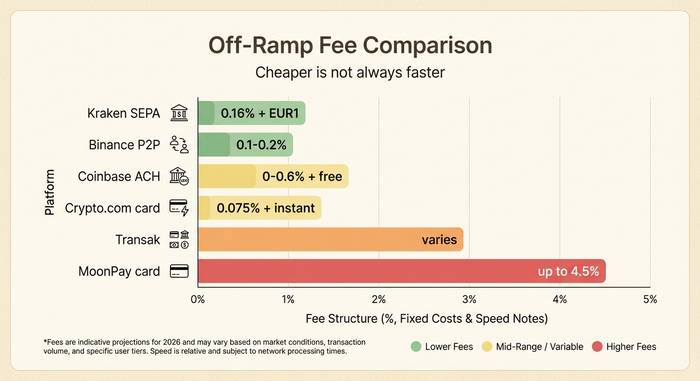
Wallet providers: MoonPay, Transak, and Ramp Network sit inside MetaMask and Trust Wallet. Tap "sell," pick your payout, done. Convenient. Expensive. Fees hit 4.5% on card payouts.
P2P: Binance P2P connects you with a buyer directly. You agree on a price, they send fiat through whatever works (bank, mobile money, cash deposit), and escrow releases your crypto when payment lands. 800+ payment methods. Works where banks do not.
Crypto debit cards: Crypto.com, Bybit, Coinbase. No withdrawal needed. Swipe the card, it converts your crypto to fiat at the register. Your landlord does not know you just paid rent with Ethereum.
Best centralized exchanges for off-ramping
| Exchange | Sell fee | Fiat withdrawal fee | Methods | Speed | Countries |
|---|---|---|---|---|---|
| Coinbase | 0-0.6% | Free ACH, $25 wire, ~1.5% card | ACH, wire, debit card, PayPal | Instant (card), 4-6 days (ACH) | 100+ |
| Kraken | 0.16-0.26% | EUR1 SEPA, $5-10 wire | SEPA, wire, ACH | 1-5 days | 190+ |
| Binance | 0.1% | $15-50 wire, EUR1-5 SEPA | Bank, P2P (800+ methods), card | Minutes (P2P), 1-3 days (bank) | 180+ |
| Bybit | 0.1% | Varies | P2P, Visa/MC card, bank | Varies | 160+ |
| OKX | 0.08-0.1% | Varies | P2P, bank, card | Minutes (P2P) | 180+ |
| Crypto.com | 0.075% | Varies | Bank, card, Visa spending card | Instant (card spending) | 90+ |
Coinbase is where most Americans start. Sell, withdraw, pick ACH, free. Problem: 4-6 business days to hit your bank. Need it now? Coinbase debit card does instant, but 1.5% fee. PayPal works too. Regulated, FDIC-insured USD balances. If you are in the US and want zero friction, this is it.
Kraken wins on cost. 0.16% maker fee is the lowest on this list. SEPA withdrawal: EUR1. Wire: $5-10. Less flashy than Coinbase but cheaper for anyone who watches their basis points. Fewer fiat options than Binance, which is the trade-off.
Binance P2P is the wild card. 800+ payment methods. I am not exaggerating. Mobile money in Nigeria. Bank transfers in Vietnam. Cash deposits in Colombia. You name a country and a payment method and Binance P2P probably supports it. Set your own price. Negotiate with the buyer. Escrow protects both sides. Up to 0.2% fee. 180 countries. 100+ fiat currencies. Nothing else comes close for global coverage.
Crypto.com Visa card skips the whole withdrawal dance. Load it with BTC, ETH, or stablecoins. Walk into a store. Swipe. The card converts to fiat in real time. You never see a bank transfer screen. Cashback up to 5% in CRO if you stake enough. For people who just want to spend crypto like money, this is the answer.
Best dedicated off-ramp providers
These companies do not run exchanges. They build the pipes that connect wallets and dApps to fiat payment rails. When you sell crypto inside MetaMask, Trust Wallet, or Ledger Live, one of these providers is handling the conversion behind the scenes.
| Provider | Off-ramp fee | Countries | Fiat currencies | Cryptos | Payout methods | Speed |
|---|---|---|---|---|---|---|
| MoonPay | Up to 4.5% (card) | 160+ | 34+ | 123+ | Card, bank | Instant (card), 1-3 days (bank) |
| Transak | Varies by region | 75-169 | 27+ | 173 | Card, bank, virtual IBAN | 1-3 business days |
| Ramp Network | Competitive | 150+ | Multiple local rails | 100+ | Cards, bank (Pix, SEPA, SPEI) | Fast |
| Alchemy Pay | Near-zero on promos | 173 | 50+ | 100+ | Visa, MC, Apple Pay, Google Pay | 1-3 business days |
MoonPay is the 800-pound gorilla. 30 million users. $3.4 billion valuation. $107.6 million in revenue for 2025. They partnered with PayPal and Mastercard in February 2026 and acquired Helio, a crypto payment processor with 6,000 merchants. The fee structure stings: up to 4.5% on card payouts. For a $1,000 withdrawal, that is $45 gone. Worth it for convenience? Your call.
Transak landed the MetaMask deal in September 2025. Exclusive off-ramp partner. 100 million MetaMask users now see Transak as the default sell option. Tether led a $16 million round in August 2025. About a third of Transak's volume flows through stablecoins. If MetaMask is your home, Transak is your off-ramp.
Ramp Network does the clever thing: document-free KYC in certain markets using Open Banking data. You connect your bank, Ramp verifies you, no passport photo upload. SOC and ISO certified. Built into MetaMask, Ledger, Trust Wallet.
Alchemy Pay covers 173 countries with 14 US state licenses. They are building their own L1 chain for payments and running near-zero fee promotions to steal market share. Aggressive play for a company nobody outside Asia talked about two years ago.
P2P off-ramps: when you want flexibility
Peer-to-peer platforms cut out the middleman's fiat infrastructure. You sell directly to another person. The platform holds crypto in escrow and releases it when the buyer confirms payment.
Binance P2P is the largest by volume and coverage. 800+ payment methods. Hundreds of fiat currencies. Mobile money options for unbanked populations. Zero trading fee for most P2P transactions (taker fee up to 0.2% in some markets). The flexibility is unmatched. If your country has limited banking infrastructure but people use mobile money, Binance P2P probably supports it.
Paxful has rebuilt after going offline in 2023. It focuses on emerging markets where traditional banking is not accessible. Gift card trading is a niche feature: sell crypto and receive Amazon, Steam, or iTunes gift cards instead of fiat.
The risk with P2P: you are trusting the counterparty to actually send the fiat payment. Escrow protects the crypto side. But if a buyer sends a bank transfer and later reverses it (chargeback fraud), you lose both the crypto and the fiat. Stick to verified traders with high completion rates and dispute resolution track records.
Crypto debit cards: spend without off-ramping
If your goal is to use crypto for daily spending rather than stacking fiat in a bank, crypto debit cards skip the off-ramp entirely.
| Card | Network | Crypto supported | Cashback | Annual fee | Key perk |
|---|---|---|---|---|---|
| Crypto.com Visa | Visa | 250+ | Up to 5% (CRO stake dependent) | $0-$400 | Real-time conversion, airport lounge access |
| Coinbase Card | Visa | All Coinbase assets | Up to 4% in crypto | $0 | Direct from Coinbase balance |
| Bybit Card | Mastercard | Multiple | Up to 10% | $0 | High cashback tiers |
These cards work at any store that accepts Visa or Mastercard. You pay in crypto. The card converts to fiat at the moment of purchase. Some cards like Crypto.com offer cashback rewards paid in CRO. The Bybit card advertises up to 10% cashback on certain tiers.
The trade-off is tax complexity. In most jurisdictions, spending crypto triggers a taxable event on every purchase. Buying coffee with Bitcoin at a profit means capital gains tax on that coffee. Some people are fine with this. Others find the reporting burden not worth the convenience.
How to pick the right off-ramp
Three questions. Answer them and the right platform picks itself.
Where do you live? US: Coinbase, free ACH, regulated, PayPal works. Europe: Kraken, EUR1 SEPA, 1-2 days, done. Emerging market with bad banking: Binance P2P, 800 payment methods including mobile money. Works where nothing else does.
How fast do you need it? Instant: crypto debit card, swipe and go. Same day: P2P, find a buyer, get paid in minutes. This week: bank transfer, 1-6 days depending on method and country. If you can wait, you pay less.
How much are you moving? Under $10,000: any platform works, pick the lowest fee. Over $100,000: OTC desks at Coinbase, Kraken, or Binance. Better pricing than public order books. Less slippage. Dedicated person handling your trade. Sometimes negotiable fees.
DeFi wallet user who does not want to transfer to an exchange first? MoonPay or Transak inside MetaMask. Higher fees, but you skip one step and sell straight from your wallet.