Scotland Currency
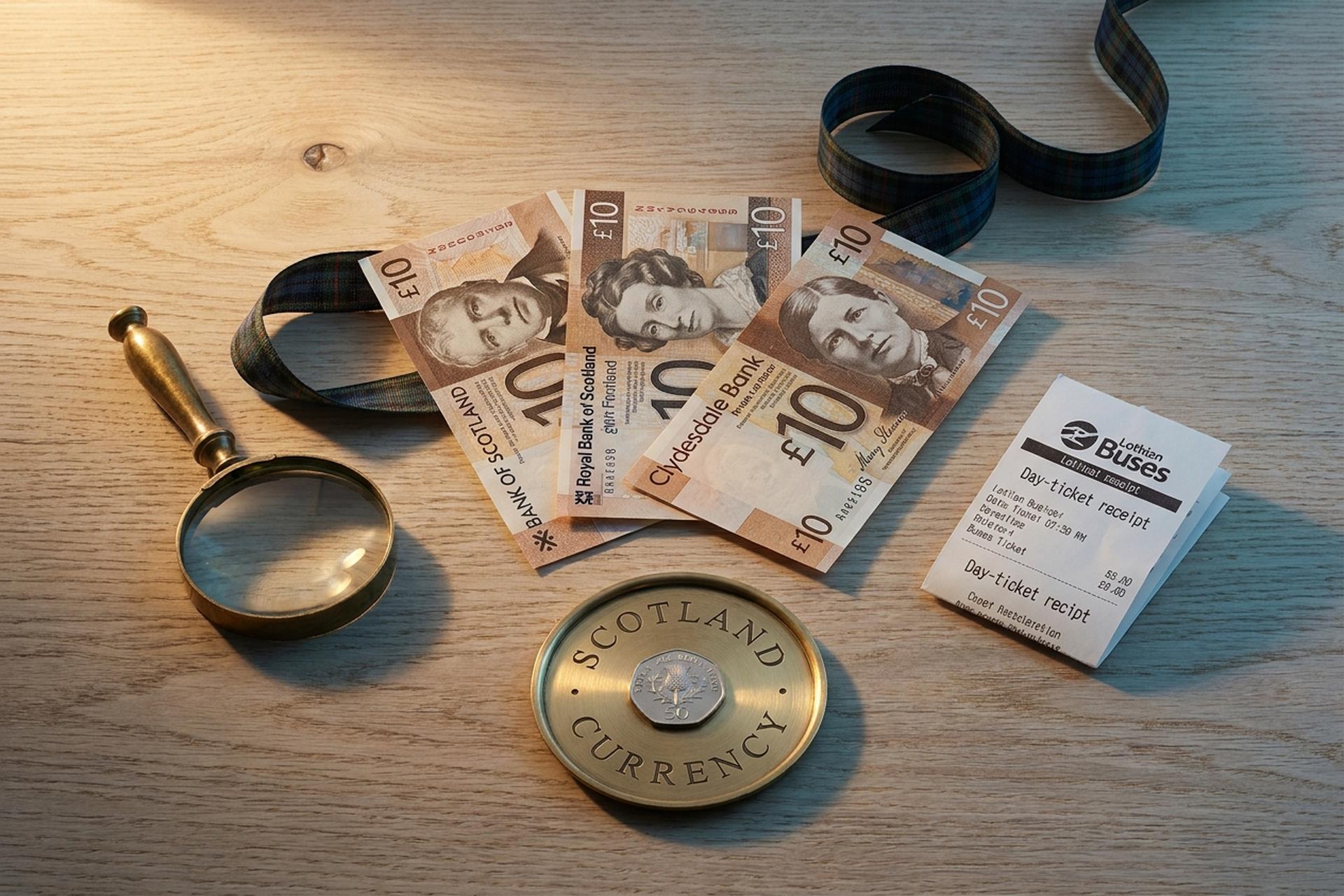
Scotland has one of the strangest currency setups in Europe. On paper, it uses the same pound sterling as England. In your wallet, you may end up with banknotes issued by three different banks in Scotland that legally are not legal tender anywhere in the United Kingdom. The coins are the same. The notes are not. Most shops in Edinburgh smile and accept a Royal Bank of Scotland £20. A café in Manchester might squint and refuse it. Everyone is technically right.
This guide walks through what the Scotland currency actually is, which banks issue those distinctive Scottish banknotes, why the "legal tender" question is more interesting than it sounds, what the pound sterling is doing against the US dollar and the euro in April 2026, and how travelers, locals, and merchants (including the small but growing crypto corner) use the currency in Scotland today. It is useful background whether you are a tourist planning your first trip or a remote worker trying to exchange currency smoothly.
What Currency Does Scotland Use? The Scotland Currency Basics
The currency of Scotland is the pound sterling. Currency code: GBP. Symbol: £. One pound is divided into 100 pence — the same UK currency unit you see in London. Scotland is part of the UK, so the British pound is the official currency here too. There is no separate "Scottish pound" on the foreign exchange market and no separate ISO code. The currency used in Scotland is the same sterling you would spend in London or Cardiff.
The Scottish currency system has a twist. The Bank of England issues sterling notes for England and Wales. In Scotland, three commercial banks issue their own. The framework sits in the Banking Act 2009, which replaced older rules going back to the Bank Notes (Scotland) Act 1845. Sterling banknotes issued in Scotland circulate alongside Bank of England banknotes for exactly the same face value. A £20 Bank of Scotland note buys what a £20 Bank of England note buys. Nothing more, nothing less. The Bank of England regulates the issuance and forces each of the three Scottish banks that issue their own notes to hold backing assets — mostly Bank of England notes and gold — equal to the value of the banknotes issued and in circulation. It is a private-bank currency backed by the central bank.
Coins in Scotland are identical across the UK. 1p, 2p, 5p, 10p, 20p, 50p, £1 and £2. All from the Royal Mint. Same exchange rate applies — no coin is worth more or less in Edinburgh than in Brighton. Whether you are in Inverness, Cardiff, or Cornwall, the coins and banknotes you see for each denomination reflect the same local currency.
Scottish Banknotes: Three Banks, Five Denominations
Scottish notes are issued by three Scottish retail banks. The Bank of England's own documentation calls the set "banknotes issued by three Scottish retail banks." The trio:
- Bank of Scotland — founded 1695. The oldest bank in Scotland still in operation.
- Royal Bank of Scotland — founded 1727.
- Clydesdale Bank — founded 1838.
Travel guides sometimes shorten this to "Bank of Scotland and Clydesdale" plus RBS, or the loose "Scotland and Clydesdale Bank" when they mean all three. Each of these banks in Scotland issues notes in £5, £10, £20, £50, and £100. The £10 note is the workhorse denomination, the one you are most likely to pull out of an ATM. Colours track Bank of England practice: blue for £5, brown for £10, purple for £20, red for £50, turquoise for £100. A £1 note still legally exists (RBS still issues one), but you will almost never see it in daily use. Most £1 transactions go through the £1 coin.
The current series is polymer. Clydesdale Bank was first, with a polymer £5 in March 2015 — the first polymer note issued anywhere in Great Britain. Bank of Scotland followed from 2016. Royal Bank of Scotland completed its polymer switch in May 2020. Polymer lasts longer. Resists tearing. Carries stronger security features: transparent windows, holographic foil, raised tactile marks for the visually impaired.
The people on each bank's series are a quiet tour of Scottish culture.
| Bank | £5 | £10 | £20 | £50 | £100 |
|---|---|---|---|---|---|
| Bank of Scotland | Sir Walter Scott | Sir Walter Scott | Sir Walter Scott | Sir Walter Scott | Sir Walter Scott |
| Royal Bank of Scotland | Nan Shepherd (writer) | Mary Somerville (scientist) | Catherine Cranston (tea entrepreneur) | Flora Stevenson (educator) | Lord Ilay (historical) |
| Clydesdale Bank | Robert Burns | Mary Slessor | Robert the Bruce | Adam Smith | Sir William Arrol |
Royal Bank of Scotland's 2020 series is the first in the UK to feature an all-female line-up of historical portraits, which was noticed at the time.
Are Scottish Banknotes Legal Tender?
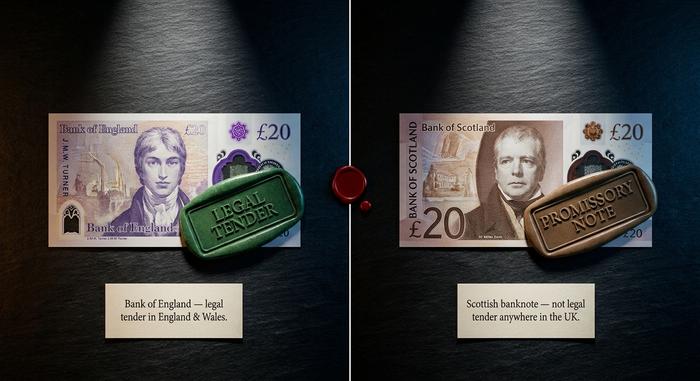
This is the fact that surprises almost every visitor. Scottish banknotes are not legal tender. Not in England. Not in Wales. Not in Northern Ireland. And, contrary to what many people assume, there is no legal tender in Scotland for paper money either. Scottish and Northern Ireland notes sit in exactly the same legal category — promissory notes backed by Bank of England deposits.
The phrase "legal tender" has a narrow legal meaning in the UK. It refers specifically to money a debtor can offer in settlement of a debt that a creditor must accept. In England and Wales, only Bank of England banknotes are legal tender. In Scotland and Northern Ireland, no paper money is legal tender at all. The coins minted by the Royal Mint are legal tender across the UK up to certain amounts.
What this means in practice is less dramatic than it sounds. Scottish banknotes are "promissory notes" backed 1:1 by Bank of England notes and gold held on deposit by the issuing banks, under Bank of England supervision. A pub in Edinburgh will take your £10 RBS note without blinking. A corner shop in Bristol might hand it back and ask for a Bank of England note instead. Both are within their rights. Acceptance of any banknote anywhere in the UK is a matter of commercial choice, not legal obligation.
The practical rule: Scottish banknotes are widely accepted throughout Scotland and usually accepted in the rest of the United Kingdom, though acceptance gets patchier the further south you go. In parts of Scotland you will sometimes get only Scottish notes from ATMs, and in parts of the UK further south you may get only Bank of England notes — both are the same sterling. If a shop in London refuses your Clydesdale £20, any high-street bank will exchange it for a Bank of England equivalent at face value. Banks will exchange Scottish notes on demand, free of charge, by law.
Scottish banknotes have been updated to polymer over the last decade, which also helps acceptance: the new notes have the same modern security features as Bank of England polymer notes, so cashiers south of the border recognise the feel. Scottish notes are accepted in Scotland in every normal scenario — pubs, shops, hotels, taxis — and their use in Scotland is effectively universal among residents and tourists alike.
Exchange Rates: GBP to USD, EUR, and PLN in 2026
GBP sits in the top five most-traded currencies worldwide. Spot rates in mid-to-late April 2026:
| Pair | Rate | What £1 equals |
|---|---|---|
| GBP/USD | ~1.27 | $1.27 |
| GBP/EUR | ~1.18 | €1.18 |
| GBP/PLN | ~4.88 | 4.88 zł |
| GBP/CHF | ~1.05 | 1.05 CHF |
Fast math. £10 is roughly $12.70 or €11.80. £20 is about $25.40. £50 is £63.50. A £100 Scottish note is worth somewhere near $127 at the mid-market rate.
Wholesale quotes, all of them. Any bureau de change, airport kiosk, or card processor adds a spread on top. Visa and Mastercard usually layer 0.2-0.8% over the interbank rate. Airport booths have no shame and tack on 5-10%. Cheapest legal way to convert GBP in 2026? A multi-currency account — Wise, Revolut, or similar. Near-mid-market quote, small flat fee, no surprises.
Using Money in Scotland: Cards, ATMs, and Contactless
Scotland is a card-first country in 2026. More than 80% of retail payments by value flow through Visa, Mastercard, and other debit cards. Contactless is accepted almost everywhere. The UK-wide contactless cap went from £45 to £100 back in October 2021 and stayed there. American Express works at major chains and hotels but is patchy at independent pubs and B&Bs. Diners Club is rare.
Apple Pay and Google Pay work at every major retailer and most small shops. If you have a phone with a UK-compatible card loaded, you can travel coast to coast almost cashless.
ATMs are everywhere. Bank-owned machines inside Scottish bank branches (Bank of Scotland, RBS, Clydesdale, Lloyds, Barclays, Halifax, TSB) let foreign Visa or Mastercard holders withdraw money with no fee. Standalone "Euronet" ATMs in tourist areas often charge, and they push Dynamic Currency Conversion (DCC). Decline DCC. Pay in GBP. Your home bank's rate will beat the terminal's.
Tipping in Scotland follows UK norms. Pub tipping is unusual. Restaurants: 10-12.5% is standard. Many places add a "discretionary service charge" to the bill, which you can politely ask them to remove.
Typical Edinburgh or Glasgow prices to calibrate:
| Item | Price |
|---|---|
| Flat white at a café | £3.50-4.50 |
| Pint of craft beer at a pub | £5.50-7.00 |
| Lothian Buses single fare | £2.00 |
| Edinburgh day ticket (buses + trams) | £5.50 |
| Mid-range B&B, per night | £90-140 |
| Three-course dinner for two, mid-range | £70-100 |
Taxi drivers typically get rounding up to the nearest pound.
English Money in Scotland and Scottish Money in England
One of the most searched questions about the Scotland currency topic is whether English notes work north of the border and whether Scottish notes work south of it. Short answer: yes in one direction, mostly yes in the other. It is a common confusion on any first trip to the UK.
English money in Scotland. Bank of England banknotes are accepted everywhere in Scotland. Shops, taxis, pubs, hotels. Nobody will refuse a £20 Bank of England note. English money is widely accepted throughout Scotland, which makes life simpler for tourists landing at Edinburgh or Glasgow with cash from an English ATM.
Scottish money in England. Messier. Scottish notes are legal currency — sterling backed 1:1 by Bank of England deposits — but not legal tender, so shops can refuse them. In practice, banks, big supermarkets, chain hotels, and city-centre venues in England take them without issue. Smaller independent shops, a few taxi drivers, and vending machines sometimes won't. The further south of Carlisle you go, the more common the hesitation. For foreign currency users on a first trip to the UK, the safe rule is easy: carry mostly Bank of England notes once you cross south of the border.
If you end up in London with a wallet of Scottish £20 notes you cannot spend, any bank branch, post office, or bureau de change will swap them at face value for Bank of England equivalents. Free of charge.
Scotland Currency Exchange: Where to Get the Best Rate
When you need to exchange currency in Scotland, the ranking from best to worst rate looks about the same as anywhere else in Europe in 2026:
| Channel | Typical spread | Notes |
|---|---|---|
| Online app (Wise, Revolut) | 0.3-0.7% | Best rate. Digital KYC needed. |
| City bureau de change (non-airport) | 1-3% | Glasgow and Edinburgh city centre. |
| High-street bank | 2-4% | ID required. Slower. |
| Airport counter | 5-10%+ | Worst rate in the country. |
| Hotel reception | 4-8% | Convenient. Expensive. |
Currency converter apps — Wise, Xe, Revolut, the Bank of England's own tool — show the live mid-market rate. Reference price only. No retail channel offers it to individuals. The best exchange rate a traveler can realistically get in 2026 is a multi-currency debit card. Load it before you fly, top up in GBP, use it at the point of sale.
For leftover Scottish notes at the end of the trip: spend them before you leave. Cleanest exit. Bureaux outside Scotland sometimes refuse them, or slap on a surcharge. Any UK high-street bank will exchange them for Bank of England notes at face value, no fee.
Scottish Economy, Bank of England, and Independence Debates
Scotland accounts for about 7.8% of UK nominal GDP in 2026. The pillars are distinct. Financial services — Edinburgh is a top-5 European asset management centre. North Sea energy. Whisky. Tourism. A growing fintech cluster. Monetary policy is not set in Edinburgh. It is set in London by the Bank of England. The BoE base rate sat at 4.25% in April 2026 after two cuts over the previous six months. UK inflation came in at 2.9% year-on-year. Close to the 2% target, not at it.
Then the politics. The 2014 independence referendum went 55-45 for "No." The SNP is still the largest party at Holyrood in 2026, and independence polls have swung between 45% and 52% since 2022. The currency question is the hardest piece of any independence plan to solve. Three options get discussed. One: keep sterling informally — a currency union or plain "sterlingisation." Two: launch a new Scottish pound pegged to GBP. Three: adopt the euro if Scotland rejoins the EU one day. No option is painless. No option has a clear majority among Scottish voters, let alone in the UK government.
For today's traveler or merchant, this is background noise. The Scotland currency in 2026 is still sterling. Issued by the Bank of England in London and by three Scottish retail banks in Edinburgh and Glasgow. Whether that holds in 2030 — open question, worth watching.
Crypto in Scotland: Regulation, Tax, and Plisio Merchant Payments
Scotland's crypto scene is smaller than London's. Distinct, though. Edinburgh hosts Zumo, one of the better-known regulated UK crypto wallets. Scottish capital since 2018. The FCA regulates every crypto-asset business operating in the UK. Under the Financial Promotions Regime that went fully live in October 2023, any crypto firm marketing to UK consumers either holds FCA authorisation or uses an authorised third-party to issue promotions. No grey area.
Crypto is legal to buy, hold, trade, and spend across Scotland on the same terms as anywhere else in the UK. HMRC treats crypto gains as capital gains for most individual investors. In 2026 the UK rates are 18% on gains inside the basic-rate band, 24% above it, after a £3,000 annual exempt amount. Coin-to-coin swaps count as taxable events. Spending crypto on goods counts too. Stricter than Poland or Germany.
The UK Travel Rule has been in force since September 2023. Crypto platforms have to share sender and recipient information on transfers over €1,000 equivalent. Scottish users see exactly the same KYC and reporting flow as any other UK customer. No regional exemption.
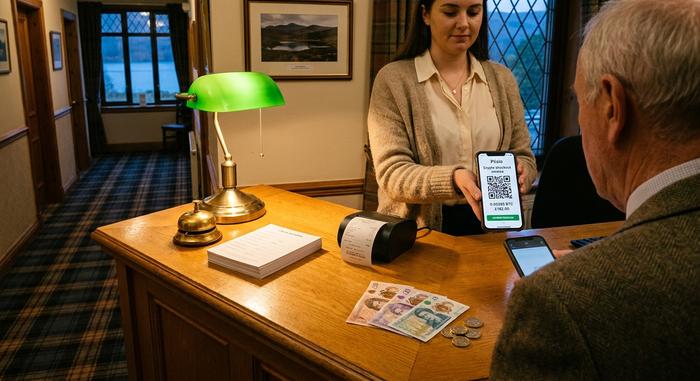
Merchants? A Scottish business that wants to accept crypto alongside GBP can plug a gateway like Plisio into WooCommerce, Magento, PrestaShop, or WHMCS in a few hours. Customers pay in BTC, ETH, USDT, USDC, LTC, or any of 30+ other assets. Plisio either settles in crypto or converts on the fly to GBP or EUR and lands the money in the merchant's bank. The value proposition is the same as anywhere else. No 1.5-3% card-network fee. No chargebacks. Instant cross-border settlement. Useful FX options when customers live in markets where cards are painful. For a Highland hotel with international guests, or an Edinburgh creative agency invoicing European clients, the crypto rail can quietly recover the 3-5% of revenue that usually vanishes into card and currency spreads.