Polish Currency: A Complete Guide to the Złoty
Poland is the biggest economy in Central Europe. It still does not use the euro. If you are flying to Warsaw next month, paying a Polish freelancer, or just adding Poland to your online shop's checkout list, the first thing you need to know is the Polish currency. It is called the złoty. The name is older than most European currencies. The version in your wallet today is younger than Google.
Here is what this guide covers. What the złoty actually is. How the coins and banknotes look in 2026. How the exchange rate has been moving. How locals pay at a shop (hint: not always with a card). Where to change your dollars or pounds without getting robbed. And how crypto is quietly eating a slice of the picture. Prices and rates below are April 2026 numbers.
What Is the Polish Currency? PLN and the Złoty Explained
The official currency of the Republic of Poland is the złoty. The currency code is PLN, and the official currency symbol is zł. The national currency is subdivided into 100 groszy (singular: grosz). Banknotes come from Narodowy Bank Polski, the National Bank of Poland, which most people just call NBP. The bank sits in Warsaw, and in 2026 it is run by Governor Adam Glapiński. The złoty is the only legal tender of Poland. It is the form of payment you will see accepted in almost every shop, taxi, and restaurant.
"Złoty" is just the Polish adjective for "golden." It comes from "złoto," the word for gold. In the 14th and 15th centuries Poles were using it as a nickname for foreign gold coins floating through the local economy — Venetian ducats, Florentine florins, Dutch guilders. It became a homegrown unit in 1496. King Sigismund I gave it full legal-tender status in a minting ordinance dated 16 February 1528. The modern version, technically the fourth zloty, dates from 1 January 1995. Its representation in the Unicode standard uses a lowercase z and ł. The currency code PLN is now used in banking systems worldwide as a unit of account.
PLN is the 20th most-traded currency on the planet. It is the most-traded currency anywhere in Central and Eastern Europe. There is no peg. The zloty floats freely against the dollar, the euro, the pound. The rate on your phone changes every few seconds. For a non-resident, PLN works as a local currency while you are in Poland and as a quoted pair on every major currency converter you might check later.
A Short History of the Polish Złoty and the Grosz
Poland's monetary history reads like a roller coaster. The name "złoty" is older than most European currencies. The actual cash in your wallet today is younger than the iPhone. Two big shocks explain the gap: the 1919 rebuild after independence, and the inflation in the early 1990s. The modern story starts on 28 February 1919, when the law that created the new currency system was passed. The Polish Security Printing Works had already opened in Warsaw on 25 January 1919. Between 1924 and 1939 the zloty quietly replaced the earlier Polish marka, which had been destroyed by hyperinflation during World War I. Collectors still love the short-lived marka.
Then came the second shock. In 1994, the average monthly salary in Poland was roughly 5.3 million old zloty. A loaf of bread cost about 7,500. NBP approved the redenomination on 11 May 1994, the law was signed in July, and on 1 January 1995 one new złoty replaced 10,000 old zloty. That single zloty became the base unit of a stable system. One zloty splits into 100 groszy. The lowercase z and ł give the PLN symbol its shape. Old notes, including a surreal 2,000,000-zloty bill from 1992 with composer Ignacy Jan Paderewski on the front, lost their status as legal tender. NBP will not exchange them. eBay still sells them for pocket change.
The grosz has a quieter backstory. It descends directly from the medieval "groschen" silver coin once used across Central Europe. A 1-grosz coin today is almost worthless on its own. You will still find them in your change at a supermarket. Shops usually round card totals and only hand you coppers if you paid in cash.
Polish Zloty Banknotes and Coins in Circulation
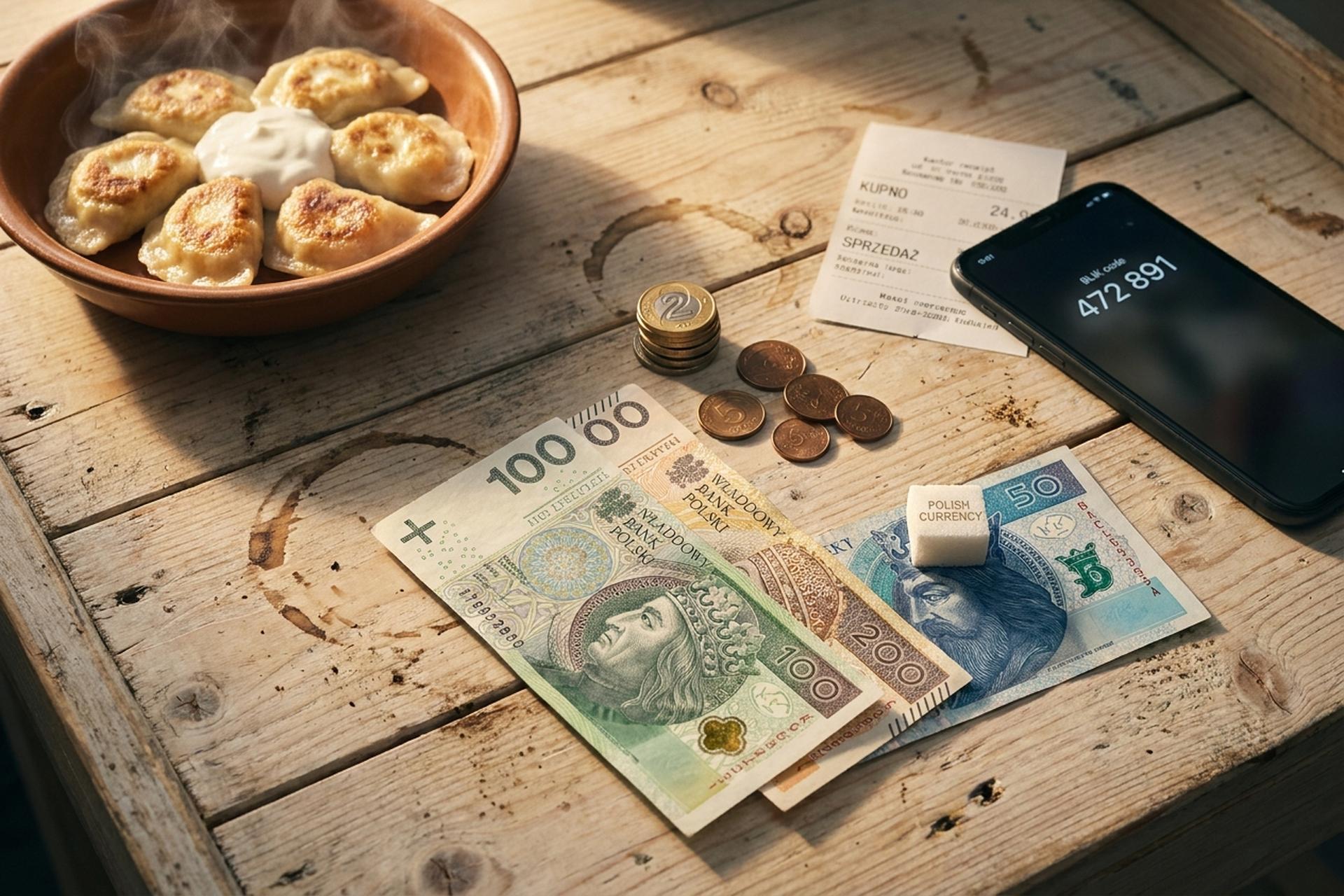
Polish zloty banknotes come in six denominations: 10, 20, 50, 100, 200, and 500 zł. The whole series has a nickname among collectors: "Kings of Poland." Every face on the front of a note is a Polish king. The order runs chronologically, from the country's founder to one of its most famous military rulers. Artist Andrzej Heidrich did the design. Printing was outsourced to De La Rue in London until 1997 and then moved home to the Polish Security Printing Works in Warsaw. The 500 zł note is the newest member of the family. NBP put it into circulation on 7 August 2017 to cut down on the sheer bulk of carrying large cash sums in stacks of 100 or 200.
Here is what you will see on each banknote:
| Banknote | Portrait on the front | Era |
|---|---|---|
| 10 zł | Mieszko I | first ruler of Polish lands |
| 20 zł | Bolesław I Chrobry | first crowned king of Poland |
| 50 zł | Kazimierz III Wielki | 14th-century king who rebuilt Poland |
| 100 zł | Władysław II Jagiełło | founder of the Jagiellonian dynasty |
| 200 zł | Zygmunt I Stary | Renaissance ruler |
| 500 zł | Jan III Sobieski | savior of Vienna in 1683 |
Polish złoty coins and banknotes move around the country through NBP regional branches. Poland's currency system uses coins from 1 grosz up to 5 zł. The smallest (1, 2, 5 gr) are lightweight copper alloy. The middle tier (10, 20, 50 gr) is nickel-plated steel. The 2-zł and 5-zł coins are bimetallic: a gold-colored ring around a silver center. Easy to recognize by touch, which helps if you are fishing coins out of a pocket at a kiosk.
NBP releases commemorative issues every year. Banknotes issued through this channel often come with upgraded security features for collectors. On 5 November 2025, NBP dropped a 20-zł collector banknote to mark the 1,000th anniversary of Bolesław the Brave's coronation. The print run was only 70,000, packaged in a folder. It was also the first Polish banknote to carry DID Wave, a holographic element that animates and shifts color as you tilt the paper. For everyday notes, the 200 zł is the most heavily protected denomination in circulation, with 15 separate anti-counterfeit features.
PLN Exchange Rates Today: USD, EUR and Travel Money
What does "PLN exchange rates today" actually look like? Depends on the pair. Here are the spot prices as of 20 April 2026:
| Pair | Rate | What 1 PLN equals |
|---|---|---|
| USD/PLN | 3.5926 | $0.2784 |
| EUR/PLN | ~4.2384 (2026 YTD average) | €0.2359 |
| GBP/PLN | ~4.881 | £0.2049 |
A quick rule while you are in Warsaw: divide the zloty amount by 3.6 to get dollars, or by 4.24 to get euros. A 100-zł bill is about $27.84 or €23.59. A pierogi plate at 20 zł is $5.60. A single tram ticket at 3.40 zł is under a dollar.
Going the other way on PLN to USD: 100 USD buys roughly 359 PLN at the mid-market rate. 100 GBP buys about 488 zł. The zloty is up about 2.1% in the last month and 3.2% over the past year. Industrial output surged 9.4% in March 2026, which supports the currency, and a softer dollar has done the rest. FX numbers shift in seconds, so treat any blog-post snapshot (including this one) as directional, not as a trading signal.
One more thing. Travel money does not move at the mid-market rate. Your card, a kantor, and an airport kiosk all slap on their own spread on top of the current exchange screen. Posted currency exchange rates are only a starting number. Always check the actual rate you will get, not the big number quoted on the board.
Polish Currency vs Euro: Why Poland Keeps the Zloty
Poland joined the European Union in May 2004, specifically on 1 May of that year. The accession treaty says Poland will adopt the euro "once convergence criteria are met." Two decades later, adopting the euro has not happened. And it will not happen soon. Here is why.
Technically, Poland has never joined ERM II. That is the exchange-rate mechanism a country must sit in for at least two years, with a stable rate against the euro, before it can switch over. Only Bulgaria and Denmark are in ERM II right now. Poland has not even applied.
Then there is public opinion. A January 2026 national poll found that 74% of Poles do not want to replace the złoty with the euro. That number has barely moved in three years. Finance Minister Andrzej Domański, from Donald Tusk's government, said out loud in January 2026 that Poland "will not adopt the euro" in the short or medium term. The opposition Law and Justice party hates the idea even more. Tusk himself has floated a referendum, mostly as leverage for other constitutional talks, not because he wants to actually push it.
The economic case is simple. Poland kept its own monetary policy through the 2008 crisis, let the zloty slide to absorb the shock, and was the one big EU economy that did not fall into recession. Growth is still around 3.3% in 2026. Inflation is close to NBP's target. Why fix what is not broken?
So. When you land in Kraków, plan to carry zloty. Some tourist-zone hotels accept euros. Shops near the German border sometimes do. The internal rate they give you is usually 5–15% worse than the market. For any normal transaction, PLN is the only currency in Poland you should actually use.
Using Money in Poland: Cards, Cash, BLIK, and ATMs
Money in Poland has gone mostly digital. Poles made 15.4 billion payment transactions in 2024, up 12% year on year. Cards now handle about 65% of retail payment volume. Cash is not dead, but its share has collapsed to 2–3% by value in modern retail, and the cash holdouts are mostly older folks and smaller rural shops.
Then there is BLIK. BLIK is Poland's homegrown mobile-payment rail, and if you have spent a week in Warsaw you know it. You generate a six-digit code in your banking app, type it into a checkout or an ATM, confirm with a PIN, and you are done. As of December 2024, BLIK had 18.5 million users. It did 665 million transactions in Q1 2025 alone, up 28% year on year. More than half of Polish online shoppers (51%) pick BLIK at checkout. The total BLIK volume is roughly equal to 1.2% of Poland's GDP. Not bad for a national rail that most non-Poles have never heard of.
For visitors, typical prices look like this:
| Item | Warsaw / Kraków | USD approx |
|---|---|---|
| Espresso | 10–14 zł | $2.80–3.90 |
| Pierogi at a milk bar | 15–22 zł | $4.20–6.10 |
| Full milk-bar meal | ~30 zł | ~$8.35 |
| 3-course meal for two, mid-range | 120–160 zł | $33–44 |
| Hotel (mid-range double) | ~312 zł / night | ~$87 |
| Warsaw single transit ticket | 3.40–4.40 zł | $0.95–1.22 |
| Warsaw monthly transit pass | ~110 zł | ~$31 |
Kraków runs about 10–15% cheaper than Warsaw.
Restaurant tipping runs 10–15%. Pay the tip in cash. Card tips often do not make it to the server, and waiters tell you so if you ask. One language trick worth memorising: when the bill arrives, "dziękuję" means "keep the change." "Proszę" means "please give me my change." One word, five złoty difference.
For cash, stick to ATMs owned by Polish banks. PKO BP, Pekao, mBank, Santander, Millennium, Citi Handlowy. Most of them charge zero access fee on foreign Visa or Mastercard withdrawals. If you visit often and keep an account in Poland, your own debit card is obviously the cheapest path. The machines to skip are Euronet. They almost always push Dynamic Currency Conversion and usually tack on a 15.90–25 zł fee. Using a card in Poland is safe and widely accepted. Shield your PIN at ATMs anyway, and give receipts a quick glance before you throw them out.
Polish Currency Exchange: Kantors, Banks, Airports
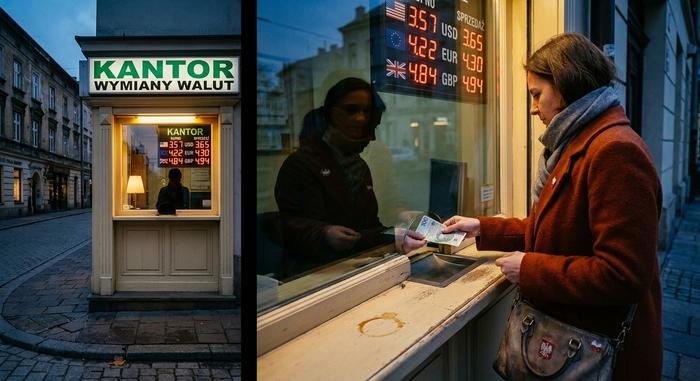
A kantor is a licensed money exchange office, the local form of foreign exchange you will see on almost every main street. It is the Polish word you need to recognize. Airports, train stations, and tourist squares have plenty of them, and most of those are the ones to avoid. The ranking below is the single most useful chart in this article if you want to exchange your money without overpaying:
| Where you exchange | Typical spread vs mid-market | Verdict |
|---|---|---|
| Online app (Wise, Revolut, Profee) | 0.3–0.7% | Best rate, digital KYC required |
| City-centre kantor, non-tourist streets | 0.5–2% | Highly competitive, cash only |
| Bank branch | 1.5–3% | Slower, ID required |
| Airport / station kantor | 5–10%+ | Worst rates anywhere |
| Hotel reception | 4–8% | Convenient, expensive |
Two questions tell you whether a kantor is honest. First, are both rates posted — "kupno" (buy) and "sprzedaż" (sell)? If only one number is shown, walk away. Second, what is the spread on major pairs? EUR, USD, and GBP should trade at a buy-sell difference of 5 to 10 groszy, not 30. Standard kantor hours are 9 AM to 7 PM on weekdays and until 2 PM on Saturdays, with 24-hour kiosks at big transport hubs.
One more trap to watch for: Dynamic Currency Conversion (DCC). When an ATM or card terminal asks whether you want to be charged in your "home currency," it is offering you its own exchange rate, which is usually 3–8% worse than your bank's. Always pay in PLN. Your bank handles the conversion later at a fairer rate.
How to Convert Polish Zloty and Send Money to Poland
If you need to convert Polish zloty for a trip, a supplier payment, or a family transfer, the cheapest route to transfer money in 2026 is almost always an online provider. Wise, Revolut, Xe, and Profee all offer near mid-market rates with a transparent fee shown before you confirm. For a typical $500 transfer when you send money abroad, a high-street bank wire might cost $12–25 plus a hidden 2–3% FX markup. A Wise or Revolut transfer typically costs under $5 total and lands within hours.
For international money transfers to Poland, here is how the main options compare in practice. A SEPA payment to a Polish bank account (in EUR) clears the same day, sometimes within seconds via SEPA Instant. A SWIFT wire from the US can take two to three business days and costs more. PayPal works but applies a 3–4% currency markup. Wise and Revolut are the lowest-friction options for under-$5,000 amounts.
Polish banks also accept BLIK transfers between accounts instantly and for free within Poland. If you are paying a Polish freelancer and they have a BLIK-enabled mobile bank, you can use any Polish-account IBAN and the money is there in seconds.
For high-value transfers (over $50,000), the calculation changes. Specialist brokers such as OFX or Currencies Direct can sometimes beat app providers by locking in forward rates and negotiating on spread.
Polish Zloty Exchange with a Debit Card and Apps
Your debit card is the simplest tool for a Polish zloty exchange on a short trip. A standard Mastercard or Visa debit tied to a Wise multi-currency account, Revolut, or N26 converts at or near the mid-market rate, with ATMs in Poland topping up your zloty balance on demand. The Revolut standard plan, for example, gives you up to £200 (or equivalent) in free ATM withdrawals per month before a 2% fee kicks in.
Watch three fees: your home bank's foreign transaction fee (0–3%), the ATM operator's access fee (sometimes 15.90 zł, sometimes zero), and the DCC option you must refuse. Stacked, the worst case is a 10% silent loss. Done right, it is under 1%.
Currency converter tools such as Xe or Google's built-in search give you the mid-market rate in real time, but remember it is the reference price, not the retail price. No provider offers it to individuals.
Crypto in Poland: Zloty, Bitcoin, and Merchant Payments
Poland is one of Europe's more crypto-engaged countries, and crypto has turned into a parallel rail for the Polish currency. Roughly 19% of Polish adults, about 7 million people, held or used crypto in 2025, per Statista. A Disruption Banking survey put the "I invest in crypto" number at 30.9%. That is higher than the number investing in stocks (21.4%) or bonds (19%). Poland also has the largest VASP registry in the EU, with more than 1,400 registered providers. Fast sign-up, low fees, lots of startups.
Is crypto legal? Yes. It is not legal tender, but you can buy it, hold it, trade it, and pay with it. KNF, the Polish financial regulator, will license crypto asset service providers under MiCA once Poland's own MiCA implementation law is actually in force. A presidential veto in late 2025 pushed that back. Grandfathering for existing VASPs ends 1 July 2026. Until the new law kicks in, GIIF handles the AML side through its older register.
Tax is simple for once. A flat 19% PIT on the money you realise when you sell crypto for fiat, or when you pay for something with crypto. Swaps between coins are not taxed. You declare on form PIT-38 once a year. Losses roll forward. From 1 January 2026, exchanges also report your transactions straight to the tax office under DAC8. So do not expect to stay invisible.
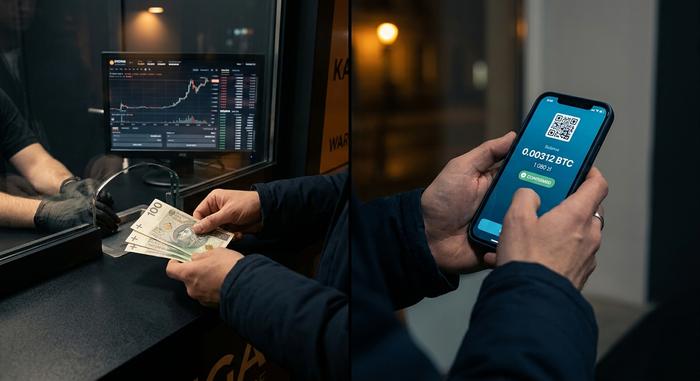
The two big Polish exchanges are Zonda (the old BitBay, rebranded in 2021) and Kanga Exchange. Both let you move PLN on and off. Zonda lists 59 coins across 102 trading pairs. On 16 April 2026 it admitted that a cold wallet holding 4,503 BTC — about $334 million — has been inaccessible since the founder vanished. If you needed another reason to stop parking coins on any exchange, there it is. Kanga took a different route. It runs 250+ physical exchange pointsacross Poland, Czechia, and the Baltics. You walk in, hand over cash zloty, walk out with BTC or ETH on your phone. It feels like a Western Union for crypto, without the bank.
For merchants, the checkout story is where a gateway like Plisio fits. A Polish shop plugs Plisio into WooCommerce, Magento, PrestaShop, or WHMCS, and starts accepting BTC, LTC, ETH, USDT, and 30+ other coins. You can settle in crypto or auto-convert to EUR/USD. The zloty side comes later: off-ramp via Zonda or Kanga whenever you want, or keep a stablecoin cushion as a hedge. The practical wins are boring but real. No 1.5–3% card-network fee. No chargebacks. Payments clear in minutes, not days. And for a Polish store selling abroad, you skip most of the PLN/EUR conversion mess.
Where does that leave the Polish currency story in 2026? In a good spot. The złoty is stable. NBP is cutting rates but gradually. BLIK and crypto wallets keep adding ways to move money in and out. It is a small currency by global standards, yet it does most of what people actually ask a currency to do.