Proof of work vs proof of stake: what is the difference and which is better?

Ethereum used to consume more electricity than the Netherlands. Then on September 15, 2022, they flipped a switch. Proof of work off. Proof of stake on. Energy consumption dropped 99.95%. Overnight. While the chain was running live. With $50 billion in DeFi sitting on it.
I remember watching the Merge countdown. Everyone expected something to break. Nothing broke. And suddenly the whole proof of work vs proof of stake argument was not academic anymore. We had data. Bitcoin burns the energy of a country. Ethereum runs on the energy of a neighborhood. Both secure hundreds of billions. Both work. They just burn different things to do it.
If you are new to crypto and keep hearing these terms thrown around, this is the piece that explains what they mean, why people fight about them, what actually changed after Ethereum switched, and why the answer to "which is better" is more complicated than either side admits.
What is proof of work?
PoW came first. Bitcoin, 2009. The core idea is stupid simple: make it cost real money to write to the ledger, so lying is more expensive than telling the truth.
In practice, thousands of miners run specialized machines that guess numbers. Over and over. Trillions of guesses per second. When a miner finds the right number, they win the right to add the next block and pocket the reward. Right now that is 3.125 BTC per block after the April 2024 halving.
The "work" is electricity. Real, physical watts burned to run hardware. More machines, more guesses, better odds. That is why Bitcoin mining looks like it does: warehouses in Texas and Paraguay packed floor to ceiling with ASICs that do nothing except hash numbers 24/7.
Security works because the math is brutal. Want to rewrite Bitcoin's history? You need 51% of global hashrate. That is over 800 exahashes per second as of 2025. The hardware alone would cost billions. The electricity to run it, billions more. Nobody has done it in 17 years. Nobody can afford to.
Bitcoin, Litecoin, Dogecoin, Monero, Zcash, Bitcoin Cash, Kadena. All PoW.
What is proof of stake?
PoS turned the whole thing upside down. Instead of proving you burned electricity, you prove you put money on the line.
Ethereum is the test case everyone watches. Lock up 32 ETH, about $56,000 at current prices. Run a node. The protocol randomly taps you to propose a block. Do it right and you get paid. Screw around, try to slip in a fake transaction, go offline when you are supposed to be working? Slashed. The protocol rips ETH right out of your stake. Not a fine. A confiscation.
Want to attack this system? You need 33% of staked ETH to cause chaos. 66% to take full control. We are talking about $20 to $40 billion worth of ETH. The act of buying that much would destroy the price before you finished acquiring it. This is a system where the attack itself makes the attack worthless. Weird but effective.
The hardware side is almost comical next to PoW. A validator runs on a mid-range laptop. My neighbor could run one from his spare bedroom. Nobody needs a warehouse or an industrial power supply. That is the whole reason PoS barely registers on the energy meter.
Ethereum, Cardano, Solana, Polkadot, Avalanche, Cosmos, Tezos, Algorand, Sui. All chose PoS.
The real numbers: PoW vs PoS compared
| Metric | Proof of work (Bitcoin) | Proof of stake (Ethereum) |
|---|---|---|
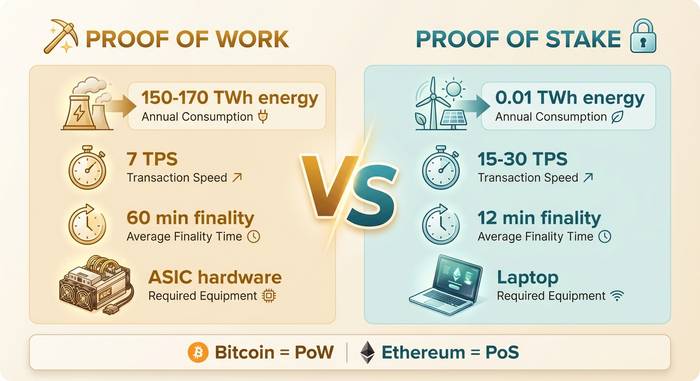
| Annual energy consumption | ~150-170 TWh | ~0.01 TWh |
| Energy comparison | Comparable to Argentina or Norway | Comparable to a few thousand homes |
| Carbon footprint (annual) | ~85-90 million tons CO2 | Negligible |
| Transaction speed | ~7 TPS | ~15-30 TPS (100,000+ with L2s) |
| Finality | ~60 minutes (6 confirmations) | ~12 minutes |
| Hardware required | ASIC miners ($2,000-$10,000+ each) | Regular computer + 32 ETH |
| Attack cost (51%) | Billions in hardware + electricity | Tens of billions in ETH |
| Annual security budget | ~$10-15B (block rewards + fees) | ~$2-3B (staking rewards) |
| Validators/miners | ~1M ASIC machines globally | ~1M+ validators |
| Market cap of top chains | ~$1.3T (Bitcoin) | ~$250B (Ethereum) |
The Merge: what actually changed when Ethereum switched
I was watching the countdown on September 15, 2022. So was half of crypto Twitter. Everyone bracing for a crash, a fork, something catastrophic. The beacon chain took over from the miners and... nothing dramatic happened. Blocks kept coming. Transactions kept processing. The most dangerous upgrade in blockchain history played out like a software update on your phone.
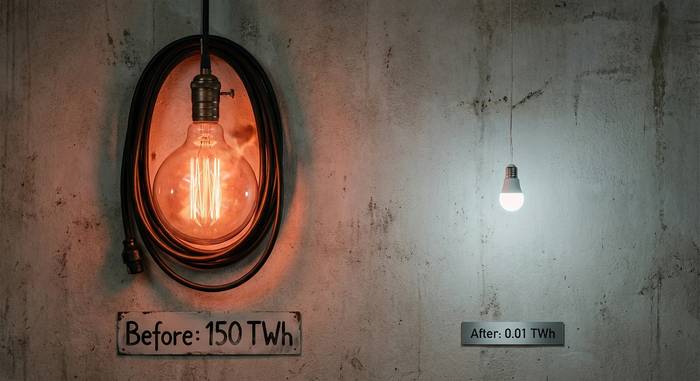
The energy drop was instant and massive. 99.95%. Cambridge confirmed it. The number is not contested by anyone. Ethereum went from Netherlands-level energy consumption to apartment-building-level. If that does not blow your mind, I do not know what would.
Issuance collapsed too. Miners were minting 13,000 ETH daily. Validators get around 1,700. And here is the wild part: EIP-1559 burns a chunk of every fee. During busy periods, more ETH gets burned than created. The network briefly went deflationary. That was literally impossible under PoW.
Mainnet speed? Same 15-30 TPS. The Merge was never about speed. L2 rollups handle that now: Arbitrum, Base, Optimism. Together they push past 100,000 TPS using Ethereum for security.
The staking economy blew up beyond what anyone predicted. 34 million ETH locked. $60 billion. A million validators. Lido holds 28% of the stake, which makes decentralization purists nervous, and they are probably right to be. But one million validators is one million validators. That is a lot of independent actors agreeing on every block.
The environmental debate: energy vs security
Here is where conversations at crypto dinners turn into arguments.
Bitcoin burns 150-170 TWh a year. Argentina uses about that much. The carbon? 85-90 million tons of CO2. Every year. Put that number in front of an ESG fund manager and watch them physically recoil.
Miners have answers. The Bitcoin Mining Council claims 60% sustainable energy. Cambridge measured 37-40%. The gap depends on how you count nuclear, whether you include stranded gas flaring projects, and whether "sustainable" means the same thing to a miner in Texas as it does to a researcher in Cambridge. Real debate, real uncertainty.
PoS people have one killer stat: Ethereum secures $250 billion using the electricity of your neighborhood. Why would you use the electricity of Argentina to do the same job?
Bitcoiners fire back: it is not the same job. Mining is permissionless. Grab a machine. Plug it in. Mine. Nobody gatekeeps you. PoS requires you to already own the token. Got 32 ETH? Great. Do not have $56,000 lying around? Then you are delegating to someone who does, and they earn the yield, not you.
I keep going back and forth on this one myself. PoW is open to anyone with a power outlet. PoS is efficient but concentrates rewards among people who already have money. Both models work. Both have a shadow side. Anyone telling you one is objectively "better" is either selling something or has not thought about it long enough.
| Factor | PoW advantage | PoS advantage |
|---|---|---|
| Energy efficiency | -- | 99.95% less energy |
| Permissionless entry | Anyone can mine | Need to own tokens first |
| Centralization risk | Mining pools dominate | Liquid staking protocols dominate |
| Hardware requirements | Expensive, specialized | Consumer-grade computer |
| Security model | Physical (electricity) | Financial (stake at risk) |
| Environmental impact | 85-90M tons CO2/year (BTC) | Negligible |
| Economic incentive | Sell-pressure from miners | Validators can hold |
Is proof of work still relevant?
I remember the hot takes in 2022. "PoW is finished." "Bitcoin will have to switch eventually." None of that happened. Bitcoin developers have zero interest in PoS. The community would fork before accepting it. Litecoin, Dogecoin, Monero: all staying put.
Miners speak with money. They bought billions in new ASICs through 2024-2025, right after the halving slashed their block reward from 6.25 to 3.125 BTC. If they thought PoW was dying, they would not be betting their businesses on it. Hashrate kept climbing to new records.
What killed the debate was not one side winning. It was both sides going home. Bitcoin does sound money. PoW works for that. Ethereum does programmable finance. PoS works for that. They stopped fighting and started ignoring each other. That is probably the healthiest outcome anyone could have hoped for.