Mewing Meaning: The Tongue Trend Reshaping TikTok Jawlines
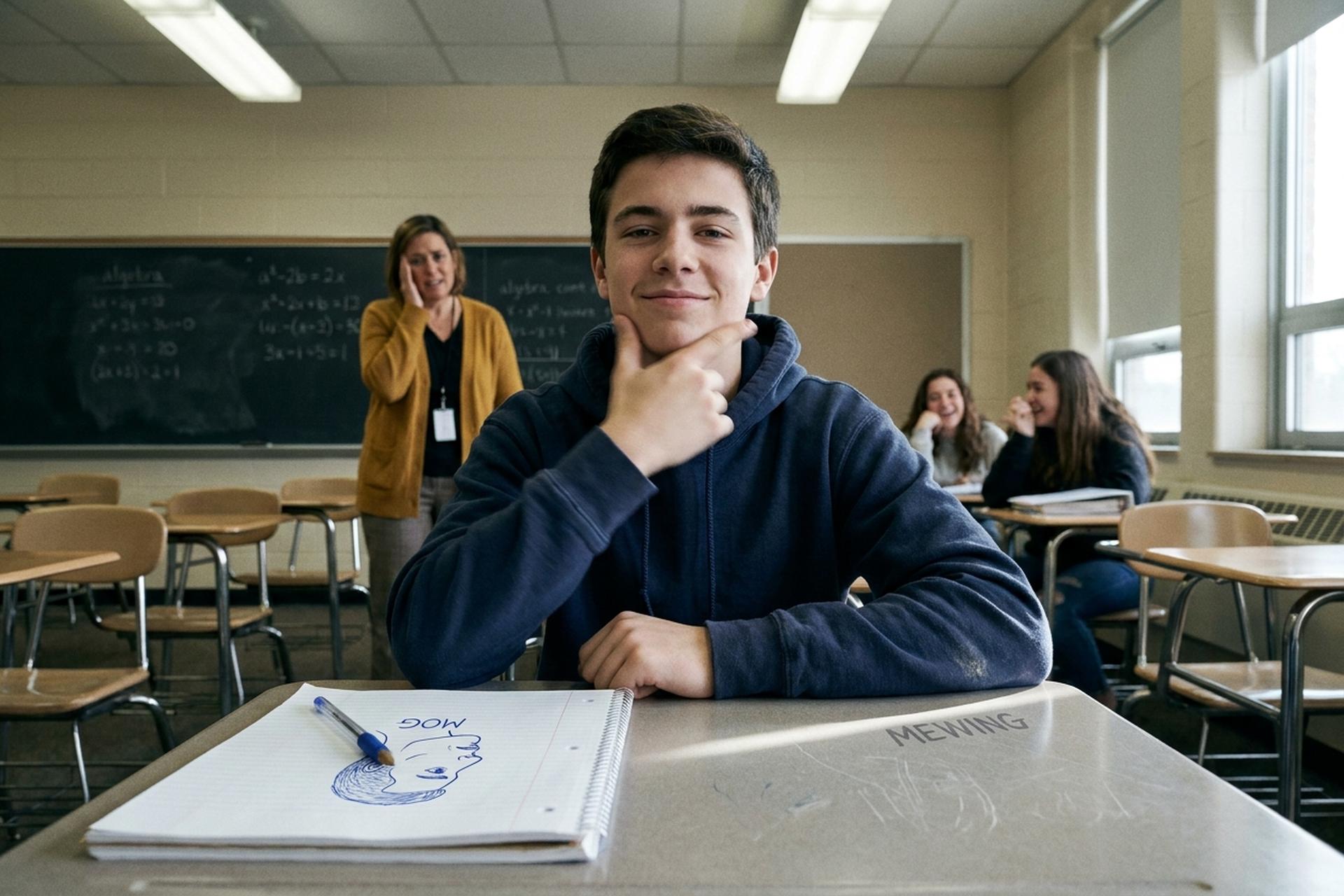
A fourteen-year-old in a US high school classroom is asked a question. Instead of answering, he raises an index finger to his lips, traces the line of his jaw with the same finger, and stares back at the teacher in silence. The whole gesture takes two seconds. The translation, according to every other student in the room, is "Can't talk, mewing." Search the same word on TikTok and you get tutorials, before-and-after montages, the "looksmaxxing" community, and millions of views on tongue-posture diagrams. Search it again on the website of the American Association of Orthodontists, and you get a polite but firm warning that none of this is supported by science. All three meanings travel under one label, and this guide separates them.
Mewing meaning: where the term came from
Mewing takes its name from Dr. Mike Mew, a British orthodontist, but the underlying theory is older than him. His father, John Mew, built a school of practice called orthotropics in the 1970s. Orthotropics argues that environmental factors, especially habitual tongue posture and mouth-closure during childhood, shape the bones of the upper jaw and face. Conventional orthodontics treats the result of malocclusion. Orthotropics tries to prevent it.
The General Dental Council of the United Kingdom struck John Mew off its register in 2017, citing false advertising and breaching patient confidentiality. He had been formally reprimanded once before, in 2010, for misleading marketing claims. He died on 25 June 2025 at age 96. His son Mike continued the practice and produced YouTube videos on tongue posture that spread the technique into looksmaxxing forums on Reddit and 4chan around 2018-2019. On 12 November 2024 the GDC struck Mike Mew off as well. The ruling cited his orthotropic treatment as "not sufficiently supported by scientific evidence and liable to cause harm" and referenced a 2017 video in which he claimed that tongue space causes "expansion of the brain." Some of his patients had reported seizure-like episodes. The colloquial verb "to mew" had already entered general internet vocabulary by then. By 2023 the same word was on every Gen Z For You Page.
How to do mewing: technique, position, soft vs hard
Three elements define proper mewing posture. Most people get one of the three wrong, which is why so many "I tried mewing for thirty days" videos show no measurable change.
1. Whole tongue against the palate. Not the tip. The entire dorsum of the tongue presses flat against the roof of the mouth, including the rear two-thirds. Healthline emphasizes this point: the back of the tongue must reach the soft palate, not just the front behind the teeth. Practitioners who maintain the position even while they swallow report it eventually becomes automatic.
2. Lips closed, teeth lightly together. Lips sealed without strain. Teeth in light contact, not clenched. Clenching introduces a separate problem called bruxism that is bad for oral health. Light contact is the resting position the technique trains.
3. Nasal breathing. Once the tongue is on the palate and the mouth is closed, breathing has to happen through the nose. Mouth-breathers cannot mew without first fixing the airway problem that forces them to breathe through the mouth.
A common debate inside the practice splits "soft mewing" from "hard mewing." Soft mewing is passive. You train the resting posture and let it become automatic over months. Hard mewing actively presses the tongue against the palate with force in shorter sessions. Most orthodontists who address the topic at all warn that hard mewing is the version most likely to cause real problems with bone structure, dental alignment, and the soft tissue between them.
| Common mewing mistakes | What it looks like | What it causes |
|---|---|---|
| Only the tongue tip up | Tip touches palate, body sags | Front teeth pushed forward, no posterior pressure |
| Clenched teeth | Jaw muscles permanently flexed | TMJ pain, bruxism, headaches |
| Mouth-breathing during practice | Lips open intermittently | Defeats the entire posture; trains nothing |
| Hard mewing for hours | Active forcing, sore tongue base | Muscle strain, possible tooth movement |
Does mewing work? Mewing claims vs orthodontist evidence
This is the section that ends most debates. Three independent medical sources reviewing the topic in 2024-2025 reach the same conclusion.
Medical News Today writes flatly that "there is currently no scientific evidence to prove that mewing is an effective technique for reshaping the face." The publication points out that all supporting evidence comes from social media and that before-and-after photo comparisons are typically misleading because the people posting them are adolescents going through normal puberty-driven facial development.
Healthline notes that one small clinical study of 33 participants found no change in muscle activity from tongue repositioning, and that any genuine results would take years, comparable to standard orthodontic treatment timelines. The publication's takeaway: not inherently dangerous, but a substitute for real care.
The American Association of Orthodontists publishes the most pointed institutional statement. On aaoinfo.org, its public-facing site, the AAO writes: "The AAO does not recommend any attempts to move teeth or align jaws without appropriate supervision." On 23 January 2024 the association escalated to a formal press release, with then-AAO president Myron Guymon, DDS, warning the public against the trend by name. The phrase covers DIY orthodontics generally. Mewing is the most-searched example of the category in 2026.
A peer-reviewed paper published in 2019 in the Journal of Oral and Maxillofacial Surgery reached a similar conclusion, stating that mewing "is not based on sound scientific evidence." No Cochrane review on the topic has been published, and no major orthodontic journal has reversed that 2019 verdict in the years since.
There is one narrow medical sub-thread worth separating. Myofunctional therapy is a legitimate clinical practice involving tongue posture and oral muscle training, prescribed for conditions including sleep apnea, tongue thrust, and post-surgical recovery. It is delivered by certified myofunctional therapists, individualized, and supported by peer-reviewed evidence in those specific clinical contexts. The mewing help that spreads on TikTok is not myofunctional therapy. The two are sometimes confused on social media; orthodontists and dentists are clear that they are different things, and mewing claims of curing anything beyond posture-related habits are not what credentialed therapists claim.
| Mewing claim | What science actually says |
|---|---|
| Reshapes adult jawline | No peer-reviewed evidence; bone growth largely completed after puberty |
| Cures sleep apnea | Sleep apnea requires CPAP, oral appliance therapy, or surgery — no clinical support for mewing |
| Fixes misaligned teeth | DIY pressure can worsen alignment; real cases need braces or orthognathic surgery |
| Defines facial structure | Soft tissue and lighting account for most "results" in before/after photos |
| Helps with breathing | Nasal breathing helps; tongue-against-palate alone does not treat airway obstruction |
Risks of mewing: misaligned teeth and other DIY damage
Mewing is rarely dangerous in the dramatic sense. The risks are subtle and accumulate over months.
The most documented harm is tooth misalignment from uneven pressure. The AAO's own writing flags it: pressing the tongue forward or asymmetrically against the front teeth can push them out of position, creating gaps or worsening pre-existing crowding. Hard mewing makes this worse.
Second comes TMJ and bite issues. Practitioners who add force or clench their teeth alongside the posture report jaw soreness, clicking, and headaches that resemble standard temporomandibular joint dysfunction. Speech impediments have also been reported, though they are less common.
The third risk is the most consequential and the least obvious. People who actually need orthodontic care delay it. A teenager with a serious malocclusion who tries mewing for a year instead of seeing an orthodontist loses a year of corrective opportunity and may end up needing more invasive treatment than they would have otherwise. Orthotropic treatment, the supervised clinical version, can run $10,000 or more. Corrective orthognathic surgery costs even more. The cost of delayed treatment compounds.
None of these risks make mewing reckless. They make it a poor substitute for a fifteen-minute consultation with a real orthodontist when something is actually wrong.
Mewing on TikTok: looksmaxxing and the cultural explosion
The reason this article exists is the same reason almost every modern beauty practice gets analyzed at length: TikTok. The hashtag #mewing reached roughly two billion views by late 2024 before TikTok removed its public hashtag counters in 2025. The trend exploded late 2023 into early 2024. Most of the videos are aspirational. A subset are tutorial. A smaller subset are debunkings by orthodontists trying to keep up with the algorithm.
The cultural infrastructure underneath is looksmaxxing: the practice, mostly among young men, of optimizing one's appearance through a stack of techniques ranging from skincare and gym to dental work and surgery. Mewing sits at the entry level of looksmaxxing because it is free, requires no equipment, and produces a sense of agency. Whether it produces results is a separate question.
Adjacent vocabulary travels with it. Mogging describes one face visibly outclassing another in a side-by-side. Canthal tilt describes the angle of the eye corners. Hunter eyes describes a specific ideal. Maxxing functions as a verb suffix attached to almost any feature. The whole vocabulary moved from niche forums into mainstream Gen Z slang faster than any orthodontist could keep up. The fact that most teenagers using the term "mewing" do not know about Mike Mew, his father, or the General Dental Council ruling is part of the trend's character. The word arrived in the culture without its baggage.
TIME ran a feature in May 2026 framing looksmaxxing as a young-male mental-health story as much as a beauty story. The reporting noted that mewing remains the most common entry point because it requires no money, no equipment, and no public commitment. A teenager can mew silently in class, alone in a bedroom, or on the way to school, and tell himself he is doing something about how he looks. Whether the technique works or not is, for that audience, almost beside the point. The act itself is the appeal.
Mewing in Gen Alpha slang: the silent gesture
There is a second meaning, and in classrooms it is now the dominant one.
A student who does not want to answer raises an index finger to his lips, then traces the line of his jaw with the same finger. The two-step gesture functions as a shush. Translated: I am holding my tongue against the roof of my mouth, so I cannot speak. It is half a joke and half a refusal. Teachers across US middle schools and high schools have reported the gesture spreading rapidly through 2024 and into 2025. Some find it disrespectful. Some have started using it back at students who interrupt.
The slang sense bypasses every medical question. There is no claim that the technique works, no reference to orthotropics, no looksmaxxing argument. It is a piece of behavior that became a meme that became a verb. The same word now means three things at once depending on who is using it.
Real alternatives: orthodontist, myofunctional therapy, surgery
For adults whose facial structure is a real concern, evidence-based options exist on the cosmetic and clinical sides. Orthognathic surgery is the most invasive and the most effective for skeletal issues; recovery runs weeks but the changes are permanent. Braces and clear aligners address tooth and bite misalignment. Botox masseter reduction reshapes a square jaw within a month and lasts three to six months per cycle. Dermal fillers can sharpen the chin or jaw angle for six to eighteen months per treatment. Myofunctional therapy, properly delivered, addresses the specific tongue and oral-muscle problems mewing claims to fix, including swallowing dysfunction and tongue thrust. For looksmaxxing-style cosmetic outcomes without medical risk, dermatologic treatments and a good gym routine deliver more visible change in less time than any tongue posture, and they have the published research to back them up.
The common thread: every option above has a clinical literature behind it and a licensed professional to consult. Mewing has neither.
Mewing meaning, finally: bone structure or beauty hack
One word, three meanings. The original is an orthotropic technique invented in the United Kingdom in the 1970s and named after the Mew family. The second is a looksmaxxing tool widely adopted by Gen Z men on TikTok. The third is a Gen Alpha classroom gesture that signals refusal to speak. Knowing which one applies depends entirely on the room you are in.