ISTG Meaning in Text: Gen Z Slang and Teen Texting Guide
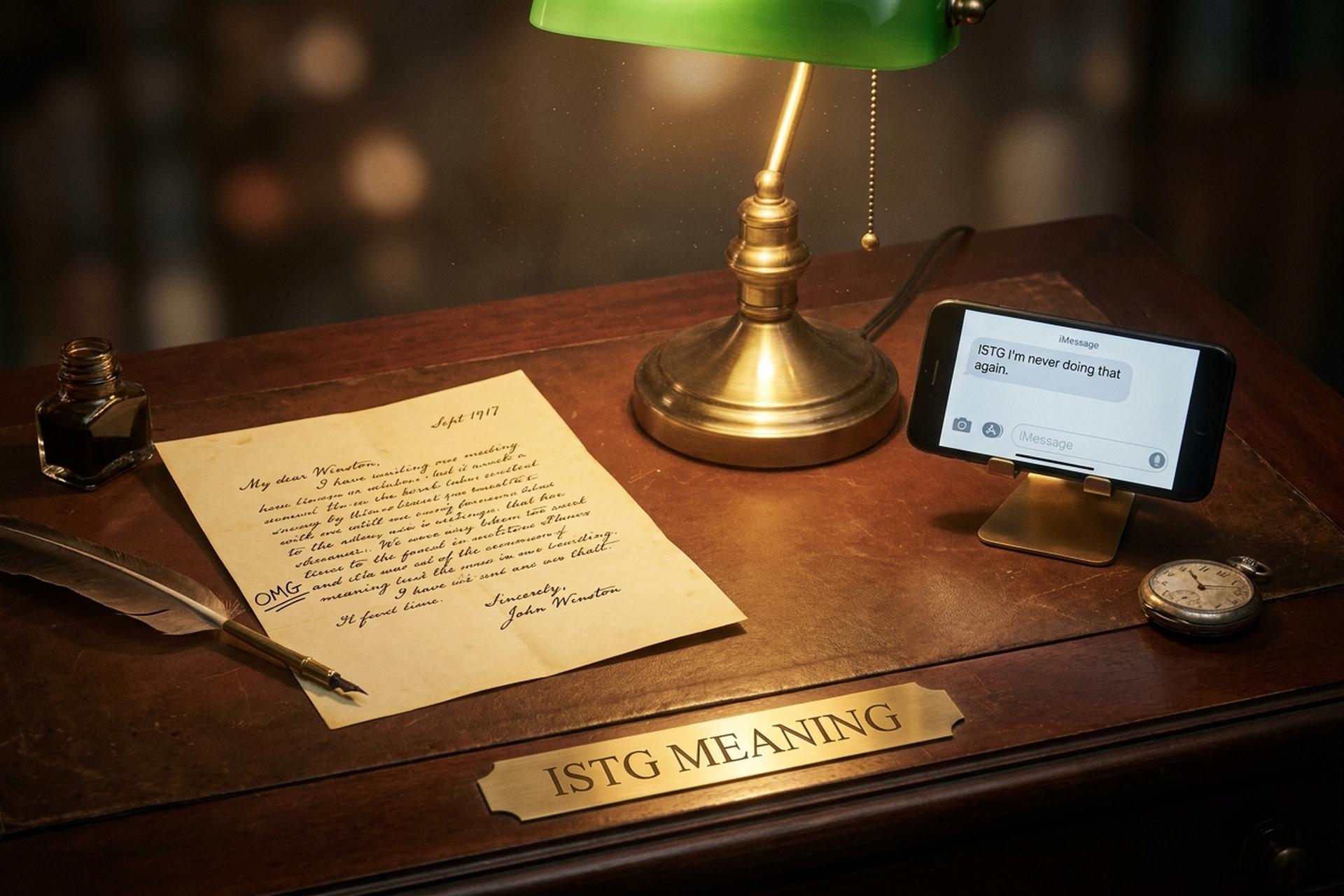
A friend texts "ISTG I'm never doing that again." You do not need to call a theologian. ISTG is short for "I swear to God." It is one of the most common emphasis acronyms in Gen Z chat, TikTok comments, and group-chat venting. The phrase has been around in texting for nearly two decades. Its current usage just looks different from the AIM version your older sibling typed in 2004.
This guide covers the ISTG meaning in plain English. Then it traces the acronym back to the early 2000s, walks through how Gen Z actually uses it today, and maps the family of related slang it lives inside. Parent trying to decode a teen text thread? Scroll below. Just curious about the letters you keep seeing? Same answer.
What ISTG means and why it stuck in texting
ISTG stands for "I swear to God." The term is used as short emphasis, the texting equivalent of a dramatic pause or a serious little promise. "ISTG he said that word for word" reads as sincere. "ISTG if the bus is late again" reads as furious. Same acronym, different jobs. Context handles the tone.
Dictionary.com's informal entry calls it an acronym for "I swear to God," used to convey "extreme seriousness, exasperation, or surprise." That public definition went up on April 27, 2018. A rough marker for when mainstream dictionaries noticed the usage. Urban Dictionary got there earlier. The first visible entry is from January 2008 and reads simply: "I swear to God. Promising."
Why did it stick? Mostly mechanics. Four letters beat five words. Digital texting rewards compression. Phrases that carry strong emotions and show up often, like "I swear to God," "for real," "shaking my head," collapse into casual acronyms and stay there. ISTG is one of the winners. Intensity varies with context, job stays the same: express a feeling you want the reader to take seriously. Sincerity. Surprise. Irritation. Pick one, type ISTG.

Where the ISTG acronym comes from: AIM to TikTok
The spoken phrase is old. "I swear to God" was a colloquial English line long before anyone shortened it. The closest ancestor acronym is OMG. NPR traced the first written use to a September 9, 1917 letter from retired British Admiral John Arbuthnot Fisher to Winston Churchill. Really. An admiral, mid-war, typing OMG into a letter. After that, OMG sat dormant most of the twentieth century. Then the mid-1990s internet wave pulled it back.
ISTG came later. Early 2000s. AIM, Yahoo Messenger, and early SMS shaped a whole wave of abbreviations. ISTG, LOL, BRB, AFK, and OMG all rode the same character-saving wave. First visible Urban Dictionary entry for ISTG: January 3, 2008. Some outlets cite 2007. Earlier entries may simply have been removed by moderators. After that, usage stayed steady through the Facebook status era, grew on Snapchat and WhatsApp in the late 2010s, and became standard Gen Z vocabulary on TikTok around 2020 to 2021.
Today it lives across Instagram captions, X replies, Discord servers, and Twitch chats. The scale is easy to miss. Pew Research's 2024 study on teens and technology found 95% of US teens own a smartphone and 46% say they are online "almost constantly," up from 24% a decade earlier. Pew's April 2026 update puts roughly 60% of teens on TikTok and 24% of all US adults on the platform daily. Every one of those users scrolls past multiple ISTGs a day without even noticing.
Quick cultural note. "I swear to God" is religious in origin. Almost nobody reads ISTG as literally religious now. It is an emphasis marker, the way "literally" drifted into an intensifier rather than a claim about literalness. Religious users, secular users, atheists, Muslims, Christians, Jews, everybody types it.
How ISTG is used in modern text messages
The acronym does four jobs in a modern text message. Each job comes with a slightly different tone. Typically, context tells you which version you are reading. Here is the usual breakdown to help you recognize the difference.
| Job | Tone | Example message |
|---|---|---|
| Sincerity | Serious | "ISTG I'm not lying, he really did that" |
| Frustration | Exasperated | "ISTG if my boss emails me at 11pm one more time" |
| Surprise | Wide-eyed | "ISTG I just saw a fox on the subway platform" |
| Agreement | Emphatic | "ISTG same, that movie was awful" |
Sincerity ISTG shows up when someone is trying to convince a skeptical friend the story is true. The acronym lets the speaker express honesty in a commonly used sincerity register. Frustration ISTG is basically a sigh compressed into letters, usually followed by a complaint. Surprise ISTG vouches for an unbelievable-sounding fact. Agreement ISTG doubles up the agreement, adding a sincerity layer on top of "same" or "fr."
In all four cases, ISTG can appear at the start, middle, or end of a sentence. Most Gen Z users place it at the start. Uppercase (ISTG) carries more intensity. Lowercase (istg) feels casual. The phrasing is interchangeable with "I swear" and "fr fr" ("for real, for real") depending on vibe.
The difference between ISTG and ISTFG
ISTG has a louder sibling. ISTFG stands for "I swear to [expletive] God," with the F standing for a common profanity. The difference is intensity. ISTG is common in everyday chat, including between people who would not normally curse. ISTFG shows up in vented group chats, closer friendships, and contexts where stronger emphasis feels warranted.
You will also see variations like IFSTG ("I f-ing swear to God"), ISTGFR, and ISTG bruh, mixing the acronym into longer exasperated phrases. None of these carry dictionary weight, and they appear mostly as one-off casual intensifiers. ISTG remains the standard.
Examples of ISTG in social media comments
The acronym shows up most often in short comments under posts, replies to tweets or X posts, and group chat venting. A few standard patterns you will see scrolling any Gen Z feed.
- Under a surprising video: "ISTG this is the funniest thing I've seen all week."
- Under a relatable post: "ISTG same, my manager literally does this every Monday."
- In a DM: "ISTG I'm going to lose it if she texts one more excuse."
- In a group chat: "ISTG we need to cancel the trip, I can't deal."
- Over a screenshot: "ISTG on god he said that out loud in the meeting."
The "on god" coda is a common doubling pattern. It layers one emphasis on top of another for extra conviction. Similar doubling happens with "fr fr," "no lie ISTG," and "ISTG istg I promise." None of these are grammatically tidy. None of them are supposed to be.
Related slang: FR, SMH, NGL, TBH, and OMG
ISTG belongs to a family of emphasis acronyms that Gen Z uses interchangeably. The table below maps the most common ones against their meaning and how they compare to ISTG.
| Acronym | Meaning | Tone vs ISTG |
|---|---|---|
| FR | For real | Slightly softer; asks for agreement more than swears by it |
| FRFR | For real, for real | Doubled for emphasis; stronger than FR |
| SMH | Shaking my head | Adds disappointment; complements ISTG in frustrated messages |
| NGL | Not gonna lie | Sincerity-focused like ISTG but softer, often self-effacing |
| TBH | To be honest | Opens an honest opinion; less emphatic than ISTG |
| IYKYK | If you know, you know | Signals in-group knowledge; not an emphasis marker |
| OMG | Oh my God | Shock or surprise; ISTG is a promise, OMG is a reaction |
| WYD | What you doing | Conversational opener; not emphasis |
| PMO | Piss me off | Frustration; often paired with ISTG ("ISTG this PMO") |
| TBF | To be fair | Softens an opinion; opposite function to ISTG |
In practice, Gen Z speakers layer these. A single paragraph-long text might read, "NGL ISTG TBH this is the worst Monday I've had." That is not considered excessive. It is how the ecosystem works. Each acronym carries a slightly different emotional nuance, and stacking them dials the speaker's feelings up or down.
Is ISTG a bad word? Context and etiquette
ISTG is not a curse word. It is emphasis that happens to invoke God. A secular user reads no religious weight into it. A religious user might read a lot.
Some Christian, Jewish, and Muslim traditions teach care around casual use of God's name. Matthew 5:34-37 tells believers to avoid oaths entirely and let their yes be yes, their no be no. A handful of conservative Christian outlets extend that argument to OMG, and by implication ISTG. Other religious writers split the two categories. A solemn oath is one thing. A reflexive texting exclamation is another. In that reading, ISTG is closer to a verbal tic than a real oath. Still, if you text somebody from a stricter religious background, the acronym can land wrong even when you meant nothing by it.
The practical etiquette is simple. In casual chat with friends, ISTG is fine. In a work Slack, a formal email, or any message where you are not sure of the recipient's background, swap in "I swear" or "honestly." OMG sits in the same spot.
Age matters too. ISTG from a 30-year-old colleague in a work chat reads differently from ISTG from a 16-year-old on TikTok. The second is native. The first often feels borrowed. Normal slang cringe tax. Every internet acronym past its peak hits this moment.

Should parents worry about teen ISTG usage
Short answer: no. ISTG is an emphasis marker. Not distress. Not danger. Not inappropriate content. A kid texting "ISTG I'm going to lose my mind over this homework" is sighing and rolling their eyes in acronym form. Venting, not a warning sign.
The better parental move is to see ISTG as one of dozens in a vocabulary that shifts every year. Other acronyms in the cluster worth knowing: PMO (piss me off), FRFR (for real, for real), and NGL (not gonna lie). A teen who pairs ISTG with PMO in the same message is expressing frustration about something specific. The acronyms tell you the tone. They do not tell you the topic. Ask what happened. That beats decoding word by word.
Parental-control guides flag ISTG as harmless. They place it outside the priority list of slang worth a real conversation. The acronyms that actually matter involve substances, sex, or self-harm. ISTG is not on those lists. Want to share some input when you see a message? Reply with a mild version like "I hear you." That opens a door. Treating every comment as a problem closes it. Most generational gaps over slang close faster with curiosity than with rules. Easy to forget when you are reading text messages at 11 pm.
ISTG meaning in Gen Z texting and TikTok 2026
By April 2026, ISTG is in the long tail of Gen Z vocabulary. Still understood, still appears on TikTok daily, but no longer novel enough to trend on its own. It sits in the background of everyday digital speech. The kind of acronym most users barely notice typing or reading.
Gretchen McCulloch, internet linguist and author of Because Internet, calls this "semantic bleaching." Her favorite example is LOL. Nobody is laughing out loud anymore when they type it. LOL now signals irony or friendliness. Same drift hits ISTG. Most users are not invoking God. They are marking intensity. Adam Aleksic, a Harvard-trained linguist whose 2025 book Algospeak maps algorithm-driven slang, adds that short acronyms survive longer when they are "SEO-safe and algorithm-friendly." ISTG passes both tests. The word survives by becoming ordinary.
TikTok and Instagram Reels lean hard on reaction captions. "ISTG my coworker said this with a straight face." The acronym does the emotional claim: I am not exaggerating. The video delivers the evidence. That rhythm is now core grammar for short-form video. Volume helps too. Adults aged 18 to 24 send and receive roughly 128 texts a day, per 99Firms' 2025 texting statistics, and 90% of Gen Z check new messages within five minutes. ISTG rides that channel.
Why a crypto blog writes about ISTG meaning
Plisio is a crypto payments blog, which is a strange home for a texting-slang explainer at first glance. The overlap is real, and it is mostly about audience.
Crypto's active user base skews young. Coinbase's State of Crypto report for the fourth quarter of 2025 found that roughly 45% of younger US investors own crypto, versus 18% of older investors. Gemini's 2025 survey pegged Gen Z ownership above 50%. Under-35 holders told Coinbase that crypto gave their generation more financial opportunity than anything else. That demographic is the same demographic that texts ISTG daily.
Crypto culture also lives on X and Discord, which is exactly where ISTG thrives. On-chain reactions to a memecoin pump frequently start "ISTG this is the last time I buy the top." A 2024 Nature Scientific Reports study on cryptocurrency discourse on X quantified emotional and swear-word density across nine major coin communities and found both were a measurable feature. ISTG fits that register. The acronym is built for the emotional swings of crypto trading, sitting next to crypto-native acronyms like LFG (Let's F*ing Go), WAGMI (We're All Gonna Make It), NGMI (Not Gonna Make It), and FOMO.
No flagship ISTG memecoin exists. The acronym never spawned a token the way "rizz" or "chillguy" did. Pump.fun has minted more than 11.9 million tokens since January 2024 per Decrypt, so short acronyms do get used as tickers, but ISTG specifically has not produced a notable project to date. It is just a piece of vocabulary. For a non-Gen Z reader, the takeaway is simple. ISTG is not going anywhere in April 2026. Understanding the ISTG meaning helps you read Gen Z chat correctly, whether you are the parent, the colleague, or the marketer on the other side of the screen.