Tools to Identify DeFi Scam Tokens: 2026 Crypto Scam Guide

A new token hits a DEX. The chart looks like a green staircase climbing the screen. Telegram lights up. Someone in the group drops a contract address. Fifteen minutes later the liquidity is gone, the chart is a cliff, and whoever sent that address is either long out of the channel or claiming the same surprise as everyone else. This pattern is the engine of on-chain fraud in 2026, and it is exactly what scam-detection tools were built to catch a few clicks earlier.
This is a practical guide for crypto users, traders and merchants who need to identify scam tokens in DeFi before money moves. It walks through the current tool stack (Token Sniffer, GoPlus, Honeypot.is, De.Fi scanner, Bubblemaps, Arkham and a handful of chain-specific scanner tools), explains the red flags and scam patterns each one surfaces, lays out a step-by-step workflow for checking a new token in under five minutes, and looks at recent scam patterns from 2024 to 2026. The goal is not to turn anyone into a smart contract auditor. The goal is to make sure that the next time a suspicious token lands in a wallet, the crypto user has the right tools open before clicking buy, so they can avoid falling victim to the cryptocurrency fraud playbooks that now dominate the crypto space.
The DeFi Scam Token Landscape for Crypto Users in 2026
On-chain scam losses have ballooned. Chainalysis's 2026 Crypto Crime Report pegs 2025 on-chain scam activity between $14 billion and $17 billion, with impersonation scams alone up roughly 1,400% year over year, the average scam payment up 253% to $2,764, and AI-enabled scams running 4.5 times more profitable than traditional ones. TRM Labs puts the broader illicit crypto volume at about $158 billion for 2025, up 145% from $64.5 billion in 2024. Immunefi reported $1.7 billion in crypto hacks and fraud by the end of April 2025, already past the full-year 2024 total of $1.49 billion. Most of that damage funnels through three channels: fake tokens and scam token contracts launched on DEXes, phishing approvals that drain wallets already holding digital assets, and off-platform investment scams that end with the victim sending stolen crypto to a laundering mule.
The DeFi slice of that pie is dominated by rug pulls, honeypots and pump-and-dump coordinated trading on new tokens. DappRadar tallied nearly $6 billion in rug-pull losses through mid-2025 (roughly 92% of that number tied to a single disputed Mantra OM collapse on 13 April 2025). Solidus Labs classified 98.6% of the roughly 7 million tokens launched on Solana's pump.fun launchpad as scams, pump-and-dumps or rug pulls, with only about 97,000 ever holding more than $1,000 in liquidity. A coordinated set of 12 wallet clusters, nicknamed "Rug Republic" by the Solidus team, created around 20% of pump.fun tokens and orchestrated 82% of the liquidity drains, netting an estimated $4.2 million in exit-scam profit.
Honeypot contracts (where a trader can buy but cannot sell) remain the cheapest, fastest scam pattern for bad actors because a single Solidity trick exploiting a contract vulnerability can be copied into a million token contracts. Ponzi schemes dressed up as yield protocols, money-laundering token launches and pig butchering scams that steer victims through fake platforms make up the rest of the picture. Potential scams also arrive as NFT mints, fraudulent airdrops and decentralize-washed DAO fronts that look legitimate on the surface. For context, DeFiLlama currently tracks over $150 billion in DeFi TVL across 503 chains and 6,735 protocols, so the scam volume sits inside a much larger, mostly legitimate ecosystem.
The good news for anyone buying tokens today is that scam detection tools have gotten much better since 2022, and most of the ones worth using are free or freemium. The bad news is that scam patterns evolve faster than the tools, so detection is a running arms race and no single scanner tool catches everything.
Red Flags in a Crypto Scam: Honeypot and Rug Pull Patterns
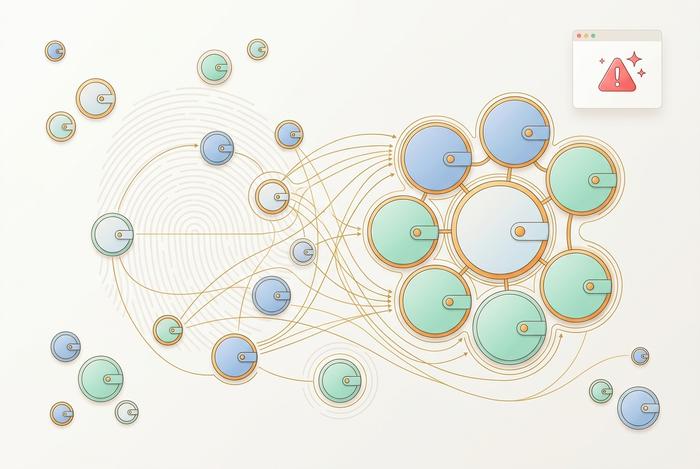
Before any tool runs, it helps to know what the tools are looking for. Almost every DeFi scam token leaves a fingerprint across one or more of these red flags.
| Red flag | What it means | Typical tool coverage |
|---|---|---|
| Honeypot logic | Buying is permitted, selling reverts | Honeypot.is, GoPlus, QuickIntel |
| Unrenounced ownership | Deployer can still mint, blacklist or pause | Token Sniffer, De.Fi scanner |
| Hidden mint function | Owner can print unlimited new supply | Token Sniffer, GoPlus |
| Upgradable proxy contract | Owner can swap the implementation later | GoPlus, SlowMist MistTrack |
| Unverified contract code | Source not published on Etherscan/BscScan | Blockchain explorer direct check |
| Extreme buy/sell tax | Tax >15% drains traders on each swap | GoPlus, DEXTools |
| No locked liquidity | LP tokens not time-locked; deployer can pull | DEXTools, DexScreener, De.Fi |
| Top-heavy token holder chart | Top 10 wallets hold >70% of supply | Bubblemaps, Arkham, Moralis |
| Insider-sniped launch | Deployer wallets buy minutes before public | Bubblemaps, Nansen |
| Anti-whale cooldowns abused | Team can throttle everyone but themselves | Token Sniffer, QuickIntel |
A rug pull happens when the deployer pulls the liquidity pool or mints new tokens and dumps. The classic honeypots trap a user's money at the sell step. A pump and dump trades on hype and predictable Telegram coordination. Pig butchering scams and recovery scams live off-chain but often end on-chain, with stolen funds routed through scam wallets that forensic tools can later label.
The shortcut rule: if more than two of the table's red flags trigger on a token, it is almost certainly a scam. If only one triggers, do a second pass with a different tool before taking any risk.
Blockchain Explorer Checks Every Token Needs
Every scan starts on a blockchain explorer. Etherscan, BscScan, Solscan, Arbiscan and Polygonscan let any user read a token's smart contract and on-chain activity for free. The first three checks are almost always the same.
First, verify that the contract source code is posted. Unverified code is a red flag on its own. Any serious crypto project publishes source to the relevant blockchain explorer so that auditors and the community can read it.
Second, read the top of the contract code for ownership functions. Search for `renounceOwnership`, `owner()`, `mint`, `setTaxFee`, `blacklist`, `pause` and `upgradeTo`. If ownership is not renounced, the deployer still controls the token. If `mint` is present and reachable, the supply is not fixed. If `upgradeTo` exists, the contract is a proxy and the implementation can be swapped later.
Third, open the Holders tab. A healthy token has broad distribution. A red-flag token has two or three wallets holding 40% to 80% of supply, often with none of them labeled as a known exchange or vesting contract. The explorer will also show recent blockchain transactions on the token, which reveals the earliest buyers and any bundled sniping patterns.
Blockchain explorers are the baseline layer for scam detection. They will not tell a user whether a token is a honeypot or whether liquidity is locked, so a dedicated scanner tool is the next step.
Scam Detection Tools Review: Token Sniffer, GoPlus, De.Fi Scanner
These are the headline scam detection tools that most crypto users reach for first in 2026.
Token Sniffer. Free web tool at tokensniffer.com. Produces an automated audit score out of 100 based on a combination of contract code analysis, holder distribution, liquidity health and a bytecode-pattern match against a database of 10,000+ known scam code templates built over five years. As of 2026 Token Sniffer indexes 47.9 million tokens across 15 chains and has flagged 6.08 million of them as scams. Its strength is speed: paste a contract address, get a color-coded risk summary in seconds. Its weakness is false confidence: a high score does not mean safe, it means "no obvious scam pattern detected." Covers Ethereum, BNB Chain, Polygon, Avalanche, Fantom and a handful of other EVM chains.
GoPlus Security. Free token security scanner at gopluslabs.io. GoPlus has built what is arguably the most widely integrated security API in the space; its token security checks are embedded into CoinGecko, OKX Wallet, Trust Wallet and many DEX aggregators. The dashboard flags honeypot logic, hidden mint functions, proxy contracts, blacklist functions, tax levels and holder concentration with binary flags that are easy to scan. Runs on Ethereum, BNB Chain, Polygon, Avalanche, Arbitrum, Base, Optimism and more.
De.Fi Scanner. Part of the De.Fi Shield suite at de.fi/scanner. Scans smart contract code for common vulnerabilities and surfaces a DeFi Score that factors audit history, contract risk, team doxxing and liquidity. De.Fi also publishes the REKT database of historical rug pulls, which is a useful reference on top of the live scanner tool. The paid tier adds deeper contract audit reports, but the free tier is enough for a first check on a new token.
Honeypot.is. Dedicated honeypot detection. Simulates a buy and sell transaction on the target token and reports whether either side reverts, plus the effective tax paid on a round trip. If Honeypot.is returns a red warning, stop. It is narrow but extremely good at what it does.
QuickIntel. A newer combined scanner tool at quickintel.io. Runs honeypot detection, liquidity-lock checks, contract code review and scam-pattern matching in one scan. Good secondary confirmation after Token Sniffer or GoPlus.
DEXTools and DexScreener. Not dedicated detection tools, but both DEX-charting platforms publish on-chain context every trader should scan before buying tokens: current liquidity, whether liquidity is locked, first-mint timestamps, buy/sell tax estimates and volume-to-holder ratios. DEXTools adds a DEXTscore reliability metric. DexScreener exposes paid "Boost" badges, which are often abused by pump-and-dump teams and should not be treated as endorsement.
RugDoc and CertiK. Slower-moving audit-style resources. RugDoc publishes hand-checked DeFi farm reviews, which skew toward BNB Chain. CertiK's Skynet and Security Leaderboard aggregate audit scores and on-chain data across a broader market. A CertiK audit is not a clean bill of health (audited projects have still rugged), but a missing audit on a supposedly serious DeFi project is itself a signal.
Honeypot Detection and Contract Audit Tools
Honeypots deserve their own category because they are the single most common beginner-killer. The pattern: a token's buy function works fine, so a trader swaps in, watches the chart rise, and then discovers the sell function silently reverts. The user's crypto assets are trapped.
Honeypot.is, QuickIntel and GoPlus all specialize in this detection. They work by simulating a small buy and an immediate sell through the actual liquidity pool, watching for revert-on-sell, high sell-side tax, blacklist blocking or any form of non-symmetric behavior between buy and sell. Two additional detection tools worth naming:
DetectHoneypot.com supports multiple chains and adds a lightweight liquidity analysis alongside the honeypot probe. ChainAware runs behavioral scam patterns across wallets and emerging tokens; its heuristics are useful against short-lifespan scam token launches.
For contract audits above basic scam checks, several smart contract auditors publish reports that are worth reading: SlowMist, PeckShield, Trail of Bits, OpenZeppelin and CertiK. None of them guarantees safety, but finding a smart contract auditing report by one of the well-known smart contract security firms (and reading the issue list, not just the cover page) is a meaningful step in contract audit due diligence. Quality smart contract auditing also signals that the team took blockchain security seriously rather than rushing a token to market.
Blockchain Forensics Tools for Spotting Bad Actors
Beyond token-level checks, wallet-level and entity-level tools show whether a token's deployer is linked to known scam wallets or earlier rug pulls. The forensics layer matters for anyone trading seriously.
Bubblemaps. Visual wallet clustering. Drop a contract address and Bubblemaps renders token holders as bubbles connected by funding lines. The Magic Nodes feature auto-clusters related wallets, Time Travel shows historic distribution, and the launch-bundle analyzer quantifies how much of total supply was bundled by coordinated wallets in the first blocks after deployment. If the top 10 bubbles are all sized the same and all trace back to a common funding source, the supposed "organic" distribution is actually one entity. Bubblemaps has cracked numerous meme-coin scam token launches publicly in 2024 and 2025.
Arkham Intelligence. On-chain intel platform at intel.arkm.com with 800 million+ labeled addresses across BTC, Ethereum, Solana and the major L2s. Useful for checking whether a deployer wallet is linked to a publicly identified crypto fraudster or to a previous rug pull. Arkham's public dashboards often surface stolen crypto flows after big hacks.
Nansen. Smart-money labeling and wallet analysis with more than 500 million labeled wallets and roughly 10,000 flagged as "Smart Money." Nansen's strength is identifying which wallets a token holder address is connected to; if a new token's early buyers are a cluster of labeled scam wallets, that is a hard signal. 2026 pricing is free tier plus Pro at $49 per month annual or $69 per month on monthly billing.
MistTrack (SlowMist). Free wallet-check service focused on money laundering and stolen-funds tracing. Useful for a fast lookup on a wallet that just sent tokens to a merchant payment address.
Forensics tools come into their own after a scam, too. Once stolen funds start moving, Arkham, Nansen, Chainalysis and TRM Labs trace flows across blockchain networks, label mixer use, identify off-ramp exchanges and feed data back to law enforcement. These analysis tools are how investigators detect fraudulent crypto flows and trace fraudulent crypto transfers into the laundering layer. For prevention, the same data helps identify suspicious tokens before a purchase, detect scam patterns on new deployments and flag known scam wallets before an approval is signed.
Prevent Scams: Step-by-Step Token Verification Workflow
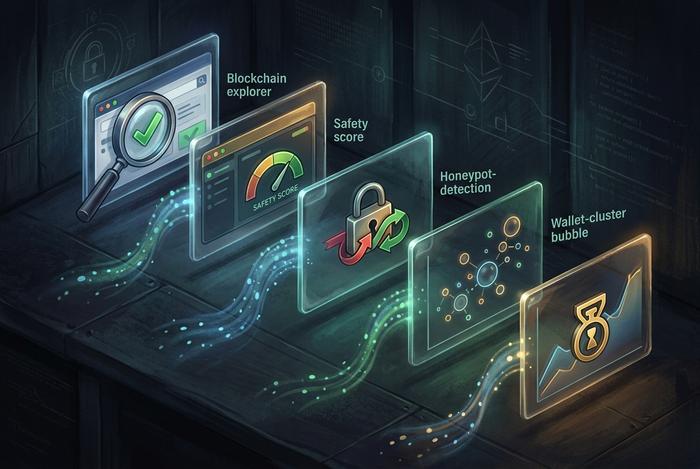
A five-minute verification workflow that works for almost any new token. The order matters because each step eliminates a different class of scam.
1. Confirm the token exists. Search the name on CoinGecko or CoinMarketCap. If it is not listed, and there is no project page, that is a signal the new crypto is extremely young or fake.
2. Open the token contract address on a blockchain explorer. Verify the contract source code is posted. Read the top of the code for mint, blacklist, pause, upgradeTo. Check ownership and holders.
3. Run Token Sniffer. Paste the contract address, scan the automated score. Read the individual flags, not just the number.
4. Run GoPlus Token Security. Check honeypot, mint, proxy, tax and holder concentration flags. GoPlus is the most reliable second opinion.
5. Run Honeypot.is. If the token is on a supported chain, this adds a behavioral simulation layer that contract-reading alone will miss.
6. Open Bubblemaps. Confirm token holder distribution is not a single cluster. If the top 10 are connected through a common funder, step away.
7. Check DexScreener or DEXTools. Confirm liquidity size, whether liquidity is locked (and for how long), the pair's age and recent trade volume.
8. Search for audits. De.Fi scanner for an automated DeFi Score, plus a CertiK, SlowMist or PeckShield audit if the project claims one. Read the findings, not the marketing.
If any of those steps fails hard (Honeypot.is red, unverified source, top three holders clustered), the verdict is no. If all eight pass, the token still could go wrong (audited projects have rugged) but the base rate of disaster drops sharply.
Notable Crypto Scam Case Studies (2024-2026)
Recent cases show how fast these patterns can move and how much money they can burn.
LIBRA (14 February 2025). An Argentine political memecoin briefly hit a peak market cap near $4 billion before crashing more than 90% within hours. Eight insider wallets cashed out approximately $107 million; aggregate investor losses are estimated at around $251 million. Team-linked wallets sold into the pump and Bubblemaps analysis in the hours after launch showed the cluster clearly.
TRUMP and MELANIA (January 2025). Both memecoins launched inside 72 hours of each other. On-chain data showed heavy insider sniping: 24 wallets bought $2.6 million of MELANIA within about two and a half minutes before the public announcement. Aggregate retail losses across both memecoins reached roughly $4.3 billion across around 2 million wallets, with insiders beating retail at a 20:1 ratio.
OM (Mantra) collapse (13 April 2025). The Mantra token lost roughly 90% of its value in a single session after large OM transfers to exchanges and forced liquidations cascaded through the derivatives market, wiping more than $6 billion in market cap in hours. The collapse was not a classic rug, but the on-chain pattern (sudden large transfers to centralized exchanges before a sharp drop) is identical to the one scam detection tools monitor.
JELLY / Hyperliquid (26 March 2025). A single whale manipulated the JELLY meme token on Hyperliquid by opening an oversized position that cascaded into forced liquidations and left roughly $13.5 million at risk in the platform's HLP vault. Hyperliquid intervened and delisted the token at a manually set price. The incident underlined that even on sophisticated perps venues, low-liquidity tokens can be weaponized.
pump.fun ecosystem (2024-2026). Tens of thousands of meme tokens are deployed each day on Solana via pump.fun-style launchers. Most die within hours. Token Sniffer, GoPlus and Honeypot.is together catch the overwhelming majority of deliberate honeypots and rugs on these rails; the leftover risk is market risk, not fraud.
The common thread across all of these cases is that the red flags were visible in the on-chain data before the move. Bubblemaps, Arkham, GoPlus and a blockchain explorer between them would have flagged each one to an informed user before buying tokens.
Merchant Safety: Accepting Bitcoin, Stablecoins and Altcoins
For a crypto-payment audience, the scam-token question flips. Merchants do not usually sell tokens, they accept them. The risks are different.
- Fake stablecoins. Scammers deploy tokens named USDT or USDC with lookalike symbols on low-fee chains. A merchant who reads only the symbol and not the token contract address may credit an account for zero-value tokens. Fix: always check the contract address against the official issuer's published contracts. The real USDT on Ethereum is `0xdAC17F958D2ee523a2206206994597C13D831ec7`; on BNB Chain it is `0x55d398326f99059fF775485246999027B3197955`. Anything else is not Tether.
- Address poisoning. A scammer generates an address whose first and last few characters match a known counterparty and sends a tiny transaction so it surfaces in the wallet history. Later, staff copy-paste from history and send funds to the attacker instead. Fix: verify every character of an address before sending.
- Dust-attack airdrops. A merchant wallet receives unsolicited tokens. Interacting with the contract (approve, swap, transfer) can trigger wallet-draining approvals. Fix: never interact with unknown airdropped tokens; do not approve. Tools like Revoke.cash and De.Fi Shield can audit and revoke stale approvals.
- Signature-based drains. A malicious front-end asks the user to sign a seemingly harmless message (an EIP-2612 `permit` or an EIP-712 off-chain signature) that actually authorizes infinite transfer. Tools: BlockSec Phalcon, Pocket Universe, Wallet Guard all simulate the signature's real state changes before it is sent.
- Memecoin payment requests. A customer insists on paying in an obscure new token. The merchant holds a honeypot. Fix: accept payments only in allowlisted assets (BTC, ETH, major stablecoins) through a payment gateway that handles token verification and conversion.
Plisio-style crypto payment processors add this abstraction automatically. The gateway checks incoming tokens against its allowlist, verifies contract address integrity, rejects suspicious tokens and handles conversion to fiat or major crypto assets. For a merchant, that offloads most of the DeFi-scam-detection burden to infrastructure already doing it at scale.
A baseline checklist for merchants accepting crypto transactions directly: use a wallet that shows the real contract address next to the symbol; keep an allowlist of accepted assets; run a quick Token Sniffer or GoPlus scan on anything outside that list; avoid any KYC-bypass or "recovery scam" offers from inbound contacts.
The Role of KYC, Regulation and Crypto Bad Actors
Regulation has accelerated around crypto fraud since 2024. MiCA took full effect in the EU on 30 December 2024, setting custody, stablecoin and market-abuse rules across all member states, with transitional grandfathering running to 1 July 2026 in most jurisdictions. Roughly 40 MiCA licenses had been issued by mid-2025 according to ESMA. In the US, the DOJ announced a crypto-fraud task force in 2024 and has since charged dozens of individuals tied to DeFi scams, ponzi schemes and pig butchering operations. On 27 February 2025, the SEC Division of Corporation Finance stated that most memecoins are not securities because they do not generate yield or convey rights to business income; enforcement against memecoin fraud has shifted toward the CFTC (commodities fraud) and the DOJ (wire fraud, money laundering). OFAC continues to sanction wallets tied to stolen crypto and money laundering, which forensics tools then flag on every screen.
For the crypto user, the practical takeaway is that KYC-gated exchanges, regulated payment gateways and on-chain screening services now form a layered defense against known scam wallets. An unregulated overseas platform that discourages KYC, or one that routes users to an offshore bad-actor exchange to trade crypto without verification, is itself a red flag. Legitimacy checks (KYC status, regulator licensing, audit history) are cheap filters that screen out most obvious fraudulent operators before money moves.
Avoiding Crypto Scam Tokens: Final Thoughts
Scam detection in 2026 is closer to a checklist than a guess. Four or five tools, a blockchain explorer window open in a second tab, and five focused minutes are enough to identify scam tokens that would have burned the same user in 2021. Token Sniffer and GoPlus catch the obvious ones. Honeypot.is catches the sell-blockers. Bubblemaps and Arkham reveal the team clusters. De.Fi scanner aggregates the audit layer. None of these detection tools alone is complete. Together they cover the overwhelming majority of scam patterns active today.
The habit that matters most is running the tools before the trade, not after. Every documented DeFi scam token and rug pull of 2025 was flagged by at least one of the scanners on launch day. Losses happened because users did not look. For crypto users, traders and merchants, a quick verification workflow is the single cheapest form of crypto insurance available, and it costs nothing beyond the five minutes it takes to open the right tabs.