
Top Crypto Trading Strategies in 2026: A Trader’s Guide
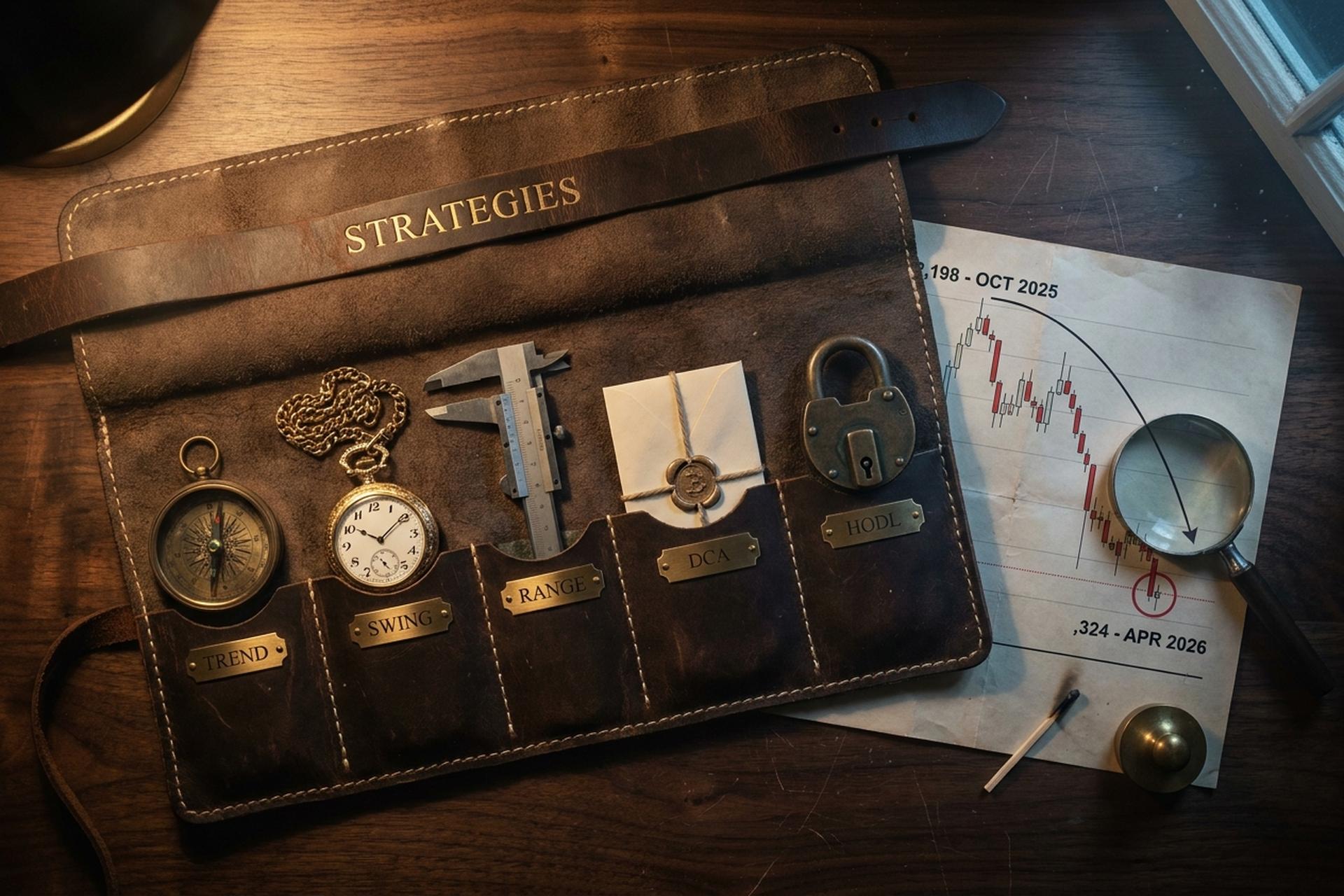
Bitcoin printed $75,324 on April 20, 2026 and $75,901 the next day. The cryptocurrency itself, treated as one of many crypto assets, sat roughly 40 percent below the $126,198 all-time high set in October 2025. Total US spot Bitcoin ETF assets under management sit near $102 billion, with BlackRock's IBIT alone at about $54 billion (roughly 45 to 49 percent of the entire spot BTC ETF market). The Wild West label no longer fits the data. What replaced it is a market that's bigger, deeper, more institutional, and just as volatile.
That mix is exactly why your trading approach and trading plan matter more than your token picks. The same Bitcoin chart can be a printing press for one trader and a slow bleed for another, depending on trading style: catching trends, fading ranges, riding momentum, or stacking sats every paycheck. This guide walks through the core crypto trading strategies for 2026 that actually work: trend trading, swing trading, range trading, DCA and HODL, plus how crypto trading bots in 2026, copy trading, grid trading, and AI trading agents fit. We'll cover the analysis tools and indicators for crypto trading that drive trading decisions, the risk rules that protect trading success, and the common mistakes new traders make.
Understanding the 2026 crypto trading market
Crypto in 2026 looks nothing like 2017 or 2021. Bitcoin spot ETFs from BlackRock, Fidelity, and a handful of others absorb retail and institutional flow daily. BlackRock's IBIT holds about $54 to $55 billion in AUM. That's 45 to 49 percent of the entire U.S. spot Bitcoin ETF market. The GENIUS Act got signed into law on July 18, 2025. It gave U.S. stablecoins a 100-percent reserve rule plus monthly disclosure requirements. The U.S. Strategic Bitcoin Reserve, set up by executive order on March 6, 2025, holds about 328,372 BTC. Strategy Inc. (formerly MicroStrategy) added 34,164 BTC for $2.54 billion on April 20, 2026. Its total: 815,061 BTC. In Europe, MiCA's transitional periods sunset on July 1, 2026. Full penalty regimes come online after.
What does this mean for traders? Large institutional flows tend to create longer trends, especially in Bitcoin and Ethereum. They also generate sharper reversals when those flows pause. Bitcoin peaked at $126,198 in October 2025. Then it dropped roughly 40 percent into Q1 2026. Total new cryptos market cap closed Q1 at $2.4 trillion. That's down 20.4 percent (or $622 billion) on the quarter. Centralized exchange spot volume came in at $2.7 trillion for Q1, down 39.1 percent QoQ. Options markets in early Q2 priced near-equal odds of a $70,000 or $130,000 BTC close for end of June. That's two-way uncertainty. You have to design your plan around it.
No single crypto strategy works in every market. The cryptocurrency market cycles between trending phases, sideways chop, and sudden volatility. Trading hours run 24/7 and never let you switch off. Successful traders match short-term strategies, short-term tactics like day trading, and long-term investment strategy to the regime. They mix trading styles as needed. Trend strategies thrive in directional moves. Range strategies thrive in flat chop. Event-driven trading kicks in around catalysts (earnings, ETF approvals, regulatory deadlines). DCA and HODL just ride out everything. The cryptocurrency trading strategies a single trader uses tend to overlap, not compete. Recognize which trading environment you're in. Don't force last week's playbook onto today's chart. Keep trading fees low enough that they don't eat the alpha. Best trading practice: write your plan down and revisit it monthly.
| 2026 market snapshot | Value | Source |
|---|---|---|
| BTC spot price | $75,324 (Apr 20), $75,901 (Apr 21) | Fortune daily price |
| BTC ATH | $126,198 (October 2025) | Multiple |
| BTC drawdown from ATH | ~-40% | Derived |
| ETH spot price | ~$2,300 | Fortune daily |
| Total crypto market cap (Q1 close) | $2.4T (-20.4% QoQ) | CoinGecko Q1 2026 Report |
| US spot BTC ETF total AUM | ~$102B | CoinDesk (April 2026) |
| BlackRock IBIT AUM | ~$54-$55B (45-49% market share) | The Block |
| Strategy Inc. BTC holdings | 815,061 BTC | Strategy press release (Apr 20) |
| US Strategic Bitcoin Reserve | ~328,372 BTC | Executive order March 6, 2025 |
Trend trading: ride momentum in cryptocurrencies
Trend trading is the oldest reliable approach to trading cryptocurrencies. The idea? Simple. Spot a clear directional price movement. Position with it. Stay until the trend breaks. In 2026, the steady ETF bid and corporate treasury accumulation have made sustained trends more common than in earlier cycles. Big buyers leave footprints. Trend trading is basically how you follow those footprints.
In practice, traders look for higher highs and higher lows during an uptrend. Or lower highs and lower lows during a downtrend. The 50-day and 200-day moving averages help confirm direction. A "golden cross" (shorter average crossing above the longer one) has historically signaled the start of new bull phases in Bitcoin. The opposite "death cross" tends to mark sustained bear pressure. These signals lag. For a swing-style position trader, lagging is a feature, not a bug.
Entries usually come on short pullbacks within the trend, not at the peak of a move. A trader watching ETH bounce off its rising 50-day moving average may add a position there, set a stop just below the average, and target a measured move higher. Why does this keep working? Because markets often trend longer than feels reasonable. Especially when macro conditions and large inflows align.
The catch is real though. Trend reversals get sharp. The roughly 40 percent BTC drop from the $126,198 October 2025 peak into the $75,000s by April 2026 caught a lot of late trend buyers. Bitcoin's prior cycle drawdown was even worse: 77 percent from $69,000 in November 2021 down to about $15,500 in late 2022, per Glassnode. A working trend strategy always pairs with a hard stop and clear position sizing. Without that, six months of profits can vanish in a week.

Swing trading: catching multi-day Bitcoin moves
Swing trading sits between day trading and HODL. Positions usually last from a few days to a few weeks. The goal? Capture meaningful chunks of a trend without sitting in front of charts all day. For most working professionals who want to trade actively, swing trading is the realistic target.
Crypto's natural volatility creates the trading opportunities. Even strong trends rarely move in straight lines. Bitcoin rips 8 percent on a Tuesday, gives back half by Friday, then pushes to a new local high a week later. Each of those waves is a swing trader's setup. The pattern repeats across timeframes. That's why support and resistance levels become the bread and butter here. Forecasting future price movements over a few days at a time is way more tractable than predicting the next month.
Two indicators do most of the work. The Relative Strength Index flags when a coin is overbought (above 70) or oversold (below 30). The MACD shows shifts in momentum. It's useful for confirming whether a bounce has staying power. A typical swing setup looks like this: ETH dips to a major support level. RSI prints under 30. MACD starts crossing higher. That's the entry. The exit comes when ETH approaches the next resistance and RSI runs above 70.
Mudrex's April 2026 short-term trading guide flags a useful position-size rule. Risk 2 to 5 percent of your portfolio per trade. Set stops 5 to 10 percent below entry. Use take-profit ladders: sell 25 percent at +20 percent, another 25 percent at +40 percent, and let the rest ride with a trailing stop. Discipline is the killer feature. Holding a swing trade past your plan, hoping for one more leg, is exactly how winning trades become losers.
Range trading: profit when the crypto market sits flat
Crypto doesn't always trend. After major rallies or corrections, prices often spend weeks or months grinding sideways inside a defined channel. Bitcoin's behavior between February and April 2026, mostly oscillating between $74,000 and $80,000, is exactly the kind of regime where range trading shines.
The strategy is simple in concept. Find a tradable range. Buy near the lower boundary, sell near the upper one, and repeat as long as the channel holds. Oscillators help with timing. The Stochastic Oscillator and RSI flag overbought conditions near resistance and oversold conditions near support, giving range traders a sharper signal than just "looks low."
The reason this works in low-volatility regimes is that price tends to revert toward the mean inside an established channel. Algorithms running market-making and grid bots reinforce that behavior, since their bids and asks cluster around recent prices. A range trader is essentially front-running that mean reversion.
The risk is the breakout. When the price finally escapes the range, the move is often fast and decisive. A trader who falls asleep at the wheel can find themselves short into a 10 percent rip or long into a flush. Range strategies need a hard stop just outside the channel and an honest answer to one question: when does this range stop being a range? Most experienced range traders close all positions and step aside the moment that line is crossed.
DCA and HODL: long-term crypto trading strategies
Not every crypto trading strategy involves screens and indicators. Dollar-cost averaging (DCA) and HODL remain the two simplest, lowest-stress approaches, and the most popular: surveys cited by Bitcoin IRA and Yellow.com put DCA as the primary strategy for roughly 59 percent of crypto investors.
DCA means buying a fixed dollar amount at a fixed interval, regardless of price. Say $200 into Bitcoin every two weeks, automated through Coinbase, Kraken, or a payment processor. The strategy smooths out volatility. Some weeks you buy at $76K, others at $82K. Over a multi-year horizon, the average cost basis tends to land below the worst lump-sum entries that mistime the market. Worth knowing, though: a Nakamoto Portfolio simulation across all historical Bitcoin windows found lump-sum buying actually beat DCA in roughly 66 percent of windows on absolute return. DCA wins on emotional steadiness and lower drawdown, not on raw outperformance. Frame it as a behavioral risk tool, not a return maximizer.
HODL is even simpler: buy and hold for years. The term came from a typo on a 2013 Bitcoin forum and stuck. It works because Bitcoin's long-term trend has remained strongly upward across multi-year windows. The 4-year rolling CAGR for Bitcoin sits near 50.5 percent, equating to roughly 5.1x of capital across a typical 4-year hold (per Glassnode and BitcoinIsTheBetterMoney). VanEck's December 2025 ChainCheck reported that 72 percent of circulating BTC had not moved in over six months, a strong signal that long-term holders dominate float. Morgan Stanley's wealth management division now suggests up to a 4 percent Bitcoin allocation for some client portfolios, which puts the HODL playbook firmly in mainstream territory.
Neither approach is risk-free. DCA still loses money during prolonged bear markets. HODL means sitting through 77 percent drawdowns (the 2022 cycle low) without selling, which is harder than it sounds. But for traders who don't want to babysit charts, these long-term plays are worth combining with shorter-term strategies as the foundation of a portfolio.
Crypto trading bots, copy trading, and grid trading
A growing share of 2026 trading volume runs through automated crypto pipelines. The best crypto trading bots in 2026 execute automated crypto trading on a fixed set of rules, free from the panic and fatigue that hurt human performance. Three forms dominate retail bot trading: grid bots, copy traders, and AI agents. Spot trading still anchors most retail volume, but automated trading is closing the gap. Beginners often start with crypto bots that combine trading automation and portfolio management in one dashboard, layering trading tools across multiple platforms.
Grid trading places laddered buy and sell orders inside a chosen price range. As price oscillates inside that grid, the bot fills cells and books small profits on each cycle. Bitsgap reports more than $9.46 billion in user funds under bot management as of 2025. Pionex has roughly 5 million registered users and 16 free built-in bots. 3Commas connects to 17-plus crypto exchanges and offers DCA strategies as well as grid setups. The strategy works best in sideways markets and breaks badly in strong trends, since the bot will keep buying as price falls through the lower boundary. Worth flagging: Pionex Inc. entered a multi-state U.S. consent order over unlicensed money transmission in 2025 and was blacklisted by France's AMF. Platform risk is real even for established bot vendors. Choosing the right crypto exchange and the best crypto trading bots matters as much as picking the strategy.
Copy trading platforms like eToro, Bybit, and Bitget let users mirror experienced traders' positions automatically. eToro reports more than 30 million registered members. Bitget Academy lists over 130,000 elite traders available to copy. The appeal is access to a working strategy without learning one. The trap is hidden risk. Many "top traders" run high-leverage strategies that look good on a six-month track record and then blow up in one bad week. Stick to traders with multi-year histories, low drawdowns, and reasonable leverage if you go this route.
AI crypto trading became the loud category in 2026. Tools like 3Commas DCA bots, TokenMetrics signals, and newer agent stacks (Virtuals Protocol, ElizaOS, OpenClaw) now route trades based on machine-learning trading logic trained on order book and on-chain data. AI agents differ from rules-based bots in that they reason, plan multi-step trading ideas, monitor mempools, and execute cross-chain trades without per-trade human approval. They feed off real-time analysis tools and adapt their approach as the market shifts. Industry sources cite AI-driven arbitrage bots as more than 35 percent of trading volume on major DEX networks (vendor data, treat as directional). Real-world performance is mixed. Some bots beat buy-and-hold in trending periods, others underperform during chop. None replace human judgment on macro shifts. Even-driven trading and high-frequency trading sit further out the complexity curve and are rare in retail use.
| Bot type | Best market regime | Risk to watch | Example platforms |
|---|---|---|---|
| Grid bot | Sideways / range | Strong breakout | Bitsgap, Pionex, 3Commas |
| DCA bot | Long-term accumulation | Stuck in bear market | 3Commas, Coinrule |
| Arbitrage bot | Cross-exchange spread | Latency, fees | Hummingbot, Cryptohopper |
| Copy trading | Any (mirror leader) | Leader blow-up risk | eToro, Bybit, Bitget |
| AI signal bot | Variable | Unproven model drift | TokenMetrics, Stoic |
Arbitrage trading deserves a separate note. Cross-exchange spreads have narrowed dramatically since 2023 as institutional market makers professionalized the space. Pure spot arbitrage today is mostly a sub-percent business after fees, although a 2024-25 academic measurement found 19 major searchers extracted about $233.8 million from 7.2 million CEX-DEX arbitrage events. The bigger arbitrage edge in 2026 sits in perpetual funding rate plays and basis trades between spot and futures, plus DEX-to-CEX gaps on newer altcoins where DEX volume now sits at roughly 21 percent of CEX volume (peaking at 37.4 percent in June 2025, per CoinGecko). These are advanced strategies and not where beginners should start.
Indicators and risk management for crypto traders
Indicators are advanced tools, not magic signals. Pile too many onto one chart and you'll just see what you want to see. The set that most professional crypto traders and advanced traders actually rely on stays small. The best crypto traders treat technical indicators as supports for trading goals. Not as the goals themselves.
Moving averages remain the foundation. The 50-day and 200-day simple moving averages on Bitcoin define the macro regime. The Relative Strength Index flags momentum extremes. MACD confirms trend shifts. Bollinger Bands measure volatility. They tighten before big moves. On-chain metrics like NVT ratio, miners' revenue, and active address counts add a layer that pure technicals miss. Token Metrics' April 2026 indicator review highlighted on-chain data as the fastest-growing supplemental signal class for retail traders. The most successful crypto strategy usually combines two or three signals. Not ten.
The 3-5-7 rule sometimes mentioned in trading circles is a basic risk frame: never risk more than 3 percent on a single trade, never have more than 5 percent total open exposure across correlated positions, and aim for a 7 percent reward target relative to your worst-case loss. The numbers vary by source, but the principle holds: cap your downside, scale your upside.
Three habits matter more than any indicator:
| Risk rule | Why it works |
|---|---|
| Risk 2-5% of portfolio per trade | Survives 10+ losing trades in a row |
| Hard stop on every position | Removes the "hope and hold" reflex |
| Take-profit ladder | Books gains without needing to call the top |
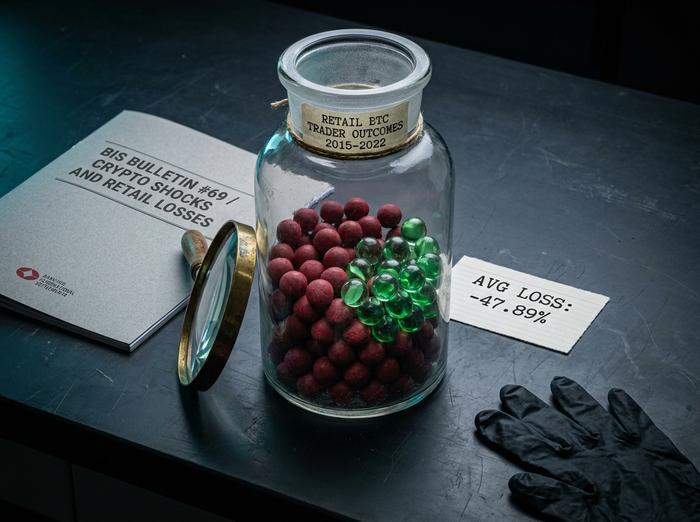
Most retail crypto traders lose money. The strongest empirical anchor is BIS Bulletin #69, drawn from 200-plus exchange-app downloads across 95 countries between August 2015 and December 2022. Between 73 and 81 percent of retail Bitcoin investors lost money on their initial investment, with an average loss of 47.89 percent of invested funds. Day-trading attrition is harsher still: industry tracking from QuantifiedStrategies finds about 13 percent of day traders are still active at three years and only roughly 7 percent remain net profitable at five years. Note one common misattribution: the often-cited "80 percent of eToro users lose money" stat refers to industry-wide CFD products, not eToro specifically. eToro's current CFD risk disclosure puts retail account losses at 50 to 51 percent. Either way, the single biggest separator between traders who survive and those who don't is risk management, not stock picking or signal subscription.



