Sui explained: what is the Sui blockchain and why does it matter?
Grayscale launched a Sui staking ETF on the NYSE in February 2026. That is not something that happens to random chains. Sui went from zero to a $2.6 billion TVL peak in under two years, pulled in institutional money from BlackRock and Franklin Templeton, and racked up 3.5 million daily active addresses at its peak in 2025. The network briefly surpassed Solana in daily users.
So what is Sui, exactly? And why has it grabbed this much attention this fast?
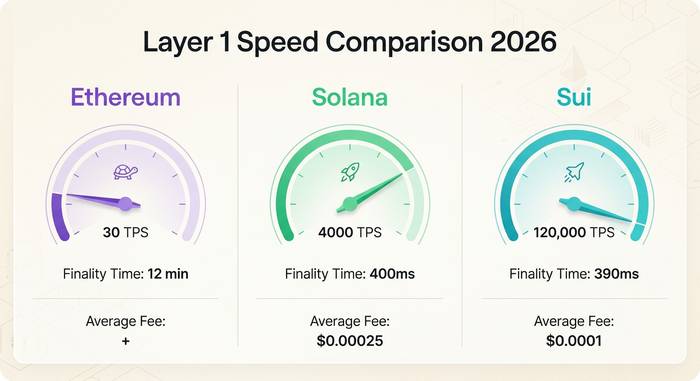
Sui is a Layer 1 blockchain built by Mysten Labs, a team of ex-Meta engineers who worked on the Diem project before it got shut down. The chain runs on the Move programming language, uses an object-centric data model instead of the traditional account model, and processes transactions in parallel. The result is sub-second finality at near-zero gas fees. If that sounds like marketing speak, the numbers back it up: 390-millisecond finality with the Mysticeti v2 consensus mechanism and transaction fees around $0.0001.
This guide walks through how Sui works, what makes it different from Ethereum and Solana, what is happening in the Sui ecosystem in 2026, and what the SUI token actually does.
How does Sui work?
Think of Ethereum like a single checkout lane at a grocery store. Everyone waits in line. Does not matter if you are buying milk and the person ahead of you is buying 200 items. You wait.
Sui built a different kind of store. Every item on the chain is its own object. Your SUI tokens? An object. Your NFT? Another object. When two transactions touch different objects, Sui runs them at the same time. No line. No waiting. That is parallel execution, and that single idea is why Sui is fast.
On Ethereum, 10,000 users doing 10,000 unrelated things still go through one by one because everything updates a single global state. On Sui, those same 10,000 transactions fire at the same time. The only ones that queue up are transactions that need the exact same object.
Under the hood, the consensus engine is Mysticeti. DAG-based, Byzantine Fault Tolerant, and as of v2, it hits about 390 milliseconds to finality. That is faster than blinking. For simple transfers where only one person owns the objects involved, Sui skips consensus entirely and confirms almost instantly. That is why sending SUI between wallets feels like it happens before you lift your finger off the button.
Validators run the network through delegated Proof of Stake. If you hold SUI, you can delegate to a validator and earn staking rewards without running any hardware yourself.
What makes Sui different from Solana and Ethereum?
People call Sui a "Solana killer." I do not think that is quite right. They target the same market, yes. DeFi, gaming, NFTs, cheap and fast transactions. But they are built in very different ways, and both can probably coexist.
| Metric | Sui | Solana | Ethereum |
|---|---|---|---|
| Programming language | Move | Rust | Solidity |
| Data model | Object-centric (parallel by default) | Account-based | Account-based |
| Consensus | Mysticeti (DAG-based BFT) | Tower BFT + Turbine | Gasper (Casper + LMD GHOST) |
| Max TPS (theoretical) | 120,000-297,000 | ~65,000 | ~30 (L1) |
| Average transaction fee | ~$0.0001 | ~$0.00025 | $0.50-$10+ |
| Block time | Sub-second | ~400ms | ~12 seconds |
| Finality | ~390ms (Mysticeti v2) | ~400ms | ~12 minutes |
| Market cap (Apr 2026) | ~$3.5B | ~$80B+ | ~$250B+ |
| TVL peak | $2.6B (Oct 2025) | $8-10B | $50B+ |
Move is the language bet that could pay off big. Meta designed it for Diem, and it was purpose-built to prevent the kind of smart contract bugs that have drained billions from Solidity projects. In Move, you cannot accidentally copy or destroy a resource. That alone wipes out entire exploit categories. Aptos uses Move too, but Sui's fork optimizes it for the object model.
Where Solana wins is ecosystem depth. It has way more DeFi protocols, more bridges, more tools, more users. Sui has 500+ active projects and 54 DeFi protocols, which is growing fast but still a fraction of Solana's footprint. One thing I find telling: Sui's full-time dev count grew 16.1% year over year while Ethereum lost 20% of its devs over the same stretch.
The real story? Solana has the users. Sui has the architecture. Ethereum has the TVL and the credibility but needs Layer 2s to stay usable. All three will probably be around in five years. The question is market share.
The Sui ecosystem in 2026
Sui's network has grown from nearly nothing to a genuine ecosystem with DeFi, gaming, NFTs, and institutional products.
DeFi on Sui
DeFi TVL on Sui peaked at $2.6 billion in October 2025 before pulling back with the broader market. About 10% of that TVL came from BTC-related assets like LBTC (Lombard's liquid-staked Bitcoin) and xBTC (via OKX). The big DeFi names on Sui right now:
| Protocol | Type | What it does |
|---|---|---|
| NAVI Protocol | Lending/borrowing | First native lending protocol on Sui. Supports SUI, WBTC, WETH, stablecoins |
| Cetus | DEX | Concentrated Liquidity Market Maker, similar to Uniswap V3. ~$255M TVL |
| Scallop Lend | Lending | First to receive an official Sui Foundation grant. ~$244M TVL |
| Aftermath Finance | DEX + yield | Multi-product suite with swaps, staking, and liquid staking |
| Turbos Finance | DEX | Concentrated liquidity with deep integration into the Sui ecosystem |
Stablecoins are coming in too. Ethena launched suiUSDe, its synthetic dollar, on Sui. BlackRock backs USDo on the network through its USD Institutional Digital Liquidity Fund. These institutional-grade stablecoins signal that real money is taking Sui seriously.
Gaming
Gaming is where Sui wants to differentiate. The object-centric model is a natural fit for game items. Every in-game asset is a unique on-chain object that players truly own, can trade, and can use across different games. XOCIETY, a shooter game, landed on the Epic Games Store through a partnership between NDUS Interactive and Sui. SEED, a Telegram mini-app with 60 million users, partnered with the Sui Foundation to push gaming into Web3 through the SEED Combinator Program. Other titles include Abyss World, Bushi, and Aftermath Islands.
The chain has minted over 52 million NFTs since launch, supported by marketplaces like TradePort, BlueMove, and Clutchy.
Institutional adoption
This is the part that separates Sui from most Layer 1 competitors. Grayscale launched the GSUI staking ETF on NYSE Arca in February 2026, offering roughly 7% staking yield with a 0.35% annual fee. Canary Capital launched a spot SUI ETF at the same time. 21Shares released a 2x leveraged SUI product. These are not crypto-native plays. These are regulated financial products sitting in traditional brokerage accounts.
Mysten Labs raised $336 million in total funding, with investors including a16z crypto, Jump Crypto, Binance Labs, Franklin Templeton, Coinbase Ventures, and Circle Ventures.

What is the SUI token and what does it do?
SUI is the native token of the Sui network. Total supply is capped at 10 billion tokens. As of April 2026, about 3.95 billion SUI (39.5%) is in circulation, with the rest vesting through May 2030.
The SUI token price sits around $0.87 with a market cap of approximately $3.5 billion, placing it in the top 30 by market cap. The token hit significantly higher levels during its late-2025 peak, surging roughly 390% over 12 months before correcting with the broader market.
What SUI does:
- Pays transaction fees (gas fees on Sui are extremely low, around $0.0001 per transaction)
- Secures the network through staking (you can delegate SUI to validators and earn staking rewards)
- Grants governance voting rights for protocol decisions
- Gets used across DeFi as collateral for lending, liquidity provision, and trading
- Powers NFT purchases and gaming transactions
The token unlock schedule is something to watch. Monthly unlocks have been adding tens of millions of SUI to the circulating supply. The next major unlock date is May 1, 2026. Token unlocks create selling pressure, which is partly why the price pulled back from its 2025 highs despite the ecosystem growing.
| SUI token snapshot | Value |
|---|---|
| Total supply | 10 billion SUI |
| Circulating supply (Apr 2026) | ~3.95 billion (39.5%) |
| Price (Apr 2026) | ~$0.87 |
| Market cap | ~$3.5 billion |
| Fully diluted valuation | ~$8.9 billion |
| Staking yield (GSUI ETF) | ~7% |
| Average transaction fee | ~$0.0001 |
| Full unlock timeline | May 2030 |
Risks and things to watch
I am not going to pretend Sui is a sure thing. It is not. None of this stuff is.
The token unlock schedule is the elephant in the room. 60% of SUI is still locked. Every month, tens of millions of new tokens hit the market. If the ecosystem does not grow fast enough to soak up that supply, the price bleeds. Simple math.
TVL fell from $2.6 billion to roughly $550 million between October 2025 and April 2026. Part of that is just the market cooling off. Part of it is money chasing yields on other chains. Whether Sui pulls that capital back when things heat up again is an open question.
Then there is the competition. Solana has years of head start and ten times the liquidity. Aptos runs Move too. Ethereum's L2s get cheaper every quarter. Sui has to outrun all of them at the same time.
VC influence is worth flagging. Mysten Labs raised $336 million and the Sui Foundation controls a big chunk of the token supply. This is not a grassroots chain like Bitcoin. The team behind it has outsized control over what happens next.
And then Walrus. Mysten Labs launched a separate storage protocol, raised $140 million for it, and even got a Grayscale trust. If Walrus works, it expands what Sui can do. If it pulls attention from the core chain, that is a problem.