Guarda Wallet Review 2026 : Secure Crypto Wallet Guide
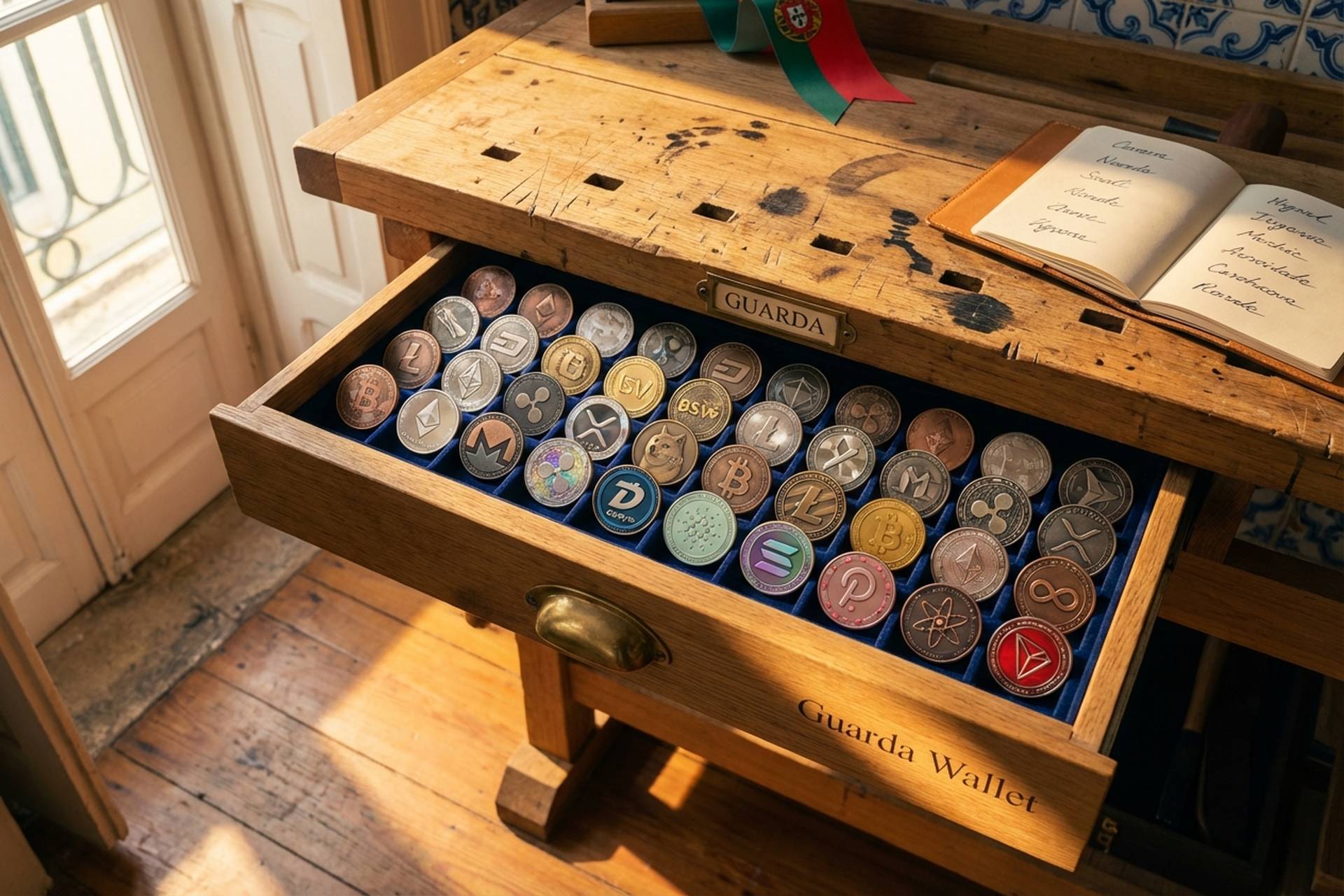
Nine years is a long time in crypto. Guarda Wallet launched in 2017 and is still shipping updates in April 2026, which by itself puts it ahead of half the wallets from that era. Most of them are gone. A few got bought. A couple got hacked. Guarda just kept going.
It is not the biggest name in the category. Not the flashiest. Not the one with the most aggressive marketing budget. What it actually is, in 2026, is a non-custodial hot wallet that covers an unusually wide surface area of blockchains, offers built-in buy, swap, staking and a prepaid Visa card, and has somehow avoided the kind of platform-level security incident that pulled down Atomic Wallet in 2023. This review walks through what Guarda Wallet actually does today, what it costs, which coins and tokens it supports, how safe it really is, and how it stacks up against Trust Wallet, MetaMask and Exodus.
Two things worth flagging up front. First, Guarda quietly moved its legal home from Estonia to Lisbon, Portugal. Today it operates as GUARDACO LDA, Portuguese company ID 516458965, with a second entity sitting in the British Virgin Islands. The company is also a member of the INATBA Finance Working Group, the European industry body for trusted blockchain applications. Modest credibility signal, but a real one. And the move matters for MiCA, which we will get to.
Second thing. Guarda still refuses to publish an official user count. Anywhere. The only hard adoption numbers come from Google Play (1 million+ downloads, 6,140 ratings, 3.9 stars as of April 15, 2026) and Trustpilot (roughly 4.2 out of 5 from around 2,186 reviewers). Those are real numbers. They are also two orders of magnitude smaller than Trust Wallet (140 million+ users) or MetaMask (30 million monthly actives), so put Guarda in the mid-tier enthusiast segment. Not mass-market. That matters when you are deciding whether to trust it with serious capital.
What is Guarda Wallet and who is it for
Short version: Guarda Wallet is a non-custodial, multi-currency crypto wallet. You store, send, receive, buy, swap and stake digital assets across 70-plus blockchains. The company never touches your private keys. Never. When you spin up a new wallet, keys get generated locally inside your browser or device, encrypted with AES, and you walk away with a 12-word recovery phrase that only you see. No KYC. No mandatory ID check. No user-facing database sitting in Lisbon for someone to hack.
So who is this for? Mostly experienced holders. People who want broad chain coverage in one app instead of juggling four separate wallets. If you hold BTC, ETH, XRP, XMR, DOGE, DGB, BSV and a grab bag of ERC-20 tokens, Guarda will actually show you all of them in one interface. Sounds easy. It is not. Most cryptocurrency wallet apps either go EVM-only (MetaMask) or curate a much smaller supported set (Exodus) to keep the user experience tight. Guarda goes the other way: it tries to be Guarda's versatile mobile cryptocurrency wallet that offers a range of financial features designed to cater to both beginners and seasoned cryptocurrency users, and it is available on web and desktop alongside mobile. Tradeoff: Guarda is a light wallet, not a full node. It trusts external services for chain data instead of verifying every block itself. That is a design choice, not a bug, but worth knowing.
Guarda Wallet features: buy, swap, stake, built-in tools
Guarda is more than a key manager with a balance screen. The app bundles a bunch of financial tools into one secure multicurrency crypto wallet, and that feature list is a big part of why it still has users in 2026 instead of being remembered as "that 2017 wallet."
- Buy crypto with a card or SEPA through integrated fiat on-ramps. Supported assets include bitcoin, ethereum, and more than 300 other coins and tokens.
- Swap between any two supported assets through the built-in DEX aggregator and ChangeNOW integration.
- Stake on 14 different blockchains directly from the wallet screen, with APYs between roughly 1% and 25.94% depending on the asset.
- Prepaid Visa card that lets you spend crypto in select European countries.
- Crypto loans against your existing holdings, typically priced at 12 to 17% APR.
- A built-in token creator that lets anyone deploy a custom ERC-20 contract without writing Solidity.
- Desktop dApp browser, NFT wallet, and portfolio tracker.
Each one of those features is there for the same reason: keep you inside the Guarda environment instead of sending you off to a third-party site. That is the business model, nothing fancier. You still hold your own private keys. The convenience rails (fiat, swap, card) are where the fees live.
Supported coins and blockchains in Guarda Wallet
Coverage is the single biggest selling point Guarda has. The homepage advertises more than 70 major blockchains and over 400,000 assets as of April 2026. That is genuinely a lot. For comparison: Exodus curates around 130 coins. MetaMask natively supports six chains plus four L2s. Coinbase Wallet claims 10,000+ assets across EVM and Solana. Only Trust Wallet actually comes close in raw coverage, and its catalog is also measured in hundreds of thousands of tokens. So Guarda is top two on pure breadth.
On the native chain side, here is what you actually get. Bitcoin (BTC). Bitcoin Cash (BCH). Bitcoin SV (BSV). Bitcoin Gold. Litecoin (LTC). Ethereum (ETH). Monero (XMR), which most hot wallets will not even touch. Zcash (ZEC). Stellar (XLM). XRP. Dogecoin. DigiByte (DGB). Tezos. Tron (TRX). Cardano. Solana. Polkadot. Cosmos. Binance Smart Chain. Plus a long tail of altcoins most competitors skip entirely. Token coverage spans ERC-20 on Ethereum, TRC-10 and TRC-20 on Tron, BEP-20 on BSC, and a laundry list of stablecoins: USDT, USD Coin USDC, DAI, Paxos Standard Token, Gemini Dollar GUSD, True USD TUSD, STASIS EURS and others. Basic Attention Token, Chainlink, MakerDAO, Shiba Inu and Pepe are all supported. If a token lives on a chain Guarda already has, you can usually add it manually by contract address.
One real gap: Guarda Wallet is not fully open-source. The mobile and desktop clients are proprietary. NerdWallet and BitDegree flag this in every review as a limitation for security-first users who want to actually audit the code themselves. Fair criticism.
Using Guarda across web, mobile and desktop
Guarda Wallet runs on almost every surface you might want. Web wallet inside any modern browser (easiest way to try it without installing anything). iOS and Android app listed as Guarda Crypto Wallet Bitcoin on both the App Store and Google Play, both under developer GUARDACO UNIPESSOAL LDA. Desktop client for Windows, macOS and Linux. A Chrome extension for Web3 dApps. And a Huawei AppGallery build for everyone outside Google's ecosystem. Six surfaces in total, which is more than most competitors bother with.
Access is protected by Touch ID or Face ID on iOS, biometric unlock on Android, and a local password on desktop. Since the private keys are generated locally, your money is safe even if you lose your phone in a cab. Just restore the 12-word seed on any other Guarda device and the balance comes back. Users who enable Touch ID or Face ID to access the crypto storage without a full password prompt are leaning on the operating system's secure enclave. That is the same standard every serious mobile wallet uses, nothing exotic.
Cross-device sync is not automatic. Each platform creates its own wallet unless you manually import the same seed phrase. So if you set up Guarda Wallet on your laptop and want the same balance on your phone, you have to type that seed in on the second device. Is that annoying? A bit. Is it a bug? No. It is a self-custody feature. You get to use your wallet on multiple devices while Guarda never sees your funds regardless of the app or device you pick.
Guarda Wallet fees in 2026: swap, buy, card
Storage is free. Always was. Guarda Wallet does not charge anything to hold coins, receive them, or send them on-chain beyond whatever the network fee happens to be on the blockchain itself. That part is straightforward and not where the money comes from.
| Fee type | Rate | Notes |
|---|---|---|
| Wallet storage | 0% | No custody fee |
| On-chain send | Network fee only | Guarda takes nothing |
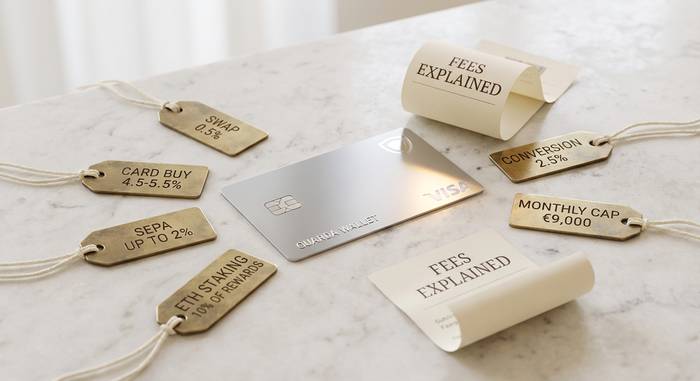
| Built-in swap (ChangeNOW) | ~0.5% + spread | User-friendly app with adjustable fees on the blockchain leg |
| Card-funded crypto buy | 4.5% to 5.5% all-in | Partner dependent (Simplex, MoonPay, Ramp) |
| SEPA crypto buy | Up to ~2% | Cheaper than card |
| ETH staking service fee | 10% of rewards | About 0.3% of the staked principal at current ETH yield |
| Visa card issuance | €15 virtual / €20 plastic | One-time fee |
| Visa card monthly | €3 | Service charge |
| Visa card crypto→EUR conversion | 2.5% | Per top-up |
| Visa card ATM withdrawal | €1.90 + 2.5% | Per withdrawal |
The monetized paths are where real money shows up. Card-based purchases at 4.5% to 5.5% are typical for the convenience-wallet category. Not cheaper than Exodus. Not cheaper than Atomic. The 0.5% swap fee, though, is actually competitive once you factor the spread. SEPA is the cheapest fiat on-ramp if you live in an eligible country. Traders who count basis points usually route swaps manually through a DEX and use the Guarda interface only for storage and staking. Most casual users do not bother.
Security and private keys in one secure crypto wallet
Here is the short version. Guarda Wallet is non-custodial, which means nobody sitting in the Lisbon office can reach your private keys. Nobody. Not support. Not an engineer. Not a court order. Keys are generated locally on your device, encrypted with AES, and the 12-word seed phrase is shown to you once during setup. You write it down. You own it. Lose it and the coins are gone. That is self-custody in one paragraph, and yes, it cuts both ways. The upside: if Guarda's servers vanished tomorrow, your balance would still be recoverable through any BIP39-compatible wallet by importing the same seed.
Want a stronger security posture? Guarda supports Ledger Nano X and Nano S Plus hardware wallets directly through the app. Your private keys never leave the Ledger device, not even during staking or swap operations. The wallet basically turns into a hotkey-free user interface sitting on top of a hardware signer. Ledger integration has been one of the most praised features across professional reviews in 2025 and 2026. For good reason.
Two honest caveats sit against this otherwise clean picture. First, the codebase is not fully open-source. An independent client audit is therefore not possible the way it is for, say, Electrum or MetaMask. Second, Guarda Wallet is a light wallet, not a full node. It relies on third-party block explorers and RPC endpoints for chain data. Theoretically, a compromised explorer could feed the app stale balances. Has it ever happened to a Guarda user? No public report I can find. But it is a structural reason why security maximalists prefer a hardware wallet plus a fully open-source desktop client for cold storage, and reserve Guarda for day-to-day activity.
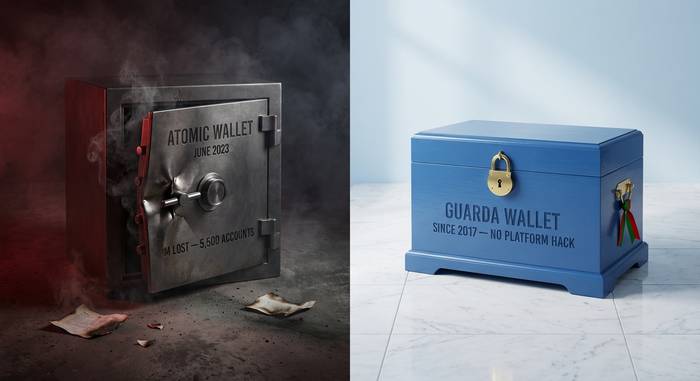
No platform-level breach of Guarda Wallet's infrastructure has been publicly documented from 2017 through early 2026. Complaints on Trustpilot and Reddit that reference "lost funds" almost always trace back to user-side problems: private-key compromise, clone apps on Google Play, or seed phrase phishing. Not a hack of Guarda itself. That is a distinction worth making clearly, because the two things look the same in a search result but are completely different events.
How to stake crypto in Guarda Wallet
This is the feature long-term holders actually use. Guarda Wallet supports around 14 assets for native in-wallet staking, and the APY range is wide. Low end sits near 1%. High end touches 26% on specific staking tokens. Some current highlights as of April 2026:
- Ethereum (ETH): ~3% APY, 10% service fee on rewards
- Cardano (ADA): ~5% APY, delegation through a Guarda validator
- Tron (TRX): 4%-10% depending on how you vote
- Cosmos (ATOM): ~10% APY
- Tezos (XTZ): ~6%
- Zilliqa (ZIL): higher double-digit yield
- Ontology (ONT): occasionally listed near 25% APY
- ChangeNOW (NOW): the high end of the Guarda lineup
Those numbers move constantly. Guarda Wallet's staking page is always more current than any review, and the mix of assets rotates every few quarters as validators come online or drop out. Rule of thumb: stake tokens you would hold anyway. Do not reach for the 26% APY coin you have never touched just because it is on the list. And remember the obvious thing: staking locks your capital for the unbonding period of whatever chain you pick, which can be days or weeks depending on the network.
Guarda Wallet vs Trust Wallet, MetaMask and Exodus
The easiest way to place Guarda Wallet in the competitive field is this: the broad-coverage dark horse. It does not win on users, branding, or UX polish. It wins on chain count. More chains than any competitor outside Trust Wallet, plus a clean security record.
| Wallet | Supported assets | Known users | Core strength | Weakness |
|---|---|---|---|---|
| Guarda | 400,000+ across 70+ chains | 1M+ downloads (Play) | Broadest native chain coverage, Ledger integration, Visa card | Closed-source client, mid-tier UX |
| Trust Wallet | Millions of tokens, 100+ chains | 140M+ users | Scale, Binance ecosystem, mobile-first | Centralized ownership concerns |
| MetaMask | EVM chains + L2s, hundreds of assets | ~30M monthly active | Web3 default, dApp integration depth | EVM-only focus |
| Exodus | 130+ curated coins | Not disclosed | Best-in-class UI, Trezor support | Limited chain coverage |
| Coinbase Wallet | 10,000+ across EVM + Solana | Tied to Coinbase brand | Brand trust, Coinbase on-ramp | EVM and Solana only |
| Atomic Wallet | Similar multi-chain | Not disclosed | Similar profile to Guarda | June 2023 $100M+ exploit scar |
Atomic Wallet is the closest positional match to Guarda Wallet, and here the clean security record really matters. Atomic lost more than $100 million across roughly 5,500 user accounts in the June 2023 exploit widely attributed to the Lazarus Group. That incident still shapes the pick between the two in professional reviews, years later. People remember. Against Trust Wallet and MetaMask, Guarda is smaller but broader on chain coverage. Against Exodus, it trades UI polish for chain breadth. Pick your tradeoff.
Guarda Visa card, loans and built-in extras
The Guarda Visa card launched with Simplex in August 2022 and, surprisingly enough, is still alive in early 2026 for users in eligible European countries. It is a prepaid Visa tied to your Guarda balance: you top up in crypto, the card converts to euros at 2.5%, and you spend anywhere Visa is accepted. Monthly spending cap sits at €9,000. Issuance costs €15 for virtual, €20 for plastic. Service is €3 a month. ATM withdrawals cost €1.90 plus another 2.5%. Live outside Europe? The card is not available for you.
The crypto loan product lets you borrow stablecoins against a basket of supported collateral. Typical approval time is 15 minutes. Interest rates run 12% to 17% APR, which is not cheap but is in line with the rest of the CeFi lending category. The token creator tool lets anyone deploy a custom ERC-20 contract directly from the interface. Is this useful? Mostly as a curiosity, but occasionally it helps small projects skip Remix and MetaMask for a quick deploy. The dApp browser and portfolio tracker round out the non-storage feature set.
None of these extras are differentiators on their own. Taken together, though, they are exactly why some users stay with Guarda instead of downgrading to a pure hot-key wallet.
Is Guarda Wallet safe? Track record and concerns
Honest answer: yes, with caveats. Nine years, no documented platform hack. That is a meaningful track record in a category where Atomic Wallet, Slope, Safemoon Wallet and several smaller operators have all been breached or exploited over the same stretch. Guarda Wallet's non-custodial architecture also means that a breach at the Lisbon office would not, on its own, expose user balances. The keys just are not there to steal.
The caveats are structural, not recent. First, the client is not fully open-source. Pro reviewers flag this every time. Second, it is a light wallet rather than a full node, which is a common weakness across the whole hot-wallet category. Third, there is no public third-party security audit from CertiK, Halborn or SOC 2. Asking the support team for one is a fair question anyone placing a serious balance should bring up. If you need an independent code audit, Guarda cannot give you one. If you are willing to trust nine years of clean operational history plus the non-custodial design, the picture is comfortable. Most users end up in the second camp.
Across Trustpilot and Reddit, recurring negative themes are: poor exchange rates on the in-app swap compared to routing manually through a DEX, support lag on niche staking chains (one Cardano staking ticket reportedly sat open for six months), and confusion between the real Guarda app and clone apps on Google Play. If you hit a problem, please contact our support team is the official guidance on the Guarda Wallet site, and the customer support team response side is actually rated positively in most reviews; the frustration comes from the long tail of niche chain issues, not general customer support.
The bottom line on using Guarda in 2026
So who should actually use this thing?
Not you if you want the absolute lowest fees. Not you if you live inside MetaMask and need the deepest dApp integration money can buy. But if you want one app that handles BTC, ETH, XMR, DGB, XRP, BSV and sixty other chains, with built-in staking and a Visa card, and you can live with a closed-source client in exchange for that breadth? Then yes, Guarda Wallet probably deserves a slot on your home screen. It has not been hacked. It quietly moved to Portugal. It sits inside the MiCA framework during the grandfathering window that runs until July 1, 2026.
For long-term cold storage, pair it with a Ledger and forget about it. For day-to-day multi-chain activity, the regular non-custodial setup is fine. For large balances, a hardware wallet is still the right answer. Same as with every other hot wallet in this category. The most useful way to think about Guarda Wallet is as a flexible workbench, not a vault. Use it like one.