Best Crypto Debit Cards in the UK for 2026: Fees & FCA Status
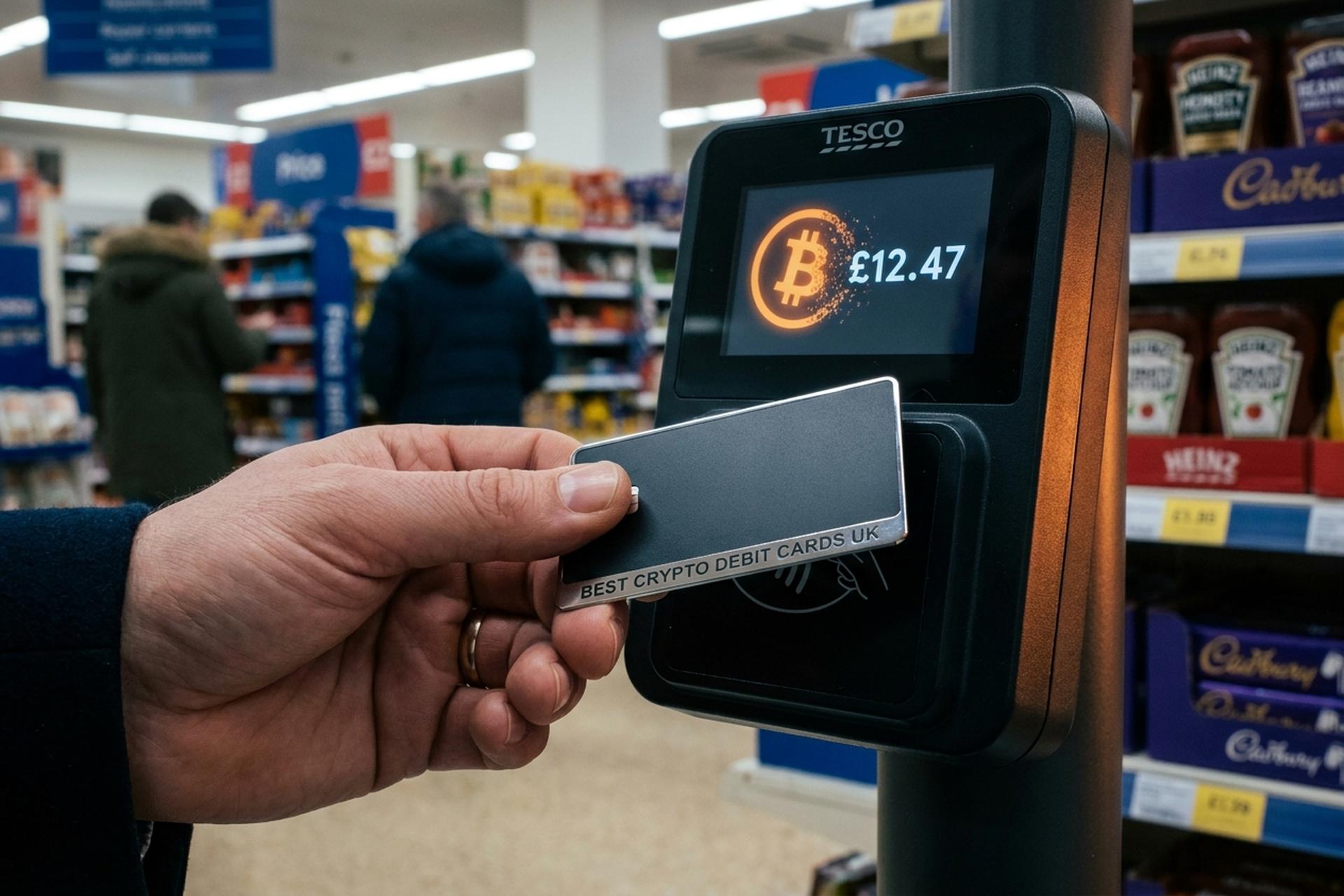
Crypto debit cards are the quiet bridge between a Bitcoin balance and a Tesco till. Swipe at the supermarket, top up an Oyster card, pay for fuel, and the card pulls from your crypto wallet in the background, converting coins to pounds at the point of sale. Simple idea. Messy reality, especially in the UK, where the Financial Conduct Authority has spent the past three years tightening which providers can sign up British customers in the first place.
According to the FCA's Cryptoassets Consumer Research 2025 (Wave 6), about 8% of UK adults, roughly 4.5 million people, owned crypto by the end of 2025, down from 12% a year earlier. The average holding rose to £1,842, which signals fewer dabblers and more committed users. Net spend on Visa-partnered crypto cards also tells the story: $14.6 million in January 2025, $91.3 million by December, a 525% year-on-year jump per Dune Analytics data cited by Cointelegraph. The UK slice of that flow is smaller than the EEA as a whole, but it is growing.
This guide walks through the best crypto debit card options available to UK users in 2026, including which cards work in the UK for everyday purchases and which are EEA-only. Every card included here either holds FCA registration for crypto-asset activities, sits under a UK EMI licence, or operates via an FCA-authorised section 21 promoter. The comparison covers fees, cashback rates, supported coins, fiat conversion mechanics, and the practical differences that matter when you actually use the card. It also flags which big-name cards quietly left the UK (Binance, Monolith, Bybit) so you aren't chasing a product that no longer accepts British residents.
How a Crypto Debit Card Works for UK Users
At a technical level, a crypto debit card is closer to a crypto prepaid card than to a traditional bank debit card. These cards are typically designed to run on the same Visa or Mastercard rails as any regular high-street debit card. The card account holds a balance, your crypto sits in a connected wallet, and the card provider runs an automatic swap engine. When you tap the terminal, three things happen in about a second. The provider quotes a live crypto-to-fiat rate, the card automatically debits the crypto holdings from your wallet, and authorises the pound sterling amount on the card network. The merchant sees a standard Visa debit or Mastercard transaction. You see a small crypto deduction in the app. Crypto is converted on the fly, and the crypto to fiat spread is typically baked into the rate rather than shown as a separate line item.
That conversion is not free, even when the headline card cost is. Most providers charge a spread (0.1% to 2%) on the crypto-to-fiat rate, plus foreign exchange markup when you spend crypto outside the UK. Premium tiers often cut these fees in exchange for a monthly fee or a native-token stake. The card network itself takes merchant interchange, but that cost is hidden from the cardholder. Some providers also offer a virtual card instantly, while the physical card arrives by post a week later.
These cards make it easy to use your crypto for daily spend once the swap engine is set up. Three card supports matter in the UK specifically. First, the card supports contactless and Apple Pay or Google Pay if you want to tap at the bus, the tube, or a parking meter. Second, the card provider must handle GBP directly, not only EUR or USD, to avoid an extra FX layer on domestic spend. Third, the card provider's issuing bank has to be a UK-authorised electronic money institution or a passported EU institution cleared to serve UK customers. Without that, the card will be declined at any merchant that checks. Crypto exchanges that run their own card programme (Crypto.com, Coinbase, Bybit, Nexo) tend to have the smoothest flow from exchange balance to card balance, and they typically show card settings directly in the app. Most cards operate similarly to traditional debit cards once the swap engine is set up. It is a debit card designed to behave like a normal UK bank card at the till: the card that allows offline contactless, supports chip-and-PIN, and runs on Visa or Mastercard. Where the experience differs is mostly under the hood. The card is a crypto debit product, so cashback is paid in tokens rather than points, and using the card also triggers the crypto-to-fiat conversion that makes this category distinct from using a debit card tied to a UK bank account. Using your card at the till is the same action; what happens in the back end is not.
One more reality check: HMRC treats every crypto-to-fiat swap as a disposal for capital gains tax. That means every coffee, sandwich, and tank of petrol paid in crypto is, on paper, a taxable event. The annual CGT allowance for 2025/26 is £3,000, with gains above that taxed at 18% (basic rate) or 24% (higher rate). From 1 January 2026, UK crypto-asset service providers including card issuers must collect and report user balances and transactions to HMRC under the Crypto-Asset Reporting Framework; the first filings are due by 31 May 2027. Most UK users sidestep the frictional CGT by funding the card with stablecoins (USDC, USDT, GBPe) or by topping it up with fiat from a linked bank transfer. The gap between traditional cards and these newer bank cards is narrowing fast, but the tax mechanics remain different, and it matters for record-keeping if you actually spend BTC or ETH directly via credit card purchases or cash withdrawals.

FCA Rules and Your Crypto Debit Card in the UK 2026
The Financial Conduct Authority supervises two things that touch crypto cards. First, anyone issuing card services to UK customers needs e-money institution authorisation or must partner with one. Second, any firm marketing crypto assets to UK consumers must be registered under the Money Laundering Regulations. The FCA's cryptoasset register has approved around 50 of 368 applicants since 2020, an approval rate of about 14%. That bottleneck is the reason several global providers are not on UK shelves.
The financial promotions regime, in force since 8 October 2023 under PS23/6, classified cryptoassets as Restricted Mass Market Investments. New users must complete a risk warning acknowledgment, a 24-hour cooling-off period, and an appropriateness assessment. The rules caught out several providers. Binance pulled its Binance Visa Card across the European Economic Area (UK included) on 20 December 2023. Monolith deactivated its Visa card on 8 October 2024 after a change in issuing-bank arrangements, ending a five-year run on behalf of 35,000 EEA customers. In 2024, CB Payments Ltd, the Coinbase Group's UK entity, was fined £3.5 million by the FCA, the regulator's first enforcement action against a cryptoasset business.
The Travel Rule has been live in the UK since 1 September 2023, separate from the financial promotions regime. Crypto firms must collect and transmit full sender and recipient data on every transfer regardless of size, with additional KYC information on transfers above €1,000. For card providers, the practical effect is stricter KYC at signup and occasional holds on top-ups from self-custody wallets if the counterparty's VASP cannot verify.
A new FSMA-based authorisation gateway is coming. The Crypto SI was enacted on 4 February 2026; the application window for the new regime opens on 30 September 2026 and closes 28 February 2027, with the regime going live on 25 October 2027. In the meantime, UK users have a straightforward filter. Check the card provider's entity on the FCA register before depositing. Confirm the issuing bank is authorised in the UK or passported. Keep copies of the risk warnings; the FCA requires them on file for compliance audits.
Top Crypto Cards Available in UK 2026: The Comparison
The table below compares the main 2026 UK-available crypto debit cards. All prices are in GBP unless otherwise stated. Cashback figures refer to the standard free tier where applicable, with higher tiers noted in the card profiles below.
| Card | Issuance cost | Cashback (standard) | Free ATM / month | FX markup | UK regulatory path |
|---|---|---|---|---|---|
| Crypto.com Visa (Midnight Blue) | Free | 0% post-Nov 2025; up to 5% on staked tiers | £180 | 0.2% UK/EU, 2% outside | FCA cryptoasset register + EMI (Foris DAX MT) |
| Wirex Visa (Standard) | Free | 0.5% in WXT (up to 8% Elite) | £200 | App-shown | FCA EMI No. 902025 |
| Nexo Card (virtual) | Free (€50 min deposit) | Up to 2% in NEXO/BTC | Plan-dependent | Plan-dependent | Section 21 via Gateway 21 |
| MetaMask Card (Virtual) | Free | 1% in mUSD | N/A | 1-2% | MetaMask issuer via partner bank; UK supported |
| Coinbase Card | £4.95 | None in UK (US-only rewards) | Operator fees | 2% abroad | FCA-registered (CB Payments Ltd) |
| Revolut | Free | Plan-dependent (not crypto-specific) | Plan-dependent | Plan-dependent | Full UK bank + FCA crypto register |
| ZEN.com Card | Free | App-shown | App-shown | 0.5% FX + ~2.5% crypto conversion | EEA EMI (Lithuania), limited UK |
A few patterns stand out across the top 10 crypto cards active for UK users. Outside the UK, the Bitget Wallet card has drawn attention for allowing users to spend crypto with aggressive cashback, but it is not on the UK list as of April 2026. Providers that run native tokens (CRO, WXT, NEXO) cluster their best crypto cashback at premium tiers that require staking or monthly subscriptions. Providers that do not run a native token (MetaMask's stablecoin model, Coinbase, Revolut) keep the structure simpler but pay less cashback in the UK specifically, and Coinbase pays no cashback to UK users at all, despite the card itself still being issued. Fiat-friendly cards such as Revolut are popular with UK users who want GBP routing, but they are less "crypto" in the pure sense, the fiat leg dominates, and the Revolut card is technically a payment card funded by in-app crypto sales rather than a true crypto-to-fiat swap at point of sale. The Uphold card remains a niche card available to UK users who want 200+ coin support via an FCA-registered issuer, but its UK availability has been intermittent through 2024-2026. The debit cards available to UK users are narrower than the list you will see on global comparison sites. The good news: the cards that did survive the 2023-2024 shakeout are the ones that allow users to spend with proper UK compliance baked in.
Best Crypto Card for Cashback: Crypto.com Visa Card
The Crypto.com Visa is the crypto Visa card most UK reviewers still recommend as the best crypto card for everyday spend, despite a difficult 2023-2025 for reward cuts. For UK users who want to spend their crypto at a familiar scale of outlet, the Crypto.com card is the default starting point. The new card, whether you apply for the first time or upgrade, is issued in the UK via Foris DAX MT Limited, which holds both an FCA cryptoasset registration (granted August 2022) and an Electronic Money Institution licence (granted 4 December 2023). That combination makes it one of the few crypto firms holding both UK permissions, and gives people in the UK a relatively clean path from UK account onboarding to card issuance. GBP top-ups by Faster Payments and SEPA are supported, contactless works on all tiers, and Google Pay went live for UK-issued cards on 24 November 2025, joining existing Apple Pay support.
The 2026 reward structure is very different from 2022. On 2 November 2025, Crypto.com removed the 1% non-staking cashback on Icy White and Rose Gold, trimmed the 2% on Obsidian, and cut some Amazon Prime, Spotify, and Netflix rebates. As of April 2026, Midnight Blue (no stake) pays 0% cashback, Ruby Steel pays up to 1-2% (with a $25 monthly cap), Royal Indigo and Jade Green pay 3% (cap disputed between the help centre's $1,250 equivalent and recent reviewer reports of $50), and Obsidian pays 5% subject to the same monthly cap. UK spending is unified at a £22,000 daily/monthly limit across tiers. Free ATM withdrawals range from £180/month (Midnight) to £900/month (Obsidian), with a 2% fee beyond. FX markup is 0.2% in the UK and EU and 2% outside on entry tier; higher tiers see 0%.
The practical pros for UK cardholders: FCA registration and EMI authorisation, GBP conversion on Faster Payments, both Apple Pay and Google Pay in the UK, and more than 100 supported coins. Cons: the Midnight tier no longer gives cashback, the CRO staking requirement locks up capital, and the cashback rules have changed twice in three years. If you spend £1,000+ a month on card and can commit CRO at Ruby or above, the maths still works. Below that, a different card is probably the better choice.
Nexo Card and MetaMask Card: DeFi-Friendly Options
Nexo and MetaMask take different routes to the same idea: let a DeFi-native user spend their crypto without selling it every time.
The Nexo Card operates as a dual-mode Mastercard. In credit mode, the card borrows against your Nexo-held crypto collateral at rates starting around 2.9% APR, and you spend the loan rather than the crypto itself. That matters under UK CGT, because borrowing is not a disposal. In debit mode, the card sells a slice of your crypto at each transaction, like a standard crypto debit card. Cashback is up to 2% in NEXO or BTC, virtual issuance is free with a €50 minimum deposit, and there are no monthly or annual fees. Nexo resumed UK onboarding in September 2024 via Gateway 21, an FCA-authorised section 21 promoter, rather than direct FCA registration. Physical card orders in the UK are temporarily paused as of April 2026; virtual cards are active and KYC-verified UK residents can apply.
The MetaMask Card takes a DeFi-native approach. The card supports a short list of tokens, USDC, USDT, wETH, EURe, GBPe, mUSD, and a few aToken equivalents, and operates directly from your MetaMask wallet on Linea, Base, Solana, and Monad. It is a crypto debit card that lets you spend directly from the wallet you already use. The virtual card is free with 1% cashback in mUSD, while the Premium Metal Card at $199 per year pays 3% on the first $10,000 spent, then 1%. UK users can sign up directly, and both Apple Pay and Google Pay are supported. Daily spending limits are $15,000 for virtual cardholders and $30,000 for Metal, with ATM limits of $1,000 and $5,000 respectively. The trade-off for the slick non-custodial experience: a narrower coin list and a 2% ATM fee on the virtual tier.

Bybit Card and Wirex: High-Cashback Alternatives
The Bybit Card is a Mastercard with headline cashback up to 10% at the top VIP tier, which requires BYB token staking. Standard tiers pay 2-5%, first 100 EUR/GBP of monthly ATM withdrawals are free, and the card supports GBP, EUR, and USD across the European Economic Area. Important caveat for British readers: the Bybit Card is not available to UK residents and has never been on UK shelves. Bybit's exchange relaunched in the UK on 19 December 2025 via a partnership with FCA-regulated Archax, but that relaunch does not extend to the card product. If you see the Bybit Card listed on a "best UK crypto cards" ranking, treat the list as out of date.
Wirex is a UK-based crypto card provider that has been running its Visa product since 2015, one of the longest continuous card operations in the market. The card is free to issue on the Standard plan, with Premium at €9.99/month and Elite at €29.99/month. It supports BTC, ETH, LTC, XRP, and the native WXT token, and pays 0.5% Cryptoback in WXT on the Standard plan, scaling up to 8% at Elite. The ATM allowance is £200 free per month, with a 2% fee on withdrawals above that. A 1% top-up fee applies when funding the card from non-WXT crypto, which annoys some users but keeps the card profitable for the issuer. Wirex holds an FCA e-money licence (No. 902025, granted 2020), which matters for UK holders who want to stay within the domestic regulatory perimeter.
For UK users who want a fiat-primary card with optional crypto sell-to-spend, the Revolut card deserves a note here. Revolut secured a full UK banking licence on 11 March 2026, covering deposits with FSCS protection up to £120,000. It supports 230+ cryptocurrencies for buying and selling inside the app and was selected in Q1 2026 for the FCA's Stablecoin Sandbox to test a GBP-pegged crypto token. On the card side, the transaction is fiat-on-fiat: you sell crypto in-app and the balance lands in your Revolut GBP account before hitting the card. It is not a pure crypto-at-the-till card, but for a UK user who wants one app for banking and crypto, it is hard to beat on convenience. Crypto credit cards from dedicated issuers remain rare in the UK, so the Revolut route, fiat debit card funded by crypto sales, is the closest practical equivalent many UK users will find.
How to Choose the Best Crypto Card for Everyday Use
The right crypto card in UK hands depends on three practical questions. What do you actually spend each month? How much crypto are you willing to stake? And do you need GBP-native routing or is EUR fine? The best crypto debit card for a casual user is rarely the same as the best crypto debit card for a heavy DeFi spender, and the cards come with different trade-offs on fees, custody, and UK availability. The best crypto debit cards available to UK users in 2026 are not the same list you would pick using a "cards for 2026" global guide. Comparing the top crypto cards in the UK specifically produces a different shortlist. Some cards offer the flexibility of both debit or credit spending on a single plastic, some allow the user to spend crypto anywhere Visa or Mastercard is accepted, and some only sensibly work if you already buy crypto regularly on the issuer's exchange.
For everyday purchases under £1,500 a month, the best crypto card is usually a free-tier card with modest cashback. Post-November 2025 cuts, the Crypto.com Midnight tier no longer pays cashback, so many UK users shift to Wirex Standard (0.5% WXT) or Nexo virtual (up to 2%) at that volume. If you spend more, the staked-tier maths starts to make sense; a Royal Indigo tier paying 3% on £4,000 of monthly spend is £1,440 of crypto rewards a year, enough to justify the locked CRO at current prices.
DeFi-native users should look at MetaMask or Nexo first. Both of them let you keep crypto custody close to the wallet you already use, and both handle stablecoins cleanly, which sidesteps the HMRC disposal issue on every coffee. Earning crypto rewards directly in stablecoins also reduces the accounting pain when using a crypto card for everyday spend. Cashback is modest, but the simpler tax treatment is worth more than an extra 1% for most active DeFi users. If you want to spend your crypto on everyday purchases like groceries and transport without selling first, a stablecoin-first card that allows stablecoin funding is the easiest path. Using a crypto card to use crypto for everyday UK spending is practical once the card allows GBP routing and the stablecoin funding rail is live.
Travellers and frequent spenders abroad should weigh ATM allowances and FX markups carefully. Revolut is still hard to beat for broad fiat coverage when you use the card abroad, even though it is not a pure crypto card. If your spend is mostly in the UK, any of the crypto cards available above will work; the fee gap only opens overseas. Card costs such as ATM fees above the free limit, physical-card ordering, and premium-tier subscriptions can add up if you are not paying attention, so factor them in before committing to one card for a year. Converting a big amount of crypto to fiat at the point of sale, especially in volatile markets, can also move the effective price enough to matter.
One last filter: check the UK availability status on the provider's own page before you sign up. Post-financial-promotions regime, providers change their UK entry rules without much press coverage. The table above reflects April 2026 status, but this market moves quickly, and the cards operate under different regulatory umbrellas.