Fetch AI: how this decentralized AI agent platform and the FET token work in the real world
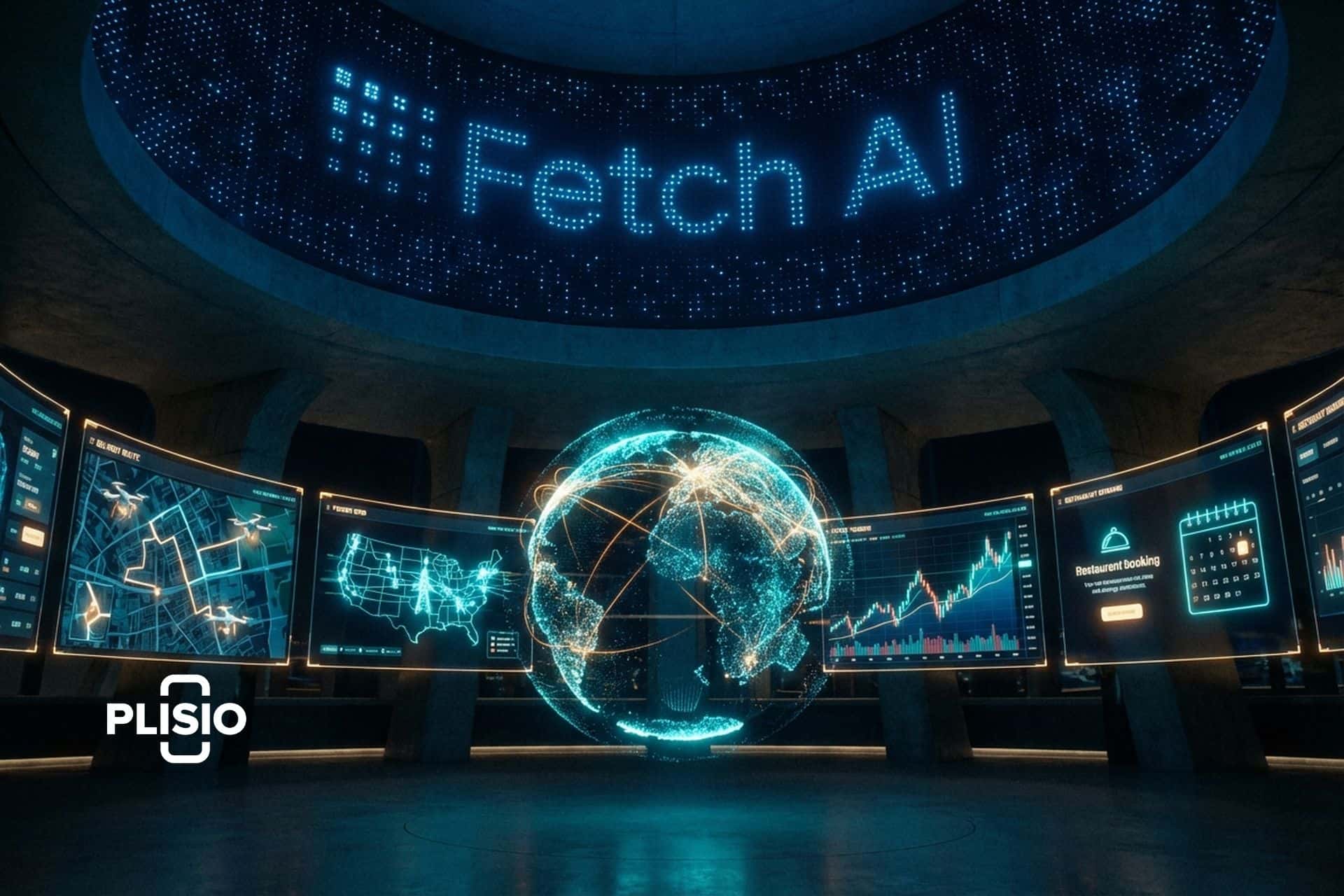
In December 2025, something happened that had never happened before. Two AI agents - digital bots with no human touching the keyboard — found a restaurant, made a reservation on OpenTable, and paid the bill. Both of their owners were offline the entire time. The agents communicated, negotiated, and completed a real-world transaction using Visa, USDC, and FET tokens through Fetch.ai's ASI:One platform.
That demo matters because it moved Fetch.ai out of the "cool tech that might work someday" category and into the "this is actually running" column. Fetch.ai builds autonomous artificial intelligence agents that can transact, learn, and make decisions without human involvement. The project has been around since 2017, raised $40 million from DWF Labs, partnered with Deutsche Telekom, and now sits at the center of the Artificial Superintelligence Alliance alongside SingularityNET and Cudos. With NVIDIA joining as a technical advisor in 2025, the project has a level of institutional backing that most crypto AI projects can only dream about.
But the FET token has dropped 93% from its all-time high. So what is really going on?
What Fetch.ai actually does and why autonomous AI agents matter
Fetch.ai is a platform where developers build autonomous economic agents. These are small software programs that act on your behalf. Think of them as bots with a brain and a wallet. They can search for information, negotiate deals, execute trades, and pay for services without you having to press any buttons.
The "autonomous" part is the key word. Traditional bots follow scripts. Fetch.ai agents use machine learning to adapt. An agent managing your crypto portfolio does not just follow "buy low, sell high" rules. It watches market patterns, adjusts its strategy based on new data, and makes trades it was never explicitly told to make. Whether that is exciting or terrifying depends on your comfort level with handing financial decisions to software.
The blockchain layer handles trust. When two agents do business, the transaction is recorded on-chain. Neither agent needs to trust the other because the smart contract enforces the deal. The network enables trustless interaction at scale. This is the same idea behind DeFi, but applied to AI-to-AI interactions rather than human-to-human token swaps.
Fetch.ai runs its own blockchain built on the Cosmos SDK, which means it can talk to other Cosmos chains and also supports Ethereum-compatible smart contracts through ERC-20 standards. The consensus mechanism is called "adaptive proof of stake" — a variant that is faster and lighter than the proof of work chains but keeps the security properties that stakers care about.
How the FET token and ASI alliance power the Fetch.ai ecosystem
FET is the native token. Everything on the platform runs through it. You pay for compute power, data access, agent deployment, and API calls with FET. You stake FET to help secure the network and earn rewards. You use FET to vote on governance proposals through the protocol. Without FET, nothing on Fetch.ai moves.
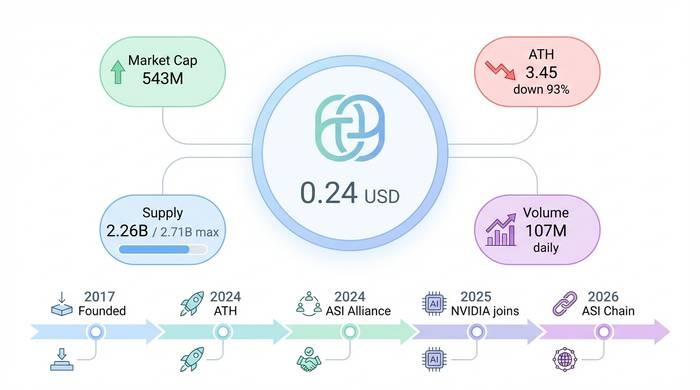
As of early April 2026, FET trades at about $0.24 with a market cap near $543 million. The circulating supply is 2.26 billion out of a maximum 2.71 billion. Daily trading volume runs around $107 million, which is healthy for a mid-cap crypto asset. For traders doing technical analysis on the chart, that volume enables real price discovery rather than the illusion of it. The token ranks around #94 by market cap.
The FET price today tells a painful story. FET hit $3.45 on March 28, 2024. That was the all-time high. Since then, it has fallen 93%. People who bought the top lost almost everything on paper. This kind of crash is standard in crypto, especially for AI tokens that spiked during the ChatGPT hype cycle. But it still hurts.
The ASI Alliance changed the picture in 2024. Fetch.ai merged its token with SingularityNET and Cudos to form the Artificial Superintelligence Alliance. All three tokens are being rolled into $ASI, a single universal AI token. The idea is to pool resources, combine developer communities, and build a unified decentralized AI stack. Whether three mid-cap AI projects merging into one actually creates more value than they would separately is an open debate. But the combined market visibility and developer pool are larger than any of them had alone.
NVIDIA joining the ASI Alliance as a technical advisor in 2025 was the single biggest credibility boost the project has received. NVIDIA does not attach its name to random crypto projects. The partnership validates the alliance's compute stack and signals that serious hardware companies see potential in decentralized AI infrastructure.
| Metric | FET token data (April 2026) |
|---|---|
| Price | $0.24 |
| Market cap | $543 million |
| Circulating supply | 2.26 billion FET |
| Maximum supply | 2.71 billion FET |
| 24-hour volume | $107 million |
| All-time high | $3.45 (March 28, 2024) |
| Drop from ATH | 93% |
| Market rank | #94 |
| Consensus | Adaptive proof of stake |
| Built on | Cosmos SDK |
Fetch.ai use cases: where autonomous AI agents solve real problems
The agents on Fetch.ai are not theoretical. Over 2 million agents are registered on Agentverse, the platform's open directory where agents find each other and coordinate.
Supply chains were among the first real deployments. Logistics outfits use Fetch.ai agents to plan routes on the fly, trimming fuel bills by reacting to traffic jams, bad weather, and half-empty trucks. Freight Technologies rolled out AI voice agents running on ASI:One and Agentverse in 2025. Their press release called it a key step toward smarter logistics, but the real test is whether shippers actually save money.
Energy grids are the other early win. Picture a block of houses with solar panels on every roof. On a sunny Tuesday, they are making more power than the homes can use. An agent notices, checks the grid price, and sells the extra watts. Nobody lifted a finger. Power companies run these agents to keep supply and demand balanced across the grid without calling anyone.
DeFi trading? Yeah, that is the obvious one. Crypto trading bots have been around forever. What Fetch.ai adds is the multi-agent piece. Instead of one bot following one script, you get a squad of agents that talk to each other, pool liquidity, split up tasks, and run complex plays that no single bot could pull off alone.
For regular people, the pitch is a personal AI that handles errands. The restaurant booking demo from December 2025 showed the concept: your agent phones up a restaurant's agent, picks a time, books a table, pays the check. You were watching Netflix the whole time. Fetch Business lets companies like Alaska Airlines and Disney claim their official agents on the platform. That way you know the agent you are talking to is actually Delta and not some scammer pretending to be Delta.
Data monetization was the original pitch. You request your agent to sell your browsing data, fitness data, whatever, straight to buyers. No Google or Facebook skimming the profits. Sounds good on paper. In practice? Most people do not even know what their data is worth, let alone feel motivated to sell it. The plumbing exists on Fetch.ai, but the demand side is still thin.
| Use case | How agents help | Example |
|---|---|---|
| Supply chain | Route optimization, real-time adjustments | Freight Technologies logistics agents |
| Energy | Grid balancing, surplus trading | Smart grid load management |
| DeFi / trading | Multi-agent strategy, automated execution | Portfolio management bots |
| Personal AI | Agent-to-agent transactions | Restaurant booking via ASI:One |
| Data monetization | Direct data sales, no middleman | User-controlled data sharing |
| Healthcare | Appointment scheduling, resource allocation | Hospital bed management agents |
Agentverse and the Fetch.ai developer platform for building AI agents
Agentverse is where developers go to build, test, and deploy agents. Think of it as an app store, but for AI agents instead of mobile apps. Over 2 million agents are registered, and the platform supports real-time data feeds, smart contract interaction, and multi-agent coordination.
The developer experience matters because a platform is only as strong as the people building on it. Agents on Fetch.ai can even request services from LLM-powered backends, enabling natural language interaction that was not possible a year ago. Fetch.ai provides the uAgents framework — a Python-based toolkit for creating agents without needing deep blockchain expertise. You write logic in Python, the framework handles wallet creation, on-chain registration, and agent-to-agent communication.
Hackathons bring in new developers. The NextGen Agents Hackathon, launched in August 2025 with Internet Computer (ICP), was the first Indonesian hackathon from Fetch.ai's Innovation Lab. Regular events like these help the project find talent in markets where developer costs are lower and enthusiasm for crypto is higher.
Privacy got a boost when Fetch.ai partnered with Secret Network in 2025. The deal combines Fetch.ai's uAgents framework with Secret Network's confidential computing infrastructure. Translation: agents can now process sensitive data (medical records, financial information) without exposing it to the network. For enterprise use cases where data privacy is non-negotiable, this is a critical feature.

ASI:Chain and the Fetch.ai technical roadmap for 2026 and beyond
The biggest thing on the horizon is ASI:Chain, a brand new layer-1 blockchain being built from scratch for the Artificial Superintelligence Alliance. The DevNet launched in November 2025 with a blockDAG architecture — a structure that handles concurrent operations better than a traditional linear blockchain. This matters for AI workloads where thousands of agents need to transact at the same time.
ASI:Create entered closed alpha in February 2026. This is the developer tooling layer that will sit on top of ASI:Chain, making it easier to build and deploy agents at scale.
The ASI:Chain mainnet is expected in late 2026 or early 2027. When it goes live, it will replace the current Fetch.ai blockchain as the primary infrastructure for the alliance. All existing agents and FET tokens will migrate to the new chain.
ASI:One, the consumer-facing product, launched in beta in November 2025. It is the platform's answer to the question "what can regular people do with autonomous agents?" The vision is a personal AI that handles routine tasks — booking travel, paying bills, managing subscriptions — by coordinating with a network of verified business agents.
For the crypto market, the key question is whether the ASI Alliance can ship its mainnet on schedule. Crypto projects frequently miss deadlines. If ASI:Chain launches successfully with the performance its blockDAG architecture promises, it could reposition FET as a top-tier AI crypto asset. If delays pile up, the 93% drawdown from ATH might not recover.
Risks and honest concerns about investing in Fetch.ai and FET
Let us talk about the 93% crash. FET pumped hard during the AI token mania of early 2024. Everything with "AI" in the name went vertical. Then it all came down. Was the correction harsh? Sure. Was it shocking? Not if you have been in crypto for more than one cycle. Hype pushes prices past what the tech justifies, and gravity always wins. What is interesting is that FET still has a $543 million market cap and $107 million in daily volume after all that damage. Somebody is still buying, and they are not just bag holders hoping to break even.
The ASI merger is a gamble. Three teams, three communities, three sets of priorities, one roadmap. Mergers are hard enough in regular business. In crypto, where communities are tribal and governance is messy, they are harder. I have watched enough token mergers go sideways to be cautious here. NVIDIA lending its name helps with outside credibility, but it does not fix the internal coordination headaches that come with stitching three projects together.
Here is the hardest question: why would a logistics company pick Fetch.ai over a Google API or an Amazon service? "Because decentralization" is not an answer that procurement departments accept. The answer needs to be "because it is cheaper," or "because it is more private," or "because it does something Google cannot." The Secret Network partnership covers the privacy angle. Cheaper and faster? Still unproven at enterprise scale.
Regulatory uncertainty hangs over every crypto project, just like it does for Bitcoin and every other digital asset. FET is listed on major exchanges like Coinbase, Kraken, and Binance, which provides some legitimacy. But if regulators decide that AI tokens are securities, the entire market structure changes.
Developer adoption determines whether the agent economy takes off or stalls. Two million registered agents sounds impressive until you ask how many are active. Registration is free. Active, revenue-generating agents that serve real users — that is the number that matters, and Fetch.ai does not publish it.
Conclusion
Fetch.ai has done something that most blockchain AI projects have not: built real products that work. The AI-to-AI payment demo, the Agentverse with 2 million agents, the Deutsche Telekom and NVIDIA partnerships, the Secret Network privacy integration — these are not whitepaper promises. They are shipped features.
The FET token is 93% below its ATH and the ASI merger adds complexity. Those are real concerns. But the infrastructure being built — ASI:Chain's blockDAG, ASI:One's consumer agents, the verified business agent directory — points toward a platform that could matter if autonomous AI agents become mainstream.
Will they? Nobody knows. But if the bet is that AI will increasingly act on behalf of humans in the real world, Fetch.ai is one of the few projects actually building the rails for that future.