France Currency
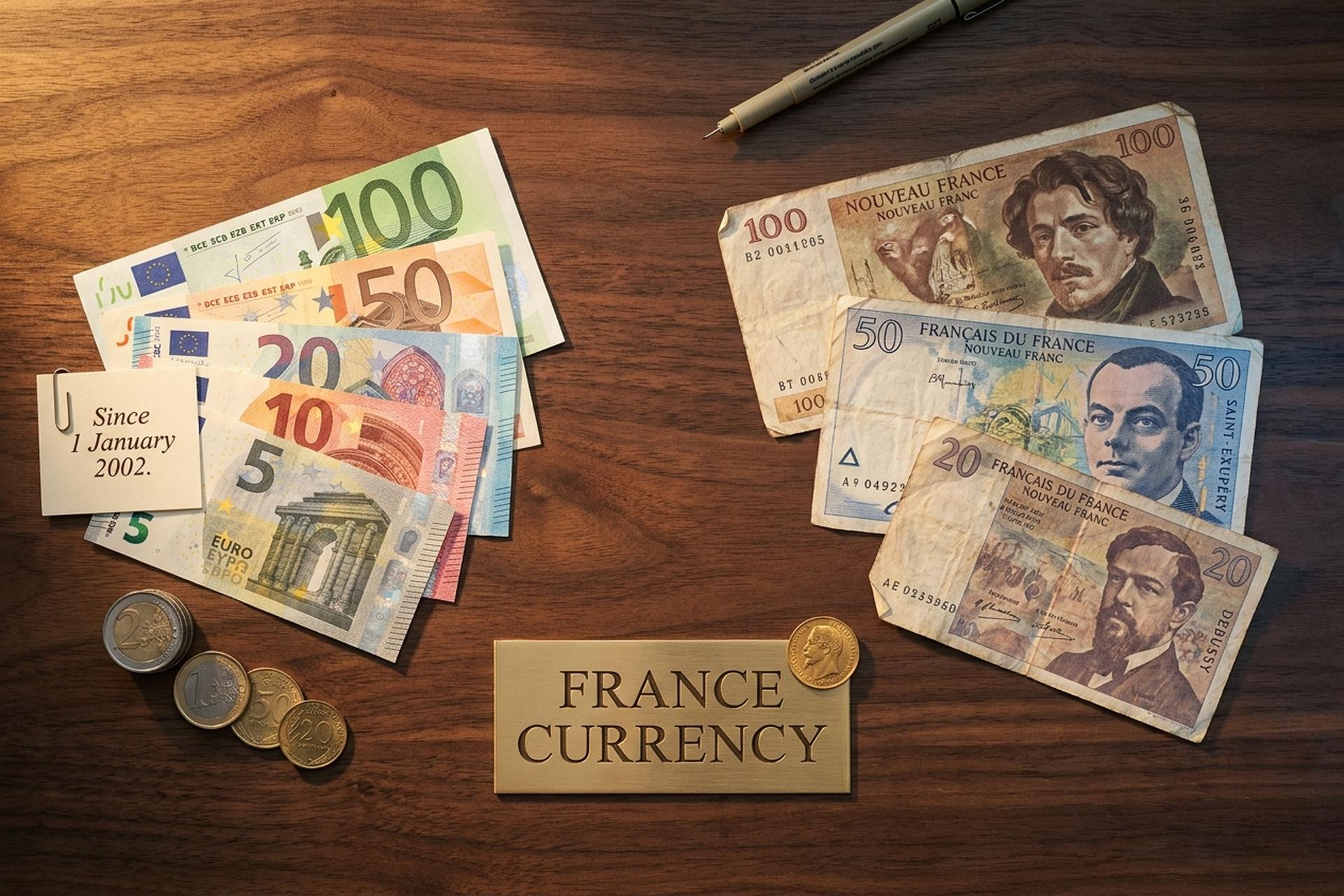
France is the second-largest economy in the eurozone, a founding member of the European Union, and the country where a lot of people still hesitate before a restaurant bill because they remember a time when prices came in francs. The France currency today is the euro. The euro has been in circulation since 1 January 2002. The franc is gone from wallets but not from memory, and the history behind the switch is more interesting than the usual "they joined the euro" story.
This guide walks through what the French currency is in 2026, how the euro banknotes and coins work, where the franc came from (a small gold coin minted to free a captured king in 1360), what the exchange rate is doing against the dollar and the pound, how to actually spend money in Paris or Lyon without paying tourist tax, and where crypto fits for French merchants under MiCA. No jargon, real numbers, April 2026 data.
What Is the France Currency in 2026?
The France currency is the euro. Code: EUR. The currency symbol is €. One euro is divided into 100 cents (in French, centimes). The euro is the official currency of France and 19 other EU member states that together form the eurozone. France was a founding member of the single-currency project. The adoption of the euro landed here in two stages. Book-money only from 1 January 1999. Then the euro on 1 January 2002, in cash form, the day French francs were replaced by the euro. From that morning on, the currency used for every legal payment in France has been the euro. Coins in circulation that morning went from francs to euros almost literally overnight.
The euro is run by the European Central Bank in Frankfurt. The Bank of France (Banque de France) is still France's central bank and handles the French side of euro issuance. Banknotes are printed at the Chamalières works in Auvergne. Coins are struck at the Monnaie de Paris mint. The French currency system is clean. One euro. One hundred cents. Coins up to €2. Banknotes from €5 up to €200. Every euro denomination circulating in France spends the same in the other 19 eurozone countries.
Paris is the second-largest financial centre in the EU behind Frankfurt and picked up real business after Brexit. Big French banks — BNP Paribas, Crédit Agricole, Société Générale — are all systemically important eurozone lenders. The euro on French soil sits on the same full-stack ECB monetary system that backs every other euro country.
A Short History of the French Franc
The history of France's currency begins with a ransom. In 1360, King John II was stuck in England as a hostage after Poitiers. His treasury needed him home. The answer was a new gold franc called the franc à cheval. It means "free on horseback." The coin shows the king armed and mounted. One franc à cheval was worth one livre tournois. The symbol ₣ later became common shorthand for the franc coin. Then five hundred years of francs — gold, silver, copper — running alongside the older livre system. Dates such as 1641, when Louis XIII struck the silver écu, mark the resets that the broader history of France forced on its money.
The modern franc came out of the French Revolution. The National Convention made it the national currency in 1795 and introduced decimal arithmetic. French franc coins were introduced in the new format: 1 franc, 10 décimes, 100 centimes. That arithmetic outlasted every regime that followed. In 1803, Napoleon's franc germinal fixed the franc at 290.034 mg of fine gold. A rare period of sound money. The gold anchor held through most of the nineteenth century and made France a founding member of the Latin Monetary Union in 1865. Bimetallic gold-and-silver Napoleons circulated well beyond France. Collectors still chase them.
Then came the twentieth century. Two world wars and four decades of inflation did the rest. The franc lost roughly 99% of its purchasing power across the 20th century through repeated devaluation. In 1960, de Gaulle hit reset with a nouveau franc. A hundred old francs became one new franc. Overnight. The nouveau franc then served as France's currency for four decades. It is the money most living travellers to France ever knew.
Then the transition to the euro. France joined on 1 January 1999 in book-money form. The conversion rate between the franc and the euro was fixed that day at €1 = 6.55957 FRF. The franc's value was locked for good. Three years later, on 1 January 2002, euro notes and coins hit the streets. Replacement by the euro moved almost instantly. Franc coins and banknotes lost legal tender the same morning, though retailers gave a short informal grace period on cash. The Banque de France kept taking back franc coins until 17 February 2005. Franc banknotes could still be swapped until 17 February 2012. After that date, old franc notes became collector items. Nothing more.
Euro Banknotes and Coins in France
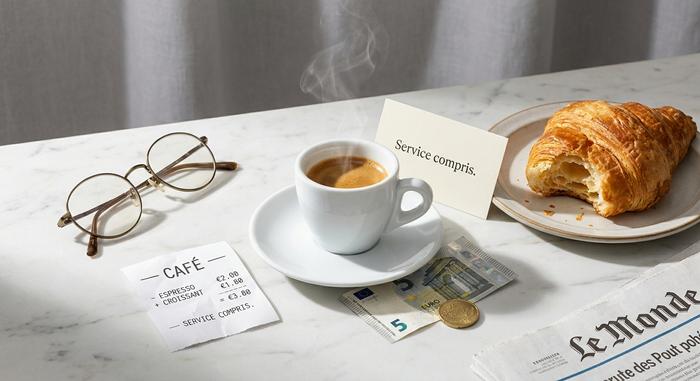
Euro banknotes come in denominations of €5, €10, €20, €50, €100, and €200. No new €500 since 27 April 2019. The ECB pulled it due to heavy use in money laundering. Existing €500 notes still count as legal tender. Everything else in circulation is the Europa series, which rolled out in stages between 2013 and 2019. The series is named after the Greek mythological figure in the hologram and watermark on every note. Every euro banknote has the same design on both sides regardless of which country issued it. The bridges on the reverse are fictional. ECB designers drew them that way on purpose to avoid national favouritism.
Euro coins work a little differently. The obverse (value side) is common across the whole eurozone. The reverse is country-specific. French euro coins carry:
| Coin | French reverse design |
|---|---|
| 1c, 2c, 5c | Marianne (allegorical figure of the French Republic) |
| 10c, 20c, 50c | The Sower (La Semeuse) |
| €1, €2 | A stylised tree inside a hexagon with "Liberté, Égalité, Fraternité" around the rim |
Every euro coin is legal tender everywhere in the eurozone. A French €2 spends the same in Rome, Madrid, or Dublin. The coin denominations you will actually handle are 5c, 10c, 20c, 50c, €1, and €2. The 1c and 2c coins still exist in France, but Finland, Belgium, and Ireland have stopped issuing them, and several eurozone countries now round cash totals to the nearest 5 cents. France has not. Yet.
France Currency Exchange Rate in April 2026
The euro is the second most-traded currency in the world. Only the US dollar trades more. Spot rates for EUR against the major pairs on 21 April 2026:
| Pair | Rate | What €1 equals |
|---|---|---|
| EUR/USD | ~1.1775 | $1.18 |
| EUR/GBP | ~0.8710 | £0.87 |
| EUR/PLN | ~4.24 | 4.24 zł |
| EUR/JPY | ~187.31 | ¥187 |
| EUR/CHF | ~0.96 | 0.96 CHF |
Quick mental math. €10 is roughly $11.80 or £8.70. €50 is about $59 or £43.50. €100 is about $118 or £87. A €200 banknote is worth somewhere near $235 on the mid-market rate. If you land in Paris with dollars, the handy rule is "multiply by 1.18" to get the dollar cost of any euro price.
These are wholesale quotes. Any bureau de change, airport counter, or card processor tacks a spread on top. Visa and Mastercard usually layer 0.2-0.8% over the interbank rate on card payments. Airport booths push 5-10%. The cheapest legal way to handle foreign exchange on EUR in 2026? A multi-currency account with Wise, Revolut, or a similar fintech. Near-mid-market rates and a small flat fee. Bank of France staff will tell you the same thing in fewer words: nothing beats the interbank rate at scale on foreign currency transactions.
The ECB, Inflation, and the French Economy
Frankfurt runs the euro. The ECB sets policy for the whole eurozone, France included. On 19 March 2026 the main refinancing rate went to 2.15%, the final cut in this easing cycle. Eurozone HICP inflation printed at 2.2% year-on-year in March 2026. France came in a touch lower, at 2.0% (revised up from an earlier 1.7% read). Softer energy costs and a cooling services sector did most of that.
France is the eurozone's second-largest economy after Germany. Nominal GDP close to $4.38 trillion in 2026. Roughly 20% of eurozone output. The mix is distinctive. Luxury goods: LVMH, Kering, Hermès. Aerospace: Airbus is based in Toulouse. Tourism: France is still the world's most-visited country. Agriculture. Plus a deep public sector that accounts for close to half of GDP through government spending.
Paris is a top-three European financial centre in 2026. Big global banks moved euro-denominated trading desks from London to Paris after Brexit — between 3,500 and 4,500 banking jobs made the trip. ESMA, which writes the technical rules for MiCA, is based here too. If you work across the EU, France is one of the easier places in Europe to open a multi-currency account, especially through digital banks like Revolut, N26, or Qonto.
Using Money in France: Cards, Contactless, and Apple Pay
France is a card-first economy in 2026. More than 70% of retail payments by value run on cards. Contactless is the default for small transactions. The French contactless limit is €50 per tap, raised from €30 in 2020 and held there since. Some banks offer "Sans Contact Plus," which lets you bump the tap limit with PIN verification. Apple Pay and Google Pay work at essentially every card terminal. With Face ID or a passcode, there is no transaction limit at all.
Cards are accepted almost everywhere. Mastercard and Visa cover the market. American Express is less widely accepted, especially at independent bistros, boulangeries, and market stalls. Diners Club is rare. Some small shops still post a minimum card payment of €10 or €15 on the counter. That is legal under French consumer law as long as the minimum is visible. Cash still matters for markets, taxi drivers, small cafés, and some rural bed-and-breakfasts.
A calibration table for Paris and Lyon prices:
| Item | Price in France |
|---|---|
| Espresso at a café counter | €1.60-2.50 |
| Croissant at a boulangerie | €1.30-2.00 |
| Paris Métro single ticket (Navigo Easy) | €2.55 |
| TGV Paris to Lyon, advance booking | €35-70 |
| Mid-range hotel night (Paris) | €140-220 |
| Bistro dinner for two with wine | €70-100 |
| Museum entry (Louvre) | €22 |
Tipping in France works differently than in the US. Service is already included in every restaurant bill under French law since 1985. The phrase on the bill is service compris. A 5-10% cash tip for good service is polite, not expected. Bars rarely see tips at all. Taxi drivers get the fare rounded up to the nearest euro or two.
ATMs, Bureau de Change, and Avoiding DCC
ATMs are everywhere in France. Every town of 2,000 people or more has at least one. City centres have dozens. A French-bank ATM — BNP Paribas, Crédit Agricole, Société Générale, LCL, Banque Populaire, Caisse d'Épargne, La Banque Postale — typically does not charge foreign Visa or Mastercard holders any operator fee on top of the interbank rate. Standalone "Euronet" kiosks in popular tourist areas charge a commission on top. They also push Dynamic Currency Conversion every single time. Decline DCC. Pay in EUR. Your home bank's rate will beat the terminal's.
For physical cash, the ranking from best to worst exchange rate in France in 2026 tracks the pattern across Europe. Exchange bureaus layer a commission on top of the visible rate, which is why the best exchange channel is rarely the most visible one on the high street:
| Channel | Typical spread | Notes |
|---|---|---|
| Online app (Wise, Revolut) | 0.3-0.7% | Best rate. Digital KYC. |
| City bureau de change, non-tourist zones | 1-3% | Avoid Opéra and Châtelet strips in Paris. |
| Bank branch | 2-4% | ID required. Slower. |
| Airport counter | 5-10%+ | Worst rate anywhere. |
| Hotel reception | 4-8% | Convenient. Expensive. |
A practical tip: French bank branches only exchange money for their own account holders. For a non-customer, a bureau de change or a multi-currency debit card is the only route. Treat your travel money as a currency and exchange stack: card first, a small cash float for markets and tips, no airport bureaux. The euro is accepted in many European countries across the eurozone, so leftover cash will still spend in Italy or Spain on your next trip.
Crypto in France: MiCA, Taxes, and Plisio for Merchants
France is one of the more crypto-engaged economies in Europe. AMF surveys put the local user base at roughly 11% of adults in 2026. About 5.5 million people. Worth repeating: the regulatory regime here is already mature, not green-field. The Autorité des marchés financiers (AMF) runs the French digital-asset register. France even had its own PSAN (prestataire de services sur actifs numériques) framework running before MiCA showed up. That means most French exchanges were already registered on the day EU-wide MiCA went fully live, 30 December 2024. The grandfathering window for PSANs to convert to a full MiCA CASP licence closes on 1 July 2026.
Tax on crypto in France is relatively clean by European standards. It edged up in 2026. For occasional traders — the default category for most retail investors — capital gains on crypto sold for fiat are taxed at the flat PFU rate of 31.4% in 2026. That is 12.8% income tax and 18.6% social contributions, after the PLFSS 2026 budget law pushed the social charge up from 17.2%. Professional traders pay progressive income tax. Crypto-to-crypto swaps are not taxable in France. That is a notable difference from the UK, which treats them as disposals. From 1 January 2026, DAC8 reporting also kicked in. French exchanges now send user transaction data to the DGFiP tax authority automatically.
Notable French crypto players. Paymium — founded 2011, one of the oldest Bitcoin exchanges in Europe, based in Paris. Coinhouse — regulated as a PSAN, offices in Paris. Bitstack — Paris-based DCA-focused app, popular with retail savers, and one of the first MiCA CASP licences approved in France in 2025 alongside Deblock, GOin, and custodian CACEIS. Binance operates in France through a local entity with an AMF registration. The AMF estimates roughly 11% of French adults now hold crypto. About 5.5 million people. That number has held steady since 2024.
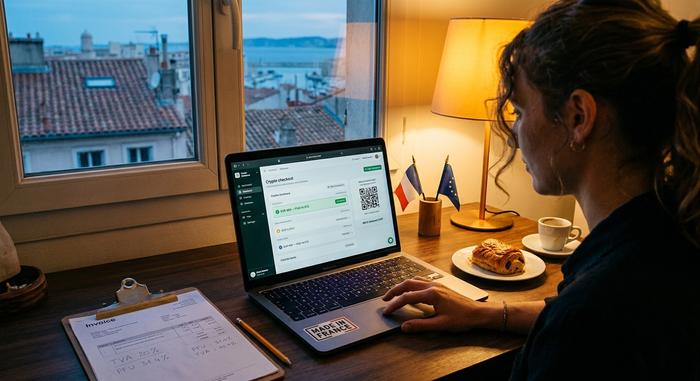
For merchants, a French online business wanting to take crypto alongside euros can plug a gateway like Plisio into WooCommerce, Magento, PrestaShop, or WHMCS in a few hours. Customers pay in BTC, ETH, USDT, USDC, LTC, or any of 30+ other assets. Plisio either settles in crypto or converts on the fly to EUR or USD, paying out into the merchant's bank. Same pitch you find anywhere. No 1.5-3% card-network fee. No chargebacks. Instant cross-border settlement. A French e-commerce store that ships to LatAm, MENA, or Southeast Asia — regions where card penetration is lower — can use the crypto rail to recover 3-5% of revenue that normally vanishes into card and FX spreads. Under MiCA, a licensed CASP gateway keeps the compliance stack clean on top of that.