
What Is Dash Cryptocurrency?
I remember when Dash was a big deal. 2017, the ICO mania, this coin hit $1,500 and people on Reddit were dead serious calling it the future of money. Today? About $33. Market cap hovering around $413 million. Rank #108 on CoinGecko. That kind of decline gives you whiplash just looking at the chart.
And yet the network hasn't died. That's the weird thing. Masternodes are running. Transactions confirm in two seconds. Fees are basically free. The tech actually works. The market just... moved on.
Dash stands for "digital cash" and that's literally what it's trying to be. Not Bitcoin's digital gold thing. Not Ethereum's smart contract playground. Dash wants you to buy your coffee with it. Whether that idea has a future in a world full of stablecoins and Apple Pay is the question nobody has a good answer to yet.
The history of Dash: from Xcoin to Darkcoin to digital cash
Evan Duffield got into Bitcoin around 2011, thought the idea was brilliant but the execution was lacking. Too slow for payments. Too transparent for anyone who cared about privacy. He spent two years messing with the code and launched his own coin in January 2014. Called it Xcoin. Yeah.
The name didn't last. It became Darkcoin within weeks because the privacy features were the selling point. Problem: a coin called "Darkcoin" attracts a certain crowd, and not all of them are people you want on your marketing materials. By early 2015, third rebrand: Dash, short for "digital cash." Three names in barely a year. Messy? Sure. But Dash stuck.
Under the hood, Duffield forked Bitcoin's code and made major changes. New mining algorithm (X11). A whole second network layer (masternodes). Built-in transaction mixing for privacy. The end result confirmed payments in two seconds while Bitcoin was still waiting ten minutes for a block.
Now here's the part that still haunts the project. In the first 48 hours after launch, a bug in the difficulty adjustment let miners grab roughly 2 million DASH. Out of a max supply of 18.9 million, that's huge. Duffield says it was an honest coding mistake. A lot of people in crypto think it was deliberate, basically a premine dressed up as a glitch. I don't know which version is true. Neither do you. But if you're putting money into Dash, the instamine controversy is something you should read about and form your own opinion on.
How Dash works: the two-tier network
OK so structurally, Dash has two layers. This was a big deal in 2014 when every other coin just had miners and nothing else.
First layer: miners doing proof of work. Same idea as Bitcoin, different algorithm. Duffield made up something called X11 that chains 11 hash functions together. His pitch was that if any single hash function gets cracked, the other ten still work. Clever in theory. In practice, companies built X11 ASICs anyway and now they dominate hashrate just like on every other PoW chain. Blocks come every 2.5 minutes, which is four times faster than Bitcoin's 10.
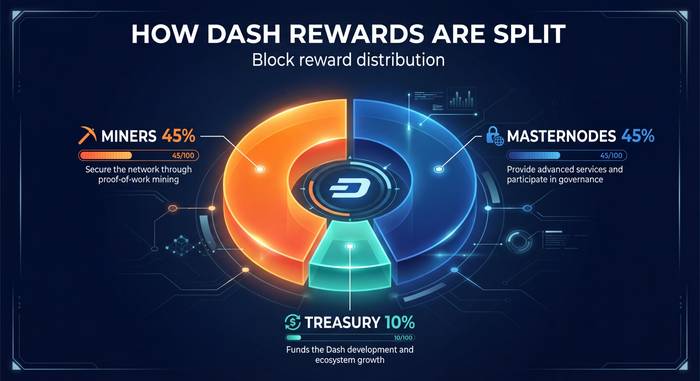
Second layer: masternodes. This was Duffield's real innovation. You lock up 1,000 DASH (about $33K at today's price) and run a server that keeps the full blockchain. In exchange you get 45% of block rewards and the right to vote on how treasury funds get spent. The masternodes handle the fancy stuff: InstantSend, CoinJoin, ChainLocks. Without them, Dash would just be another Bitcoin clone with a different mining algorithm. With them, it's actually a different kind of network.
Block rewards in Dash split three ways:
| Recipient | Share | Role |
|---|---|---|
| Miners | 45% | Secure the blockchain via proof of work |
| Masternodes | 45% | Provide InstantSend, CoinJoin, governance |
| Treasury | 10% | Funds development, marketing, proposals |
That 10% treasury is unusual. Most cryptocurrencies fund development through donations, venture capital, or a foundation sitting on pre-mined tokens. Dash funds itself from the protocol. Anyone can submit a proposal to the treasury, and masternode operators vote on whether to fund it. It's a decentralized organization baked into the coin itself, a DAO before DAOs were trendy.
InstantSend and CoinJoin: the features that matter
Two features actually matter and both depend on those masternodes.
InstantSend: you send Dash, a group of masternodes locks the transaction inputs, and the payment confirms in roughly two seconds. Not two minutes. Not ten minutes. Two seconds. At a checkout counter, that's the difference between "this works like a debit card" and "everyone's staring at me while I wait for a block confirmation." It's the single best argument for Dash as a payment coin.
CoinJoin: your transaction gets mixed in with other people's transactions. Your coins go into a pool, different coins come out. Way harder to trace who paid whom. It's optional though. Default Dash transactions are transparent like Bitcoin. You turn on CoinJoin when you want privacy, similar to choosing cash over a credit card in the physical world. Dash isn't as private as Monero (where mixing is mandatory on every transaction) but it's a meaningful step up from Bitcoin.
There's also ChainLocks. Masternodes form a quorum to sign off on each new block. Somebody tries a 51% attack? They'd need to overpower the miners AND compromise the masternode layer. That double barrier is a smart design choice.
Where Dash stands in 2026
I'm not going to sugarcoat this. Dash has had a rough few years.
It peaked around $1,500 in December 2017. Next bull cycle, 2021, only got to about $460. As of March 2026 we're at $33. That's a 98% drop from the high. Daily trading volume sits around $43 million with a turnover ratio so low that CoinGecko basically flags it as "thin." If you try to sell a large DASH position, you'd move the price against yourself just by placing the order. Liquidity is a real problem.
Adoption was supposed to be the thing. DashDirect launched in July 2021 promising spending access at 375,000 stores and 155,000+ websites. Which sounds amazing until you realize most of that works through gift card integrations, not native DASH checkout. It's the crypto debit card trick again: technically you "paid with Dash," practically someone converted it to dollars behind the scenes. The Dash Core Group is still building. Dash Platform and DashPay aim to replace wallet addresses with human-readable usernames and make the whole experience feel like Venmo. Could be great. Could also be too late.
Good stuff though? The network works. Over 3,500 masternodes humming along. ChainLocks doing their job. Treasury model still funding development without outside investors. Cypherock X1 hardware wallet recently added Dash support. Small win, but real infrastructure matters.
Dash is in that weird zone where the tech is solid but the narrative is gone. Whether that's a buying opportunity or a value trap depends entirely on whether the payments narrative comes back to crypto. I honestly don't know which way that goes.
| Metric | Value (March 2026) |
|---|---|
| Price | ~$33 |
| Market cap | ~$413 million |
| Rank | ~#108 |
| Circulating supply | ~12.4 million DASH |
| Max supply | 18.9 million |
| Active masternodes | ~3,500+ |
| Block time | ~2.5 minutes |
| InstantSend speed | ~2 seconds |
| Transaction fee | ~$0.0002 |
| Mining algorithm | X11 (proof of work) |
Dash vs Bitcoin: a quick comparison
| Feature | Dash | Bitcoin |
|---|---|---|
| Primary purpose | Digital cash for payments | Store of value |
| Consensus | PoW + masternodes (two-tier) | PoW only |
| Block time | 2.5 minutes | 10 minutes |
| Fast payments | InstantSend (~2 seconds) | Lightning Network (off-chain) |
| Privacy | CoinJoin (optional mixing) | Pseudonymous only |
| Supply cap | 18.9 million | 21 million |
| Governance | On-chain treasury + masternode voting | Off-chain (BIPs, community consensus) |
| Market cap (2026) | ~$413M | ~$1.33T |
On paper, Dash wins on payments. Faster, cheaper, has privacy built in. In reality, Bitcoin won the whole game by not trying to compete on payments. BTC became digital gold. Dash wanted to be digital cash, but that niche got crowded fast. Litecoin, Bitcoin Cash, XRP, and now stablecoins all fight for the same "spend me at the store" position. And stablecoins don't have the volatility problem that makes merchants nervous about accepting crypto in the first place.
Is Dash worth buying in 2026?
Not going to tell you what to do with your money. But I'll lay out both sides because I think it's more complicated than people admit.
Why someone might buy: the tech actually works, which is more than you can say for a lot of altcoins. Two second payments. Fees that are essentially zero. A governance system that funds its own development without needing VCs or a foundation sitting on a pile of tokens. If crypto payments ever get real traction at the point of sale, Dash is one of the few coins that's already built for it. And at $33, it's either a bargain or a trap. Both are possible.
Why someone might not: the market has been saying "no thanks" for years. Down 98% from the peak isn't a bear market. It's a narrative collapse. Stablecoins solve the payment problem without any price volatility. Lightning Network gives Bitcoin fast payments. Dash's instamine controversy never went away. Trading volume is low enough that getting in or out of a big position is genuinely difficult. And the developer ecosystem is small.
My honest take? If you believe digital cash coins will have a comeback and you're comfortable losing what you put in, Dash has working technology and a track record of not dying. If you need safety, this isn't it.



