What Does ’Yeet’ Mean? Origin and Dictionary Entry
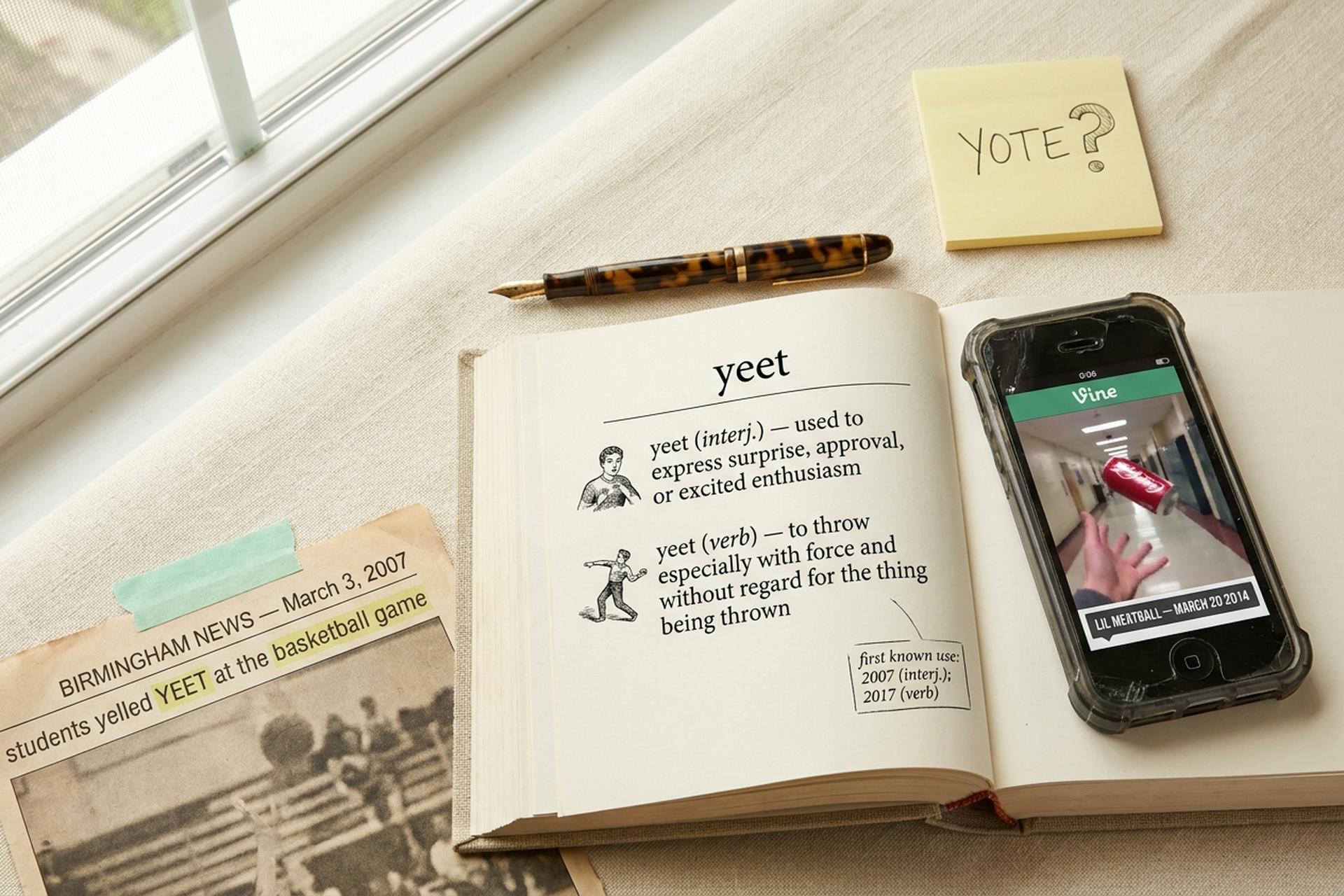
March 3, 2007. The Birmingham News, covering a basketball game at Ramsay High in Alabama, quoted students yelling something the reporter could not quite spell. The word was "yeet". Seven years before Vine launched the dance global. Fifteen years before Merriam-Webster slid it into the dictionary. Almost two decades before Gen Alpha would start teasing millennials for still using it. Already being yelled in the bleachers.
So what is the article? A clean look at what yeet actually means. The timeline from Birmingham to TikTok. The dictionary entries that finally formalised it. Parts of speech and the joke past tense ("yote"). The AAVE roots academic linguists trace it back to. And where the word stands in 2026 now that Gen Alpha has mostly moved on. No fake experts. No fabricated stats. Real history, real sources, plain language.
What Does 'Yeet' Actually Mean? A Working Definition
Shortest working definition has two pieces. As a verb, yeet means to throw something with force. Often without much care for where the object lands. As an interjection, it expresses surprise, approval, or excitement. Same emotional register as "yes" or "let's go".
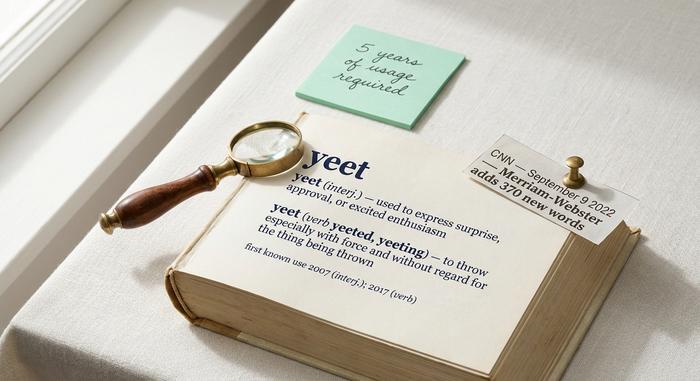
Merriam-Webster, which added the word in September 2022, splits it into exactly those two senses. The interjection is glossed as "used to express surprise, approval, or excited enthusiasm". The verb: "to throw especially with force and without regard for the thing being thrown". Dictionary.com tacks on a second verb sense for movement: "to move forcefully or quickly". That covers the "I'm gonna yeet myself out of bed" usage that became common somewhere around 2017 and 2018.
What ties both meanings together? Forceful release. A throw releases an object. An exclamation releases a feeling. Yeet does either job equally. That dual life is most of why the word spread so quickly across so many different contexts.
The Etymology of Yeet: From Birmingham to Vine
Most popular timelines start in 2014 with the Vine. The actual etymology runs deeper.
The earliest documented appearance in print is the Birmingham News article on March 3, 2007. Students were yelling "yeet" at a basketball game; the reporter wrote down what they heard. A year later, on March 11, 2008, an Urban Dictionary contributor going by "Bubba 'Skoal' Johnson" added the first online entry, defining yeet as a basketball exclamation used by a player who was certain a three-pointer was going in.
A short timeline puts the rest of the history in order.
| Date | Event |
|---|---|
| March 3, 2007 | Earliest print appearance, Birmingham News |
| March 11, 2008 | First Urban Dictionary entry |
| February 12, 2014 | Yeet dance YouTube clip by Milik Fullilove |
| February 28, 2014 | Hip-hop track titled "Yeet" by Quill |
| March 1, 2014 | Yeet Facebook page launched, 29,000+ likes in first month |
| March 20, 2014 | Lil Meatball Vine posted by Jasmine Nicole |
| April 2014 | Twitter creator network spreads the dance to mainstream feeds |
| 2017 | First documented verb usage, per Merriam-Webster |
| February 17, 2018 | Donovan Mitchell wins NBA Slam Dunk Contest amid peak yeet era |
| 2018 | American Dialect Society names yeet runner-up Word of the Year (107 votes) |
| 2021 | Dictionary.com adds yeet among 300 updates |
| September 2022 | Merriam-Webster adds yeet (one of 370 new words) |
Etymology Merriam-Webster lists the origin as "phonesthemic", meaning the word sounds like what it is, similar to "yeesh" or "yikes." The University of Colorado Boulder's linguistics blog has separately noted that the term entered mainstream English through African American English channels, a thread the Vine wave amplified rather than created.
Yeet on Vine: Lil Meatball and the 2014 Wave
The Vine moment most people actually remember is the one that broke yeet into the open internet. March 20, 2014. A creator going by Jasmine Nicole posted a clip of a thirteen-year-old from Dallas known as Lil Meatball, performing the yeet dance. Within two weeks the video had pulled more than 122,000 revines and 104,000 likes.
That Vine was not even the first. Milik Fullilove had uploaded a yeet-dance YouTube video on February 12, 2014. A hip-hop track called "Yeet" by Quill went up on February 28. A Yeet Facebook page launched March 1 and racked up nearly 30,000 likes in its first month. So by the time Lil Meatball hit Vine, the dance was already spreading. Know Your Meme credits a cluster of early creators with seeding it: @1ballout_, @Thefuhkinmann, @KronicCaviar, @AXXXXJXY, @JollyceM, @SmashBro_KB.
What did Vine actually contribute? The visual format. A six-second loop of someone yeeting an empty soda can across a hallway sticks in your head better than any paragraph could. The platform died in 2017. The word survived the platform.

Verb, Interjection, or Noun? Yeet's Parts of Speech
Most slang words sit in one part of speech and stay there. Yeet quickly stretched across three.
| Part of speech | Example | Sense |
|---|---|---|
| Interjection | "I got the job, yeet!" | Excitement, surprise, approval |
| Verb (transitive) | "He yeeted the ball into the hoop." | To throw with force |
| Verb (intransitive) | "I yeeted out of there as fast as I could." | To move forcefully or quickly |
| Noun | "He hit the yeet at the end of the song." | A specific dance move |
This grammatical flexibility helps explain how quickly the word colonised English. A new slang term that works as one part of speech has to fight for adoption. A term that works as four flows into whatever sentence shape is convenient.
The transitive verb sense became the most-used form by around 2017, which lines up with Merriam-Webster's first-known-use date for the verb. The dance noun lives mostly in references to the original 2014 wave; few people in 2026 would describe a current dance as "the yeet."
Yeet Examples in Real Sentences Today
Worth seeing the word in context. An example is worth more than any definition. Below are a few real sentences in current usage, each one illustrating a different sense.
- "Just passed my driving test. Yeet." (interjection, approval)
- "He yeeted his backpack across the room and collapsed on the bed." (transitive verb)
- "I yeeted out of that meeting the second the camera was off." (intransitive verb, fast movement)
- "She yeeted a paper airplane that hit the ceiling and stuck there." (transitive verb)
- "Did you see Tyler? He yeeted that goal in from the halfway line." (transitive verb, sports)
Notice how the same word pulls totally different duty. The interjection feels like a celebration. The transitive verb feels like a small piece of physical comedy. The intransitive verb feels like an escape. All three readings are valid; the surrounding sentence picks the right one with almost no conscious effort.
When Yeet Joined the Dictionary
The dictionary path for yeet is a useful little case study in how slang formally enters English.
Dictionary.com went first, in 2021, slipping yeet in alongside roughly 300 other update entries. Merriam-Webster followed in September 2022, adding yeet inside a batch of 370 new words and phrases that drew major coverage from CNN, NPR, and CBS News. Merriam-Webster's stated standard for inclusion is "sustained, widespread, and meaningful use across extended periods and diverse communities". Yeet had cleared that bar.
There is a running self-aware joke from the lexicography team. As Merriam-Webster put it, "we don't just yeet it into the dictionary the first time we encounter it". The unwritten rule of thumb is roughly five years of consistent published usage. Which is why a word that broke on Vine in 2014 took until 2022 to make the official Merriam-Webster cut.
What about Oxford? The Oxford English Dictionary has not, to public record, formally added yeet as of mid-2026. OED tends to lag the American dictionaries by several years on internet slang. Whether yeet makes the cut before it goes fully out of fashion is an open question.
Past Tense Yote: An English Strong-Verb Joke
The most consistently entertaining piece of yeet's grammar is the running argument about its past tense.
The standard, dictionary-recommended past tense is "yeeted." That is the form Merriam-Webster lists. It is what most speakers actually say.
The funnier alternative is "yote." That form treats yeet as if it were a strong verb in the Old English tradition, the kind that gives English speak/spoke/spoken and freeze/froze/frozen. Apply that pattern to yeet and you get yeet/yote/yoten. Some speakers go further with "yought" by analogy with seek/sought. None of this is grammatically correct in any standard sense. That is exactly why it is funny.
The Language Log blog at the University of Pennsylvania's Linguistic Data Consortium has written about the joke seriously. Eric S. Raymond titled a 2019 blog post "Yeet not, unless ye be yoten upon," which has become an unofficial benchmark of how committed to the bit a writer can be. The construction is a bit of mock Germanic morphology that English-speaking internet users have collectively kept alive for almost a decade.
In a polished sentence, use yeeted. In a chat with friends who appreciate dead languages, use yote. Both are signalling something more than meaning.
AAVE Roots and the Bleaching of Yeet
A linguistic analysis published by the University of Colorado Boulder in May 2021 made a sharper point about yeet's history than the dictionary entries do.
The paper described yeet as a case of indexical bleaching. The term refers to a pattern in internet language where a word originating in African American English migrates to mainstream platforms and, in the process, loses recognition of its Black cultural origins. The paper analysed Twitter usage and identified two clusters of yeet users. One cluster acknowledged the word's AAE roots and used it accordingly. The other used it without that context, often in mock or comedic ways.
This is not a niche academic concern. The same pattern has played out with "lit," "salty," "on fleek," and many other terms. A word coined in Black communities goes viral, the broader internet picks it up, and within a few years the AAE provenance is invisible to most users. The mainstream dictionaries that eventually add the word rarely flag this history.
For readers who want to use yeet without flattening that history, the practical recommendation from the linguistics literature is straightforward. Acknowledge the origin where it matters; do not use AAE-coded terms in mock-Black ways; and recognise that the internet's appetite for new words is also an appetite that consumes their cultural context.
Is Yeet Still Popular in 2026 ?
The honest answer is: less than it was, and for a specific reason.
By 2025, Gen Alpha slang trackers had logged a clear shift. Yeet had been displaced in active vocabulary by a new wave of terms: "rizz" (charisma), "sigma" (lone-wolf cool), "skibidi," "gyat," "fanum tax," "negative aura." Strommen's Gen Alpha slang report in 2025 went so far as to flag yeet as a word that no longer appears in active use among middle-school students. Parade's running Gen Alpha slang explainer makes the same call. When millennials use yeet in 2026, they are doing what Gen X used to do with "groovy" or "rad" — speaking the slang of a previous youth cohort that no longer claims them.
That is not a death sentence for the word. Yeet is durable enough to have crossed into the dictionary, which means it will keep showing up in news headlines and brand copy long after it has stopped being cool. But the cultural energy has moved on. By the time a word is in Merriam-Webster, it is almost always too late to be the next thing.
How Parents Can Talk to Kids About Yeet
Parents who hear their kid yeet something and want to ask about it have an easy way in.
The word itself is not problematic. No drug reference. No sexual euphemism. Plain slang. Two minor exceptions worth knowing about. First, "yeet" sometimes shows up in dark-humour TikTok corners as a euphemism for self-harm jokes. Second, yeet has been used in mockery of AAE speakers, which is a context-dependent harm rather than a property of the word itself.
What is the practical playbook for most parents? Ask what the kid actually means by it. If the answer is "I yeeted my homework into my backpack", that is the verb in action. If the answer is "yeet" as a victory shout, that is the interjection. If the answer is anything else, the conversation has just surfaced something more interesting than the word itself.
Slang vocabulary moves fast. It is a generational marker. Asking about it without judgment generally produces better information than trying to ban it. By the time you have read this paragraph, half the words your kid uses will already have shifted anyway.