MB Meaning: Megabyte, My Bad, and Every Other MB
You get a text from a friend: "sorry forgot ur bday mb." You stare. Is "mb" megabyte? Are they billing you for storage? Are you supposed to reply with a gigabyte?
Two letters, one acronym, and at least a dozen meanings depending on where you see it. In 2026 the same "mb" can appear in a Gen Z apology, a product page listing storage, a mobile data plan, a Bitcoin explorer, or a Mercedes-Benz ad. Context does most of the heavy lifting. When context is not enough, this guide will do the rest.
The short answer: in a text message, MB almost always means "my bad," a casual apology. In tech, MB is the megabyte, a unit for measuring file size, memory, and data. Everywhere else, it is something more niche. Below we go through every MB you are likely to run into, with examples, numbers, and one table to decode any MB you meet online.
MB Meaning in Text: Why It Usually Means 'My Bad'
Scroll through any chat app and "mb" is probably in there. A Preply survey of 1,820 US residents published in April 2025 found that roughly 1 in 9 Americans admits to using an acronym in text without knowing exactly what it stands for. MB sits right in that group. Most of the time it means "my bad", a low-effort apology for something small. Missed your turn at pool, showed up late, sent the wrong meme: mb, mb, and mb.
The phrase "my bad" is older than the texting form. The Oxford English Dictionary traces it to a 1986 basketball guide, with earlier spoken use on courts in the late 1970s. NBA player Manute Bol is often credited with pushing it into pro basketball vocabulary in the late 1980s, and the 1995 film Clueless moved it into the mainstream teen lexicon. The two-letter abbreviation came later, alongside SMS character limits and the rise of lowercase, punctuation-free social apps like Snapchat and Discord in the 2010s.
There is a generational gap. Data from The Local Project shows that US adults aged 18–24 send and receive over 128 texts per day, while adults over 55 manage about 16, an 8x difference. If you talk to teenagers in lowercase all day, "mb" is muscle memory. If you email for a living, you may never have typed it. The Preply survey also flagged a quiet surprise: millennials slightly beat Gen Z on acronym comprehension by 1.5 percentage points, despite Gen Z being the more confident group.
A few real examples of MB in use:
- "just saw ur message mb" (apology for slow reply)
- "mb i forgot to send the file" (small-error apology)
- "oh mb you meant the Thursday one" (admitting a misunderstanding)
- "i thought u left already mb lol" (playful, not seriously regretful)
Close cousins of the "my bad" meaning show up too, and they depend on the reader to pick the right one:
- Maybe or might be. "wanna go to the party?" "mb" as an open, non-committal answer.
- Message back. "mb me later" on older chat platforms.
- Mind blown. Used as a reaction, often after surprising news.
The rule of thumb: if the sender did something wrong or awkward, MB is "my bad." If the sender is answering a question without committing, it is closer to "maybe." If the sender is reacting to a wild fact, it is probably "mind blown." Reading the two messages above and below "mb" resolves almost every case.
Where MB is not fine: formal emails, client messages, and any job context stricter than a tech startup. In those settings write out "sorry for the mix-up," "apologies for the delay," or a full sentence. Two-letter apologies read as careless.
MB as Megabyte: The Standard Digital Storage Unit
Pop open the storage panel on your phone. Jam a USB drive into a PC. Almost every number shown next to an app, a photo, or a folder is either in MB or in its bigger sibling GB. That's the megabyte: a basic unit of digital information. It lives on every computer, phone, and connected device you have touched in the past 20 years.
Start at the smallest step. One megabyte is roughly 1 million bytes. One byte is eight bits. And a byte is how much digital information a computer needs to remember a single character, whether that's "A," a number, or a symbol. Multiply by a million and a single MB can comfortably hold a short novel, a 500-page reference document in plain text, a compressed pop song, or a modest photo. The "M" comes from the SI prefix "mega," which is just 1000 × 1000. Neat math. Widely used. A convenient shortcut that still carries the entire tech world.
Two things trip up new users here.
Capital B versus lowercase b. Capital B is a byte, lowercase b is a bit. One megabyte equals eight megabits. File sizes use MB. Internet speeds use Mbps, megabits per second. A 100 Mbps connection can shove about 12.5 MB per second down the pipe at best. Your internet provider quotes Mbps because the bigger number reads better on a billboard.
MB versus MiB. Storage companies sell drives using decimal MB of 1,000,000 bytes. Operating systems used to count the same drives in binary MB of 1,048,576 bytes, which is 1024 × 1024 sitting on powers of 2. That 4.8% gap is why your shiny "1 TB" drive shows up as 931 GB in Windows. In 1999 the International Electrotechnical Commission published the mebibyte, shorthand MiB, along with binary prefixes meant to live beside SI prefixes without stepping on them. The IEEE, ISO, and NIST all blessed it. And yet most real-world gear still says MB for both. Context keeps doing the job. The accuracy gap only starts to matter when you are doing exact storage math.
Want some real-world anchors for what a single MB feels like? Quick tour. A typical uncompressed photo from a mid-range camera runs 3–5 MB. iPhone JPEGs sit at 3–8 MB. HEIC is 2–5 MB. ProRAW can easily blow past 25 MB. One minute of 128 kbps MP3 audio comes in at about 1 MB. A page of plain text without any formatting? Well under 10 KB. A short uncompressed novel, still right around 1 MB. A three-minute 1080p video clip lands anywhere from 150 to 300 MB depending on codec.
Inside memory and RAM, an MB looks downright tiny. A mid-range 2026 phone has 8 GB of RAM, which is 8,192 MB. Flagship models stretch to 16 GB. Gaming laptops routinely go 32 GB. Back in the 1990s a full desktop PC ran on 16 MB of RAM total and engineers had to sweat every kilobyte. That lineage explains why MB survives in documentation and spec sheets even now, when GB and TB dominate every consumer conversation.
MB, MiB, and Mbps: Definitions, Examples Per Second
Almost every digital confusion story starts with these three abbreviations. Three similar labels. Three different jobs. Mix one up and nothing on your screen lines up with what you thought you bought.
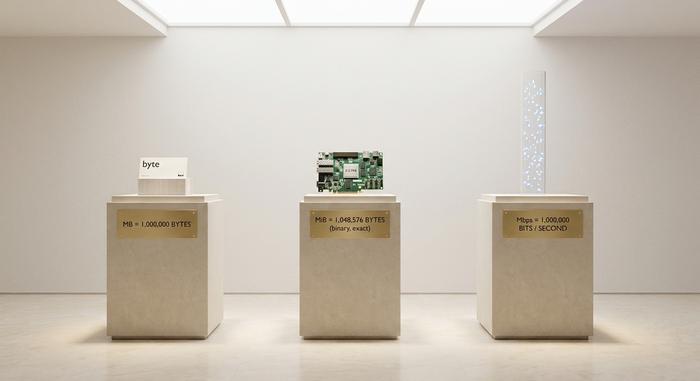
Start with plain MB. The megabyte. Your file-size and storage unit. One MB comes in two flavors depending on who is doing the counting. Drive makers use 1,000,000 bytes, the tidy decimal number lifted straight from SI. Operating systems and memory vendors historically use 1,048,576 bytes, the binary version. At small scale nobody feels the gap. By 500 MB the two definitions already disagree by about 24 MB. Scale up from there and the gap keeps growing with you.
Now MiB. Say it as "mebibyte." The IEC invented the label so the binary version would stop pretending to be the decimal one. Exactly 1,048,576 bytes, no wiggle room. Where does MiB show its face? Linux command-line tools. Engineering datasheets. Hobby-hardware documentation. FPGA boards, for one, will list 512 MiB right next to 536 MB so nobody can claim the two labels mean the same thing. IEEE, ISO, and NIST all blessed MiB. Best Buy shoppers still almost always see plain MB on the box.
Finally Mbps. A speed, not a size. Megabits per second, lowercase b. Divide by eight to get real megabytes per second out of a download. Internet speed tests and carrier billboards all trumpet Mbps because the number lands eight times bigger than the real MB/s figure, and big numbers sell plans. Netflix's own streaming guidelines are 5 Mbps for HD and 25 Mbps for 4K, which translates to about 0.6 MB/s and 3.1 MB/s of real throughput.
Here is a simple decoder for these related acronyms.
| Acronym | Stands for | What it measures | Example |
|---|---|---|---|
| MB | Megabyte | Data stored | A 5 MB photo |
| MiB | Mebibyte | Data stored (binary) | 512 MiB of RAM |
| Mb | Megabit | Data per unit (1/8 of MB) | Rarely used alone |
| Mbps | Megabits per second | Network speed | 100 Mbps broadband |
| MBps | Megabytes per second | File transfer speed | 12.5 MBps at 100 Mbps |
If you remember one thing, remember this: lowercase b is for bits and travels through cables; uppercase B is for bytes and sits on your disk. Every mismatch in the wild comes from mixing the two.
How Many MB in a GB? Drives, File Sizes, Storage
Wondering if your 32 GB phone plan is generous or laughable? The answer starts with a conversion nobody explains clearly on the signup page. In the decimal SI system, a gigabyte is 1,000 MB. Most operating systems count in binary instead, so for them a gigabyte is 1,024 MB. A tiny difference on paper. The moment you buy a terabyte drive, the difference turns into dozens of missing gigabytes that weren't actually missing.
A ladder, from the smallest unit to the absurdly large, makes the scale land.
| Unit | Equals | Typical example |
|---|---|---|
| Byte (B) | 1 byte | One character of text |
| Kilobyte (KB) | 1,024 bytes | A short email |
| Megabyte (MB) | 1,024 KB | A high-resolution photo |
| Gigabyte (GB) | 1,024 MB | About 250 songs (MP3) |
| Terabyte (TB) | 1,024 GB | A mid-range internal drive |
| Petabyte (PB) | 1,024 TB | Internet archive for a mid-size library |
| Exabyte (EB) | 1,024 PB | Internet-scale monthly traffic |
A few rough conversions worth keeping in your head:
- 1 GB fits roughly 250 MP3 songs, 200 high-res photos, or about 4 hours of standard-definition streaming.
- 1 TB carries a chunky personal archive of photos and videos, or thousands of ebooks.
- A 128 GB phone can in theory hold 130,000 MB, but apps, the OS, and caches devour that number faster than you'd expect.
Quick warning for anyone shopping for external storage. A drive labeled "500 GB" is using the decimal meaning: 500,000,000,000 bytes. Plug it in, format it, and the OS counts in binary. It shows 465 GB. The drive isn't lying. The OS isn't broken. Two different unit conventions, one label.
MB in Real Life: Email Attachments, Video, RAM, USB
Five places cover almost every time you'll see an MB label in daily life.
Email first. Gmail won't let you attach more than 25 MB to a single message. Anything bigger ends up in Google Drive instead. Outlook's cap sits in the same zone, 20 to 25 MB. That's precisely why everyone in an office eventually learns to compress a PDF or replace a clip with a shared link. One raw 4K video off a phone will sail past the limit before you finish writing the subject line.
Video next. A one-minute 1080p smartphone clip lands around 60 to 130 MB. Bump to 4K at 60 fps and a single minute can pass 500 MB. Streaming hurts the wallet less, because Netflix and YouTube squeeze everything on the fly. Netflix at standard quality hovers near 1 GB per hour, about 17 MB a minute. Need a mental shortcut for file-size math? Every step up the ladder multiplies by roughly 1000 in SI or 1024 in binary. End of chart.
RAM runs in a totally different gear. A mid-range 2026 phone ships with 8 GB of random-access memory, which is 8,192 MB if you insist on the old units. Flagships hit 12 or 16 GB. Gaming laptops happily go 32 GB. Windows 11 treats 4 GB as a floor and really breathes at 16. One background browser tab often devours 100 to 300 MB all by itself. Anything smaller on a modern spec sheet feels antique.
USB flash drives left megabyte territory long ago. The cheapest stick in 2026 still starts at 16 GB, or 16,000 MB. The 1-GB, 256-MB, and 64-MB drives that used to fill every office drawer are now sold mostly as nostalgia. Micro-SD cards run 64 GB up to 1 TB for cameras, drones, and handhelds. A modern PC almost never touches anything under a few GB in its own drives.
Last, mobile data plans. This is where MB still genuinely bites. Ericsson's November 2025 Mobility Report puts the average smartphone at 21 GB of mobile data a month globally, roughly 700 MB a day. North American subscribers average 25 GB a month. Users in the India region top the chart at 36 GB. A single 30-minute HD Netflix session alone eats about 500 MB. No wonder "unlimited" plans almost always bury a deprioritization threshold a few dozen gigs in.
MB in Bitcoin: 1 MB Block Size and What It Means Today
Step into any crypto conversation and MB flips meaning. Here, it's the maximum size of a Bitcoin block. Tiny number. Gigantic consequences. Few numbers in open-source software have caused this much shouting.
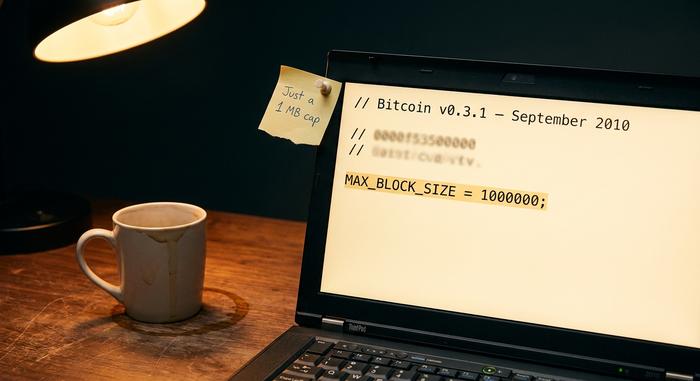
Satoshi Nakamoto slid the 1 MB cap into Bitcoin v0.3.1 in September 2010 (the commit itself is dated July). The motive was boring. Stop opportunists from spamming the young network with oversized blocks. Satoshi and Hal Finney both spoke about the cap as temporary. Temporary turned permanent. Permanent became the fuse on the longest civil war the space has seen.
Between 2015 and 2017, Bitcoin split along scaling lines. Big blockers pushed for a raise. Bitcoin XT wanted 8 MB. Bitcoin Classic wanted 2 MB. Bitcoin Unlimited wanted no cap at all. Small blockers dug in. Their case: larger blocks make running a full node expensive, and expensive nodes mean the network centralizes around big miners and big server farms. The standoff earned itself a name, the Block Size Wars, and ended, more or less, in August 2017.
The way out was Segregated Witness. SegWit moved signature data out of the main block and tucked it into a separate "witness" area. It also swapped raw-byte accounting for weight units. On paper, the ceiling shifted close to 4 MB. SegWit locked in on August 9, 2017 at block 479,808 and activated on August 24, 2017 at block 481,824. That same month, big blockers forked off Bitcoin Cash with 8 MB blocks. Bitcoin Cash later went to 32 MB and, since May 2024, runs an adaptive block-size algorithm with no fixed upper bound.
Taproot came next, on November 14, 2021 at block 709,632. Taproot did not touch the size limit. What it brought was Schnorr signatures (a touch smaller) and a fresh scripting layer that cracked the door open for Ordinals. Starting early 2023, Ordinals began stuffing images, text, and BRC-20 token data into Taproot's witness space, which gets a 75% weight discount. The effect was loud and fast. Bitcoin's average block size peaked at 2.29 MB in March 2024 during the height of the inscription boom, per D-Central's data.
And now? The average Bitcoin block sits near 1.626 MB as of March 30, 2026, per blockchain.com figures cited by AMBCrypto. Inscription share of block space has crashed from roughly 50% at its 2024 peak down to under 5% in 2025. Daily inscription fees run near $300,000 across the whole network. The full chain crossed 692.65 GB in October 2025 and keeps padding 100 to 150 GB a year on top of that.
| Milestone | Date | Block size detail |
|---|---|---|
| Satoshi caps block size at 1 MB | Sept 2010 | Hard-coded in v0.3.1 |
| Block Size Wars peak | 2015–2017 | XT, Classic, Unlimited proposed 2–8 MB |
| SegWit activates | Aug 24, 2017 | Weight cap ~4 MB theoretical |
| Bitcoin Cash hard fork | Aug 2017 | 8 MB, later 32 MB |
| Taproot activates | Nov 14, 2021 | Enables Ordinals |
| Ordinals peak block size | Mar 2024 | 2.29 MB average |
| Current average block size | Mar 30, 2026 | 1.626 MB |
Ethereum does not use MB the same way. It caps each block by gas rather than bytes. Post-Merge, the Ethereum gas limit ran at about 30 million; it stepped up to 36 million in February 2025 and reached 45–60 million later in 2025, roughly doubling within a year. Block throughput, not physical block size, is Ethereum's scaling metric. Different blockchains, different ceilings.
Other Meanings of MB and Usage Tips for Each
Slang and storage eat up most of what people actually search for. Even so, MB is one of the most overloaded two-letter acronyms in active circulation. A short list of the others, so the next one you spot in the wild makes sense:
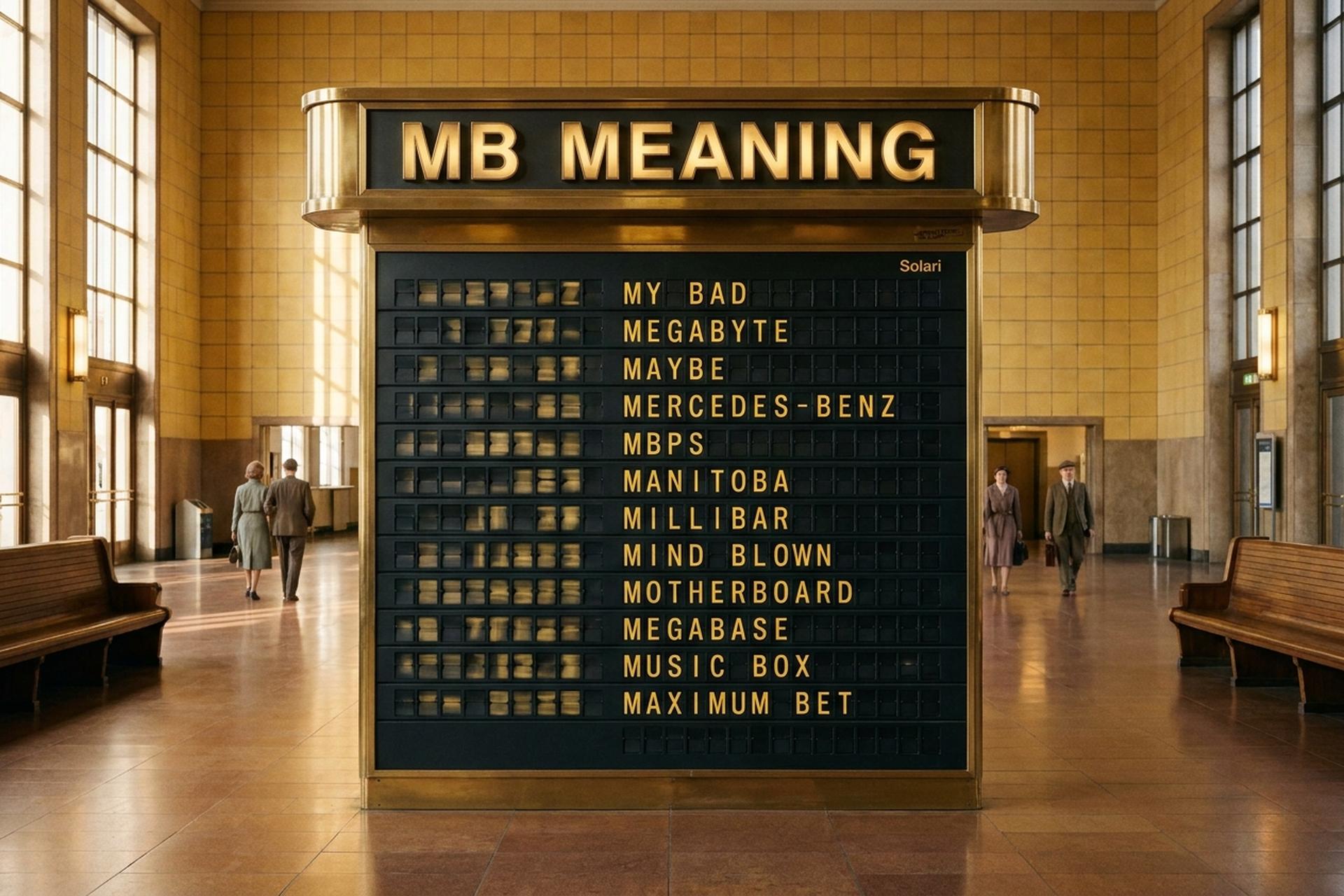
Mercedes-Benz. The German carmaker uses MB on product pages, parts catalogs, and enthusiast forums.
Millibar, written lowercase mb. An atmospheric pressure unit you still see in weather reports. Sea-level pressure is about 1013.25 mb. The SI replacement, hPa, keeps creeping in, but it hasn't killed the old label yet.
Manitoba, postal code MB. Canadian province. A Winnipeg address ends in "MB."
Megabase, lowercase Mb. A genomics unit equal to one million DNA base pairs. If the reference material you're looking at is a paper on gene sequences, Mb is almost never a megabyte.
Maximum bet. Slot machines and some online casinos label the max-bet button as "MB."
Music box. Niche gaming term for in-game background tracks or items.
Bachelor of Medicine. Written "MB" in medical degree listings, especially outside the US.
Motherboard. A staple abbreviation in PC-building subreddits, forum threads, and product reviews.
So when should you type "mb" yourself, and when should you spell it out? Quick cheat sheet:
- Personal texts, Discord, Twitch, Instagram DMs, TikTok comments: MB for "my bad" is fine. Context handles the rest.
- Professional email, client messages, academic writing: write "my apologies," "I apologize for the mistake," or a full sentence. Acronyms read as flippant.
- Technical documentation, product specs, drive labels: use MB for megabyte, MiB where accuracy really matters. Mixing the two inside one document reads as sloppy.
- Crypto discussion: use MB for block size, GB for full-chain weight, bytes or vBytes for transaction size. Keep Mbps out unless you're genuinely discussing network throughput.
Consistency beats correctness here. A page that flips between Mb and MB and MBps will lose every reader, no matter which convention is technically right. Pick one, stick with it, and define it once in plain English early on.