DCA Trading Bot: Buying Low, Selling High in Crypto
Crypto prices refuse to sit still. Bitcoin trades near $77,000 in April 2026. Last October, it lost 14% in a single session, and $19 billion in leveraged positions was wiped out before most of Asia had finished breakfast. If you have ever stared at your phone wondering whether to buy, hold, or run, you already know the real problem with investing in crypto: it is not the asset, it is the timing.
This is where a DCA trading bot earns its keep. The bot does not guess the bottom. It does not wait for the perfect moment. It just executes your plan on schedule, buying a fixed amount of an asset at regular intervals and quietly building an average entry price while you do something else with your day.
The rest of this guide walks through how these bots work, how to set one up, which platforms make sense in 2026, and where the whole approach breaks down. It is aimed at beginners, though the comparison tables should still save a few hours of research for anyone who has used bots before.
Understanding Dollar-Cost Averaging in Crypto Trading
Dollar-cost averaging is one of the oldest ideas in investing. Instead of putting a large sum into an asset at a single moment, you split that sum into smaller slices and invest each slice at regular intervals. Over time, your average entry price reflects the ups and downs of the market rather than the price on one specific day.
The math is simple. If you buy $100 of Bitcoin every week for a year and BTC trades between $60,000 and $110,000 during that period, your average entry will land somewhere in the middle. You will not catch the exact low, but you also will not load your entire position at the top. That is the whole point of using dollar-cost averaging: you trade the hope of perfect timing for a much lower impact of volatility. Fixed dollar amounts and a strict schedule also distribute your investment across moods, news cycles, and cryptocurrencies you might otherwise avoid on a bad day.
Crypto markets are an unusually good fit for this approach. Traditional equity markets rarely move more than 2–3% in a day. Bitcoin routinely moves 5% or more, and altcoins can double or collapse inside a week. In that kind of environment, trying to time the market is a losing game for most retail investors, while a dollar cost averaging strategy works quietly in the background regardless of short-term noise. A 2025 industry survey cited by the Rockland Times found 83.5% of crypto investors have used DCA at least once, and 59% use it as their primary strategy.
What Is a DCA Trading Bot and How DCA Bot Works
A DCA trading bot is an automated trading tool connected to your exchange account through an API key. It watches the market, follows the rules you gave it, and places buy (and sometimes sell) orders on your behalf. You never have to open the app and click "buy" again.
Here is how a typical DCA bot works in practice:
1. You connect the bot to an exchange like Binance, Coinbase, or OKX using a read-and-trade API key (no withdrawal permission required).
2. You pick a trading pair, for example BTC/USDT.
3. You set the base order size, the frequency of purchases, and optionally the price deviation that triggers extra buys.
4. You configure a take-profit target if you want the bot to exit the position when the price recovers by a certain percentage.
5. The bot then automatically buys the asset at regular intervals until you tell it to stop.
Advanced DCA bots add another layer: instead of only buying on a fixed time schedule, they place additional "safety orders" each time the price drops by a set percentage. The logic is simple: when prices are low and your trigger conditions are met, the bot places more DCA orders automatically. This pulls the average entry price lower during a dip and lets the position close profitably after even a modest bounce. That behavior is why many platforms describe smart DCA bots as tools that help you "buy low" and take profit once the market conditions allow it.
How a DCA Bot Automates Your Crypto Trading
The core job of any DCA bot is to automate crypto trading that you would otherwise have to do by hand, buying a cryptocurrency at regular intervals so you do not have to. Manual trading means remembering to open the app on the same day every week, having the money ready, watching for slippage, and resisting the urge to skip a week when the headlines turn bearish. Most people fail at least one of those steps, which is why manual DCA often drifts into "I will start next month" territory.
A bot removes every one of those friction points. It uses your exchange's API to check your balance, place the order at the exact time you scheduled, and log the trade. If you funded the account with stablecoins, it will automatically buy the asset regardless of price. If you set a deviation trigger, it will place additional buy orders when the asset drops, bringing your average cost down.
Most platforms also let the bot automatically buy and sell. The sell side is useful when you want to take profit in stages or close the entire position after a set gain. Cryptocurrency markets move both ways, and a good bot handles both directions with the same discipline. The trend is hard to ignore: roughly 65% of crypto trading volume in 2026 involves some form of automation, and the trading-bot market itself is valued at $47.4 billion in 2025, projected at $54.1 billion in 2026 according to Business Research Insights.
Setting Up Your DCA Trading Strategy in 5 Steps
Setting up a DCA trading strategy takes about ten minutes, whether you are using 3Commas, KuCoin, Bitsgap, or a built-in exchange tool. The steps barely differ between them.
Start by picking a bot provider that supports your exchange. Trade on Binance? Almost every major service works. Use a smaller exchange? Check compatibility before you pay for anything. Then create an API key on the exchange side. Give it spot trading permission only. Never enable withdrawals. Copy the key and secret into the bot dashboard.
Next comes the pair and the base order size. For a beginner account, a base order between $10 and $50 per cycle is sensible. Stick to liquid pairs like BTC/USDT or ETH/USDT unless you have a reason to do otherwise. Set the frequency after that. A simple schedule, such as every Monday at 09:00 UTC, is plenty for a long-term DCA plan. Advanced users layer price deviation triggers on top (buy extra when the price drops 3%, for example), but that can wait.
Last comes the exit rule. You can tell the bot to take profit at a specific percentage gain, or let it hold indefinitely and simply accumulate. Both are valid; they just reflect different goals. Once the bot is live, most platforms let you pause, resume, edit, or terminate it whenever you want. Backtesting the configuration against historical data before going live is highly recommended, especially if you are using technical indicators or a custom trading strategy.
Key Benefits for Crypto Traders Using a DCA Bot
Beyond the obvious "it saves time" pitch, there are concrete reasons crypto traders choose a DCA bot over pressing buttons themselves. The best bot platforms reduce the impact of single-day mistakes and reduce the risk of investing a large sum at the wrong moment. Traders who want to keep their exposure to cryptocurrency trading without watching screens all day find DCA the simplest path.
The first payoff is emotional. Fear and greed account for most retail losses, and a bot does not feel either, which helps you avoid the stress of watching red charts. The second payoff is discipline: the bot buys the same amount at the same time whether the news cycle is green or red. Over a few months, that consistency produces a lower blended cost basis than any single-date buy, because you are spreading purchases across dips and rallies instead of chasing one "good" moment.
The last two matter for beginners. Hands-off portfolio building means you can run a DCA bot for months and simply let the bot accumulate your position while you work, sleep, or travel. And most platforms ship with pre-configured templates, so you do not need to understand technical indicators to start. The bot allows you to focus on longer-term decisions, like which asset you believe in, rather than short-term price noise. That is the underlying value proposition of crypto DCA for anyone who is not a full-time trader.

Advanced DCA Bots: Safety Orders and Average Entry
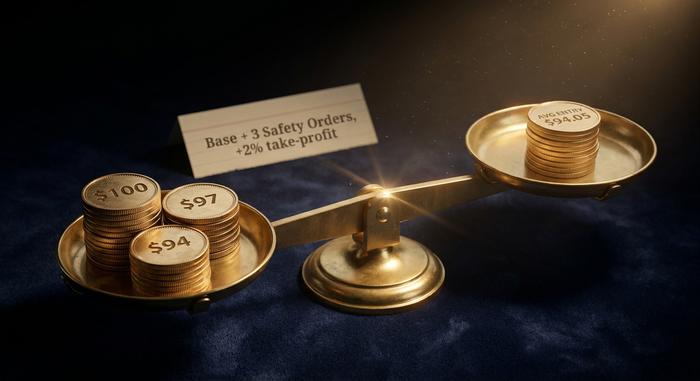
Basic DCA buys on a timer. Advanced DCA bots add a second dimension: price-based safety orders. The idea is straightforward. The bot opens a base order at the current price. If the market drops by a preset percentage, it adds a safety order. If the market drops further, another safety order kicks in. Each extra buy pulls the average entry price lower, which means the position closes profitably as soon as the price recovers to a target level set above that new average.
Here is a simple illustration using round numbers:
| Order | Price | Amount | Cumulative cost | Average entry |
|---|---|---|---|---|
| Base order | $100 | $100 | $100 | $100.00 |
| Safety order 1 (–3%) | $97 | $100 | $200 | $98.49 |
| Safety order 2 (–6%) | $94 | $100 | $300 | $96.97 |
| Safety order 3 (–10%) | $90 | $200 | $500 | $94.05 |
| Take-profit (+2%) | $95.93 | close | — | Profit |
Notice what happened. Even though the price is still below the original $100 entry, the position closes in profit because the average entry price dropped to $94.05. Advanced DCA bots can chain dozens of safety orders, use position multipliers (each safety order larger than the last), and route everything through a single take-profit rule. They are powerful but unforgiving during prolonged bear markets, where the safety orders may run out before the price recovers.
DCA Bot vs Grid Bot: Comparing Crypto Bot Strategies
DCA is not the only automated strategy around. Grid bots are the other popular choice, and they solve a different problem entirely.
A grid bot chops a price range into levels, then places alternating buy and sell orders at each one. Price bounces between the rails, bot buys low and sells high on every swing, small profits stack up. It is a range-bound tool, designed for sideways markets where nothing much is happening.
A DCA bot is the opposite temperament. It likes direction. Downtrends in particular, because each dip brings the average entry lower and sets up a cleaner exit on the rebound. It does not care where the upper boundary is. Grid trading is one branch of bot trading; arbitrage bots are another, making money on tiny price gaps between exchanges. DCA sits alongside those as a separate investment strategy focused on averaged entries over time, not short-term spreads.
Which one should you pick? Grid when the market is consolidating and volatility is high inside a tight band. DCA when you want long-term exposure, expect a recovery, or just want to automate regular purchases regardless of price. If you have enough capital, nothing stops you from running both, with one bot harvesting the chop while another accumulates the core position.
Neither approach wins in every regime. A crypto trading strategy built around both can work across different market conditions, provided the capital behind each sleeve is sized correctly.
Top Trading Platforms to Automate Your DCA Strategy
Picking the right platform matters. Pricing, supported exchanges, and customization of advanced bot settings vary widely. Many services offer a 7-day free trial or a longer window so you can use DCA features and test orders are placed correctly before committing. Here is a comparison of the most common DCA crypto trading bot choices as of 2026.
| Platform | Starting price (2026) | Users | Supported exchanges | Standout feature |
|---|---|---|---|---|
| 3Commas | Expert $140/mo ($110 annual) | 100,000+ active | 15+ (Binance, Coinbase, OKX, Kraken, Bybit) | Backtesting up to 365 days of historical data |
| Pionex | Free (no subscription) | 5,000,000+ | Pionex only | 16 built-in bots, 0.05% trading fee |
| Bitsgap | $28/mo Basic, up to $146/mo Pro | 500,000+ | 17+ | $300B+ cumulative volume, smart orders |
| Cryptohopper | $29/mo Explorer, up to $107.50/mo Hero | 1,000,000 | 16+ | Marketplace and copy-trading |
| TradeSanta | $18/mo Basic, up to $90/mo Maximum | Not disclosed | ~12 | Clean entry-level interface |
| Altrady | €20/mo | Not disclosed | 20+ | QFL signal integration, 5-day free trial |
| Binance Auto-Invest | Free | 280M+ registered | Binance only | Native DCA into Flexible Savings for APY |
| Coinbase Recurring Buy | 1.49% per transaction | 120M+ total | Coinbase only | One-click DCA, 8.7M monthly active traders |
Exchange-native bots (Binance, KuCoin, Crypto.com, OKX) are free and tightly integrated with your exchange account, which makes them a good starting point. Third-party platforms like 3Commas and Bitsgap cost money but let you automate your DCA across multiple exchanges from one dashboard, with richer features such as advanced bot settings, portfolio analytics, and copy-trading of public bots. 3Commas moved to a three-tier Starter / Pro / Expert structure on October 28, 2025, and Bitsgap reports that users have launched more than 3.7 million bots producing over $530 million in cumulative profits since 2017.
How a Crypto DCA Strategy Handles Market Volatility
Volatility is the main reason DCA was adopted in crypto in the first place. A single bad week in Bitcoin can move the price 15%. Altcoins can do that in a single day. Investors who load a full position on a good-feeling morning regularly find themselves 20% underwater by Friday, and most of them then sell at the bottom because the loss feels worse than the gain did.
A crypto DCA strategy handles that problem by converting volatility from an enemy into raw material. Each dip is just another buy at a lower price. The bot does not care if Monday was red or green. It follows the schedule, updates the average, and keeps going. Over a multi-month horizon the effect compounds, and the final blended cost ends up well below the worst price paid and above the best.
There is a practical limit to this. DCA only works if you have the patience and the capital to ride out a drawdown without stopping the plan. Stopping the bot during a deep dip is the single most common user mistake. If you believe in the asset enough to start, you have to be willing to let the bot automate the purchases through the ugly months, not just the easy ones.
Risks and Limitations of DCA Bot Strategies
DCA bot strategies are not a guaranteed-profit machine. Anyone telling you otherwise is selling something.
Prolonged bear markets still hurt. If the asset falls and never meaningfully recovers, a DCA bot will simply buy the same asset at lower prices forever. You still end up underwater, just with a smaller loss than a lump-sum investor. A 2025 Bull Bitcoin simulation across 4.7 million portfolios between 2016 and 2025 showed lump-sum beats DCA in 82.5% of scenarios; DCA only wins in the 17.5% of cases where the investor enters near a peak that is followed by a long decline, which is exactly when most beginners feel compelled to buy.
Transaction fees also accumulate. Dozens of small trades add up. On an exchange charging 0.1% per trade, weekly purchases over a year cost 5.2% of your total volume. On a lower-fee exchange it is less, but it is never zero.
Leverage is a harder problem. Some futures DCA bots use leverage and double the position on each drop. In a sharp, sustained move, they can liquidate the entire account. The May 2022 collapse of Terra/LUNA wiped Three Arrows Capital's $462 million LUNA position down to roughly $2,700 in days, and the October 10, 2025 flash crash liquidated $19 billion in leveraged positions with Bitcoin falling 14% inside a single session.
The other two risks are quieter but just as real. A bot does only what you told it to do, not what is right, so if the fundamental thesis of the asset changes no bot will notice; you still need to review positions periodically. Your bot also holds API access to your exchange, and a breach at the bot provider, or a poorly secured API key, can end badly. In December 2022, a 3Commas API-key leak exposed around 100,000 users and led to an estimated $20 million in stolen funds, documented by Halborn and tracked by a pending class action (Freeman et al. v. 3Commas). Always restrict the key to trading-only, enable IP whitelisting, and keep withdrawal permission disabled.
One more factor for EU-based users: the July 1, 2026 MiCA deadline, after which any bot platform serving EU customers must be authorized as a Crypto-Asset Service Provider or stop operating. Some smaller platforms may exit the EU rather than comply, which could strand existing users without notice.
A sensible approach is to treat a DCA bot as a tool, not an oracle. It handles the boring, repetitive part of crypto trading well. It does not replace research, risk management, or common sense.