
Exodus Wallet Review 2026: A Crypto Bitcoin Wallet Breakdown

Look, most people pick a crypto wallet roughly the way they pick a phone case. They grab whatever looks clean, install it, move on. And for years, that is basically how Exodus wallet built its user base. Pretty crypto app, no forced signup, a quiet promise that the wallet also hands you every key to your bitcoin and every other asset you drop into it. Buying and holding crypto using one app, that is the whole pitch. It is a self-custody wallet by design. Exodus doesn't collect personal information when you spin up a new wallet, and ten years later that is still the headline feature.
The pitch itself? Has not moved much since 2015. What has moved is the entire world around it. Exodus went public on the NYSE in December 2024. Its parent company now files quarterly earnings like any boring listed firm. Bitcoin Lightning support got switched off in August 2025. A supply-chain attack in April 2025 put Exodus users in the crosshairs, even though Exodus itself never actually got breached. And the wallet is, somehow, still near the top of every "best desktop wallet" list for beginners in 2026.
So the real question. Is the Exodus wallet still worth installing in 2026? This Exodus wallet review walks through the features, the fees, the security story, the staking side, the pros, the cons, and how the whole thing stacks up against Trust Wallet and MetaMask. By the time you finish reading, you will know for sure whether Exodus fits the way you hold crypto or whether you should just go look somewhere else.
What Is the Exodus Wallet? Origins & Exodus Movement
So what even is Exodus, technically? A self-custodial software wallet for crypto assets. Free to download, runs locally on your machine, and you keep full access to your wallet at literally all times. I would argue it is one of the easier crypto wallets available for someone completely new to crypto, and the wallet offers an interface that still holds up for people who have been in the space since 2017. The company behind it, Exodus Movement, Inc., got founded in 2015 in Omaha, Nebraska by two guys: JP Richardson and Daniel Castagnoli. Richardson spent years at BitPay first, and years beyond that contributing to open-source Bitcoin libraries. Castagnoli came from a design background, with past work at Apple, BMW, Disney and Nike. That pairing, a Bitcoin engineer plus a product designer, matters more than it sounds. Exodus was one of the very first wallets to actually look like a finished consumer product rather than a debugger window.
Ten years on, the company is still parked in that same niche. Exodus was founded in 2015 and that has not changed. Exodus is one of the earliest wallets to treat design as a first-class concern, and the product is still a wallet for everyday use instead of a pro trader's cockpit. Starting a crypto journey with a secure, simple wallet like this is honestly why so many people landed on Exodus in the first place. No ICO. No token. Just software you download, a 12-word seed phrase you write on paper, and support for a very long list of coins.
The public-company piece happened in late 2024. Exodus Movement went through a Form 10 registration with the SEC and uplisted from OTCQX to NYSE American on December 18, 2024 under the ticker EXOD. As of April 9, 2026, EXOD trades around $6.27 with a market cap near $187 million, well off its 52-week high of $56. The numbers are not screaming "rocket": FY2025 revenue came in at a record $121.6 million, up a modest 5% year over year, with total swap volume of $6.89 billion (+21% YoY), according to the company's own investor materials.

Exodus Wallet Features: UI, Coins, Swap, Staking
Exodus wallet features cluster around four pillars: storage, swapping, staking, and Web3. Think of it as a Swiss Army knife that tries to handle 80% of what a crypto user needs without sending them off to a centralized exchange.
- Multi-chain storage for 50+ networks and hundreds of assets
- In-app swaps through aggregators (ChangeNOW, ChangeHero historically)
- Native staking for SOL, ADA, ATOM, XTZ, ALGO, ONT, VET and more
- NFT gallery for Ethereum, Solana, and Polygon collectibles
- Trezor hardware wallet pairing on desktop
- Web3 dApp connection via the Chrome extension
- Fiat on-ramp through MoonPay and Ramp Network
- Portfolio tracking with price charts and fiat conversion
- Biometric unlock on mobile (Face ID, Touch ID, fingerprint)
Everything happens inside a single app. No sub-accounts, no separate spot/futures tabs, no sign-up flow. That is the entire Exodus pitch in one sentence.
Supported Crypto and Networks in Your Exodus Wallet
Okay, the asset count question. Exodus wallet support technically covers 50+ blockchain networks with what the company likes to call "unlimited token support" on any compatible chain. Exodus supports somewhere north of 280 assets depending on who is doing the counting, and you can easily send and receive crypto across 50 networks without ever leaving the app. Adding custom tokens? No waiting for wallet developers to list them first. You do it yourself. The model is simple: Exodus curates a core lineup of assets, all supported by Exodus directly, and then lets you manually add everything else (ERC-20, BEP-20, Solana SPL, and so on) on top of that. Which is how one wallet ends up covering roughly every crypto you are plausibly going to hold, all within one simple crypto home base.
The exact supported coin count is fuzzy on purpose, by the way. Exodus's own marketing line says "50+ networks." Google Play's listing says 350+ assets. Independent reviews bounce between 280 and 450. The reason for the spread is exactly what I described: a curated core plus custom token loading.
Which networks actually matter here? Bitcoin, Ethereum, Solana, Cardano, XRP, TRON, Avalanche, Base, Arbitrum, Optimism, Polygon, BNB Smart Chain, Algorand, Cosmos, Tezos, Polkadot. The big names, including bitcoin itself as the flagship coverage. Stablecoins (USDC, USDT, DAI) show up across multiple chains, not just Ethereum. If you care about privacy coins, Monero works for basic send and receive, and Zcash works but only in transparent mode, not shielded.
| Asset type | Examples | Notes |
|---|---|---|
| Layer 1 blockchains | Bitcoin, Ethereum, Solana, Cardano, XRP, TRON | Native support, not via wrapped tokens |
| EVM L2s | Arbitrum, Optimism, Base, Polygon | Full multi-chain balance view |
| Stablecoins | USDC, USDT, DAI | Available on Ethereum, Solana, TRON and more |
| NFTs | ETH, SOL, Polygon collections | Auto-detected in the NFT gallery |
| Custom tokens | Any ERC-20, BEP-20, SPL | Added manually by contract address |
Sources: Exodus supported assets docs, Google Play listing, Coin Bureau review.
Desktop, Mobile App and Exodus Web3 Wallet Extension
Here is the useful thing about Exodus. It runs on whatever hardware you already own, mobile and desktop. Windows laptop? Covered. M-series MacBook? Covered. Random Linux box in the closet? Also covered. The mobile app handles both iOS and Android. And the Exodus Web3 wallet lives as a Chrome extension that plays nicely with Brave too. Everything syncs through the same 12-word seed phrase, so if you lose your phone in a cab, you restore the entire setup on a new device in maybe thirty seconds. That wide coverage is part of why Exodus keeps ranking among crypto wallets available for everyday users. Honestly, it is one of the few wallets available across every major consumer OS without feeling like an afterthought on any of them.
Each surface, though, is a slightly different beast. Desktop is where the deepest feature set lives. Want to connect your Exodus to a Trezor hardware wallet? You do that on desktop, and yes, it handles every current Trezor model: Model One, Model T, Safe 3, Safe 5, and the new Safe 7. That combo gives you cold-storage signing plus the cleanest staking flow the product offers. The mobile app trades depth for convenience: Face ID unlock, fiat buys through MoonPay and Ramp, and a trimmed-down trading view that is easier to poke at while you wait in line for coffee. The Web3 wallet extension exists for one reason, DeFi. Fire it up in the browser, connect to Uniswap or OpenSea or Jupiter, sign a transaction, done.
Which one should you actually run? I mean, depends on how you use crypto day to day. Holding a small stack and mostly checking balances from the couch? The Exodus mobile wallet on its own is plenty. Planning to stake or pair with a Trezor? You need the desktop client, full stop. Spending half your evenings bouncing through DeFi protocols? Install the extension and treat it as your day-to-day Web3 wallet.
Using the Exodus Mobile Wallet on iOS and Android
Using the Exodus mobile wallet for the first time takes under three minutes. You download the wallet app, tap "Create new wallet," write down the 12-word recovery phrase offline (please, actually write it down), and you are in. That recovery phrase is the only thing that can restore your wallet if you lose the device. No email. No KYC. No phone verification. The entire onboarding flow exists to get you to a funded address as fast as possible.
The iOS app currently holds a 4.6-star rating on the US App Store with more than 35,000 ratings, which is unusually strong for a financial app. The Android app sits in similar territory on Google Play. Reviewers praise the clean layout and the fact that Exodus does not nag you for permissions you do not need.
What people actually like about it on mobile: the unified balance view across all your chains, the one-tap swap flow, biometric unlock, and the ability to buy crypto directly within the app using your bank card, Apple Pay, or Google Pay. You can also sell crypto through the same fiat partners when you need to cash out. Exodus is available on the Apple App Store and on Google Play, with the mobile client sharing features with the desktop version through a QR-code sync. You can sync Exodus across devices as often as you need. What people complain about: spreads on the swap feature, the fact that there is no traditional two-factor authentication, and occasional support delays on complex issues. None of that is unique to Exodus, but it is worth knowing before you deposit serious funds.
Built-in Exchange: Swap Crypto Directly in Your Wallet
The ability to swap crypto directly in your wallet is probably the single feature that hooked Exodus's early user base. Open the app, pick what you want to trade, get a quote, confirm. The entire flow takes under thirty seconds and never touches a centralized exchange.
Under the hood, Exodus does not run its own order book. It routes your trade to a third-party aggregator, historically ChangeNOW, ChangeHero and similar partners. In 2024 Exodus launched a rebranded "Exodus Swap" experience with fees "starting at 0.5%" plus a variable spread that moves with liquidity and market conditions. There is no flat fee disclosed publicly. You see the "you get" number before you confirm, and you decide whether to accept.
Is it cheap? Not really. Compared to doing the same trade on a top-tier centralized exchange like Kraken or Coinbase Advanced, you usually pay more through the Exodus swap. You are buying convenience, not a discount. For small portfolio rebalancing, that trade-off is fine. For moving six figures, most veterans route through a real exchange and then withdraw back to Exodus.
Staking and Rewards on the Exodus Crypto Wallet
Staking is where the Exodus crypto wallet quietly earns its keep for long-term holders. Instead of sending coins to a centralized staking platform and taking on custody risk, you can delegate directly from inside the wallet while still holding your private keys. Rewards get paid to the same address.
Supported staking assets as of 2026 include Solana, Cardano, Cosmos, Tezos, Algorand, Ontology, VeChain, and Ethereum via partners. Yields vary a lot by network. Cryptopolitan reports APR ranges between 1.24% and 13.88% across all supported assets.
| Coin | Typical APY | Unbonding period | Notes |
|---|---|---|---|
| Solana (SOL) | ~6-7% | ~3 days (epoch-based) | Delegated via Everstake |
| Cardano (ADA) | ~4-5% | No lock-up | Rewards every epoch |
| Cosmos (ATOM) | ~15-18% | 21 days | Highest yield, longest lock |
| Tezos (XTZ) | ~5-6% | None | Automatic liquid baking |
| Algorand (ALGO) | ~5-7% | None | Governance rewards |
Sources: Everstake, Bitcompare, Cryptopolitan as of 2025-2026. Live APYs move daily, so check Exodus's staking hub before committing.
Worth knowing: Exodus staking is non-custodial. You delegate to validators, but the keys never leave your device. If Exodus the company disappeared tomorrow, your staked SOL would still be yours. That is a meaningful difference from staking on Coinbase or Kraken, where you are trusting the exchange with custody.
Is the Exodus Wallet Safe for Your Crypto Holdings?
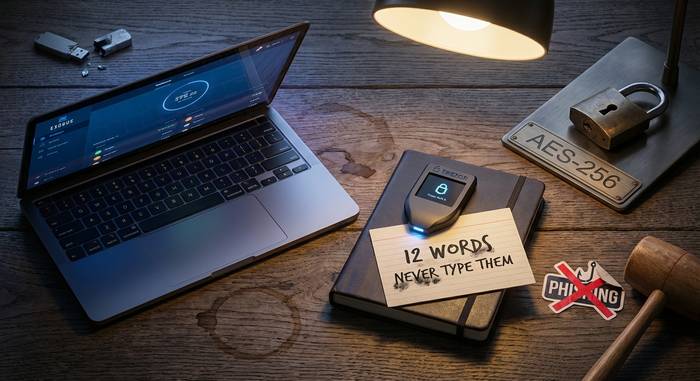
The honest answer here, and I do mean honest: Exodus is about as safe as any well-built hot wallet, which translates to not as safe as a Ledger or Trezor sitting in a drawer. That is just how software wallets work. Exodus lives on a machine connected to the internet, end of story. The wallet uses AES-256 encryption on your local keys, and you protect them with a password of your choosing. To secure crypto at any kind of scale, that is a solid baseline. It is certainly not the ceiling. Your 12-word seed phrase belongs to you and only you. Exodus never sees it, never stores it, and has zero way to recover it if you lose it. Brutal but fair.
This architecture has held up for ten full years now, which is genuinely something. There has never been a direct breach of Exodus's own infrastructure. Zero. The company runs a public HackerOne bug-bounty program specifically to surface vulnerabilities before they ever become real incidents.
Now the big 2025 footnote, and it is worth understanding because the headlines were misleading. Back in April, a malicious npm package called "pdf-to-office" got caught injecting address-swapping malware into locally installed Exodus v25.13.3 and v25.9.2. To be very clear: this was a supply-chain attack on a dev dependency. Not an Exodus breach. The official installer pulled directly from exodus.com was completely clean. The users who got hit had pulled that npm package through a separate dev toolchain and then, crucially, installed Exodus on the very same machine. The lesson is one you already know somewhere in your bones: only download your wallet from the official site, verify installer hashes if you can, and never run a crypto wallet on the same laptop you use for messy dev work.
What Exodus does not have, and what reviewers keep flagging year after year:
- No traditional two-factor authentication on the wallet itself (relies on device password plus biometrics instead)
- Closed-source codebase, which limits independent community audits
- No multisig support whatsoever
- Standard hot-wallet exposure, meaning a compromised device basically equals compromised keys
For anyone storing life-changing amounts, the standard advice still applies, no exceptions. Pair Exodus with a Trezor hardware wallet on desktop so the actual signing happens on the offline device. Keep most of your long-term holdings cold. Use Exodus only as the "checking account" layer for daily movement. And please, please, never photograph or cloud-store your seed phrase. I know people who lost everything to that one mistake.
Fees, Pricing, and How to Use Exodus Profitably
You use the wallet for free. The app costs nothing to download, nothing to install, and nothing to hold coins in. Within the app, every core feature is free to use. Sending and receiving carries only the standard blockchain network fee, which goes to miners or validators, not to Exodus. Exodus has no custody fees, no maintenance fees, and no monthly subscription.
Revenue shows up in two places. First, swap spreads on the built-in exchange, which the company says start at 0.5% plus a variable spread based on market conditions. Second, partner commissions on fiat on-ramp providers like MoonPay and Ramp when you buy crypto with a card. FY2025 swap volume hit $6.89 billion, which produced the bulk of the company's $121.6 million in revenue.
For end users, the practical guidance is straightforward. Small trades inside the wallet are fine when you value convenience. Larger trades, say anything above a few thousand dollars, are usually cheaper on a proper exchange. Use Exodus for holding, staking and everyday moves. Use a real exchange for big rebalances and then withdraw back.
Exodus Wallet Pros and Cons for Crypto Users
Let's break it down without the marketing gloss. Exodus wallet pros and cons for everyday crypto users shake out like this.
| Pros | Cons |
|---|---|
| Clean UI that genuinely helps beginners | No 2FA on the wallet itself |
| 50+ networks and 280+ assets in one app | Closed-source code |
| Non-custodial, you hold the keys | Swap spreads higher than top exchanges |
| Free to download and use | Bitcoin Lightning support ended Aug 2025 |
| Trezor hardware pairing on desktop | Hot-wallet exposure on compromised devices |
| In-app staking without giving up custody | No multisig |
| NFT gallery and Web3 dApp access | Mobile app supports fewer assets than desktop |
| Publicly listed parent company (EXOD) | Customer support can be slow on complex cases |
Who Exodus is great for: beginners learning self-custody, hobbyists who want a clean home base across multiple chains, and long-term holders who stake a portion of their bag. Who should probably look elsewhere: power DeFi traders who need every advanced setting (MetaMask or Rabby fits better), privacy maximalists who need shielded transactions, and anyone holding enough that a hardware-only setup is the right answer.
Customer Support and Product Updates
Exodus offers customer support through an in-app help center, email, and a knowledge base that actually tends to answer questions instead of dead-ending on marketing copy. The company claims 24/7 support availability, and response times on straightforward issues are usually acceptable. Complex issues, particularly anything involving a swap partner like MoonPay or a transaction on a third-party chain, can drag on for days.
Updates ship roughly every two weeks, which is aggressive for a wallet of this scale. The changelog is public and readable at exodus.com. Notable 2024-2026 updates: the rebranded Exodus Swap experience in 2024, the shutdown of Bitcoin Lightning Network support on August 18, 2025 (a lot of guides still list Lightning as a feature, but it is gone), and continued expansion of EVM chain coverage across 2025.
Trustpilot sits at roughly 4.0 out of 5 from 4,000-plus reviews as of April 2026. The positive reviews talk about the interface and the non-custodial model. The negative reviews cluster around swap partner disputes and the slow pace of support on edge cases. That distribution is normal for any wallet that handles millions of users.
Exodus vs Trust Wallet, MetaMask, Ledger
Exodus is not the biggest player in the space. It is not even close. Trust Wallet reports around 115 million total users and 17 million monthly active users. MetaMask reports 143 million total users and roughly 30 million MAU. Exodus, by contrast, has 19.2 million cumulative downloads since 2015 and 1.5 to 1.6 million MAUs as of early 2026. That gap is huge.
So why does Exodus still land on every "best crypto wallet" list? Because it wins on a specific axis: desktop-first, multi-chain UX for people who want a visual dashboard and not a debugger. MetaMask is built around EVM chains and browser-first DeFi. Trust Wallet is mobile-native and owned by Binance. Ledger is a hardware company that ships its own software on top. None of them really compete with Exodus on the "beautiful desktop app with Trezor pairing" niche.
The useful rule of thumb:
- Pick Exodus if you want a clean, multi-chain wallet with swaps, staking and optional hardware pairing
- Pick MetaMask or Rabby if you live on Ethereum DeFi and need advanced controls
- Pick Trust Wallet if you are mobile-only and want maximum chain support
- Pick Ledger or Trezor if you need cold storage for serious amounts
The smart setup, for most people who hold more than pocket money, is to combine them. Ledger or Trezor for long-term cold storage. Exodus wallet as the daily driver that pairs with Trezor. MetaMask for one-off DeFi sessions when you need it.
Starting Your Crypto Journey with Exodus
If you are starting your crypto journey in 2026, Exodus is your gateway to self-custody, one of the safest on-ramps into holding your own keys. Download Exodus now and join millions of users who rely on Exodus to manage their crypto journey. Exodus is built for that first-wallet crypto experience, giving you secure wallet access to your assets within one secure crypto environment. Exodus lets you access your crypto from mobile or desktop, and Exodus displays balances in both native coin and fiat. Exodus provides connect-your-Exodus-to-Trezor pairing for added security, while Exodus also offers staking within Exodus itself. It is a leading all-in-one crypto home base, and Exodus is built to keep your assets safely stored in your Exodus wallet for easy access. Download Exodus from exodus.com, write your 12-word seed phrase on paper, put that paper somewhere only you can find, and fund the wallet with an amount you can afford to lose while you learn. The wallet using Exodus's standard setup works the same on any supported device. Then watch how the pieces work: receiving BTC from an exchange, swapping a little ETH for USDC, staking a small bag of SOL, connecting the Web3 extension to a dApp.
You will make mistakes. Everyone does. The point of starting with a self-custodial wallet is that your mistakes teach you something permanent instead of getting hidden behind a customer-service ticket. Once you understand how seed phrases, addresses, networks and gas fees actually behave, you can decide whether Exodus is your long-term home or a stepping stone to something more specialized.
Exodus has survived the 2017 boom, the 2018 crash, the 2021 mania, the 2022 CEX collapses, and the 2025 supply-chain scare. Not many crypto products can say that. For a first wallet, a travel wallet, or a staking home base, the Exodus wallet still holds up in 2026. Just do not treat it as a vault.



